Canada Smart Home Market Size, Share, and COVID-19 Impact Analysis, By Product (Security & Access Controls, Video Door Phones, Security Cameras, Smart Locks, Sound bars and Speakers, Sensors, Smart Home Appliances, and Others), By Technology (Wi-Fi, Bluetooth, and Others), and Canada Smart Home Market Insights, Industry Trend, Forecasts to 2035
Industry: Information & Technology
Canada Smart Home Market Size Insights Forecasts to 2035
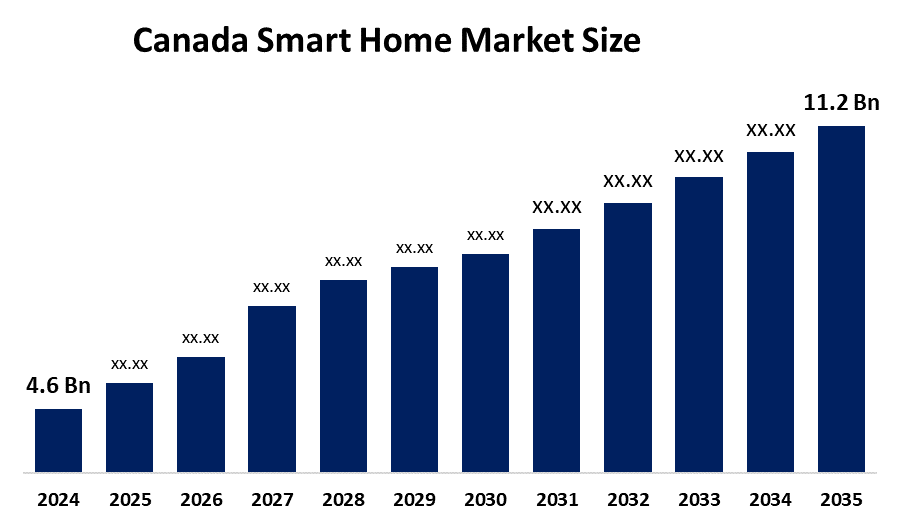
- The Canada Smart Home Market Size Was Estimated at USD 4.6 Billion in 2024
- The Market Size is Expected to Grow at a CAGR of Around 8.4% from 2025 to 2035
- The Canada Smart Home Market Size is Expected to Reach USD 11.2 Billion by 2035
Get more details on this report -
According to a research report published by Spherical Insights & Consulting, The Canada Smart Home Market Size Is Anticipated To Reach USD 11.2 Billion By 2035, Growing At A CAGR Of 8.4% From 2025 To 2035. The Canada Smart Home market is driven by the growth of maritime trade, rising shipping activity, government initiatives to support port infrastructure, the rising demand for fuel in logistics and transportation, and the adoption of cleaner, low-sulfur fuels to comply with IMO regulations.
Market Overview
The Canada smart home market refers to the ecosystem of interconnected home devices and systems that automate, monitor, and control residential functions such as security, lighting, entertainment, and energy management through internet connectivity. The market includes smart security systems, access controls, sensors, speakers, cameras, and connected appliances that use wireless communication technologies to connect their components. The market growth is supported by increasing smartphone penetration, expansion of high-speed internet connectivity, and the rising popularity of voice assistants and AI-based home automation platforms. The consumer trend toward energy-efficient solutions that offer convenience and enable remote monitoring is driving smart home technology adoption in Canadian households.
The Canada smart home market is undergoing major technological developments, which result from AI-powered automation systems, growing security needs, and environmental sustainability requirements. Smart assistants and machine-learning systems are increasingly being integrated into homes to automatically manage lighting, temperature, and appliance operations, which improves user convenience and personalization. Homeowners use smart cameras and locks and video doorbells to enhance safety measures while accessing remote monitoring capabilities in real time.
The Canadian government supports smart home adoption through energy efficiency programs and smart grid development initiatives. The government promotes smart thermostats and sensors and connected energy management systems through its policies that support energy conservation and carbon reduction efforts. The availability of energy-efficient device incentives and rebates drives residential sector adoption of smart home technology.
Report Coverage
This research report categorizes the market for the Canada smart home market based on various segments and regions, and forecasts revenue growth and analyses trends in each submarket. The report analyses the key growth drivers, opportunities, and challenges influencing the Canada Smart home market. Recent market developments and competitive strategies, such as expansion, product launch, development, partnership, merger, and acquisition have been included to draw the competitive landscape in the market. The report strategically identifies and profiles the key market players and analyses their core competencies in each sub-segment of the Canada smart home market.
Canada Smart Home Market Report Coverage
| Report Coverage | Details |
|---|---|
| Base Year: | 2024 |
| Market Size in 2024: | USD 4.6 Billion |
| Forecast Period: | 2025-2035 |
| Forecast Period CAGR 2025-2035 : | 8.4% |
| 2035 Value Projection: | USD 11.2 Billion |
| Historical Data for: | 2020-2023 |
| No. of Pages: | 220 |
| Tables, Charts & Figures: | 110 |
| Segments covered: | By Product, By Technology |
| Companies covered:: | Google LLC, Amazon.com Inc., Apple Inc., Samsung Electronics Co. Ltd., Honeywell International Inc., Schneider Electric SE, ADT Inc., Johnson Controls, Ecobee Inc., Others |
| Pitfalls & Challenges: | COVID-19 Empact, Challenge, Future, Growth, & Analysis |
Get more details on this report -
Driving Factors
The Canada Smart Home market develops because residential spaces require greater convenience and comfort and safety solutions. The home system operation now achieves effortless control because more people use IoT devices together with voice assistants. People now learn about energy-efficient solutions which save money so they choose to install smart thermostats and sensors. The connected home systems now operate better because broadband networks expand and more people use smartphones. Urbanization growth together with higher disposable income in Canadian homes drives better consumer spending on modern home automation technologies.
Restraining Factors
High installation costs and cybersecurity concerns associated with connected devices restrain market growth. Compatibility issues between different brands and lack of standardization also hinder adoption. Moreover, privacy concerns related to data collection and storage limit consumer confidence in smart home technologies.
Market Segmentation
The Canada smart home market share is classified into product and technology.
- The security & access controls segment accounted for the largest revenue market in 2024 and is expected to grow at a significant CAGR during the forecast period.
The Canada smart home market is segmented by product into security & access controls, video door phones, security cameras, smart locks, sound bars and speakers, sensors, smart home appliances, and others. Among these, the security & access controls segment accounted for the largest revenue market in 2024 and is expected to grow at a significant CAGR during the forecast period. The dominance of this segment is attributed to the rising concerns of residential safety, the adoption of smart locks and alarms, and the ability to monitor the system using mobile applications and voice assistants. Furthermore, insurance discounts for smart security systems are encouraging homeowners to install advanced security solutions
- The wi-fi segment accounted for the largest share in 2024 and is expected to grow at a significant CAGR during the forecast period.
The Canada Smart Home market is segmented by technology into wi-fi, bluetooth, and others. Among these, the wi-fi segment accounted for the largest share in 2024 and is expected to grow at a significant CAGR during the forecast period. The reason for the dominance of Wi-Fi technology is its ease of installation, high compatibility with smart devices, and widespread availability of broadband internet, which makes seamless connectivity and automation possible. In addition, the increasing use of cloud-based smart home platforms that need constant internet connectivity further enhances the use of Wi-Fi technology in smart homes.
Competitive Analysis:
The report offers the appropriate analysis of the key organizations/companies involved within the Canada smart home market, along with a comparative evaluation primarily based on their product offering, business overviews, geographic presence, enterprise strategies, segment market share, and SWOT analysis. The report also provides an elaborate analysis focusing on the current news and developments of the companies, which includes product development, innovations, joint ventures, partnerships, mergers & acquisitions, strategic alliances, and others. This allows for the evaluation of the overall competition within the market.
List of Key Companies
- Google LLC
- Amazon.com Inc.
- Apple Inc.
- Samsung Electronics Co. Ltd.
- Honeywell International Inc.
- Schneider Electric SE
- ADT Inc.
- Johnson Controls
- Ecobee Inc.
- Others
Key Target Audience
- Market Players
- Investors
- End-users
- Government Authorities
- Consulting and Research Firm
- Venture capitalists
- Value-Added Resellers (VARs)
Recent Developments:
In Feb 2025, using a cloud IoT platform, Lauritz Knudsen Electrical and Automation introduced the enConnect series, which included wireless Wi-Fi switches, lighting, and curtain controls.
Market Segment
This study forecasts revenue at the Canada, regional, and country levels from 2020 to 2035. Spherical Insights has segmented the Canada smart home market based on the below-mentioned segments:
Canada Smart Home Market, By Product
- Security & Access Controls
- Video Door Phones
- Security Cameras
- Smart Locks
- Sound bars and Speakers
- Sensors
- Smart Home Appliances
- Others
Canada Smart Home Market, By Technology
- Wi-Fi
- Bluetooth
- Others
Frequently Asked Questions (FAQ)
-
1. What is the Canada smart home market?The Canada smart home market refers to connected residential devices and automation systems that enhance comfort, security, and energy efficiency through IoT technologies.
-
1. What is the Canada smart home market size?Canada Smart home market size is expected to grow from USD 4.6 billion in 2024 to USD 11.2 billion by 2035, growing at a CAGR of 8.4% during the forecast period 2025-2035.
-
3. What are the key drivers of the Canada smart home market?The market is driven by increasing adoption of IoT devices, rising security concerns, energy efficiency awareness, and smartphone connectivity.
-
4. Which product dominates the Canada smart home market?Security & access control devices dominate due to the high demand for home monitoring and safety solutions.
-
5. What are the major trends in the Canada smart home market?Key trends include AI automation, smart security adoption, and energy-efficient connected appliances.
-
6. Who are the key companies operating in the Canada smart home market?Major players include Google LLC, Amazon.com Inc., Apple Inc., Samsung Electronics Co. Ltd., Honeywell International Inc., Schneider Electric SE, ADT Inc., Johnson Controls, Ecobee Inc.
-
7. What is the future outlook for the Canada smart home market?The market is expected to grow steadily due to IoT expansion, smart energy adoption, and increasing demand for connected living environments.
Need help to buy this report?