Global Camera Lens Market Size, Share, By Type of Lenses (Prime Lenses, Zoom Lenses, Macro Lenses, Specialty Lenses, Telephoto Lens, and Built-in Lens), By Distribution Channels (Online Channels, Offline Retail Stores, and Specialty Store), By Application (Smartphones, Professional Cameras, Automotive, Surveillance, and Others), and By Region (North America, Europe, Asia-Pacific, Latin America, Middle East, and Africa), Analysis and Forecast 2025 - 2035.
Industry: Semiconductors & Electronics
Global Camera Lens Market Insights and Forecasts to 2035
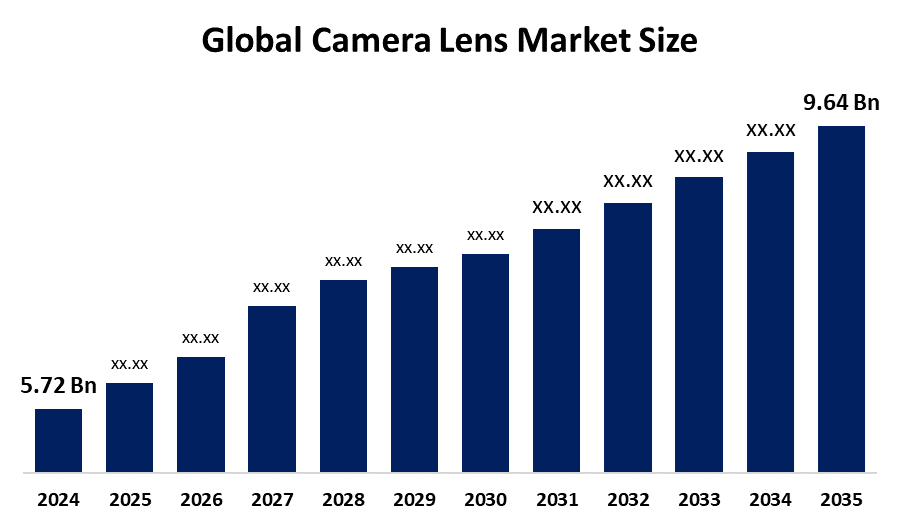
- The Global Camera Lens Market Size Was Estimated at USD 5.72 billion in 2024
- The Market Size is Expected to Grow at a CAGR of around 4.86% from 2025 to 2035
- The Worldwide Camera Lens Market Size is Expected to Reach USD 9.64 billion by 2035
- North America is expected to grow the fastest during the forecast period.
Get more details on this report -
According to a research report published by Spherical Insights, the global Camera Lens market size was worth around USD 5.72 billion in 2024 and is predicted to grow to around USD 9.64 billion by 2035 with a compound annual growth rate (CAGR) of 4.86% from 2025 to 2035. The global camera lens market is driven by rising demand for high-quality imaging, growing smartphone adoption, expansion of surveillance systems, increasing content creation, and advancements in optical technologies, enhancing performance, zoom capabilities, and image clarity.
Market Overview
The global camera lens market refers to the industry focused on the production and sale of optical lenses used in cameras, smartphones, automotive systems, and surveillance devices. The market experiences growth because consumers want higher-quality images, more people use smartphones, and security systems become more common. In July 2024, Carl Zeiss Group announced a Rs. 2,500 crore (approximately USD 300 million+) investment to build a new optical lens manufacturing facility in Bengaluru, India. The plant will significantly boost production capacity for lenses, including those used in eyewear and other optical applications. Government initiatives, such as electronics manufacturing incentives, digitalization programs, and support for semiconductor and optical component production, are boosting market expansion. Market trends include increasing consumer preference for mirrorless cameras and smartphones with multiple cameras, along with growing demand for compact and lightweight lenses. The development of AI-based image processing, improved optical zoom technology, and new lens coating techniques enables better image quality and system functionality. In June 2023, LG Innotek announced an investment of approximately USD 994 million (about 1.3 trillion KRW) to expand its camera module production capacity at its Hai Phong, Vietnam facility, aiming to more than double output. The demand for accurate high-definition imaging solutions is increasing in both advanced and developing markets for new technologies, including autonomous vehicles, AR/VR devices, healthcare imaging, and smart cities.
Report Coverage
This research report categorizes the global camera lens market based on various segments and regions, forecasts revenue growth, and analyzes trends in each submarket. The report analyses the key growth drivers, opportunities, and challenges influencing the global camera lens market. Recent market developments and competitive strategies, such as expansion, product launch, development, partnership, merger, and acquisition, have been included to draw the competitive landscape in the market. The report strategically identifies and profiles the key market players and analyzes their core competencies in each sub-segment of the camera lens market.
Global Camera Lens Market Report Coverage
| Report Coverage | Details |
|---|---|
| Base Year: | 2024 |
| Market Size in 2024: | USD 5.72 billion |
| Forecast Period: | 2025-2035 |
| Forecast Period CAGR 2025-2035 : | CAGR of 4.86% |
| 2035 Value Projection: | USD 9.64 billion |
| Historical Data for: | 2020-2023 |
| No. of Pages: | 240 |
| Tables, Charts & Figures: | 110 |
| Segments covered: | By Type of Lenses, By Distribution Channels |
| Companies covered:: | Canon Inc, Sony Corporation, Nikon Corporation, Fujifilm Holdings Corporation, Panasonic Holdings Corporation, Sigma Corporation, Tamron Co Ltd, Carl Zeiss AG, Leica Camera AG, OM Digital Solutions, Largan Precision Co Ltd, Sunny Optical Technology Group, Genius Electronic Optical Co Ltd, Sekonix Co Ltd, Samyang Optics Co Ltd, and Others |
| Pitfalls & Challenges: | COVID-19 Empact, Challenge, Future, Growth, & Analysis |
Get more details on this report -
Driving Factors
The global camera lens market has experienced expansion because smartphone photography needs advanced camera technology, which produces high-quality pictures. The rising use of social media platforms, together with content creation activities, has created a demand for advanced imaging technologies. The demand for security system components has increased because of the growing use of surveillance systems in commercial spaces, residential buildings, and public areas. The development of advanced driver assistance systems and self-driving technology in the automotive industry has created a greater need for specialized lenses. The market expansion is driven by two main factors, which include the increasing use of mirrorless cameras and the continuous development of optical technology that brings AI-powered imaging enhancements together with improved zoom performance.
Restraining Factors
The global camera lens market faces restraints because manufacturers need to incur high costs for producing precision optics and advanced materials. Emerging markets show price sensitivity, which restricts their ability to purchase premium lenses. The standalone camera and interchangeable lens market experiences decreased demand because smartphone cameras have improved at a fast pace. The industry faces production challenges because of supply chain disruptions that arise from its need for specialized components and because manufacturers compete with each other, which decreases their pricing power and profit margins.
Market Segmentation
The global camera lens market share is classified into types of lenses, distribution channels, and applications.
The zoom lenses segment accounted for the largest share in 2024, approximately 34%, and is anticipated to grow at a significant CAGR during the forecast period.
Based on the type of lenses, the global camera lens market is divided into prime lenses, zoom lenses, macro lenses, specialty lenses, telephoto lenses, and built-in lenses. Among these, the zoom lenses segment accounted for the largest share in 2024, approximately 34%, and is anticipated to grow at a significant CAGR during the forecast period. This is because zoom lenses offer high versatility, allowing users to adjust focal lengths without changing lenses, making them ideal for both professional and consumer applications. Their widespread use in smartphones, digital cameras, and surveillance systems, along with increasing demand for convenience and multi-functional imaging solutions, continues to drive their dominance in the market.
The offline retail stores segment accounted for the highest market revenue in 2024, approximately 46%, and is anticipated to grow at a significant CAGR during the forecast period.
Based on the distribution channels, the global camera lens market is divided into online channels, offline retail stores, and specialty stores. Among these, the offline retail stores segment accounted for the highest market revenue in 2024, approximately 46%, and is anticipated to grow at a significant CAGR during the forecast period. This is because offline channels allow customers to physically inspect lenses, test compatibility, and receive expert guidance before purchase. Professional photographers and enthusiasts often prefer in-store buying for high-value products, ensuring quality assurance and after-sales support, which continues to drive the dominance of offline retail stores in the market.
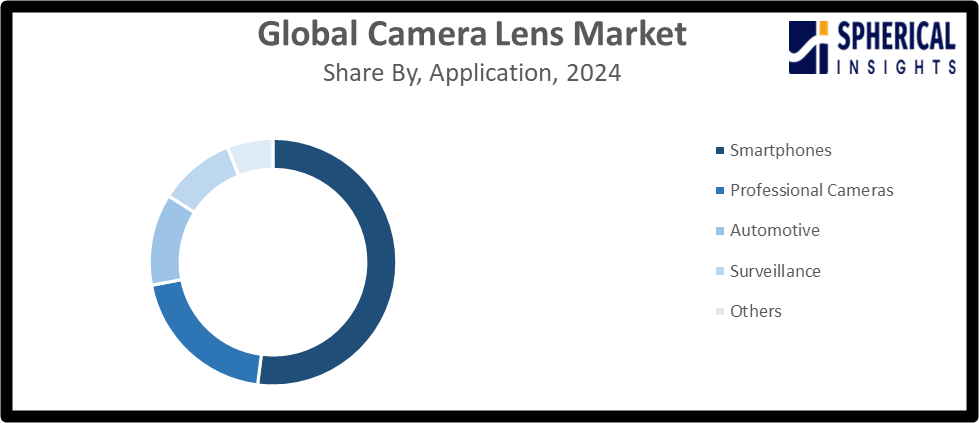
The smartphones segment dominated the market in 2024, approximately 52%, and is projected to grow at a substantial CAGR during the forecast period.
Based on the application, the global camera lens market is divided into smartphones, professional cameras, automotive, surveillance, and Others. Among these, the smartphones segment dominated the market in 2024, approximately 52%, and is projected to grow at a substantial CAGR during the forecast period. The dominance is driven by the massive global adoption of smartphones, increasing demand for high-quality mobile photography, and continuous integration of multi-lens camera systems. Additionally, rising social media usage, content creation trends, and advancements in compact lens technologies are further accelerating the demand for camera lenses in smartphone applications.
Get more details on this report -
Regional Segment Analysis of the Global Camera Lens Market
- North America (U.S., Canada, Mexico)
- Europe (Germany, France, U.K., Italy, Spain, Rest of Europe)
- Asia-Pacific (China, Japan, India, Rest of APAC)
- South America (Brazil and the Rest of South America)
- The Middle East and Africa (UAE, South Africa, Rest of MEA)
Asia Pacific is anticipated to hold the largest share of the global camera lens market over the predicted timeframe.
Asia Pacific is anticipated to hold the largest share of the global Camera Lens market over the predicted timeframe, approximately 42% market share. The growth is driven by the strong presence of major electronics and smartphone manufacturers, high consumer demand for imaging devices, and rapid urbanization. Expanding surveillance systems, growing adoption of automotive imaging technologies, and cost-effective production capabilities further support market expansion. Additionally, supportive government initiatives promoting local manufacturing, R&D, and digital infrastructure strengthen the region’s competitive position, while increasing investment in content creation, media, and technology sectors fuels the demand for advanced camera lenses.

Get more details on this report -
The North America region is expected to grow at the fastest rate during the forecast period, approximately 7% market share. The market growth is fueled by rapid technological advancements in professional and smartphone cameras, increasing adoption of automotive imaging and AI-enabled surveillance systems, and rising demand for high-resolution imaging. Expanding content creation, media, and entertainment industries further drive the market. Additionally, strong investments in research, innovation, and smart city initiatives, combined with widespread use of imaging devices across enterprises and consumers, contribute to the region’s fast-paced growth.
Competitive Analysis:
The report offers the appropriate analysis of the key organizations/companies involved within the global camera lens market, along with a comparative evaluation primarily based on their product offering, business overviews, geographic presence, enterprise strategies, segment market share, and SWOT analysis. The report also provides an elaborative analysis focusing on the current news and developments of the companies, which includes product development, innovations, joint ventures, partnerships, mergers & acquisitions, strategic alliances, and others. This allows for the evaluation of the overall competition within the market.
List of Key Companies
- Canon Inc
- Sony Corporation
- Nikon Corporation
- Fujifilm Holdings Corporation
- Panasonic Holdings Corporation
- Sigma Corporation
- Tamron Co Ltd
- Carl Zeiss AG
- Leica Camera AG
- OM Digital Solutions
- Largan Precision Co Ltd
- Sunny Optical Technology Group
- Genius Electronic Optical Co Ltd
- Sekonix Co Ltd
- Samyang Optics Co Ltd
- Others
Key Target Audience
- Market Players
- Investors
- End-users
- Government Authorities
- Consulting and Research Firm
- Venture capitalists
- Value-Added Resellers (VARs)
Recent Development
In September 2025, Sigma Corporation announced its launch schedule for new I-series lenses, including the 35mm F1.2 II and the 20-200mm F3.5-6.3, both designed for full-frame mirrorless cameras.
In April 2024, Nikon completed the acquisition of RED.com, LLC, a U.S.-based digital cinema camera manufacturer, making it a wholly owned subsidiary. This strategic move allows Nikon to integrate RED expertise in digital cinema and 8K technology with its own advanced optical and imaging capabilities. The acquisition strengthens Nikon’s presence in the premium cinema and professional imaging market, supporting the development of high-end cameras and lenses and contributing to growth in the global camera lens and imaging industry.
In August 2023, Hefei Haitu Microelectronics completed a Pre-B round of equity financing worth several hundred million yuan, equivalent to about USD 50 million or more. The funds are being used to expand mass production of CMOS image sensors and support R&D in sensors for machine vision, automotive electronics, and medical imaging applications. This development is related to the global camera lens and imaging market because image sensors and optical components are critical parts of camera modules used in smartphones, automotive systems, surveillance, and other imaging devices.
In June 2023, Nikon Corporation released the NIKKOR Z 70-180mm f/2.8 telephoto zoom lens for its mirrorless Z-mount camera system. This lens features a constant f/2.8 aperture, compact design, and fast autofocus, making it suitable for portraits, events, and low-light shooting.
Global Camera Lens Market, By Type of Lenses
- Prime Lenses
- Zoom Lenses
- Macro Lenses
- Specialty Lenses
- Telephoto Lens
- Built-in Lens
Global Camera Lens Market, By Distribution Channel
- Online Channels
- Offline Retail Stores
- Specialty Store
Global Camera Lens Market, By Application
- Smartphones
- Professional Cameras
- Automotive
- Surveillance
- Others
Global Camera Lens Market, By Regional Analysis
- North America
- US
- Canada
- Mexico
- Europe
- Germany
- UK
- France
- Italy
- Spain
- Russia
- Rest of Europe
- Asia Pacific
- China
- Japan
- India
- South Korea
- Australia
- Rest of Asia Pacific
- South America
- Brazil
- Argentina
- Rest of South America
- Middle East & Africa
- UAE
- Saudi Arabia
- Qatar
- South Africa
- Rest of the Middle East & Africa
Frequently Asked Questions (FAQ)
-
1. What is the global camera lens market?The global camera lens market refers to the industry involved in designing, manufacturing, and selling lenses for cameras, smartphones, drones, automotive systems, and surveillance devices. It includes a wide range of products, from consumer-grade lenses to high-end professional optics.
-
2. Which factors are driving demand for camera lenses?Rising adoption of smartphones with multiple cameras, growth in professional photography and videography, increasing use of surveillance systems, and advancements in optical technologies are major growth drivers.
-
3. What are the key types of camera lenses in demand?Popular types include prime lenses, zoom lenses, macro lenses, telephoto lenses, wide-angle lenses, and specialty lenses like fisheye and tilt-shift, each serving different photographic or industrial needs.
-
4. Which regions are emerging as high-growth markets?Asia Pacific, particularly China, India, and Japan, is emerging as a high-growth region due to large electronics manufacturing hubs, increasing smartphone penetration, and growing content creation industries.
-
5. How is technology shaping the camera lens market?Innovations like AI-based image processing, optical image stabilization, advanced lens coatings, and miniaturized lens modules for smartphones and drones are improving image quality and lens performance.
-
6. Who are the major end-users of camera lenses?End-users include consumers (for photography and smartphones), professional photographers and videographers, automotive OEMs, surveillance companies, drone manufacturers, and medical imaging equipment producers.
-
7. What challenges does the camera lens market face?High production costs for precision optics, supply chain dependencies for specialty components, rapid technological changes, and competition from smartphone-integrated cameras can limit growth in certain segments
Need help to buy this report?