Global Caffeic Acid Market Size, Share, By Source (Natural Extraction and Synthetic), By Application (Pharmaceuticals, Food & Beverages, Cosmetics, and Others), By End User (Pharmaceutical Manufacturing, Food Processing, Personal Care, and Others), and By Region (North America, Europe, Asia-Pacific, Latin America, Middle East, and Africa), Analysis and Forecast 2026 - 2035
Industry: Chemicals & Materials
Global Caffeic Acid Market Insights Forecasts to 2035
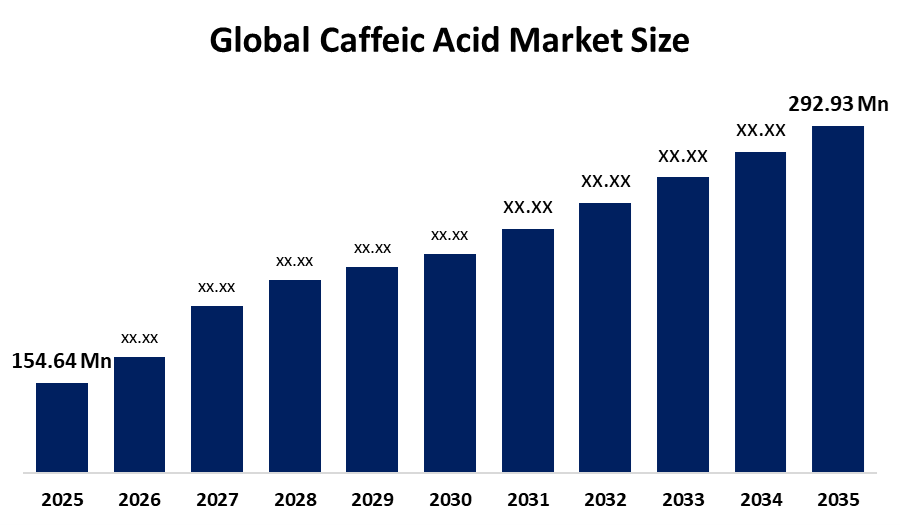
- The Global Caffeic Acid Market Size Was Estimated at USD 154.64 Million in 2025
- The Market Size is Expected to Grow at a CAGR of around 6.6% from 2026 to 2035
- The Worldwide Caffeic Acid Market Size is Expected to Reach USD 292.93 Million by 2035
- Asia Pacific is expected to grow the fastest during the forecast period.
Get more details on this report -
According to a Research Report Published by Spherical Insights and Consulting, the Global Caffeic Acid Market Size was worth around USD 154.64 Million in 2025 and is predicted to grow to around USD 292.93 Million by 2035 with a compound annual growth rate (CAGR) of 6.6% from 2026 to 2035. Global expansions of efficient, eco-friendly extraction methods, biotechnological production using engineered microbes, and AI-driven process optimization, which reduce costs, improve purity, and expand applications in pharmaceuticals, nutraceuticals, and cosmetics are all driving opportunities in the caffeic acid market.
Market Overview
The caffeic acid market involves all activities from producing to distributing and using caffeic acid which exists as a natural phenolic compound in coffee, fruits, and herbs and people value it because of its antioxidant, anti-inflammatory, and health benefits. The process starts with raw material sourcing and continues through extraction and purification technologies until the final products reach distribution for pharmaceuticals, nutraceuticals, cosmetics, food additives, and animal feed. The market expands because technological advancements create opportunities which include eco-friendly extraction methods that use green solvents, ultrasonic, and enzymatic techniques together with biotechnological synthesis through engineered microbes and AI-based process optimization with quality control. Natural bioactives see increased demand from consumers while health applications continue to expand which results in higher adoption rates.
Government agencies establish a positive environment for innovation and market expansion through their implementation of regulations and quality standards together with R&D funding and support of sustainable production practices. For instance, in February 2026, The Government of India allocated INR 4408 crore to the Ministry of AYUSH to establish complete funding for traditional medicine research and development of herbal products. The government funding enables plant-based compounds such as caffeic acid to develop through enhanced infrastructure for medicinal plant cultivation and research and development and quality standardization.
In March 2024, the U.S. NIH announced its yearly budget which reached approximately USD 47 billion to support biomedical research activities. The funding enables research on plant-based bioactive compounds which includes studies caffeic acid to develop new pharmaceutical and nutraceutical products.
Report Coverage
This research report categorizes the caffeic acid market based on various segments and regions, forecasts revenue growth, and analyzes trends in each submarket. The report analyses the key growth drivers, opportunities, and challenges influencing the caffeic acid market. Recent market developments and competitive strategies, such as expansion, product launch, development, partnership, merger, and acquisition, have been included to draw the competitive landscape in the market. The report strategically identifies and profiles the key market players and analyses their core competencies in each sub-segment of the caffeic acid market.
In May 2025, Japan’s AMED issued a call for proposals for the Drug Discovery Platform Promotion Research Project focusing on medicinal plant studies, breeding, and production technology development. This research study investigates plant-derived bioactive compound development for commercial products through its research work improving access to research materials and drive product development efforts, which will result in better raw materials for the caffeic acid market.
Caffeic Acid Market Report Coverage
| Report Coverage | Details |
|---|---|
| Base Year: | 2025 |
| Market Size in 2025: | USD 154.64 Million |
| Forecast Period: | 2026-2035 |
| Forecast Period CAGR 2026-2035 : | CAGR of 6.6% |
| 2035 Value Projection: | USD 292.93 Million |
| Historical Data for: | 2020-2024 |
| No. of Pages: | 230 |
| Tables, Charts & Figures: | 120 |
| Segments covered: | By Source, By Application |
| Companies covered:: | Cayman Chemical Company, Merck KGaA, Biosynth AG, BASF SE, Tokyo Chemical Industry, Penta Manufacturing Company, Wuhan Hezhong Bio-Chemical Manufacture, Hubei Yuancheng Technology Co., Ltd., Vizag Chemical International, Glentham Life Sciences Ltd., Alfa Chemistry, Nanjing Shunxiang Pharmaceutical Technology Co., Ltd., Layn Natural Ingredients, Xian Natural Field Bio-Technique Co., Ltd., Spectrum Chemical Manufacturing Corp., and other key players |
| Pitfalls & Challenges: | COVID-19 Empact, Challenge, Future, Growth, & Analysis |
Get more details on this report -
Driving Factors
Rapid technological innovation is one of the main drivers of the caffeic acid market's growth. The combination of natural antioxidant demand for pharmaceuticals, nutraceuticals, cosmetics, and food industries and increasing health-conscious consumer trends establishes the primary driver for the caffeic acid market. Advances in green extraction methods, ultrasonic and enzymatic processes, and biotechnological production with engineered microbes brought improvements to efficiency, purification, and production capacity. The combination of AI with automated systems leads to enhanced production efficiency and better quality control while decreasing operational expenses. Additionally, Government support through regulations, quality standards, and sustainable practice incentives drives innovation and implementation while creating market expansion throughout worldwide market.
Restraining Factors
High production costs, inconsistent raw material availability, stringent regulatory requirements, competition from synthetic antioxidants and cheaper substitutes, limited awareness in emerging regions, and consistent product quality and stability challenges are the main factors restricting the caffeic acid market.
Market Segmentation
The caffeic acid market share is classified into source, application, and end user.
- The natural extraction segment dominated the market in 2025, approximately 67%, and is projected to grow at a substantial CAGR during the forecast period.
Based on the source, the caffeic acid market is divided into natural extraction and synthetic. Among these, the natural extraction segment dominated the market in 2025, approximately 67%, and is projected to grow at a substantial CAGR during the forecast period. Increasing consumer demand for plant derived and clean labelled ingredients, strong preference for naturally sourced caffeic acid, and widely used in end use applications is driving the natural extraction industry.
- The pharmaceuticals segment accounted for the largest share in 2025, approximately 34%, and is anticipated to grow at a significant CAGR during the forecast period.
Based on the application, the caffeic acid market is divided into pharmaceuticals, food & beverages, cosmetics, and others. Among these, the pharmaceuticals segment accounted for the largest share in 2025, approximately 34%, and is anticipated to grow at a significant CAGR during the forecast period. Strong antioxidant, anti-inflammatory, and therapeutic properties, high demand for disease prevention, supplements, and drug formulations, increasing prevalence of chronic diseases, and growing global demand for health and wellness is driving the pharmaceuticals industry.
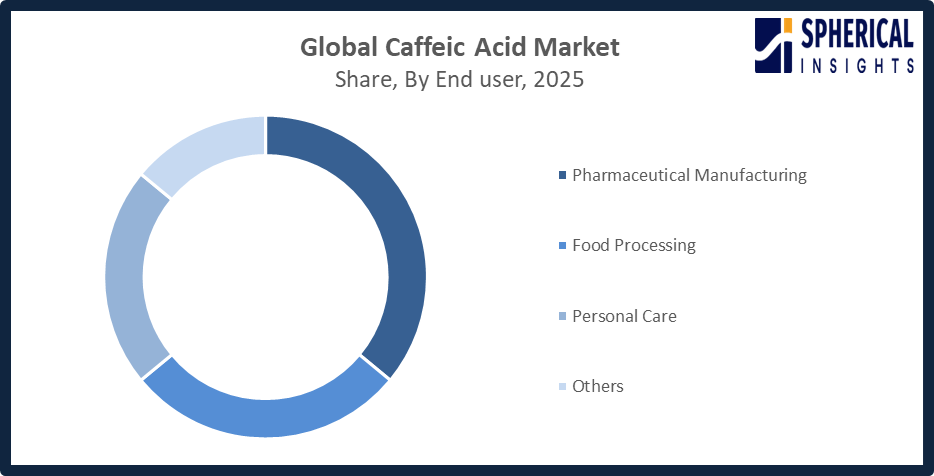
- The pharmaceutical manufacturing segment accounted for the highest market revenue in 2025, approximately 36%, and is anticipated to grow at a significant CAGR during the forecast period.
Based on the end user, the caffeic acid market is divided into pharmaceutical manufacturing, food processing, personal care, and others. Among these, the pharmaceutical manufacturing segment accounted for the highest market revenue in 2025, approximately 36%, and is anticipated to grow at a significant CAGR during the forecast period. Rising prevalence of chronic diseases, growing health-conscious populations, increased investment in functional and preventive healthcare products, and heavily rely for its antioxidant, anti-inflammatory, and therapeutic benefits is bolstering the pharmaceutical manufacturing market.
Get more details on this report -
Regional Segment Analysis of the Caffeic Acid Market
- North America (U.S., Canada, Mexico)
- Europe (Germany, France, U.K., Italy, Spain, Rest of Europe)
- Asia-Pacific (China, Japan, India, Rest of APAC)
- South America (Brazil and the Rest of South America)
- The Middle East and Africa (UAE, South Africa, Rest of MEA)
North America is anticipated to hold the largest share of the caffeic acid market over the predicted timeframe.

Get more details on this report -
North America is anticipated to hold the largest share of the caffeic acid market over the predicted timeframe. North America receives its industrial strength by government support for advanced pharmaceutical and nutraceutical sectors which depend on bioactive compounds like caffeic acid for drug research and dietary supplement production. The region's position is further reinforced by its R&D capabilities together with its biotechnology adoption, sustainable extraction techniques, and its strict product quality regulations establish a strong base for development. The market expansion receives support as people become more health conscious and they increasingly seek products made from natural components. Additionally, major corporations and ongoing research progress in pharmaceutical and dietary supplement innovation further strengthens its market dominance.
Asia Pacific is expected to grow at a rapid CAGR in the caffeic acid market during the forecast period. The demand for natural antioxidants in food, pharmaceuticals, and cosmetics products experiences growth as consumers now have higher disposable incomes and better health knowledge. The region benefits from abundant plant raw materials and cost-effective production, which results in lower manufacturing expenses. The pharmaceutical and cosmetic industries experience industrial growth because of their success in countries such as China, India, Japan, and South Korea. Additionally, strong governments support for herbal products and increasing consumers interest in clean-label and nutraceutical products accelerate the market growth.
Government launches include China’s MOA, March 2025 expanded cultivation of medicinal plants with traceability systems improves supply and quality of plant-based bioactives, South Korea’s January 2025 National Bio Committee strengthens biotech R&D and innovation, indirectly benefiting natural compounds like caffeic acid and India’s June 2024 Biopharmaceutical Alliance improves R&D, supply chains, and raw material availability, indirectly boosting access to caffeic acid for pharmaceuticals and nutraceuticals.
Competitive Analysis:
The report offers the appropriate analysis of the key organizations/companies involved within the caffeic acid market, along with a comparative evaluation primarily based on their product of offering, business overviews, geographic presence, enterprise strategies, segment market share, and SWOT analysis. The report also provides an elaborative analysis focusing on the current news and developments of the companies, which includes product development, innovations, joint ventures, partnerships, mergers & acquisitions, strategic alliances, and others. This allows for the evaluation of the overall competition within the market.
List of Key Companies
- Cayman Chemical Company
- Merck KGaA
- Biosynth AG
- BASF SE
- Tokyo Chemical Industry
- Penta Manufacturing Company
- Wuhan Hezhong Bio-Chemical Manufacture
- Hubei Yuancheng Technology Co., Ltd.
- Vizag Chemical International
- Glentham Life Sciences Ltd.
- Alfa Chemistry
- Nanjing Shunxiang Pharmaceutical Technology Co., Ltd.
- Layn Natural Ingredients
- Xian Natural Field Bio-Technique Co., Ltd.
- Spectrum Chemical Manufacturing Corp.
- Others
Key Target Audience
- Market Players
- Investors
- End-users
- Government Authorities
- Consulting and Research Firm
- Venture capitalists
- Value-Added Resellers (VARs)
Recent Development
- In April 2026, Tokyo Chemical Industry Co., Ltd. provides high purity caffeic acid as a currently available product which scientists and industrial users can access through its worldwide chemical reagent collection. The product maintains its presence in the market because it supplies continuous availability for biochemical research and product development needs.
- In October 2025, Scientific Research Developments described new anti-diabetic agents through the design and synthesis process of caffeic acid derivatives which resulted in the creation of novel compounds.
- In July 2024, Tokyo Chemical Industry collaborated with a Japanese biotechnology firm to create microbial fermentation methods which would produce high purity caffeic acid to decrease the need for plant-derived sources.
Market Segment
This study forecasts revenue at global, regional, and country levels from 2020 to 2035. Spherical Insights has segmented the caffeic acid market based on the below-mentioned segments:
Global Caffeic Acid Market, By Source
- Natural Extraction
- Synthetic
Global Caffeic Acid Market, By Application
- Pharmaceuticals
- Food & Beverages
- Cosmetics
- Others
Global Caffeic Acid Market, By End User
- Pharmaceutical Manufacturing
- Food Processing
- Personal Care
- Others
Global Caffeic Acid Market, By Regional Analysis
- North America
- US
- Canada
- Mexico
- Europe
- Germany
- UK
- France
- Italy
- Spain
- Russia
- Rest of Europe
- Asia Pacific
- China
- Japan
- India
- South Korea
- Australia
- Rest of Asia Pacific
- South America
- Brazil
- Argentina
- Rest of South America
- Middle East & Africa
- UAE
- Saudi Arabia
- Qatar
- South Africa
- Rest of the Middle East & Africa
Frequently Asked Questions (FAQ)
-
1. What are the key applications of caffeic acid?Caffeic acid is widely used in pharmaceuticals, nutraceuticals, cosmetics, and food & beverages for its antioxidant, anti-inflammatory, and anti-cancer properties. It is also used in research and dietary supplements.
-
2. What are the main sources of caffeic acid?Caffeic acid can be derived from natural plant sources such as coffee, fruits, vegetables, and herbs, or synthetically produced for industrial applications.
-
3. What is the role of extraction and purification technologies in the market?Advanced extraction, purification, and standardization technologies ensure high-purity caffeic acid, consistent bioactivity, and regulatory compliance, critical for pharmaceuticals and nutraceutical formulations.
-
4. What is the significance of market research and quality testing?Quality testing ensures product efficacy, stability, and safety. Analytical techniques like HPLC and LC-MS are commonly used to quantify caffeic acid content.
-
5. Which industries benefit most from caffeic acid?Pharmaceuticals, nutraceuticals, personal care/cosmetics, food & beverage, and research sectors rely on caffeic acid for health-promoting, functional, and therapeutic applications.
-
6. What is the expected market growth timeline?The caffeic acid market is projected to grow steadily through the late 2020s and into the 2030s, driven by rising demand for natural antioxidants, bioactive compounds, and health-oriented products.
Need help to buy this report?