Global Building Insulation Materials Market Size, Share, By Material Type (Foamed Plastics, Fiberglass, Stone Wool, Biobased Materials, and Others), By Application (Wall Insulation, Underfloor Insulation, Roof Insulation, Duct Insulation, and Miscellaneous), By End User (Residential, Commercial, and Others), and By Region (North America, Europe, Asia-Pacific, Latin America, Middle East, and Africa), Analysis and Forecast 2026 - 2035.
Industry: Advanced Materials
Global Building Insulation Materials Market Insights Forecasts to 2035
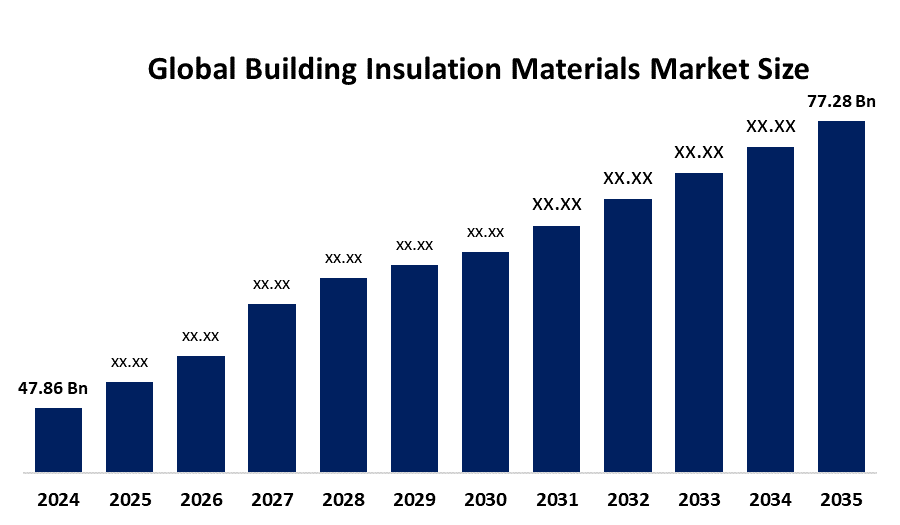
- The Global Building Insulation Materials Market Size Was Estimated at USD 47.86 Billion in 2025
- The Market Size is Expected to Grow at a CAGR of around 4.91% from 2026 to 2035
- The Worldwide Building Insulation Materials Market Size is Expected to Reach USD 77.28 Billion by 2035
- North America is expected to grow the fastest during the forecast period.
Get more details on this report -
According to a research report published by Spherical Insights and Consulting, The Global Building Insulation Materials Market Size was worth around USD 47.86 Billion in 2025 and is predicted to grow to around USD 77.28 Billion by 2035 with a compound annual growth rate (CAGR) of 4.91% from 2026 to 2035. Global advancement in eco-friendly and smart insulation solutions, innovations in prefabricated insulated panels, nanotechnology-enhanced coatings, and digital design tools like BIM enhancing installation efficiency, minimizing waste, and enabling real-time energy management are all driving opportunities in the building insulation materials market.
Market Overview
The building insulation materials market consists of the global sector which handles the manufacturing, distribution and use of materials that serve to minimize heat movement and boost energy conservation while delivering comfort in residential, commercial and industrial building spaces. The product range includes fiberglass, mineral wool, polystyrene, polyurethane foam, aerogels, vacuum insulation panels and advanced eco-friendly alternatives which builders use for construction of walls, roofs, floors, and HVAC systems. The market opportunities emerge from higher energy prices, stricter energy efficiency, green building standards, increasing demand for retrofitting of old buildings, and advanced insulation technologies which include smart systems and nano-engineered materials with exceptional performance.
The government establishes energy codes and standards while providing financial incentives for energy efficient building projects and advocating environmentally friendly construction methods which drive building owners to invest in advanced insulation solutions. The market growth results from these elements as countries work to achieve climate objectives while decreasing carbon emissions from constructed environments. For instance, in February 2026, India’s Union Budget increased funding for the MNRE by around 24% to a record high, with major allocations toward rooftop solar and clean energy infrastructure, underpinning broader energy efficient building practices that indirectly support insulation uptake by lowering operational energy use and promoting green construction incentives.
In April 2025, Japan’s MLIT mandates all new residential and non-residential buildings to comply with energy efficiency standards which existing energy efficiency standards of the Building Energy Conservation Law. The regulations establish thermal insulation performance requirements which create a strong market need for insulation products.
Report Coverage
This research report categorizes the building insulation materials market based on various segments and regions, forecasts revenue growth, and analyzes trends in each submarket. The report analyses the key growth drivers, opportunities, and challenges influencing the building insulation materials market. Recent market developments and competitive strategies, such as expansion, product launch, development, partnership, merger, and acquisition, have been included to draw the competitive landscape in the market. The report strategically identifies and profiles the key market players and analyses their core competencies in each sub-segment of the building insulation materials market.
Global Building Insulation Materials Market Report Coverage
| Report Coverage | Details |
|---|---|
| Base Year: | 2024 |
| Market Size in 2024: | USD 47.86 Billion |
| Forecast Period: | 2024-2035 |
| Forecast Period CAGR 2024-2035 : | CAGR of 4.91% |
| 2035 Value Projection: | USD 77.28 Billion |
| Historical Data for: | 2020-2023 |
| No. of Pages: | 240 |
| Tables, Charts & Figures: | 95 |
| Segments covered: | By Material Type, By Application |
| Companies covered:: | Owens Corning, Saint-Gobain S.A., ROCKWOOL International A/S, Kingspan Group plc, Knauf Insulation, BASF SE, Armacell International S.A., Atlas Roofing Corporation, Aspen Aerogels Inc., Beijing New Building Materials Co., Ltd., Cellofoam North America Inc., Covestro AG, Dow, DuPont, GAF Materials LLC, Others, and |
| Pitfalls & Challenges: | COVID-19 Empact, Challenge, Future, Growth, & Analysis |
Get more details on this report -
Driving Factors
Rapid technological innovation is one of the main drivers of the building insulation materials market's growth. Increasing energy expenses and the need for energy-efficient building solutions is the main factor driving the market for building insulation materials. Market expands because of government rules and green building incentives which drive construction activities. The development of new technologies, which include vacuum insulation panel, aerogels, phase change materials and smart insulation systems improves thermal efficiency while decreasing material requirements. The demand for construction materials increases due to urban population growth and construction activities for new buildings and the restoration of existing structures. Additionally, the rising public understanding about environmental sustainability and carbon footprint reduction drives the adoption of sustainable insulation materials that contain recycled content.
In April 2025, Japan’s government launched multi-subsidy Home Energy Conservation 2025 Campaign which will continue until 2026 to promote energy-efficient housing construction and renovation which enable homeowners and builders to implement energy-saving upgrades that include high-performance insulation and efficient windows and building envelope improvements.
Restraining Factors
High development and deployment costs, limited awareness of long-term energy savings, technical installation challenges, lack of skilled labor, fluctuating raw material prices, supply chain disruptions, and stringent building codes in some regions are the main factors restricting the building insulation materials market.
Market Segmentation
The building insulation materials market share is classified into material type, application, and end user.
- The fiberglass segment dominated the market in 2025, approximately 34%, and is projected to grow at a substantial CAGR during the forecast period.
Based on the material type, the building insulation materials market is divided into foamed plastics, fiberglass, stone wool, biobased materials, and others. Among these, the fiberglass segment dominated the market in 2025, approximately 34%, and is projected to grow at a substantial CAGR during the forecast period. High thermal performance at a low cost, widely available material, easy to install in both residential and commercial construction, high durability, fire resistance, and adaptability for walls, roofs, and ceilings is driving the fiberglass industry.
- The wall insulation segment accounted for the largest share in 2025, approximately 29%, and is anticipated to grow at a significant CAGR during the forecast period.
Based on the application, the building insulation materials market is divided into wall insulation, underfloor insulation, roof insulation, duct insulation and miscellaneous. Among these, the wall insulation segment accounted for the largest share in 2025, approximately 29%, and is anticipated to grow at a significant CAGR during the forecast period. Energy efficient nature, account for a major portion of buildings thermal envelope, significantly reduce heat loss, improves indoor comfort, and strong government energy codes and green building standards is driving the wall insulation industry.
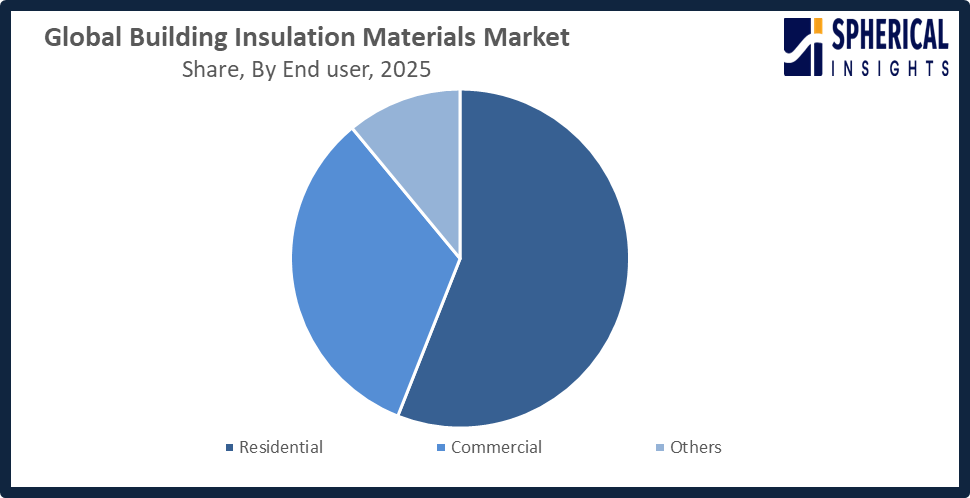
- The residential segment accounted for the highest market revenue in 2025, approximately 56%, and is anticipated to grow at a significant CAGR during the forecast period.
Based on the end user, the building insulation materials market is divided into residential, commercial, and others. Among these, the residential segment accounted for the highest market revenue in 2025, approximately 56%, and is anticipated to grow at a significant CAGR during the forecast period. Increased demand for energy-efficient and comfortable living spaces, rising awareness of energy savings, supportive government incentives for green housing, and increasing new residential construction is bolstering residential market.
Get more details on this report -
Regional Segment Analysis of the Building Insulation Materials Market
- North America (U.S., Canada, Mexico)
- Europe (Germany, France, U.K., Italy, Spain, Rest of Europe)
- Asia-Pacific (China, Japan, India, Rest of APAC)
- South America (Brazil and the Rest of South America)
- The Middle East and Africa (UAE, South Africa, Rest of MEA)
Asia Pacific is anticipated to hold the largest share of the building insulation materials market over the predicted timeframe.
Asia Pacific is anticipated to hold the largest share of the building insulation materials market over the predicted timeframe. Asia Pacific advances through increasing urbanization, growing populations, and expanding building projects. The region's position is further reinforced the rising use of eco-friendly, locally sourced insulation materials, driven by sustainability goals and cost considerations. People now understand benefit of thermal management efficiency including high energy expenses and severe climate situations. Energy-efficient construction receives support from government rules, green building programs, and financial incentives. Additionally, the Asia-Pacific region develops into an essential market for global building insulation materials because of its tropical and subtropical climate technological innovations and increasing industrial growth.
Government initiatives include India’s February 2026, Tripartite MoU in Andhra Pradesh under PMAY brings energy-efficient appliances to 500,000 homes, supporting energy-saving housing goals, China’s MOHURD’s 14th Five-Year Plan for Building Energy Efficiency and Green Building Development focus on building envelope performance, and Australia’s October 2025, expansion of Commercial Building Disclosure program enhances energy efficiency, indirectly boosting insulation demand.
North America is expected to grow at a rapid CAGR in the building insulation materials market during the forecast period. The demand rises from high-performance insulation products in residential, commercial and industrial sectors results from strict energy efficiency standards and ambitious climate targets. The region establishes its retrofitting potential from its existing building stock, which allows for energy cost reduction through insulation upgrades. The common use of smart building technology together with digital energy management system implementation creates a separate factor that enhances advanced insulation systems. The combination of consumer sustainability awareness and government green construction incentives enables North America to achieve fast growth in its insulation market.
Government launches include the U.S. ongoing DOE programs promote energy-efficient retrofits and insulation improvements through guidance, tax incentives, and building codes and Canada’s February 2026, Greener Home Initiatives provides grants and loans for homeowners to upgrade insulation, windows, doors, and attics, supporting energy-efficient renovations.
Competitive Analysis:
The report offers the appropriate analysis of the key organizations/companies involved within the building insulation materials market, along with a comparative evaluation primarily based on their product of offering, business overviews, geographic presence, enterprise strategies, segment market share, and SWOT analysis. The report also provides an elaborative analysis focusing on the current news and developments of the companies, which includes product development, innovations, joint ventures, partnerships, mergers & acquisitions, strategic alliances, and others. This allows for the evaluation of the overall competition within the market.
List of Key Companies
- Owens Corning
- Saint-Gobain S.A.
- ROCKWOOL International A/S
- Kingspan Group plc
- Knauf Insulation
- BASF SE
- Armacell International S.A.
- Atlas Roofing Corporation
- Aspen Aerogels Inc.
- Beijing New Building Materials Co., Ltd.
- Cellofoam North America Inc.
- Covestro AG
- Dow
- DuPont
- GAF Materials LLC
- Others
Key Target Audience
- Market Players
- Investors
- End-users
- Government Authorities
- Consulting and Research Firm
- Venture capitalists
- Value-Added Resellers (VARs)
Recent Development
- In January 2026, Knauf Insulation established its new dedicated blowing wool production line at its Shelbyville Indiana facility to increase production capacity for fiberglass insulation products.
- In October 2025, Knauf expanded its Performance+ fiberglass insulation collection which received Asthma and Allergy Friendly Certification together with Verified Healthier Air status for all products while providing better indoor environmental quality and energy efficiency solutions.
- In June 2025, Saint Gobain launched very low carbon glass wool insulation production at its Isover plant in Forssa, Finland, powered by decarbonized energy, reducing the products’ carbon footprint and supporting low emission building solutions.
- In May 2025, Saint-Gobain announced the launch of Isover plant in Forssa Finland producing very low carbon glass wool insulation after establishing decarbonized energy sources and the new product line reduces greenhouse gas emissions while supporting environmentally friendly construction methods.
- In February 2024, BASF introduced its new HFO blown PIR system for insulation sandwich panels which delivers reduced global warming impacts together with better thermal insulation and fire protection capabilities that enable sustainable building design.
Market Segment
This study forecasts revenue at global, regional, and country levels from 2020 to 2035. Spherical Insights has segmented the building insulation materials market based on the below-mentioned segments:
Global Building Insulation Materials Market, By Material Type
- Foamed Plastics
- Fiberglass
- Stone Wool
- Biobased Materials
- Others
Global Building Insulation Materials Market, By Application
- Wall Insulation
- Underfloor Insulation
- Roof Insulation
- Duct Insulation
- Miscellaneous
Global Building Insulation Materials Market, By End User
- Residential
- Commercial
- Others
Global Building Insulation Materials Market, By Regional Analysis
- North America
- US
- Canada
- Mexico
- Europe
- Germany
- UK
- France
- Italy
- Spain
- Russia
- Rest of Europe
- Asia Pacific
- China
- Japan
- India
- South Korea
- Australia
- Rest of Asia Pacific
- South America
- Brazil
- Argentina
- Rest of South America
- Middle East & Africa
- UAE
- Saudi Arabia
- Qatar
- South Africa
- Rest of the Middle East & Africa
Frequently Asked Questions (FAQ)
-
1.What are the benefits of using building insulation materials?Insulation reduces energy consumption, improves indoor comfort, lowers greenhouse gas emissions, and helps comply with energy efficiency regulations.
-
2.Which materials are most commonly used in insulation?The main materials include fiberglass, foamed plastics, stone wool, and biobased materials like cellulose or hemp, with fiberglass dominating globally.
-
3.How are building codes influencing insulation demand?Stringent energy efficiency standards and mandatory thermal insulation requirements in new buildings directly boost the adoption of high-performance insulation materials.
-
4.What role does sustainability play in insulation adoption?Demand for eco-friendly, recyclable and bio-based insulation materials are rising due to stricter environmental regulations and green building certifications.
-
5.How is technology shaping the insulation materials market?Advanced technologies like vacuum insulation panels, aerogels, and phase-change materials are improving thermal performance while reducing material thickness.
-
6.What innovations are emerging in the market?Innovations include smart insulation systems, hybrid insulation combining multiple materials, and AI-assisted building energy modeling to optimize performance and sustainability.
Need help to buy this report?