Global Broadband Network Gateway (BNG) Market Size, Share, and Analysis, By Type (Traditional BNG and vBNG), By Services (Installation & Deployment Services, Configuration Services, and Support & Maintenance Services), By Connection (Wired and Wireless), By End-users (Residential and Commercial), and By Region (North America, Europe, Asia-Pacific, Latin America, Middle East, and Africa), Analysis and Forecast 2025 - 2035
Industry: Information & Technology
Global Broadband Network Gateway (BNG) Market Insights Forecasts to 2035
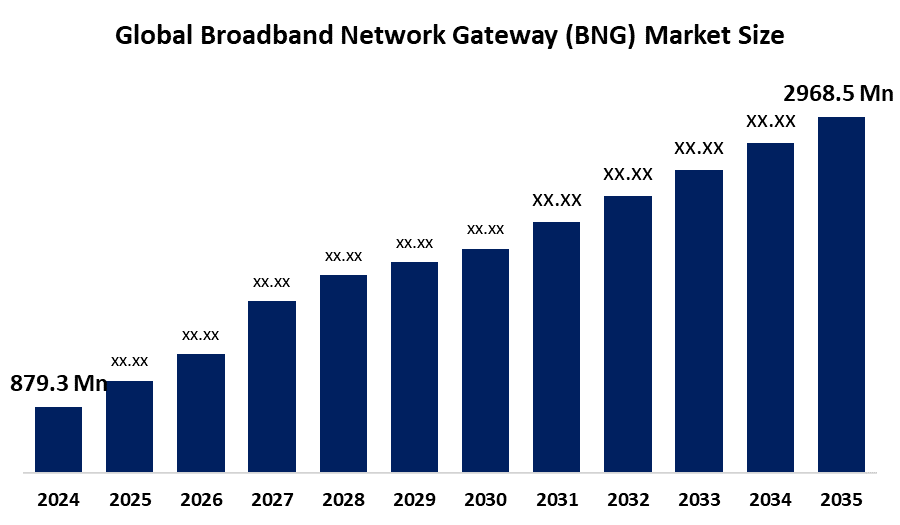
- The Global Broadband Network Gateway (BNG) Market Size Was Estimated at USD 879.3 Million in 2024
- The Market Size is Expected to Grow at a CAGR of around 11.7% from 2025 to 2035
- The Worldwide Broadband Network Gateway (BNG) Market Size is Expected to Reach USD 2968.5 Million by 2035
- Asia Pacific is expected to grow the fastest during the forecast period.
Get more details on this report -
According to a research report published by Spherical Insights and Consulting, the global broadband network gateway (BNG) market size was worth around USD 879.3 million in 2024 and is predicted to grow to around USD 2968.5 million by 2035 with a compound annual growth rate (CAGR) of 11.7% from 2025 to 2035. The broadband network gateway (BNG) market is expanding with surging demand for high-speed internet, 5G expansion, and increasing Fibre-to-the-Home (FTTH) deployments. The shift toward virtualized, cloud-native BNGs and IoT device growth drives this expansion to manage traffic and enhance security efficiently.
Broadband Network Gateway (BNG) Market Key Takeaways
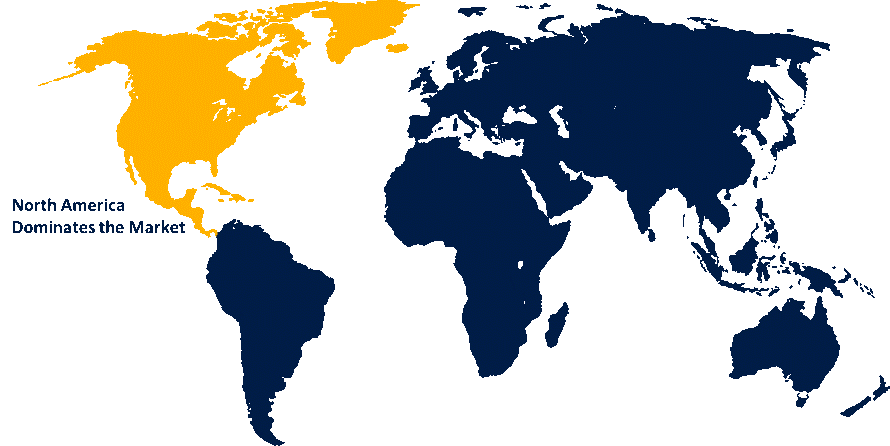
- North America accounted for the largest market share in 2024.
- Asia Pacific is expected to grow at the fastest CAGR during the forecast period.
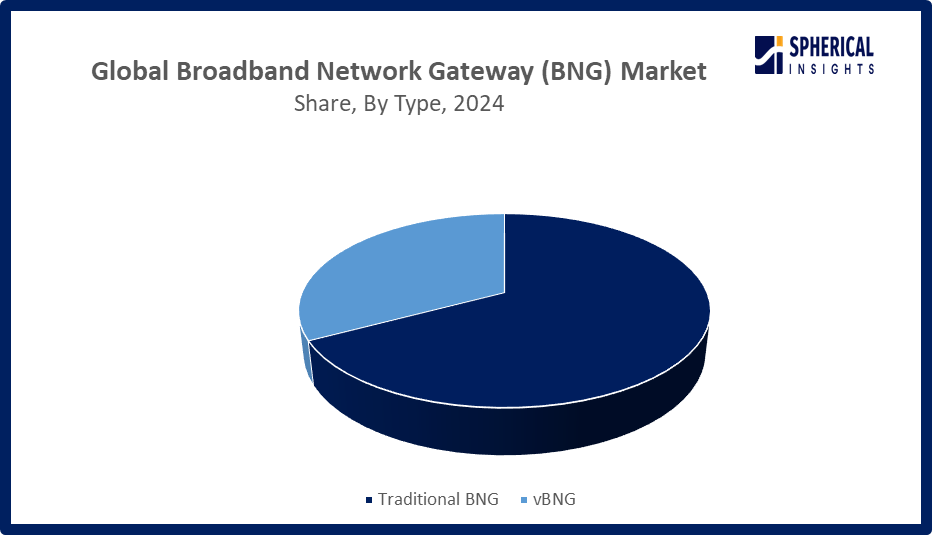
- By type, the traditional BNG segment held a dominant share of the market in 2024.
- By type, the vBNG segment is expected to grow at the fastest CAGR in the market between 2024 and 2035.
- By services, the support & maintenance services segment accounted for a considerable revenue share in the market in 2024.
- By services, the installation & deployment services segment is expected to grow at the highest CAGR in the market during the studied years.
- By connection, the wired segment led the global market in 2024.
- By connection, the wireless segment is expected to grow with the highest CAGR in the market during the studied years.
- By end-users, the residential segment registered its dominance in the market in 2024.
- By end-users, the commercial segment is expected to witness the fastest growth in the market over the forecast period.
Market Overview
The broadband network gateway (BNG) market refers to the infrastructure segment that provides key routing and control functions between broadband access and core networks, managing subscriber sessions, IP allocation, quality of service, and traffic aggregation to ensure seamless internet connectivity for residential and commercial users. Key uses include subscriber session management, policy enforcement, IPv4/IPv6 support, integration with RADIUS/AAA systems, and seamless handling of high-speed broadband traffic from FTTH, DOCSIS, and 5G fixed-wireless access deployments.
Primary market drivers are the explosive growth in data consumption, proliferation of connected devices and IoT applications, rapid fiber broadband rollouts, rising demand for high-speed internet driven by remote work, video streaming, and cloud services, plus the shift toward virtualized and cloud-native BNG architectures. Opportunities include virtualization (vBNG) for greater flexibility and cost efficiency, integration with 5G core and software-defined networking (SDN), edge computing capabilities, and strong demand in emerging markets undergoing digital infrastructure expansion. In March 2026, Governor Matt Meyer and Delaware DTI announced federal approval of the state’s $107 million Broadband Equity, Access, and Deployment (BEAD) plan to expand high-speed internet to 4,728 unserved and underserved homes and businesses. Construction begins in Fall 2026, targeting rural areas across New Castle, Kent, and Sussex counties for universal broadband access.
Broadband Network Gateway (BNG) Market Trends
- Shift to virtualized and cloud-native BNG (vBNG): Telecom operators are moving from hardware-based systems to software-defined, cloud-native BNGs for better scalability, flexibility, and cost efficiency.
- Integration with 5G and fixed-mobile convergence: BNG solutions are evolving to support unified handling of fixed and mobile traffic, enabling seamless connectivity and low-latency services.
- Rising adoption of AI and automation: AI-driven analytics and automation are being used to optimize traffic management, enhance network performance, and improve operational efficiency in complex broadband environments.
Report Coverage
This research report categorizes the broadband network gateway (BNG) market based on various segments and regions, forecasts revenue growth, and analyzes trends in each submarket. The report analyses the key growth drivers, opportunities, and challenges influencing the broadband network gateway (BNG) market. Recent market developments and competitive strategies, such as expansion, type launch, development, partnership, merger, and acquisition, have been included to draw the competitive landscape in the market. The report strategically identifies and profiles the key market players and analyses their core competencies in each sub-segment of the broadband network gateway (BNG) market.
Global Broadband Network Gateway (BNG) Market Report Coverage
| Report Coverage | Details |
|---|---|
| Base Year: | 2024 |
| Market Size in 2024: | USD 879.3 Million |
| Forecast Period: | 2025-2035 |
| Forecast Period CAGR 2025-2035 : | 11.7% |
| 2035 Value Projection: | USD 2968.5 Million |
| Historical Data for: | 2020-2023 |
| No. of Pages: | 268 |
| Tables, Charts & Figures: | 112 |
| Segments covered: | By Type, By Services, By Connection, By End-users |
| Pitfalls & Challenges: | COVID-19 Empact, Challenge, Future, Growth, & Analysis |
Get more details on this report -
Driving Factors
The global broadband network gateway (BNG) market is primarily driven by the rapid growth of broadband and 5G networks, increasing demand for high-speed internet, and rising data traffic from streaming, cloud services, and IoT devices. Telecom operators are upgrading infrastructure to ensure efficient traffic management, subscriber session control, and quality of service. The transition to virtualized BNG (vBNG) and cloud-native architectures enables scalability, cost reduction, and network automation, further fueling adoption. Regulatory initiatives promoting digital connectivity and expanding broadband access in emerging markets also support market growth, making BNG deployment a critical component of modern network infrastructure.
Restraining Factors
The global broadband network gateway (BNG) market faces restraints from high deployment and maintenance costs, complex integration with legacy networks, and security concerns related to large-scale data handling. Additionally, slower broadband adoption in some emerging regions and regulatory challenges can limit market expansion and delay network modernization projects.
Market Segmentation
Type Insights
Why did the traditional BNG segment lead the broadband network gateway (BNG) market?
The traditional BNG segment led the market, holding a major 67% share in 2024. The segment growth is due to its widespread deployment in legacy telecom infrastructure and proven reliability in managing large subscriber bases. Telecom operators prefer traditional BNG for its stability, high performance, and compatibility with existing systems. Additionally, significant investments in fixed broadband networks and slower migration to virtualized solutions have sustained its market dominance.
The vBNG segment is expected to show the fastest growth over the forecast period, as increasing adoption of cloud-native and software-defined networking solutions. It offers scalability, flexibility, and lower operational costs, making it ideal for supporting 5G, IoT, and rapidly expanding broadband networks.
Get more details on this report -
Services Insights
Why did the support & maintenance services segment dominate the market?
The support & maintenance services segment dominated the broadband network gateway (BNG) market with the 45% share in 2024. The segment dominance is attributed to the continuous need for network monitoring, performance optimization, and timely troubleshooting in complex broadband environments. As data traffic grows and networks expand, operators rely on ongoing maintenance to ensure reliability, minimize downtime, and extend infrastructure lifespan. Additionally, frequent software updates and security management further drive demand for these services.
The installation & deployment services segment is expected to witness the fastest growth in the market over the forecast period. The growth is owing to the rapid expansion of broadband infrastructure, increasing 5G and fiber rollouts, and rising demand for quick network implementation. Service providers require efficient deployment to support growing connectivity needs and reduce time-to-market.
Connection Insights
How does the wired segment dominate the broadband network gateway (BNG) market?
The wired segment held the 61% market share in 2025, and its growth is driven by superior bandwidth capacity, low latency, and high reliability compared to wireless alternatives. Widely deployed in fiber (FTTH), DSL, and cable networks, it supports stable, high-speed connectivity for dense urban populations. Additionally, strong investments in fiber infrastructure and existing fixed-line networks continue to reinforce its leading market position.
The wireless segment is expected to gain the highest market share between 2024 and 2035. The growth is due to rapid 5G deployment, expansion of fixed wireless access, and cost-effective network rollout in remote areas. Its flexibility and faster implementation make it ideal for meeting rising broadband demand globally.
End-users Insights
Which end-users segment dominated the broadband network gateway (BNG) market?
The residential segment contributed 70% of the market share in 2024. The residential segment is driven by rising demand for high-speed internet in homes. Increased use of smart devices, streaming platforms, and remote work has significantly boosted data consumption, requiring advanced BNG solutions for efficient traffic management. Moreover, the growing adoption of smart home technologies and IoT devices is expected to further support sustained growth in this segment.
The commercial segment is expected to expand rapidly in the market in the coming years, as increasing enterprise digitalization, cloud adoption, and demand for secure, high-speed connectivity. Businesses require advanced BNG solutions to manage large data volumes, support remote operations, and ensure reliable network performance across organizational environments.
Regional Segment Analysis of the Broadband Network Gateway (BNG) Market
- North America (U.S., Canada, Mexico)
- Europe (Germany, France, U.K., Italy, Spain, Rest of Europe)
- Asia-Pacific (China, Japan, India, Rest of APAC)
- South America (Brazil and the Rest of South America)
- The Middle East and Africa (UAE, South Africa, Rest of MEA)
Why has North America dominated the broadband network gateway (BNG) market?
North America dominated the broadband network gateway (BNG) market, with the largest share of 38% in 2024. The region's growth is driven by its highly developed telecommunications infrastructure and early adoption of advanced networking technologies. The region has a high penetration of broadband services, supported by strong investments in fiber and 5G deployments. Major telecom operators and technology providers are actively investing in upgrading network capabilities, including virtualised and cloud-native BNG solutions. Additionally, increasing data consumption from streaming, cloud computing, and enterprise applications further drives demand for efficient traffic management and high-performance network gateways. In February 2026, Senator Roger Wicker announced federal approval of Mississippi’s BEAD broadband plan, securing $1.2 billion to expand high-speed internet. The initiative will connect 93,283 homes with $508 million in federal funds, supplemented by $321 million in private investment, overseen by the state’s Office of Broadband Expansion and Accessibility.
Get more details on this report -
U. S. Broadband Network Gateway (BNG) Market Trends
The U.S. Broadband Network Gateway (BNG) market is witnessing strong growth due to rising internet traffic, fixed-mobile convergence, and increasing demand for high-speed connectivity. Over 57% of operators are shifting to virtualized BNG, while 61% of ISPs deploy BNG solutions for better traffic management. Cloud-native architectures, SDN/NFV adoption, and smart city expansion further accelerate market growth. In December 2025, U.S. Senator Amy Klobuchar announced NTIA approval of Minnesota’s BEAD Final Proposal, securing $652 million to expand high-speed internet statewide. The funding aims to deliver fast, reliable broadband to unserved and underserved areas, helping bridge the digital divide and improve connectivity across all communities.
Why is Asia Pacific the fastest-growing region in the broadband network gateway (BNG) market?
Asia Pacific is expected to experience the fastest growth over the forecast period. The region is rapidly growing in the market due to rapid urbanization, expanding internet user base, and large-scale deployment of fiber and 5G networks. Governments in countries like China and India are heavily investing in digital infrastructure to improve connectivity. Additionally, rising adoption of cloud services, IoT devices, and increasing demand for high-speed internet in both urban and rural areas are accelerating market growth across the region.
China Broadband Network Gateway (BNG) Market Trends
The Chinese broadband network gateway (BNG) market is growing rapidly due to large-scale fiber broadband expansion and aggressive 5G deployment. Rising data consumption, smart city initiatives, and government-backed digital infrastructure programs drive demand. Increasing adoption of virtualized BNG and cloud-native networks further supports scalable, efficient traffic management across China’s telecom ecosystem. In July 2024, China’s Ministry of Industry and Information Technology approved licenses for China Telecom, China Mobile, and China Unicom to build international communication gateway hubs in Nanning, Qingdao, Kunming, and Haikou, enhancing global connectivity, supporting the Belt and Road Initiative, and boosting digital economy growth.
How is the opportunistic rise of Europe in the broadband network gateway (BNG) market?
Europe’s opportunistic rise in the broadband network gateway (BNG) market is driven by strong regulatory support for digital connectivity, widespread fiber rollout initiatives, and increasing 5G deployment. Investments under EU digital programs and the growing demand for high-speed internet are accelerating adoption. Additionally, telecom operators are embracing virtualized BNG and SDN technologies to enhance network efficiency, scalability, and service delivery across the region.
Competitive Analysis:
The report offers the appropriate analysis of the key organizations/companies involved within the broadband network gateway (BNG) market, along with a comparative evaluation primarily based on their type of offering, business overviews, geographic presence, enterprise strategies, segment market share, and SWOT analysis. The report also provides an elaborative analysis focusing on the current news and developments of the companies, which includes type development, innovations, joint ventures, partnerships, mergers & acquisitions, strategic alliances, and others. This allows for the evaluation of the overall competition within the market.
List of Key Companies
- Huawei Technologies
- Juniper Networks, Inc.
- Cisco Systems, Inc.
- Nokia Corporation
- Ericsson
- ZTE Corporation
- Benu Networks, Inc.
- netElastic
- ADTRAN
- RtBrick
- Arista Networks
- Casa Systems, Inc.
- Verizon Communications Inc.
- Others
Key Target Audience
- Market Players
- Investors
- End-users
- Government Authorities
- Consulting and Research Firm
- Venture capitalists
- Value-Added Resellers (VARs)
Recent Development
- In February 2026, the Healey-Driscoll Administration secured $18.8 million in federal Broadband Equity, Access, and Deployment (BEAD) funding for Massachusetts. The Massachusetts Technology Collaborative’s Broadband Institute will expand high-speed internet to 2,565 homes, businesses, and 1,243 community anchor institutions across 251 communities, using fiber, hybrid, and satellite technologies to achieve full statewide broadband coverage.
- In December 2025, the California Public Utilities Commission submitted the state’s Broadband Equity, Access, and Deployment (BEAD) Final Proposal to the NTIA, seeking up to $1.86 billion in federal funding. The plan aims to expand high-speed internet to unserved and underserved communities, including rural areas, Tribal lands, and low-income neighborhoods across California.
- In September 2025, Elisa and Juniper Networks achieved a breakthrough by piloting the world’s first combined BNG and UPF on a single MX Series router. The innovation reduces costs, improves efficiency, and enables unified handling of fixed and mobile broadband traffic in live networks.
- In August 2025, Nokia announced that Netplus deployed 400G routing and SDAN solutions to expand broadband and IPTV services across Punjab. The rollout supports nearly two million users, enabling scalable, energy-efficient networks while advancing IPTV adoption and high-bandwidth applications like e-commerce and digital education.
- In April 2025, Adtran partnered with 6WIND to deliver scalable virtual BNG and vCGNAT solutions. Integrated into Adtran’s Mosaic platform, the offering enables service providers to replace hardware-based systems with cloud-native alternatives, improving scalability, reducing costs, and simplifying broadband network operations.
Market Segment
This study forecasts revenue at global, regional, and country levels from 2020 to 2035. Spherical Insights has segmented the broadband network gateway (BNG) market based on the below-mentioned segments:
Global Broadband Network Gateway (BNG) Market, By Type
- Traditional BNG
- vBNG
Global Broadband Network Gateway (BNG) Market, By Services
- Installation & Deployment Services
- Configuration Services
- Support & Maintenance Services
Global Broadband Network Gateway (BNG) Market, By Connection
- Wired
- Wireless
Global Broadband Network Gateway (BNG) Market, By End-users
- Residential
- Commercial
Global Broadband Network Gateway (BNG) Market, By Regional Analysis
- North America
- US
- Canada
- Mexico
- Europe
- Germany
- UK
- France
- Italy
- Spain
- Russia
- Rest of Europe
- Asia Pacific
- China
- Japan
- India
- South Korea
- Australia
- Rest of Asia Pacific
- South America
- Brazil
- Argentina
- Rest of South America
- Middle East & Africa
- UAE
- Saudi Arabia
- Qatar
- South Africa
- Rest of the Middle East & Africa
Frequently Asked Questions (FAQ)
-
1. What innovations in virtualized BNG (vBNG) are transforming network scalability and efficiency?Innovations in virtualized BNG (vBNG) include cloud-native architectures, disaggregation (CUPS), and software-defined networking, enabling horizontal scaling and flexibility. vBNG solutions now achieve up to 770 Gbps throughput and reduce costs by up to 70%, significantly improving network scalability and operational efficiency.
-
2. How are telecom operators optimizing costs through software-defined networking in BNG deployments?Telecom operators optimize costs in BNG deployments using SDN and virtualization, reducing CAPEX/OPEX by 10-30% TCO over five years and up to 70% hardware costs, while improving resource utilization and automation efficiency.
-
3. What economic factors are influencing investments in broadband infrastructure and BNG systems?Economic factors influencing investments in broadband infrastructure and BNG systems include high capital expenditure trends, with operators investing about $89.6 billion in 2024 in the U.S. alone, alongside rising demand for data, AI, and cloud services. However, higher interest rates and a 10% capex decline in 2024 reflect cost pressures and cautious spending decisions.
-
4. How are government digital inclusion initiatives impacting BNG adoption worldwide?Government digital inclusion initiatives are accelerating BNG adoption by expanding broadband access and usage. For instance, the U.S. allocated $65 billion for broadband expansion, while OECD data shows urban broadband adoption exceeds rural by 4-5%, driving network upgrades and higher demand for scalable BNG systems to manage increased connectivity.
-
5. What challenges do legacy network systems pose for modern BNG implementation?Legacy network systems hinder modern BNG implementation due to compatibility issues, limited scalability, and outdated protocols. Around 30% of operators run mixed-generation networks, increasing deployment time by 20%, while 95% face integration challenges, leading to higher costs, delays, and performance inefficiencies.
-
6. How is edge computing influencing the deployment and functionality of BNG solutions?Edge computing enhances BNG deployment by enabling low-latency processing and distributed traffic management, reducing bandwidth usage. It improves scalability, with edge-cloud systems scaling up to 10× better than cloud-only, while vBNG solutions achieve up to 1 Tbps throughput, boosting efficiency.
-
7. What security innovations are being integrated into BNG systems to handle rising cyber threats?Security innovations in BNG systems include deep packet inspection (DPI), intrusion detection/prevention systems (IDS/IPS), AI-driven threat analytics, and advanced authentication protocols. Over 62% of deployments use containerized security frameworks, while 38% of operators report increased workloads for security compliance, highlighting growing cybersecurity integration.
-
8. What is the impact of fiber broadband expansion on BNG infrastructure demand?Fiber broadband expansion significantly increases BNG infrastructure demand by requiring high-capacity traffic management and scalability. With data usage rising over 30% annually and FTTH deployments accelerating, telecom operators must deploy advanced BNGs to handle millions of subscribers and multi-gigabit speeds efficiently.
Need help to buy this report?