Brazil Household Kitchen Appliances Market Size, Share, and COVID-19 Impact Analysis, By Product (Refrigerator, Cooking Appliances, Dishwasher, Range Hood, and Others), By Technology (Conventional and Smart Appliances), and Brazil Household Kitchen Appliances Market Insights, Industry Trend, Forecasts to 2035
Industry: Consumer Goods
Brazil Household Kitchen Appliances Market Insights Forecasts to 2035
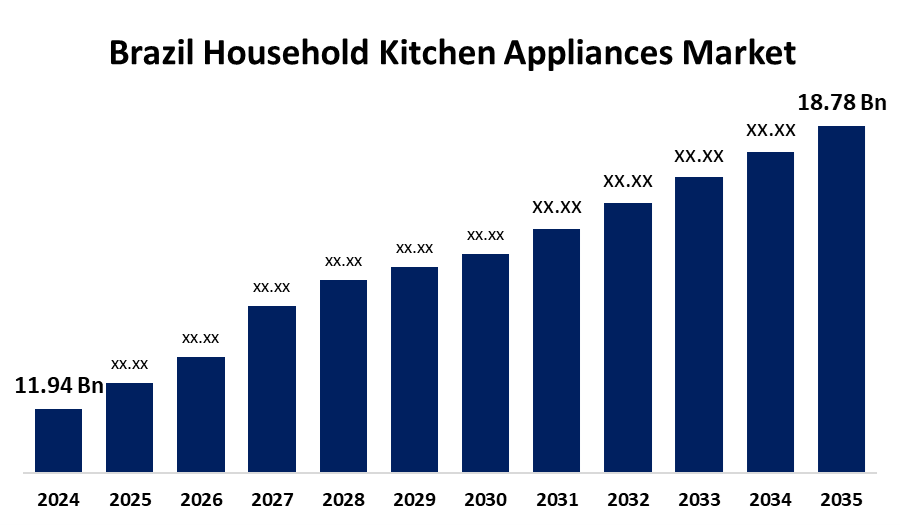
- The Brazil Household Kitchen Appliances Market Size Was Estimated at USD 11.94 Billion in 2024
- The Market Size is Expected to Grow at a CAGR of Around 4.2% from 2025 to 2035
- The Brazil Household Kitchen Appliances Market Size is Expected to Reach USD 18.78 Billion by 2035
Get more details on this report -
According to a research report published by Spherical Insights & Consulting, the Brazil household kitchen appliances market size is anticipated to reach USD 18.78 billion by 2035, growing at a CAGR of 4.2% from 2025 to 2035. The Brazil household kitchen appliances market is growing due to rising urbanization, increasing disposable income, changing consumer lifestyles, and growing demand for convenient, energy-efficient, and smart kitchen appliances. Growth in e-commerce and modern retail channels also supports market expansion.
Market Overview
The Brazil household kitchen appliances market refers to the industry involved in the production, distribution, and sale of electrical and non-electrical appliances used in household kitchens within Brazil. The market is used in homes to assist with daily kitchen tasks such as cooking, food preparation, storage, and cleaning. These appliances improve convenience, efficiency, and time-saving in household kitchens. The market is driven by rising urbanization, increasing disposable income, changing consumer lifestyles, and growing demand for convenient, energy-efficient, and smart kitchen appliances. Growth in e-commerce and modern retail channels also supports market expansion.
Key opportunities in the Brazilian household kitchen appliances market include the growing adoption of smart/IoT-enabled and energy-efficient appliances, increasing demand for compact multifunctional products for urban homes, and expanding e-commerce channels. Rising disposable incomes, a growing middle class, strong demand for coffee makers, and growth potential in Brazil’s Northeast region further support market expansion. In March 2025, the Brazilian government began implementing a phased tax reform, introducing a Dual VAT system with CBS (Contribution on Goods and Services) and IBS (Goods and Services Tax). The initiative includes new technical updates for electronic fiscal documents and a transition period until 2033. This reform is important for the market as it simplifies taxation, improves transparency, and supports smoother business operations, benefiting sectors including household appliances and consumer goods.
Report Coverage
This research report categorizes the market for the Brazil household kitchen appliances market based on various segments and regions, and forecasts revenue growth and analyses trends in each submarket. The report analyses the key growth drivers, opportunities, and challenges influencing the Brazil household kitchen appliances market. Recent market developments and competitive strategies, such as expansion, product launch, development, partnership, merger, and acquisition, have been included to draw the competitive landscape in the market. The report strategically identifies and profiles the key market players and analyses their core competencies in each sub-segment of the Brazil household kitchen appliances market.
Brazil Household Kitchen Appliances Market Report Coverage
| Report Coverage | Details |
|---|---|
| Base Year: | 2024 |
| Market Size in 2024: | USD 11.94 Billion |
| Forecast Period: | 2025-2035 |
| Forecast Period CAGR 2025-2035 : | 4.2% |
| 2035 Value Projection: | USD 18.78 Billion |
| Historical Data for: | 2020-2023 |
| No. of Pages: | 204 |
| Tables, Charts & Figures: | 115 |
| Segments covered: | By Product , By Technology |
| Companies covered:: | Tramontina., Mondial, EMBRACO LLC., Haier.com., LG Electronics., Panasonic Brazil., Midea, SAMSUNG, Whirlpool, Electrolux, Others, and |
| Pitfalls & Challenges: | COVID-19 Empact, Challenge, Future, Growth, & Analysis |
Get more details on this report -
Driving Factors
The Brazil household kitchen appliances market is driven by rising disposable incomes, rapid urbanization, and expanding middle-class households. Consumers are increasingly demanding premium, smart, and energy-efficient appliances that improve convenience and reduce energy consumption. The growing popularity of built-in and space-saving appliances in urban apartments, along with strong e-commerce growth and digital retail channels, is boosting product accessibility. In addition, changing lifestyles, a rising interest in home cooking and healthy eating, technological innovation, and replacement demand for modern appliances are further supporting market growth across Brazil.
Restraining Factors
The Brazil household kitchen appliances market is mostly constrained by high financing costs, elevated import duties, and currency fluctuations that increase product prices. Additionally, low consumer purchasing power, limited awareness of energy-efficient appliances, and logistical constraints further hinder market growth.
Market Segmentation
The Brazil household kitchen appliances market share is classified into product and technology.
- The cooking appliances segment accounted for the largest revenue market share in 2024 and is expected to grow at a significant CAGR during the forecast period.
The Brazil household kitchen appliances market is segmented by product into refrigerator, cooking appliances, dishwasher, range hood, and others. Among these, the cooking appliances segment accounted for the largest revenue market share in 2024 and is expected to grow at a significant CAGR during the forecast period. This is due to the rising kitchen renovations, increasing home dining trends, and growing demand for stylish, easy-to-clean, and multifunctional appliances. Consumers are increasingly adopting premium induction cooktops and convection ovens for modern kitchens. Brazil’s strong manufacturing base and supportive regulations are attracting new investments, and in March 2025, Tramontina launched its first built-in induction cooktop series, reflecting the shift toward integrated kitchen solutions.
- The conventional segment dominated the share in 2024 and is anticipated to grow at a remarkable CAGR during the forecast period.
The Brazil household kitchen appliances market is segmented by technology into conventional and smart appliances. Among these, the conventional segment dominated the share in 2024 and is anticipated to grow at a remarkable CAGR during the forecast period. This is due to their affordability, easy installation, and dependable performance. Entry-level gas cooktops and basic electric ovens remain popular as they offer lower upfront costs and simple plug-and-play usage. Their straightforward design, minimal maintenance needs, and fewer service requirements also increase consumer confidence, particularly in regions with limited after-sales service infrastructure.
Competitive Analysis:
The report offers the appropriate analysis of the key organizations/companies involved within the Brazil household kitchen appliances market, along with a comparative evaluation primarily based on their product offering, business overviews, geographic presence, enterprise strategies, segment market share, and SWOT analysis. The report also provides an elaborate analysis focusing on the current news and developments of the companies, which includes product development, innovations, joint ventures, partnerships, mergers & acquisitions, strategic alliances, and others. This allows for the evaluation of the overall competition within the market.
List of Key Companies
- Tramontina.
- Mondial
- EMBRACO LLC.
- Haier.com.
- LG Electronics.
- Panasonic Brazil.
- Midea
- SAMSUNG
- Whirlpool
- Electrolux
- Others
Key Target Audience
- Market Players
- Investors
- End-users
- Government Authorities
- Consulting and Research Firm
- Venture capitalists
- Value-Added Resellers (VARs)
Recent Developments:
- In January 2026, Samsung Electronics launched the upgraded Bespoke AI Laundry Combo with faster wash-to-dry cycles, improved drying technology, and AI-based sensors for optimized washing. This innovation supports the market by increasing demand for smart, energy-efficient home appliances and enhancing convenience for modern households.
- In January 2025, Panasonic Holdings Corporation showcased new AI, robotics, and sustainability innovations at the CES 2025 under the theme Well into the Future. The company also introduced its Panasonic Go initiative, supporting AI-driven solutions and smart technologies, which may accelerate innovation in the global home and kitchen appliances market.
Market Segment
This study forecasts revenue at the Brazil, regional, and country levels from 2020 to 2035. Spherical Insights has segmented the Brazil household kitchen appliances market based on the below-mentioned segments:
Brazil Household Kitchen Appliances Market, By Product
- Refrigerator
- Cooking Appliances
- Dishwasher
- Range Hood
- Others
Brazil Household Kitchen Appliances Market, By Technology
- Conventional
- Smart Appliances
Frequently Asked Questions (FAQ)
-
Q: What is the Brazil household kitchen appliances market?A: The Brazil household kitchen appliances market refers to the industry involved in the production, distribution, and sale of electrical and non-electrical appliances used in household kitchens within Brazil.
-
Q: What are the government initiatives for the Brazil household kitchen appliances market?A: In March 2025, the Brazilian government began implementing a phased tax reform, introducing a Dual VAT system with CBS (Contribution on Goods and Services) and IBS (Goods and Services Tax).
-
Q: How is the Brazil household kitchen appliances market segmented?A: The market is segmented by product and technology.
-
Q: What are the driving factors of the Brazil household kitchen appliances market?A: The market is driven by increasing disposable income, changing consumer lifestyles, and growing demand for convenient, energy-efficient, and smart kitchen appliances. Growth in e-commerce and modern retail channels also supports market expansion.
-
Q: What are the constraints of the market?A: The market is constrained by high financing costs, elevated import duties, and currency fluctuations that increase product prices. Additionally, low consumer purchasing power and limited awareness of energy-efficient appliances.
Need help to buy this report?