Global Boron 11 Trifluoride 11BF3 Market Size, Share, By Type (Etherate Complexes Type, Dimethanol Complexes Type, and Others), By Purity Grade (Technical Grade, High Purity Grade, and Ultra-High Purity Grade), By End User (Chemical & Petrochemical Industry, Aerospace & Defense, Pharmaceutical Companies, Electronics & Semiconductor Industry, and Research & Academic Institution), and By Region (North America, Europe, Asia-Pacific, Latin America, Middle East, and Africa), Analysis and Forecast 2025 - 2035.
Industry: Chemicals & Materials
Global Boron 11 Trifluoride 11BF3 Market Insights and Forecasts to 2035
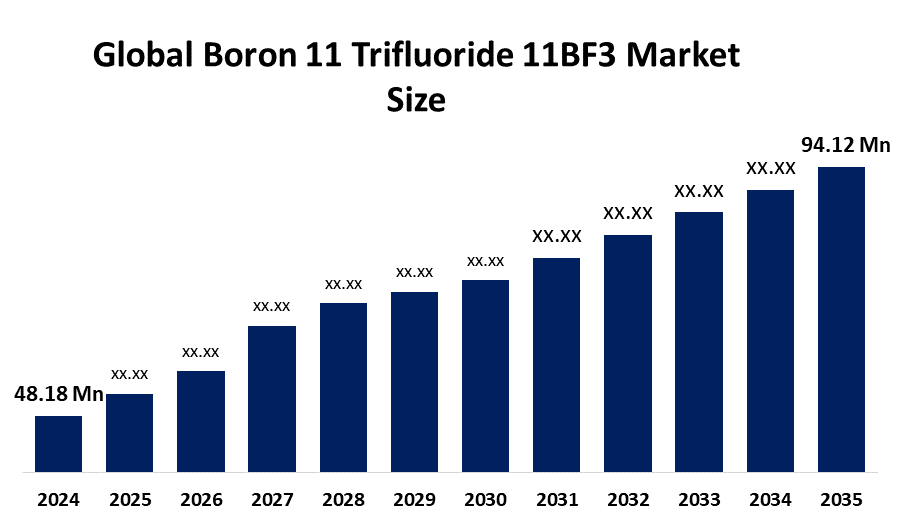
- The Global Boron 11 Trifluoride 11BF3 Market Size Was Estimated at USD 48.18 million in 2024
- The Market Size is Expected to Grow at a CAGR of around 6.28% from 2025 to 2035
- The Worldwide Boron 11 Trifluoride 11BF3 Market Size is Expected to Reach USD 94.12 million by 2035
- North America is expected to grow the fastest during the forecast period.
Get more details on this report -
According to a research report published by Spherical Insights, the global boron 11 trifluoride 11BF3 market size was worth around USD 48.18 million in 2024 and is predicted to grow to around USD 94.12 million by 2035 with a compound annual growth rate (CAGR) of 6.28% from 2025 to 2035. The global boron 11 trifluoride 11BF3 market is driven by rising demand in semiconductor manufacturing, electronics, lithium-ion batteries, and specialty chemical applications, supported by industrial expansion, high-purity gas requirements, and increasing investments in advanced materials and nuclear research.
Market Overview
The global boron-11 trifluoride 11BF3 market refers to the niche segment focused on isotopically enriched boron trifluoride gas, which serves nuclear applications, semiconductor manufacturing, and advanced chemical synthesis because of its high purity and neutron absorption properties. The market experiences growth because electronic products, lithium-ion batteries, and specialty chemicals show increasing demand while nuclear research activities continue to expand. The demand for nuclear safety, advanced material development, and clean energy solutions receives support through government initiatives. In October 2024, the Heavy Water Board (HWB) inaugurated an electronics-grade Boron-11 (>99.8%) enrichment facility at Talcher, strengthening domestic production capabilities and reducing reliance on imports for semiconductor-grade Boron-11 used in BF3 gas applications. The market shows key trends which include greater demand for high-purity specialty gases, companies establishing local production facilities, and businesses adopting environmentally friendly chemical manufacturing methods. The combination of better isotope separation methods, superior gas management systems, and advanced recycling systems boosts production output while protecting worker safety. The use of 11BF3 provides performance and reliability benefits that create opportunities for next-generation electronics, electric vehicles, and nuclear shielding applications.
Report Coverage
This research report categorizes the global boron 11 trifluoride 11BF3 market based on various segments and regions, forecasts revenue growth, and analyzes trends in each submarket. The report analyses the key growth drivers, opportunities, and challenges influencing the global boron 11 trifluoride 11BF3 market. Recent market developments and competitive strategies, such as expansion, product launch, development, partnership, merger, and acquisition, have been included to draw the competitive landscape in the market. The report strategically identifies and profiles the key market players and analyzes their core competencies in each sub-segment of the boron 11 trifluoride 11BF3 market.
Driving Factors
The boron 11 trifluoride 11BF3market expands because semiconductor manufacturing and electronics production require high-purity specialty gases. The market usage increases because of the rapid growth in lithium-ion batteries and energy storage systems. The market expands because the product serves as an effective catalyst for increasing applications in petrochemical refining and pharmaceutical synthesis. The demand for isotopically enriched materials in nuclear energy and research projects drives their growing requirement. Emerging economies boost industrial growth while material science and clean energy technology progress, which drives market development and business expansion in the industry.
Restraining Factors
The Boron-11 Trifluoride 11BF3 market faces restraints because isotopically enriched boron requires expensive production methods, which create difficult manufacturing challenges. The operation costs of the business increase because they must handle two dangerous materials, which require special storage methods. The market experiences restricted growth because of environmental and safety regulations and the scarcity of essential materials and specialized facilities.
Market Segmentation
The global boron 11 trifluoride 11BF3 market share is classified into type, purity grade, and end user.
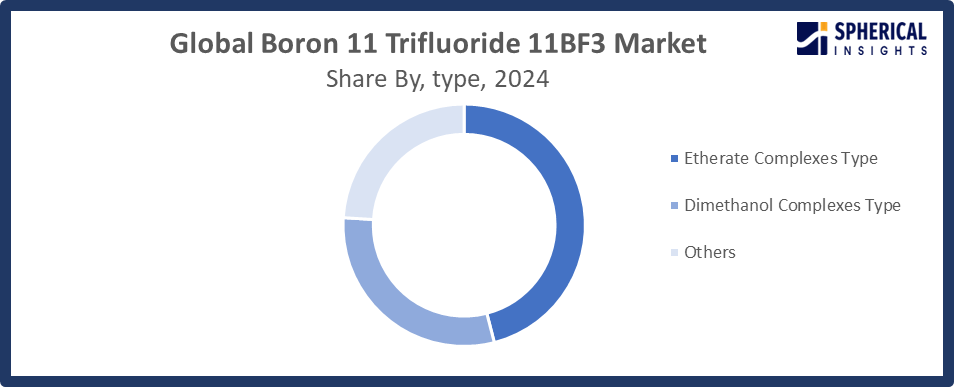
The etherate complexes type segment accounted for the largest share in 2024, approximately 46%, and is anticipated to grow at a significant CAGR during the forecast period.
Based on the type, the global boron 11 trifluoride 11BF3 market is divided into etherate complexes type, dimethanol complexes type, and others. Among these, the etherate complexes type segment accounted for the largest share in 2024, approximately 46%, and is anticipated to grow at a significant CAGR during the forecast period. This is because etherate complexes offer higher stability, easier handling, and enhanced catalytic efficiency compared to other forms, making them widely preferred in chemical synthesis, petrochemical processing, and pharmaceutical applications. Their compatibility with various industrial processes and ability to improve reaction control further support their dominant position in the market.
Get more details on this report -
The high purity grade segment accounted for the highest market revenue in 2024, approximately 49%, and is anticipated to grow at a significant CAGR during the forecast period.
Based on the purity grade, the global boron 11 trifluoride 11BF3 market is divided into technical grade, high purity grade, and ultra-high purity grade. Among these, the high purity grade segment accounted for the highest market revenue in 2024, approximately 49%, and is anticipated to grow at a significant CAGR during the forecast period. This is because high-purity grade 11BF3 offers an optimal balance between cost and performance, making it widely suitable for semiconductor manufacturing, chemical synthesis, and industrial catalysis. Its consistent quality, reduced impurities, and compatibility with sensitive processes drive strong demand across key end-use industries.
The electronics & semiconductor industry segment dominated the market in 2024, approximately 42%, and is projected to grow at a substantial CAGR during the forecast period.
Based on the end user, the global boron 11 trifluoride 11BF3 market is divided into chemical & petrochemical industry, aerospace & defense, pharmaceutical companies, electronics & semiconductor industry, and research & academic institutions. Among these, the electronics & semiconductor industry segment dominated the market in 2024, approximately 42%, and is projected to grow at a substantial CAGR during the forecast period. The dominance is driven by the increasing demand for high-purity specialty gases in semiconductor fabrication, chip manufacturing, and advanced electronic components, where 11BF3 is widely used for etching, doping, and precision chemical processes requiring minimal impurities and high performance.
Regional Segment Analysis of the Global Boron 11 Trifluoride 11BF3 Market
- North America (U.S., Canada, Mexico)
- Europe (Germany, France, U.K., Italy, Spain, Rest of Europe)
- Asia-Pacific (China, Japan, India, Rest of APAC)
- South America (Brazil and the Rest of South America)
- The Middle East and Africa (UAE, South Africa, Rest of MEA)

Get more details on this report -
Asia Pacific is anticipated to hold the largest share of the global boron 11 trifluoride 11BF3 market over the predicted timeframe.
Asia Pacific is anticipated to hold the largest share of the global Boron 11 Trifluoride 11BF3 market over the predicted timeframe, approximately 40% market share. The growth is driven by the strong presence of semiconductor and electronics manufacturing hubs, rapid industrialization, expanding lithium-ion battery production, growing demand for high-purity specialty gases, supportive government policies, investments in advanced materials and chemical industries, cost-effective production, and an established supply chain.
The North America region is expected to grow at the fastest rate during the forecast period, approximately 27% market share. The market growth is fueled by increasing investments in semiconductor fabrication and advanced electronics manufacturing, rising demand for high-purity specialty gases in aerospace, defense, and nuclear applications, strong government initiatives promoting domestic chip production, expanding research infrastructure, the presence of leading industry players, and continuous technological advancements in chemical processing and electronics.
Competitive Analysis:
The report offers the appropriate analysis of the key organizations/companies involved within the global boron 11 trifluoride 11BF3 market, along with a comparative evaluation primarily based on their product offering, business overviews, geographic presence, enterprise strategies, segment market share, and SWOT analysis. The report also provides an elaborative analysis focusing on the current news and developments of the companies, which includes product development, innovations, joint ventures, partnerships, mergers & acquisitions, strategic alliances, and others. This allows for the evaluation of the overall competition within the market.
List of Key Companies
- BASF SE
- Honeywell International Inc.
- Arkema Group
- The Linde Group
- Praxair Technology Inc
- Entegris Inc
- Matheson Tri-Gas Inc
- Voltaix LLC Air Liquide division
- Stella Chemifa Corporation
- Tanfac Industries Ltd
- Gulbrandsen Chemicals Inc
- Navin Fluorine International Ltd
- Qingzhou Chenkai Chemical Co Ltd
- Zibo Shuanglian Petroleum & Chemical Co Ltd
- Hunan Heaven Materials Development Co Ltd
- Others
Key Target Audience
- Market Players
- Investors
- End-users
- Government Authorities
- Consulting and Research Firm
- Venture capitalists
- Value-Added Resellers (VARs)
Recent Development
- In October 2024, Honeywell International Inc. announced a planned spin-off of its Advanced Materials business to sharpen its portfolio focus on core specialty gases and materials, including those used in semiconductor and electronics applications, such as high-purity Boron-11 trifluoride 11BF3
Market Segment
This study forecasts revenue at global, regional, and country levels from 2020 to 2035. Spherical Insights has segmented the global boron 11 trifluoride 11BF3 market based on the below-mentioned segments:
Global Boron 11 Trifluoride 11BF3 Market, By Type
- Etherate Complexes Type
- Dimethanol Complexes Type
- Others
Global Boron 11 Trifluoride 11BF3 Market, By Purity Grade
- Technical Grade
- High Purity Grade
- Ultra-High Purity Grade
Global Boron 11 Trifluoride 11BF3 Market, By End User
- Chemical & Petrochemical Industry
- Aerospace & Defense
- Pharmaceutical Companies
- Electronics & Semiconductor Industry
- Research & Academic Institution
Global Boron 11 Trifluoride 11BF3 Market, By Regional Analysis
- North America
- US
- Canada
- Mexico
- Europe
- Germany
- UK
- France
- Italy
- Spain
- Russia
- Rest of Europe
- Asia Pacific
- China
- Japan
- India
- South Korea
- Australia
- Rest of Asia Pacific
- South America
- Brazil
- Argentina
- Rest of South America
- Middle East & Africa
- UAE
- Saudi Arabia
- Qatar
- South Africa
- Rest of the Middle East & Africa
Frequently Asked Questions (FAQ)
-
1. What is Boron‑11 Trifluoride, and why is it important?A: Boron‑11 Trifluoride 11BF3 is an isotope‑enriched specialty gas used for precision chemical processes, neutron detection, and semiconductor applications where high purity and predictable performance are essential.
-
2. How does 11BF3 differ from regular BF3?A: 11BF3 is enriched in the Boron‑11 isotope, which has specific neutron absorption and chemical properties, making it preferable for nuclear instrumentation and advanced semiconductor processes compared with standard boron trifluoride.
-
3. Which industries are primary users of 11BF3?A: Major users include semiconductor fabrication, chemical synthesis, research institutions, and certain nuclear and defense applications that require high‑purity specialty gases.
-
4. What technological trends are influencing the 11BF3 market?A: Trends include the development of advanced isotope separation methods, improved gas delivery and handling systems, and integration of specialty gases into more automated semiconductor fabrication processes.
-
5. What are typical purity grades available for 11BF3?A: 11BF3 is offered in purity grades ranging from technical grade to ultra‑high purity, with the highest grades used in semiconductor and precision research applications.
-
6. How do regulatory and safety requirements impact the 11BF3 market?A: Strict safety and hazardous materials regulations affect the production, storage, and handling of BF₃ gases. Compliance adds cost and complexity but ensures safe industrial use.
-
7. What are the key supply chain challenges for 11BF3?A: Challenges include limited global enrichment capacity for Boron‑11, reliance on a small number of specialty gas producers, and logistical constraints in transporting high‑purity hazardous gases internationally.
Need help to buy this report?