Global Bodyshop Management Software Market Size, Share, By Software Type (Cloud-Based Software, On-Premises Software, and Hybrid Software Solutions), By Bodyshop Size (Small Bodyshops, Medium-Sized Bodyshops, and Large Bodyshops), By End User (Independent Bodyshops, Franchise Chains, Insurance Companies, Managed Service Providers, and Others), and By Region (North America, Europe, Asia-Pacific, Latin America, Middle East, and Africa), Analysis and Forecast 2026 - 2035.
Industry: Automotive & Transportation
Global Bodyshop Management Software Market Insights Forecasts to 2035
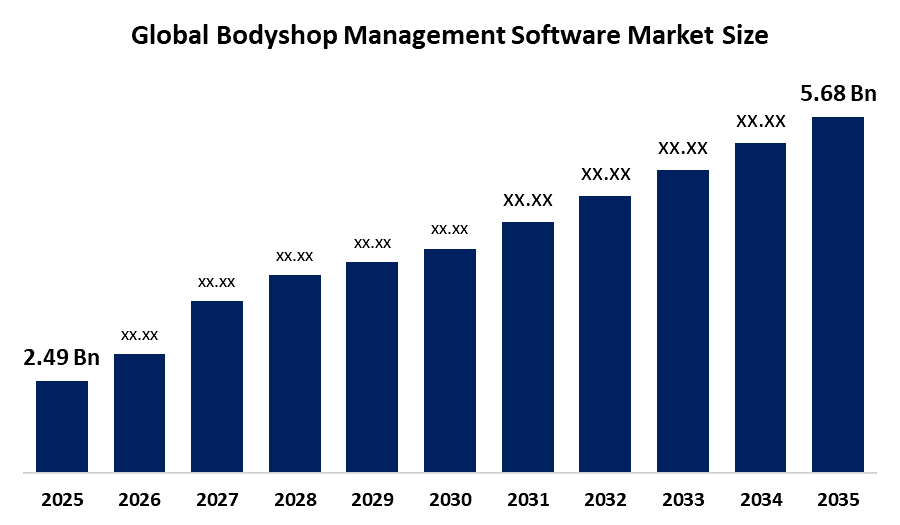
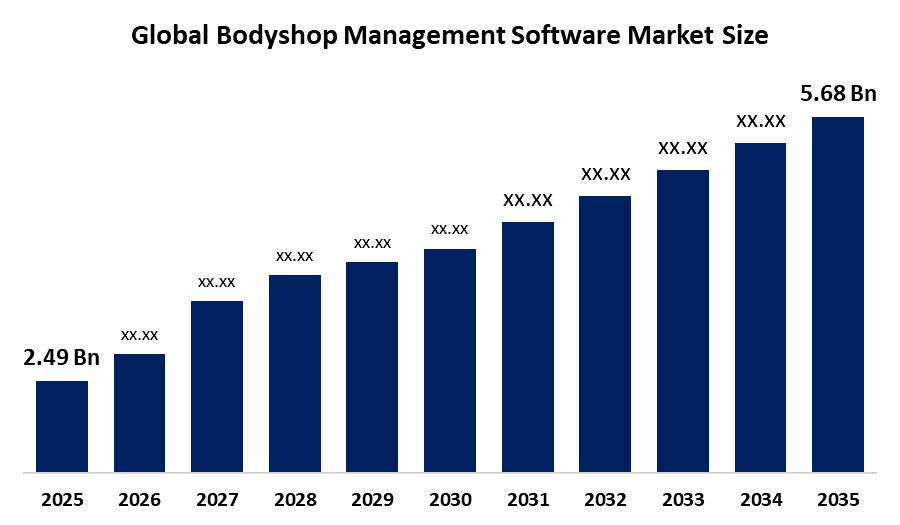
- The Global Bodyshop Management Software Market Size Was Estimated at USD 2.49 Billion in 2025
- The Market Size is Expected to Grow at a CAGR of around 8.6% from 2026 to 2035
- The Worldwide Bodyshop Management Software Market Size is Expected to Reach USD 5.68 Billion by 2035
- Asia Pacific is expected to grow the fastest during the forecast period.
Get more details on this report -
According to a research report published by Spherical Insights and Consulting, the global bodyshop management software market size was worth around USD 2.49 billion in 2025 and is predicted to grow to around USD 5.68 billion by 2035 with a compound annual growth rate (CAGR) of 8.6% from 2026 to 2035. Global expansion of cloud-based solutions, artificial intelligence, automation technologies, mobile and IoT system integration, increased complexity of vehicles, and seamless integration with insurance and payment platforms are all driving opportunities in the bodyshop management software market.
Market Overview
The bodyshop management software market refers to digital solutions designed to streamline and automate all essential operations which automotive repair and collision centers need for their work. The system uses cloud-based platforms with AI-driven tools and mobile applications to create integrated systems that connect workshops with insurers and suppliers. The market will experience growth because vehicle systems become more complicated, repair processes need to improve, and businesses start using digital remote management systems. The increasing adoption of electric vehicles and advanced driver-assistance systems creates a higher demand for specialized software solutions.
Government initiatives support digitalization in the automotive sector by creating vehicle safety and repair standards, which receive funding to modernize the industry through advanced technology and standardized system implementation in workshops. For instance, in December 2025, INR 35657 crore total investment in the PLI Auto Scheme and the increased Union Budget allocation of INR 5940 crore for 2025-27 leads to bodyshop management software market expansion results from advanced technology adoption, electric vehicle implementation, and digital manufacturing process development which create a need for upgraded repair and service networks established.
In May 2025, The U.S. DOT SMART Grants awarded a total of USD 85 million to fund projects that focus on connected vehicle technology and advanced transportation systems. The funding supports workshops and service centers to implement digital systems which include bodyshop management software that enables them to operate with modern data-intensive vehicles.
Report Coverage
This research report categorizes the bodyshop management software market based on various segments and regions, forecasts revenue growth, and analyzes trends in each submarket. The report analyses the key growth drivers, opportunities, and challenges influencing the bodyshop management software market. Recent market developments and competitive strategies, such as expansion, product launch, development, partnership, merger, and acquisition, have been included to draw the competitive landscape in the market. The report strategically identifies and profiles the key market players and analyses their core competencies in each sub-segment of the bodyshop management software market.
Global Bodyshop Management Software Market Report Coverage
| Report Coverage | Details |
|---|---|
| Base Year: | 2024 |
| Market Size in 2024: | USD 2.49 Billion |
| Forecast Period: | 2026-2035 |
| Forecast Period CAGR 2026-2035 : | 8.6% |
| 2035 Value Projection: | USD 5.68 Billion |
| Historical Data for: | 2020-2024 |
| No. of Pages: | 220 |
| Tables, Charts & Figures: | 110 |
| Segments covered: | By Software Type, By Bodyshop Size |
| Companies covered:: | CCC ONE, Mitchell 1, Solera, Shopmonkey, Tekmetric, Shop-Ware, ALLDATA, iAutobody, Flight by SRS, Coach Software, UltraMATE, AutoFluent, Web-Est, Nexsyis Collision, RepairShopr, Others |
| Pitfalls & Challenges: | COVID-19 Empact, Challenge, Future, Growth, & Analysis |
Get more details on this report -
Driving Factors
Rapid technological innovation is one of the main drivers of the bodyshop management software market's growth. Automotive workshops require better operational efficiency and faster vehicle repair processes, which is the main factor driving the market for bodyshop management software. The increasing need for advanced digital solutions arises from the growing complexity of modern vehicles which include electric vehicles and vehicles equipped with advanced driver assistance systems. The growing use of cloud-based platforms together with automation tools creates better workflow management while decreasing operational mistakes and boosting work efficiency. Additionally, businesses now focus on customer service delivery and customers need to track their orders in real time with strong government support further propel the market growth.
In September 2024, India’s PM E DRIVE Scheme provides financial support for electric vehicles and their necessary charging infrastructure through its total funding of INR 10900 crore. The program supports both electric vehicle adoption and digital transformation requirements of workshops and bodyshops management software.
Restraining Factors
High initial implementation costs, data security and privacy concerns, limited technical expertise, resistance to digital transformation slow adoption rates, integration challenges with legacy systems, and inconsistent internet connectivity in some regions are the main factors restricting the bodyshop management software market.
Market Segmentation
The bodyshop management software market share is classified into software type, bodyshop size, and end user.
- The cloud-based software segment dominated the market in 2025, approximately 65%, and is projected to grow at a substantial CAGR during the forecast period.
Based on the software type, the bodyshop management software market is divided into cloud-based software, on-premises software, and hybrid software solutions. Among these, the cloud-based software segment dominated the market in 2025, approximately 65%, and is projected to grow at a substantial CAGR during the forecast period. Cost effectiveness, offers flexibility and scalability, allows real-time data access, remote management, and easy integration with insurance systems, mobile apps, and other digital tools for efficient connectivity is driving the cloud-based software industry
.
- The large bodyshops segment accounted for the largest share in 2025, approximately 60%, and is anticipated to grow at a significant CAGR during the forecast period.
Based on the bodyshop size, the bodyshop management software market is divided into small bodyshops, medium-sized bodyshops, and large bodyshops. Among these, the large bodyshops segment accounted for the largest share in 2025, approximately 60%, and is anticipated to grow at a significant CAGR during the forecast period. Higher operational efficiency, increased need for advanced digital solutions, ability to handle large repair volumes, require integrated system for inventory, and have stronger financial capacity to invest in sophisticated software is driving the large bodyshops industry
.
- The independent bodyshops segment accounted for the highest market revenue in 2025, approximately 50%, and is anticipated to grow at a significant CAGR during the forecast period.
Based on the end user, the bodyshop management software market is divided into independent bodyshops, franchise chains, insurance companies, managed service providers, and others. Among these, the independent bodyshops segment accounted for the highest market revenue in 2025, approximately 50%, and is anticipated to grow at a significant CAGR during the forecast period. Increased demand for software to improve efficiency, manage repair workflows, handle insurance claims, enhance customer service, and growing shift toward cloud-based tools is bolstering independent bodyshops market.
Get more details on this report -
Regional Segment Analysis of the Bodyshop Management Software Market
- North America (U.S., Canada, Mexico)
- Europe (Germany, France, U.K., Italy, Spain, Rest of Europe)
- Asia-Pacific (China, Japan, India, Rest of APAC)
- South America (Brazil and the Rest of South America)
- The Middle East and Africa (UAE, South Africa, Rest of MEA)
North America is anticipated to hold the largest share of the bodyshop management software market over the predicted timeframe.

Get more details on this report -
North America is anticipated to hold the largest share of the bodyshop management software market over the predicted timeframe. The region benefits from a high concentration of technologically advanced automotive workshops and a mature insurance ecosystem that encourages digital claims processing. North American consumers now expect bodyshops to deliver their services within shorter timeframes while providing clear payment details and updates on repair progress which leads bodyshops to use cloud solutions and mobile technology. The market expansion receives support from two widespread presence of high-speed internet and the technology adoption habits of both small and large bodyshops. North America has become the top regional market for bodyshop management software which includes substantial government support for digital transformation and electric vehicle repair facility development.
Asia Pacific is expected to grow at a rapid CAGR in the bodyshop management software market during the forecast period. The automotive sector experiences fast growth while digital technology adoption increases. The rising number of vehicles in China and India creates demand for effective repair and maintenance solutions. The region's workshops demonstrate a different development path because bodyshops shift from using manual methods to adopting cloud-based and mobile-enabled software systems. Government initiatives support smart cities, digitalization, and electric vehicle infrastructure development facilities faster technology adoption. Additionally, the increasing presence of international automotive manufacturers and franchise networks in city areas creates a demand for unified management systems. This pattern establishes Asia-Pacific as the fastest growing market among all global regions.
Government launches include in December 2025, China launched its Automotive Industry Digital Transformation Plan to promote connected, intelligent vehicles and digitalised manufacturing, in June 2025, Japan’s METI and MLIT updated the Mobility DX Strategy to accelerate AI and software-driven vehicle technologies to adopt digital management tools, and in January 2025, the ASEAN DGIF established harmonised digital infrastructure across member states, supporting integrated automotive services, thereby driving growth in the bodyshop management software market.
Competitive Analysis:
The report offers the appropriate analysis of the key organizations/companies involved within the bodyshop management software market, along with a comparative evaluation primarily based on their product of offering, business overviews, geographic presence, enterprise strategies, segment market share, and SWOT analysis. The report also provides an elaborative analysis focusing on the current news and developments of the companies, which includes product development, innovations, joint ventures, partnerships, mergers & acquisitions, strategic alliances, and others. This allows for the evaluation of the overall competition within the market.
List of Key Companies
- CCC ONE
- Mitchell 1
- Solera
- Shopmonkey
- Tekmetric
- Shop-Ware
- ALLDATA
- iAutobody
- Flight by SRS
- Coach Software
- UltraMATE
- AutoFluent
- Web-Est
- Nexsyis Collision
- RepairShopr
- Others
Key Target Audience
- Market Players
- Investors
- End-users
- Government Authorities
- Consulting and Research Firm
- Venture capitalists
- Value-Added Resellers (VARs)
Recent Development
- In February 2026, Mitchell 1 presented its latest software developments and product enhancements for automotive repair business operations which included shop management and estimating and customer relationship management systems at the 2026 VISION Hi Tech Training and Expo. The new software developments together with product improvements work to enhance both operational efficiency and customer interaction processes for bodyshops.
- In January 2026, Shopmonkey introduced new software features which allow users to access unlocked labour rates and conduct better digital vehicle inspections and use coupon tools and enjoy improved online payment options, which help bodyshop managers to handle their operations more flexibly while interacting with customers.
- In November 2025, Solera officially launched ShopCentral, a new cloud based, AI enabled repair shop management platform which integrates scheduling and billing and inventory management and analytics and customer workflows to optimize auto repair operations.
- In March 2023, PPG introduced its PPG LINQ digital ecosystem which serves as a cloud-based system that links various software and hardware components to optimize vehicle body shop repainting work while boosting operational productivity.
Market Segment
This study forecasts revenue at global, regional, and country levels from 2020 to 2035. Spherical Insights has segmented the bodyshop management software market based on the below-mentioned segments:
Global Bodyshop Management Software Market, By Software Type
- Cloud-Based Software
- On-Premises Software
- Hybrid Software Solutions
Global Bodyshop Management Software Market, By Bodyshop Size
- Small Bodyshops
- Medium-Sized Bodyshops
- Large Bodyshops
Global Bodyshop Management Software Market, By End User
- Independent Bodyshops
- Franchise Chains
- Insurance Companies
- Managed Service Providers
- Others
Global Bodyshop Management Software Market, By Regional Analysis
- North America
- US
- Canada
- Mexico
- Europe
- Germany
- UK
- France
- Italy
- Spain
- Russia
- Rest of Europe
- Asia Pacific
- China
- Japan
- India
- South Korea
- Australia
- Rest of Asia Pacific
- South America
- Brazil
- Argentina
- Rest of South America
- Middle East & Africa
- UAE
- Saudi Arabia
- Qatar
- South Africa
- Rest of the Middle East & Africa
Frequently Asked Questions (FAQ)
-
1. What technologies do bodyshop management software solutions support?BMS solutions support cloud computing, IoT-enabled diagnostics, AI-based workflow optimization, telematics integration, mobile apps for customer communication, and digital inventory management.
-
2. What types of vehicles or systems are supported?BMS platforms support traditional internal combustion engine vehicles, electric vehicles, hybrid vehicles, and connected cars, including integration with telematics and ADAS, measurement accuracy, and advanced propagation modeling.
-
3. What is the role of digital workflow automation in bodyshops?Digital workflow automation streamlines repair scheduling, job tracking, inventory management, parts ordering, and billing, reducing human errors and improving operational efficiency and customer satisfaction.
-
4. What is integration with insurance and OEM systems in BMS?BMS integrates with insurance claims platforms, OEM service systems, and diagnostic databases, enabling faster approvals, accurate repair estimations, and seamless parts ordering.
-
5. What industries benefit from bodyshop management software?Automotive repair chains, independent bodyshops, fleet management companies, insurance providers, EV service centers, and automotive dealerships benefit from improved workflow, reporting, and customer management.
-
6. What is the expected adoption timeline for advanced BMS solutions?Widespread adoption of cloud-based, AI-enabled BMS solutions is expected between 2025-2030, driven by EV growth, regulatory mandates for digital records, and increasing demand for operational efficiency.
Need help to buy this report?