Global Body Bar Soap Market Size, Share, and COVID-19 Impact Analysis, By Material Type (Natural and Synthetic), By Distribution Channel (Online Retail, Supermarkets and Hypermarkets, Specialty Stores, Pharmacy Outlets, Beauty Stores, and Direct Sales), and By Region (North America, Europe, Asia-Pacific, Latin America, Middle East, and Africa), Analysis and Forecast 2025 - 2035.
Industry: Consumer Goods
Global Body Bar Soap Market Insights Forecasts to 2035
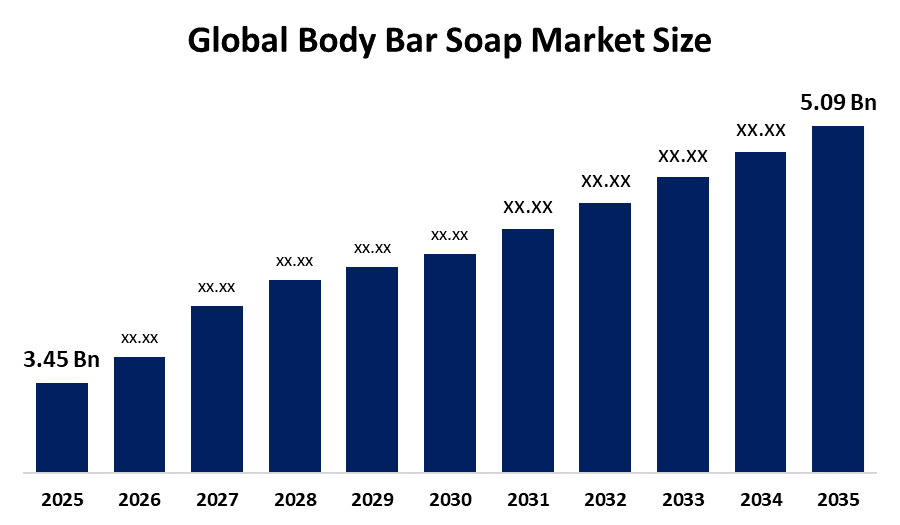
- The Global Body Bar Soap Market Size Was Estimated at USD 3.45 Billion in 2025
- The Market Size is Expected to Grow at a CAGR of around 3.97% from 2026 to 2035
- The Worldwide Body Bar Soap Market Size is Expected to Reach USD 5.09 Billion by 2035
Get more details on this report -
Key Takeaways -
- North America dominated the market with the largest share in 2025.
- Asia Pacific is expected to grow the fastest during the forecast period.
- By material type, the synthetic segment dominates the body bar soap market, while the organic soap segment is the fastest growing segment in the market.
- By distribution channels, the supermarkets and hypermarkets segment is anticipated to hold the dominant share of about 35.0%; on the other hand, the online retail segment is emerging in the body bar soap market.
According to a research report published by Spherical Insights and Consulting, the Global Body Bar Soap Market size was worth around USD 3.45 Billion in 2025 and is predicted to grow to around USD 5.09 Billion by 2035 with a compound annual growth rate (CAGR) of 3.97% from 2026 and 2035. The market for body bar soap has a number of opportunities to grow due to its sustainability profile and shift towards premium, multi-functional formulations.
Key Trends in Body Bar Soap Market –
- Demand for plastic-free, eco-friendly packaging
- Multifunctional bars offering exfoliation or heavy moisturizing
- Increase trend of men’s grooming and e-commerce growth
Market Overview
The global body bar soap industry is the market inclining towards “skin health” and premium experiences, with products often containing shea butter and coconut oil for moisturizing properties. Body bar soap is a solid cleansing product designed to remove dirt, sweat, and oils from the skin, often made through saponification, which is a chemical reaction between fats/oils and a base. Unlike liquid body wash, bars are generally more concentrated, eco-friendly, with minimal packaging, and last longer.
Innovation and market expansion are anticipated as a result of major players' growing R&D expenditures and expanding partnerships. For instance, in June 2025, Unilever announced it had signed an agreement to acquire personal care brand Dr. Squatch from growth equity firm Summit Partners.
Report Coverage
This research report categorizes the body bar soap market based on various segments and regions, forecasts revenue growth, and analyzes trends in each submarket. The report analyses the key growth drivers, opportunities, and challenges influencing the body bar soap market. Recent market developments and competitive strategies such as expansion, type launch, development, partnership, merger, and acquisition have been included to draw the competitive landscape in the market. The report strategically identifies and profiles the key market players and analyses their core competencies in each sub-segment of the body bar soap market.
Global Body Bar Soap Market Report Coverage
| Report Coverage | Details |
|---|---|
| Base Year: | 2025 |
| Market Size in 2025: | USD 3.45 Billion |
| Forecast Period: | 2025 - 2035 |
| Forecast Period CAGR 2025 - 2035 : | CAGR of 3.97% |
| 2035 Value Projection: | USD 5.09 billion |
| Historical Data for: | 2020-2024 |
| No. of Pages: | 220 |
| Tables, Charts & Figures: | 110 |
| Segments covered: | By Material Type, By Distribution Channel |
| Companies covered:: | Unilever, Procter & Gamble, Colgate-Palmolive, Henkel, Beiersdorf AG, Johnson & Johnson, Reckitt Benckiser Group, Godrej Consumer Products Limited, COW Company, Woods Naturals, Beaumont Products, Bronners, Kimberly Clark, and Others |
| Pitfalls & Challenges: | COVID-19 Empact, Challenges, Future, Growth, & Analysis |
Get more details on this report -
Driving Factors
Growing awareness about personal hygiene and skin health
Increased awareness of personal hygiene and skin health is expected to drive the body bar soap market. For instance, DHSK College organized awareness talk on skin health and hygiene in April 2026, in collaboration with the Department of Philosophy and Illumis Aesthetic Clinic, to raise awareness about proper skin care, hygiene, and overall well-being among students and faculty members.
Natural products trend
Replacing body wash with a bar of soap is one of the easiest swaps for safer skincare and sustainability. Some brands have developed all-natural, non-toxic and organic bar soap brands packed with skin-nourishing ingredients and don’t contain any harmful chemicals. Further, products made from plant-based ingredients are formulated using organic farming practices, ensuring that the raw materials are cultivated without the use of harmful pesticides or fertilizers. Consumers' increased awareness about the harmful effects of synthetic ingredients on health and the environment, along with prioritization towards eco-friendly and sustainable personal care products, is driving the market growth.
Restraining Factors
Availability of substitute products
Bar soap substitutes like handwash and sanitizers, especially during the period of the COVID-19 pandemic, are restraining the market demand. Further, increased raw material prices and the presence of harmful content like sodium lauryl sulfate hamper its adoption, which may result in restraining the market growth.
Market Segmentation
The Body Bar Soap Market share is classified into material type and distribution channels.
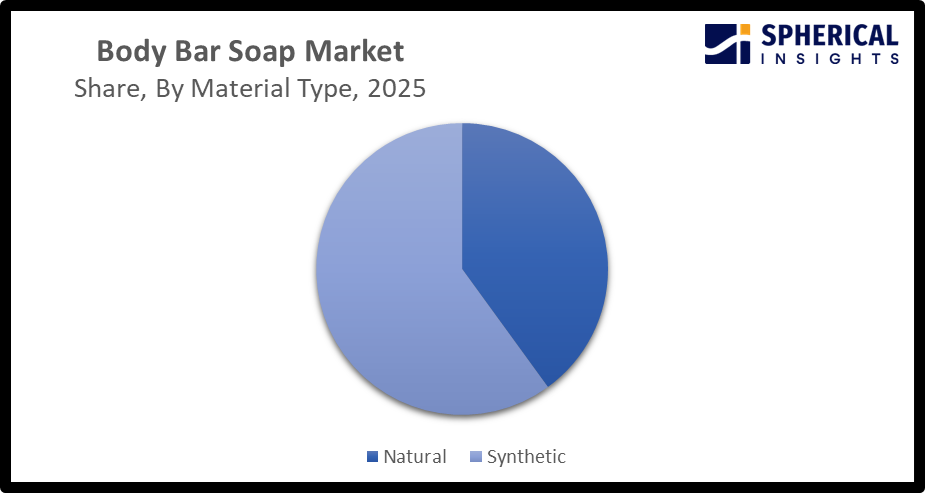
- The synthetic segment dominated the market with the largest share of about 60.0% in 2025 and is projected to grow at a substantial CAGR during the forecast period.
Based on the material type, the body bar soap market is divided into natural and synthetic. Among these, the synthetic segment dominated the market with the largest share of about 60.0% in 2025 and is projected to grow at a substantial CAGR during the forecast period. This is because many conventional soaps closely resemble synthetic detergents more than time-tested traditional soap recipes. Skipping the traditional saponification process, conventional soap relies on a blend of synthetic detergents produced with petrochemicals, along with artificial dyes, synthetic fragrances, and phthalates. While the organic segment is the fastest-growing segment in the body bar soap market, due to changing consumer behavior patterns for beauty and personal care.
Get more details on this report -
- The supermarkets and hypermarkets segment accounted for the dominant market share of about 35.0% in 2025 and is projected to grow at a substantial CAGR during the forecast period.
Based on the distribution channels, the body bar soap market is divided into online retail, supermarkets and hypermarkets, specialty stores, pharmacy outlets, beauty stores, and direct sales. Among these, the supermarkets and hypermarkets segment accounted for the dominant market share of about 35.0% in 2025 and is projected to grow at a substantial CAGR during the forecast period. Extensive reach, convenience, and the ability to offer a wide variety of brands under one roof in supermarkets and hypermarkets are responsible for driving the market. The segment enables physical assess to product quality and comparing it with other products. Further, the online retail segment is a growing segment driven by a preference for online purchasing with the upsurging awareness of e-commerce and the increasing number of internet users.
Regional Segment Analysis of the Body Bar Soap Market
- North America (U.S., Canada, Mexico)
- Europe (Germany, France, U.K., Italy, Spain, Rest of Europe)
- Asia-Pacific (China, Japan, India, Rest of APAC)
- South America (Brazil and the Rest of South America)
- The Middle East and Africa (UAE, South Africa, Rest of MEA)
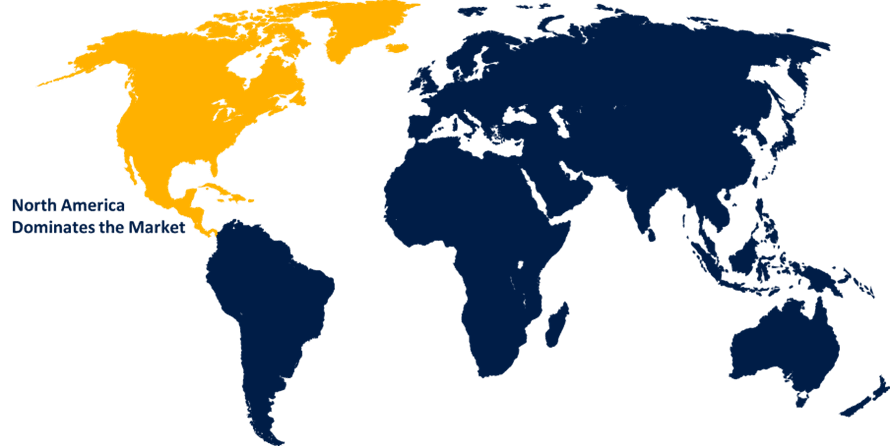
North America is anticipated to hold the largest share of the Body Bar Soap market over the predicted timeframe.
North America is anticipated to hold the largest share of about 30.0% in the Body Bar Soap market over the predicted timeframe. The market ecosystem in North America is strong, due to increasing consumer demand for formulations free from parabens, sulfates, and artificial fragrances. The demand for body bar soaps has been driven by the region's commercial spaces like shopping malls, food courts, showrooms, and others. The U.S. is leading the North America body bar soap market, due to the consumer changing inclination towards natural and sustainable products.
Get more details on this report -
Asia Pacific is expected to grow at a rapid CAGR of approximately 5.5% in the Body Bar Soap market during the forecast period. The Asia Pacific area has a thriving market for body bar soaps due to rapid urbanization, growing population, and the region’s increasing disposable incomes, fueling demand for premium/natural products. China is a dominant country, while India is growing at the fastest rate within the Asia Pacific region. High hygiene awareness, rapid urbanization, and strong pivot towards premium, natural, and specialized formulations are propelling the body bar soap market in the region.
Competitive Analysis:
The report offers the appropriate analysis of the key organizations/companies involved within the body bar soap market, along with a comparative evaluation primarily based on their type of offering, business overviews, geographic presence, enterprise strategies, segment market share, and SWOT analysis. The report also provides an elaborative analysis focusing on the current news and developments of the companies, which includes type development, innovations, joint ventures, partnerships, mergers & acquisitions, strategic alliances, and others. This allows for the evaluation of the overall competition within the market.
List of Key Companies
- Unilever
- Procter & Gamble
- Colgate-Palmolive
- Henkel
- Beiersdorf AG
- Johnson & Johnson
- Reckitt Benckiser Group
- Godrej Consumer Products Limited
- COW Company
- Woods Naturals
- Beaumont Products
- Bronners
- Kimberly Clark
- Others
Key Target Audience
- Market Players
- Investors
- End-users
- Government Authorities
- Consulting And Research Firm
- Venture capitalists
- Value-Added Resellers (VARs)
Recent Development
In September 2025, Lifebuoy, Hindustan Unilever Limited's trusted soap brand, continues its transformation from a hygiene icon to a skin protection essential with the launch of its on-ground 'Skinvestigator' event.
In September 2025, Mitchell Family Office, the distinguished Michigan-based private investment firm, announced the strategic acquisition of CosBar, the iconic multi-brand beauty retailer, for an undisclosed amount.
Market Segment
This study forecasts revenue at global, regional, and country levels from 2020 to 2035. Spherical Insights has segmented the Body Bar Soap Market based on the below-mentioned segments:
Global Body Bar Soap Market, By Material Type
- Natural
- Synthetic
Global Body Bar Soap Market, By Distribution Channel
- Online Retail
- Supermarkets and Hypermarkets
- Specialty Stores
- Pharmacy Outlets
- Beauty Stores
- Direct Sales
Global Body Bar Soap Market, By Regional Analysis
- North America
- US
- Canada
- Mexico
- Europe
- Germany
- UK
- France
- Italy
- Spain
- Russia
- Rest of Europe
- Asia Pacific
- China
- Japan
- India
- South Korea
- Australia
- Rest of Asia Pacific
- South America
- Brazil
- Argentina
- Rest of South America
- Middle East & Africa
- UAE
- Saudi Arabia
- Qatar
- South Africa
- Rest of the Middle East & Africa
Frequently Asked Questions (FAQ)
-
1. What is the market size of the body bar soap market?The global body bar soap market size is expected to grow from USD 3.45 Billion in 2025 to USD 5.09 Billion by 2035, at a CAGR of 3.97% during the forecast period 2026-2035.
-
2. Which region holds the largest share of the body bar soap market?North America is anticipated to hold the largest share of the body bar soap market over the predicted timeframe.
-
3. What is the forecasted CAGR of the Global Body Bar Soap Market from 2025 to 2035?The market is expected to grow at a CAGR of around 3.97% during the period 2026–2035.
-
4. Who are the top companies that are involved in the Global Body Bar Soap Market?Key players include Unilever, Procter & Gamble, Colgate-Palmolive, Henkel, Beiersdorf AG, Johnson & Johnson, Reckitt Benckiser Group, Godrej Consumer Products Limited, COW Company, Dr. Woods Naturals, Beaumont Products, Dr. Bronners, and Kimberly Clark.
-
5. What are the main drivers in the body bar soap market?A growing awareness about personal hygiene and skin health, and natural product trends, are major market growth drivers of the body bar soap market.
-
6. What challenges are limiting the adoption of body bar soap?Factors like the availability of the product’s substitutes remain key restraint in the body bar soap market.
-
7. What are the key trends in the body bar soap market?The demand for plastic-free, eco-friendly packaging, multifunctional bars offering exfoliation or heavy moisturizing, and the increasing trend of men’s grooming and e-commerce growth are major key trends in the body bar soap market.
Need help to buy this report?