Global Blood Collection Tubes Market Size, Share, and COVID-19 Impact Analysis, By Material Type (Plastic, Glass, and Coated), By Additive Type (EDTA, Sodium Citrate, and Serum Separator), By Application (Clinical Diagnostics, Blood Banking, and Research), and By Region (North America, Europe, Asia-Pacific, Latin America, Middle East, and Africa), Analysis and Forecast 2025 - 2035
Industry: Healthcare
Global Blood Collection Tubes Market Insights Forecasts to 2035
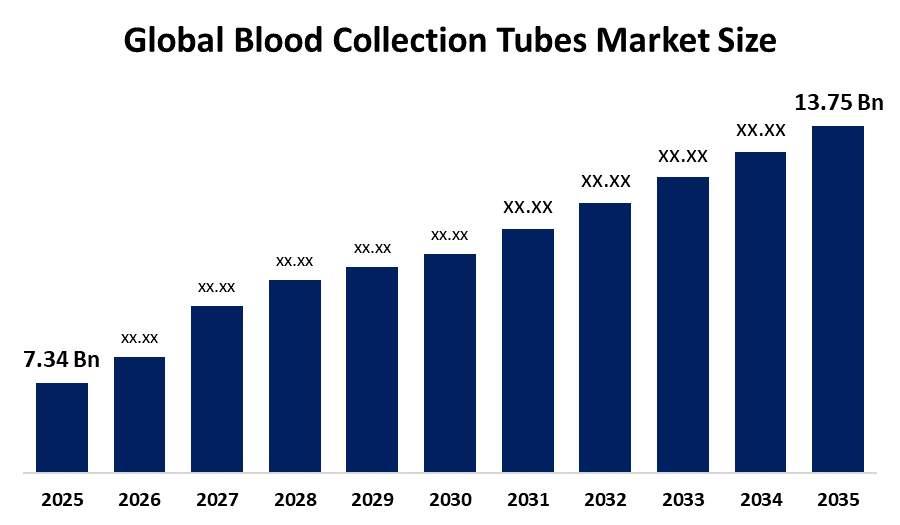
- The Global Blood Collection Tubes Market Size Was Estimated at USD 7.34 Billion in 2025
- The Market Size is Expected to Grow at a CAGR of around 6.48% from 2026 to 2035
- The Worldwide Blood Collection Tubes Market Size is Expected to Reach USD 13.75 Billion by 2035
Get more details on this report -
Key Takeaways -
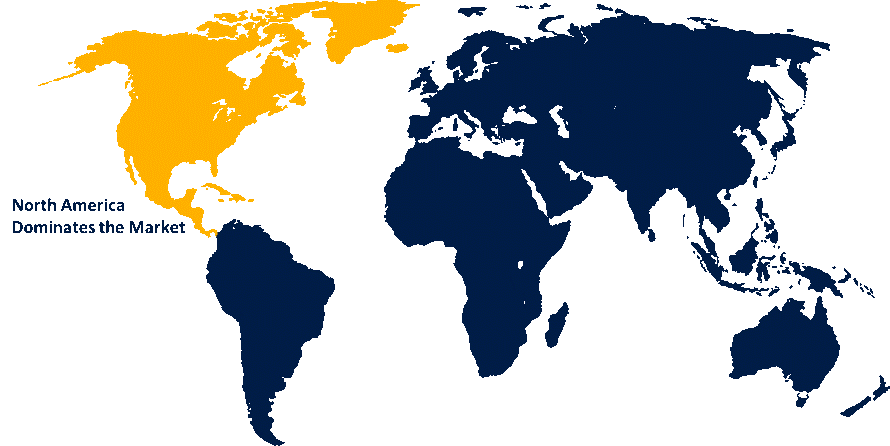
- North America dominated the market with the largest share in 2025.
- Asia Pacific is expected to grow the fastest during the forecast period.
- By material type, the plastic segment dominates the blood collection tubes market, while the glass segment is the emerging segment in the market.
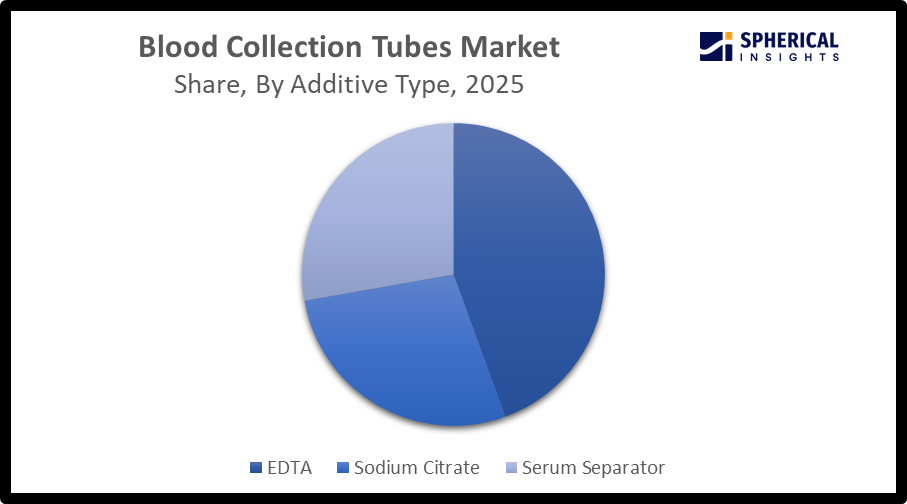
- By additive type, the EDTA segment is anticipated to hold the dominant share, on the other hand, the sodium citrate segment is growing at the fastest rate in the blood collection tubes market.
- By application, the clinical diagnostics segment is expected to hold the dominant share, while the blood banking segment is emerging in the market during the forecast period.
According to a research report published by Spherical Insights and Consulting, the Global Blood Collection Tubes Market size was worth around USD 7.34 Billion in 2025 and is predicted to grow to around USD 13.75 Billion by 2035 with a compound annual growth rate (CAGR) of 6.48% from 2026 and 2035. The market for blood collection tubes has a number of opportunities to grow due to the increasing point-of-care and home-based testing, development of specialized tubes for molecular diagnostics, laboratory automation compatibility, adoption of smart, barcoded tubes for sample tracking, and expansion in emerging markets. An increasing diagnostic demand, a growing ageing population, and high chronic disease prevalence are propelling the blood collection tubes market.
Key Trends in Blood Collection Tubes Market –
- Inclination towards vacuum-based, plastic tubes
- Use of sustainable/eco-friendly materials
- Growth in automation, safety-engineered products
Market Overview
The global blood collection tubes industry refers to a vital medical sector centered on producing sterile plastic or glass tubes that are used for the collection, storage, and transportation of blood samples for laboratory testing. Blood collection tubes are specialized, color-coded, vacuum, or non-vacuum containers used for blood collection, containing specific additives to prepare samples for diagnostic tests (e.g., EDTA for CBC, Sodium Citrate for coagulation), ensuring sterile, precise, and efficient blood drawing for laboratory analysis.
Innovation and market expansion are anticipated as a result of major players' growing R&D expenditures and expanding partnerships. For instance, in September 2024, Kriya Medical Technologies, headquartered in Chennai, launched the ICHOR Medical Molding System, a fully automated manufacturing system designed to produce 250 million blood collection tubes each year.
Report Coverage
This research report categorizes the blood collection tubes market based on various segments and regions, forecasts revenue growth, and analyzes trends in each submarket. The report analyses the key growth drivers, opportunities, and challenges influencing the blood collection tubes market. Recent market developments and competitive strategies such as expansion, type launch, development, partnership, merger, and acquisition have been included to draw the competitive landscape in the market. The report strategically identifies and profiles the key market players and analyses their core competencies in each sub-segment of the blood collection tubes market.
Driving Factors
Increasing number of surgeries and ageing population
Detecting blood clotting (coagulation) during and after surgery is critical for managing bleeding risks and preventing thrombosis. It was estimated that approximately 310 million major surgeries are performed worldwide each year, with 40-50 million in the USA and 20 million in Europe. Further, the significantly growing aging population is driving the demand for surgical services, enhancing the need for developing strategies for managing an increased workload without sacrificing quality of care, which ultimately aids in driving the market demand. For instance, according to the US Census Bureau, the domestic population would increase 7.9% by 2010, and 17.0% by 2020. The fastest growing segment of this population consists of individuals over the age of 65%, their numbers are expected to increase 13.3% by 2010 and 53.2% by 2020.
Investment in healthcare infrastructure and advancement in device production
An increasing investment in healthcare infrastructure in diagnostic laboratories, especially in the emerging economies, is driving the growth of the blood collection tubes market. Driven by automation, increasing chronic disease rates, and demand for safe, standardized sample collection, market expansion occurs. Furthermore, advancements in the production of blood collection tubes are focused on enhancing automation, improving sample integrity and safety, and smart technology integration. The blood collection tube sector is providing opportunities for manufacturers and entrepreneurs to seek scalable production and long-term profitability in a high-demand healthcare market, due to developments in tube materials and vacuum technology.
Restraining Factors
Dearth of skilled workforce and increased cost of the equipment
The shortage of skilled healthcare professionals (including phlebotomists and lab technicians) and the increased cost of advanced blood collection equipment are restraining the blood collection tube market.
Market Segmentation
The Blood Collection Tubes Market share is classified into material type, additive type, and application.
- The plastic segment dominated the market in 2025 and is projected to grow at a substantial CAGR during the forecast period.
Based on the material type, the blood collection tubes market is divided into plastic, glass, and coated. Among these, the plastic segment dominated the market in 2025 and is projected to grow at a substantial CAGR during the forecast period. This is due to its superior safety, being shatter-resistant and lightweight, and reduced breakage risk. Plastic blood collection tubes are an economical option and safer to use owing to their increased durability and flexibility, making them less likely to break during storage and transportation. While the glass segment is the emerging segment in the blood collection tubes market, due to its chemical inertness, optical clarity, superior resistance to temperature, and compatibility with a wide range of samples and additives.
- The EDTA segment accounted for the dominant market share in 2025 and is projected to grow at a substantial CAGR during the forecast period.
Based on the additive type, the blood collection tubes market is divided into EDTA, sodium citrate, and serum separator. Among these, the EDTA segment accounted for the dominant market share in 2025 and is projected to grow at a substantial CAGR during the forecast period. The increasing focus on accurate and reliable blood testing in hospitals, clinics, and research institutions contributes to driving the segmental market growth. EDTA (Ethylenediaminetetraacetic acid) blood collection tubes are essential, typically lavender-topped, medical devices used in hematology to prevent blood from clotting by chelating calcium ions. Further, the sodium citrate segment is the fastest-growing segment, driven by its use in most coagulation assays, including PT and aPTT tests.
Get more details on this report -
- The clinical diagnostics segment accounted for the largest market share in 2025 and is projected to grow at a substantial CAGR during the forecast period.
Based on the application, the blood collection tubes market is divided into clinical diagnostics, blood banking, and research. Among these, the clinical diagnostics segment accounted for the largest market share in 2025 and is projected to grow at a substantial CAGR during the forecast period. This is due to its primary application for immediate, routine, and specialized testing, ensuring sample stability. Blood collection tube is increasing used in hospitals and laboratories for disease diagnosis and patient management. On the other hand, the blood banking segment is emerging in the blood collection tubes market, owing to efficient blood storage and transfusion in the healthcare sector.
Regional Segment Analysis of the Blood Collection Tubes Market
- North America (U.S., Canada, Mexico)
- Europe (Germany, France, U.K., Italy, Spain, Rest of Europe)
- Asia-Pacific (China, Japan, India, Rest of APAC)
- South America (Brazil and the Rest of South America)
- The Middle East and Africa (UAE, South Africa, Rest of MEA)
North America is anticipated to hold the largest share of the Blood Collection Tubes market over the predicted timeframe.
Get more details on this report -
North America is anticipated to hold the largest share of about 50.0% in the blood collection tubes market over the predicted timeframe. The market ecosystem in North America is strong due to the integration of advanced blood collection technologies by the manufacturers. Further, the region’s advanced healthcare infrastructure and diagnostic procedures contribute to propelling the region’s blood collection tubes market. The U.S. is leading the North America blood collection tubes market, accounting for nearly 45-50% region’s share, due to increasing government initiatives, geriatric population, and prevalence of chronic diseases.
Asia Pacific is expected to grow at a rapid CAGR of approximately 5.5% in the blood collection tubes market during the forecast period. The Asia Pacific area has a thriving market for Blood Collection Tubes due to the increasing prevalence of chronic disease, rising diagnostic testing and healthcare infrastructure expansion. Due to government support for creating awareness about medications, blood donation, and personalizing medications, the market is expected to grow. China is the leading country in the region’s market, owing to persistent R&D initiatives and technology-focused investments.
Competitive Analysis:
The report offers the appropriate analysis of the key organizations/companies involved within the blood collection tubes market, along with a comparative evaluation primarily based on their type of offering, business overviews, geographic presence, enterprise strategies, segment market share, and SWOT analysis. The report also provides an elaborative analysis focusing on the current news and developments of the companies, which includes type development, innovations, joint ventures, partnerships, mergers & acquisitions, strategic alliances, and others. This allows for the evaluation of the overall competition within the market.
List of Key Companies
- Becton, Dickinson & Company
- Greiner Bio-One International GmbH
- Terumo Corporation
- Sarstedt AG & Co. KG
- Qiagen N.V.
- Medical Srl
- AdvaCare Pharma
- Narang Medical Limited
- Hindustan Syringes & Medical Devices Ltd
- DWK Life Sciences (Wheaton)
- RAM Scientific Inc.
- Nipro Medical Corporation
- Sekisui Medical Co., Ltd.
- Medtronic plc
- Others
Key Target Audience
- Market Players
- Investors
- End-users
- Government Authorities
- Consulting And Research Firm
- Venture capitalists
- Value-Added Resellers (VARs)
Recent Development
- In February 2026, Q-Sera Pty Ltd, an Australian venture-backed company, announced the first product launch of its patented evacuated blood collection technology, with the launch by Japanese medical device company, Terumo Corporation, of its VenoJect II RAPClotTM blood collection tubes in the Japanese market.
- In March 2025, Vitestro, a pioneer in medical robotics, proudly reveals the name of its autonomous blood drawing device: Aletta, the first autonomous robotic device designed to perform automated blood draws with unparalleled precision and consistency.
- In September 2024, Kriya Medical Technologies, headquartered in Chennai, launched the ICHOR Medical Molding System, a fully automated manufacturing system designed to produce 250 million blood collection tubes each year.
- In May 2023, Angamaly, Kerala-based CML Biotech, one of the largest manufacturers of blood collection tubes in India, installed the world's first integrated machine, HUSKY-ICHOR, for manufacturing blood collection tubes.
Market Segment
This study forecasts revenue at global, regional, and country levels from 2020 to 2035. Spherical Insights has segmented the Blood Collection Tubes Market based on the below-mentioned segments:
Global Blood Collection Tubes Market, By Material Type
- Plastic
- Glass
- Coated
Global Blood Collection Tubes Market, By Additive Type
- EDTA
- Sodium Citrate
- Serum Separator
Global Blood Collection Tubes Market, By Application
- Clinical Diagnostics
- Blood Banking
- Research
Global Blood Collection Tubes Market, By Regional Analysis
- North America
- US
- Canada
- Mexico
- Europe
- Germany
- UK
- France
- Italy
- Spain
- Russia
- Rest of Europe
- Asia Pacific
- China
- Japan
- India
- South Korea
- Australia
- Rest of Asia Pacific
- South America
- Brazil
- Argentina
- Rest of South America
- Middle East & Africa
- UAE
- Saudi Arabia
- Qatar
- South Africa
- Rest of the Middle East & Africa
Frequently Asked Questions (FAQ)
-
1. What is the market size of the blood collection tubes market?The global blood collection tubes market size is expected to grow from USD 7.34 Billion in 2025 to USD 13.75 Billion by 2035, at a CAGR of 6.48% during the forecast period 2026-2035.
-
2. Which region holds the largest share of the blood collection tubes market?North America is anticipated to hold the largest share of the blood collection tubes market over the predicted timeframe.
-
3. What is the forecasted CAGR of the Global Blood Collection Tubes Market from 2025 to 2035?The market is expected to grow at a CAGR of around 6.48% during the period 2026–2035.
-
4. Who are the top companies that are involved in the Global Blood Collection Tubes Market?Key players include Becton, Dickinson & Company, Greiner Bio-One International GmbH, Terumo Corporation, Sarstedt AG & Co. KG, Qiagen N.V., Medical Srl, AdvaCare Pharma, Narang Medical Limited, Hindustan Syringes & Medical Devices Ltd, DWK Life Sciences (Wheaton), RAM Scientific Inc., Nipro Medical Corporation, Sekisui Medical Co., Ltd., and Medtronic plc.
-
5. What are the main drivers in the blood collection tubes market?An increasing number of surgeries, ageing population, investment in healthcare infrastructure and advancement in device production, are major market growth drivers of the Blood Collection Tubes market.
-
6. What challenges are limiting the adoption of Blood Collection Tubes?Factors like dearth of skilled workforce and increased equipment cost remain key restraints in the blood collection tubes market.
-
7. What are the key trends in the blood collection tubes market?The inclination towards vacuum-based, plastic tubes, use of sustainable/eco-friendly materials, growth in automation, and safety-engineered products are major key trends in the blood collection tubes market.
Need help to buy this report?