Global Big Data Analytics In Telecom Market Size, Share, By Analytics (Descriptive Analytics, Diagnostic Analytics, Predictive Analytics, and Prescriptive Analytics), By Deployment (On-Premises and Cloud), By End User (Telecom Service Providers, Internet Service Providers, Mobile Virtual Network Operators, and Others), and By Region (North America, Europe, Asia-Pacific, Latin America, Middle East, and Africa), Analysis and Forecast 2025 - 2035.
Industry: Electronics, ICT & Media
Global Big Data Analytics In Telecom Market Insights and Forecasts to 2035
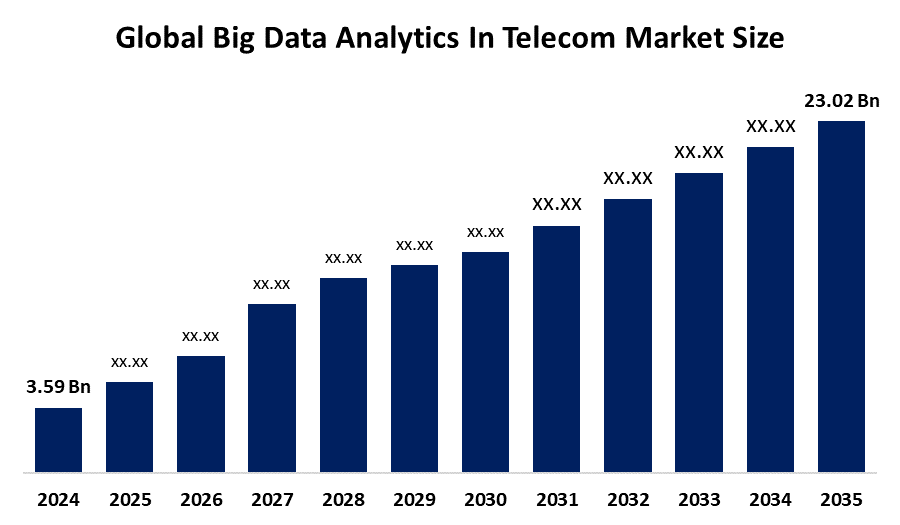
- The Global Big Data Analytics In Telecom Market Size Was Estimated at USD 3.59 Billion in 2024
- The Market Size is Expected to Grow at a CAGR of around 18.4% from 2025 to 2035
- The Worldwide Big Data Analytics In Telecom Market Size is Expected to Reach USD 23.02 Billion by 2035
- Asia Pacific is expected to grow the fastest during the forecast period.
Get more details on this report -
According to a research report published by Spherical Insights and Consulting, the global big data analytics in telecom market size was worth around USD 3.59 billion in 2024 and is predicted to grow to around USD 23.02 billion by 2035 with a compound annual growth rate (CAGR) of 18.4% from 2025 to 2035. Global expansion of AI and ML, rapid growth of IoT devices generates huge amounts of real-time data, need for advanced analytics, and deployment of 5G networks enhances data speed and connectivity, are all driving opportunities in big data analytics in the telecom market.
Market Overview
Big data analytics in the telecom market refers to the process of collecting, processing, and analyzing vast volumes of structured and unstructured data generated from network operations, customer interactions, call records, and connected devices to derive actionable insights. Telecommunication companies use data mining, predictive analytics, artificial intelligence, machine learning and real-time data processing technologies to achieve better network performance, improved customer service, decreased customer churn, fraud detection, and effective pricing optimization. The field generates opportunities for businesses through personalized service delivery, resource allocation efficiency and creation of new revenue streams from data-based services and decision-making capabilities based on intelligence.
The government establishes data protection laws that protect user privacy and cybersecurity while backing 5G digital infrastructure development and advancing telecom sector innovation through policies that support advanced analytics adoption. For instance, in February 2026, the Government of India approved the India AI Mission with a budget of around INR 10,300+ crore over five years. This is one of the largest central government programs focused on building AI, big data analytics, and compute infrastructure accessible to startups, researchers, and public institutions.
In May 2025, China's Action Plan for Digital China Development implements its digital economy development policy through the establishment of a national data market system, expansion of artificial intelligence technologies and their practical uses, achievement of more than 300 EFLOPS computing capabilities, and the development of data infrastructure together with analytical systems for all industry sectors which include telecommunications.
Report Coverage
This research report categorizes the big data analytics in telecom market based on various segments and regions, forecasts revenue growth, and analyzes trends in each submarket. The report analyses the key growth drivers, opportunities, and challenges influencing the big data analytics in telecom market. Recent market developments and competitive strategies, such as expansion, product launch, development, partnership, merger, and acquisition, have been included to draw the competitive landscape in the market. The report strategically identifies and profiles the key market players and analyses their core competencies in each sub-segment of the big data analytics in telecom market.
Global Big Data Analytics In Telecom Market Report Coverage
| Report Coverage | Details |
|---|---|
| Base Year: | 2024 |
| Market Size in 2024: | USD 3.59 Billion |
| Forecast Period: | 2025-2035 |
| Forecast Period CAGR 2025-2035 : | 18.4% |
| 2035 Value Projection: | USD 23.02 Billion |
| Historical Data for: | 2020-2023 |
| No. of Pages: | 220 |
| Tables, Charts & Figures: | 110 |
| Segments covered: | By Analytics, By End User |
| Companies covered:: | IBM Corporation, Oracle Corporation, Microsoft Corporation, Amazon Web Services, Google LLC, SAP SE, SAS Institute Inc., Huawei Technologies Co., Ltd., Cisco Systems, Inc., Teredata Corporation, Accenture PLC, Ericsson AB, Cloudera, Inc., Amdocs Inc., Nokia Corporation, Others |
| Pitfalls & Challenges: | COVID-19 Empact, Challenge, Future, Growth, & Analysis |
Get more details on this report -
Driving Factors
Rapid technological innovation is one of the main drivers of big data analytics in telecom market. The rapid expansion of smartphone usage, Internet of Things devices and digital services, together with 4G and 5G network expansion, leads to increased data creation. Artificial intelligence and machine learning developments enable users to analyze data more rapidly, while cloud computing delivers unlimited data storage and processing power. The rising need for personalized customer experiences, together with efficient network administration and immediate decision-making processes, drives system adoption. The requirement to identify fraudulent activities and minimize expenses and gain market superiority combined with government support for digital transformation and data infrastructure development, has driven the expansion of big data analytics in telecommunications.
In July 2023, the Telecom Regulatory Authority of India published its official recommendations about using Artificial Intelligence and Big Data in the telecommunications industry, which created a government-approved framework for controlling AI and big data implementation throughout the telecom sector.
Restraining Factors
High implementation and infrastructure costs, data privacy and security concerns, strict regulatory requirements, limited data usage, integration challenges with legacy systems, a shortage of skilled professionals, and managing and processing vast and complex data sets in real time are the main factors restricting the big data analytics in telecom market.
Market Segmentation
The big data analytics in telecom market share is classified into analytics, deployment, and end user.
- The predictive analytics segment dominated the market in 2024, approximately 34%, and is projected to grow at a substantial CAGR during the forecast period.
Based on the analytics, the big data analytics in telecom market is divided into descriptive analytics, diagnostic analytics, predictive analytics, and prescriptive analytics. Among these, the predictive analytics segment dominated the market in 2024, approximately 34%, and is projected to grow at a substantial CAGR during the forecast period. The most widely used and foundational form of analysis, easier to implement, cost-effective, and provides immediate insights that support daily operations and decision-making, and serves as the base for more advanced analytics, is driving the predictive analytics industry.
- The cloud segment accounted for the largest share in 2024, approximately 50%, and is anticipated to grow at a significant CAGR during the forecast period.
Based on the deployment, the big data analytics in telecom market is divided into on-premises and cloud. Among these, the cloud segment accounted for the largest share in 2024, approximately 50%, and is anticipated to grow at a significant CAGR during the forecast period. Massive cloud’s scalability, flexibility, and cost-effectiveness support real-time analytics, faster deployment, and easy integration with AI and machine learning tools, and process massive volumes of data without heavy upfront infrastructure investments, which is driving the cloud industry.
- The telecom service providers segment accounted for the highest market revenue in 2024, approximately 55%, and is anticipated to grow at a significant CAGR during the forecast period.
Based on the end user, the big data analytics in telecom market is divided into telecom service providers, internet service providers, mobile virtual network operators, and others. Among these, the telecom service providers segment accounted for the highest market revenue in 2024, approximately 55%, and is anticipated to grow at a significant CAGR during the forecast period. Provides enormous volumes of data from call records, network operations, and customer interactions, requiring advanced analytics to optimize network performance, reduce churn, detect fraud, and enhance customer experience, is bolstering the telecom service providers market.
Regional Segment Analysis of the Big Data Analytics In Telecom Market
- North America (U.S., Canada, Mexico)
- Europe (Germany, France, U.K., Italy, Spain, Rest of Europe)
- Asia-Pacific (China, Japan, India, Rest of APAC)
- South America (Brazil and the Rest of South America)
- The Middle East and Africa (UAE, South Africa, Rest of MEA)
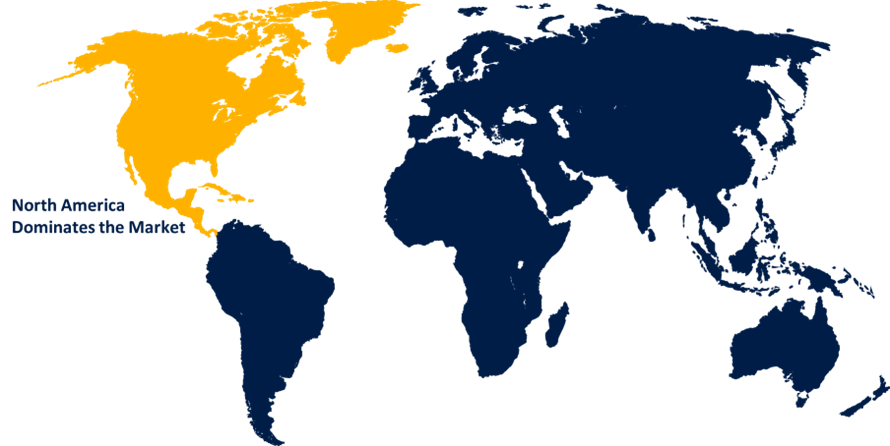
North America is anticipated to hold the largest share of the big data analytics in telecom market over the predicted timeframe.
Get more details on this report -
North America is anticipated to hold the largest share of the big data analytics in telecom market over the predicted timeframe. Strong government backing for advanced technological infrastructure and early adoption of digital innovation are what propel North America. The region, particularly the United States, has a numerous major telecom companies together with top technology firms, which drive the quick adoption of big data solutions. The market expansion receives additional support through substantial funding dedicated to artificial intelligence and machine learning and cloud computing technologies. The region experiences continuous data production because of its widespread smartphone and Internet of Things device adoption. North America maintains its leading position because of government support together with effective regulatory systems and industry-wide commitment to data-based decision making.
Government initiatives include the U.S. AI Strategy & Policy, supporting broad AI innovation and U.S. NSF government funding for AI research and analytics tool development. Canada’s Pan Canadian Artificial Intelligence Strategy with funding for AI research, commercialization, and compute capacity that industry can leverage and Canada’s Federal AI Strategy for Public Service initiative to embed AI responsibly across government systems and operations, enable the data, talent, and technology environment that telecom operators use for big data analytics.
Asia Pacific is expected to grow at a rapid CAGR in the big data analytics in telecom market during the forecast period. Countries like China, India, and Japan are witnessing significant growth in smartphone adoption, internet penetration, and mobile data usage, generating vast amounts of data for analysis. The growing need for inexpensive data services combined with the large number of available users drives this expansion. Governments are actively promoting digital initiatives and smart city projects, which lead telecom operators to implement advanced analytics solutions. The telecom companies of the region work to better customer experience while decreasing customer losses and improving their network performance which drives the demand for big data analytics solutions, making Asia-Pacific the fastest-growing region.
Government launches include Goa AI Mission 2027, July 2025, which focus on AI adoption, governance, and innovation hubs, Japan’s Digital Agency’s Priority Plan for a Digital Society, June 2025, establishes national data governance, interoperability, and infrastructure strategies to enhance data usage and analytics capabilities, and Singapore’s, Smart Nation initiative and Smart Nation 2.0 drive nationwide digital transformation, IoT adoption, and open data platforms that feed analytics ecosystems, strengthen AI, big data, and digital ecosystems that indirectly support telecom analytics .
Competitive Analysis:
The report offers the appropriate analysis of the key organizations/companies involved within the big data analytics in telecom market, along with a comparative evaluation primarily based on their product of offering, business overviews, geographic presence, enterprise strategies, segment market share, and SWOT analysis. The report also provides an elaborative analysis focusing on the current news and developments of the companies, which includes product development, innovations, joint ventures, partnerships, mergers & acquisitions, strategic alliances, and others. This allows for the evaluation of the overall competition within the market.
List of Key Companies
- IBM Corporation
- Oracle Corporation
- Microsoft Corporation
- Amazon Web Services
- Google LLC
- SAP SE
- SAS Institute Inc.
- Huawei Technologies Co., Ltd.
- Cisco Systems, Inc.
- Teredata Corporation
- Accenture PLC
- Ericsson AB
- Cloudera, Inc.
- Amdocs Inc.
- Nokia Corporation
- Others
Key Target Audience
- Market Players
- Investors
- End-users
- Government Authorities
- Consulting and Research Firm
- Venture capitalists
- Value-Added Resellers (VARs)
Recent Development
- In March 2026, Snowflake introduced Project SnowWork as its research preview which operates as an autonomous enterprise AI platform that connects AI agents with daily business operations to manage planning and analysis work and multiple data processing tasks by understanding user commands in natural language. The move makes it easier for business users to generate insights and execute tasks based on enterprise data.
- In November 2025, Verizon has established a strategic partnership with AWS to develop high capacity, low-latency fibre networks that will link AWS data centers for improved support of artificial intelligence applications and analytics processing. The telecom industry has gained new advantages through this development which enhances data transfer capabilities and increases the operational capacity of AI-based analytics systems.
- In October 2025, Airtel announced a partnership with IBM to integrate AI ready cloud infrastructure and analytics-friendly compute resources into its cloud platform. The system improves data processing capabilities while supporting analytics work in regulated industries, which leads to better big data handling for telecom services.
- In October 2025, Airtel officially declared its strategic alliance with Google to create India's first major artificial intelligence research facility and data center which will be built in Visakhapatnam. The investment funds research efforts in artificial intelligence and develops infrastructure for processing large data sets, which will enhance the telecom industry by providing improved computing power and advanced data analysis capabilities.
- In August 2025, Airtel's digital business unit Xtelify introduced its sovereign telecommunications-grade cloud platform Airtel Cloud, together with an artificial intelligence software suite that helps telecom companies and enterprises manage big data operations and optimize their workforce, handle data and interact with customers. The platform provides telecommunication companies with tools to utilize their data resources and AI technology for better service delivery and operational performance.
Market Segment
This study forecasts revenue at global, regional, and country levels from 2020 to 2035. Spherical Insights has segmented the big data analytics in telecom market based on the below-mentioned segments:
Global Big Data Analytics In Telecom Market, By Analytics
- Descriptive Analytics
- Diagnostic Analytics
- Predictive Analytics
- Prescriptive Analytics
Global Big Data Analytics In Telecom Market, By Deployment
- On-Premises
- Cloud
Global Big Data Analytics In Telecom Market, By End User
- Telecom Service Providers
- Internet Service Providers
- Mobile Virtual Network Operators
- Other
Global Big Data Analytics In Telecom Market, By Regional Analysis
- North America
- US
- Canada
- Mexico
- Europe
- Germany
- UK
- France
- Italy
- Spain
- Russia
- Rest of Europe
- Asia Pacific
- China
- Japan
- India
- South Korea
- Australia
- Rest of Asia Pacific
- South America
- Brazil
- Argentina
- Rest of South America
- Middle East & Africa
- UAE
- Saudi Arabia
- Qatar
- South Africa
- Rest of the Middle East & Africa
Frequently Asked Questions (FAQ)
-
1. What technologies do telecom big data analytics solutions support?Big data analytics in telecom leverages technologies like AI and machine learning, predictive analytics, network traffic analysis, real-time streaming analytics, cloud computing, edge analytics, and IoT integration to optimize network performance, enhance customer experience, and reduce operational costs.
-
2. What data sources are analyzed in telecom big data?Telecom analytics processes Call Detail Records, network performance metrics, subscriber data, social media and customer feedback, IoT device data, and service usage logs to provide insights for network optimization, targeted marketing, and predictive maintenance.
-
3. What is the role of real-time analytics in telecom?Real-time analytics enables operators to monitor network performance, detect anomalies, and respond to faults immediately, ensuring high service quality, low latency, and efficient allocation of network resources.
-
4. What is network traffic analytics in telecom?Network traffic analytics examines patterns in data flow, congestion points, and bandwidth utilization, allowing telecom providers to predict peak demand, optimize routing, and improve Quality of Service before customer experience is affected.
-
5. What industries benefit from telecom big data analytics?Industries including smart cities, autonomous vehicles, industrial IoT, healthcare, finance, and media & entertainment leverage telecom big data analytics to improve connectivity, enable real-time services, and drive personalized customer experiences.
-
6. What is the expected adoption timeline for big data analytics in telecom?Telecom operators globally are actively deploying big data analytics solutions in the 2020s, with widespread commercial adoption expected to reach maturity by the late 2020s, as 5G and AI-driven networks become mainstream.
Need help to buy this report?