Global Beverage Stabilizers Market Size, Share, By Product Type (Xanthan Gum, Pectin, Carrageenan, Gum Arabic, Guar Gum, and Emulsifiers), By Function (Thickening, Emulsification, and Suspension Stabilization), By Application (Fruit Drink, Carbonated Drink, Energy Drink, Alcoholic Drink, and Others), and By Region (North America, Europe, Asia-Pacific, Latin America, Middle East, and Africa), Analysis and Forecast 2025 - 2035
Industry: Food & Beverages
Global Beverage Stabilizers Market Insights and Forecasts to 2035
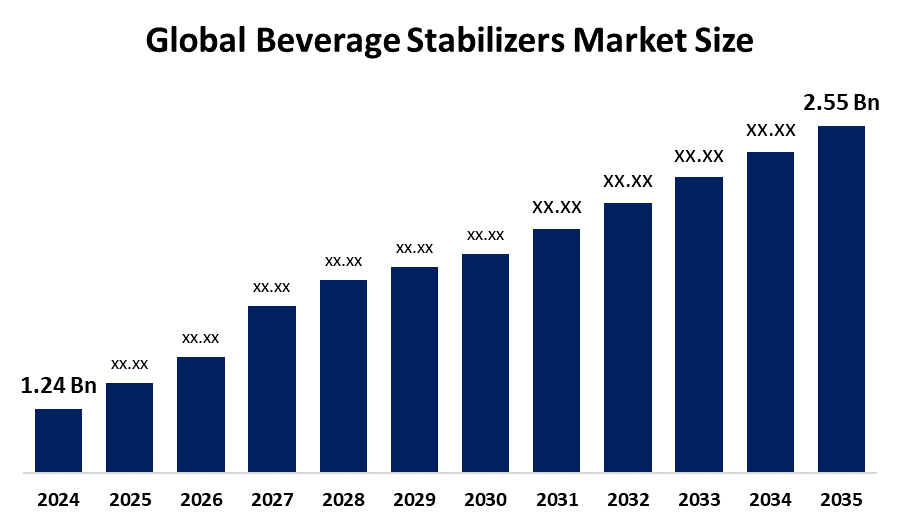
- The Global Beverage Stabilizers Market Size Was Estimated at USD 1.24 billion in 2024
- The Market Size is Expected to Grow at a CAGR of around 6.77% from 2025 to 2035
- The Worldwide Beverage Stabilizers Market Size is Expected to Reach USD 2.55 billion by 2035
- Middle East & Africa is expected to grow the fastest during the forecast period.
Get more details on this report -
According to a research report published by Spherical Insights, the global beverage stabilizers market size was worth around USD 1.24 billion in 2024 and is predicted to grow to around USD 2.55 billion by 2035 with a compound annual growth rate (CAGR) of 6.77% from 2025 to 2035. The global beverage stabilizers market is driven by rising demand for ready-to-drink beverages, increasing consumption of plant-based drinks, growing focus on product quality and shelf stability, and the expanding food and beverage industry globally.
Market Overview
The global beverage stabilizers market refers to ingredients used to maintain consistency, texture, and shelf stability in beverages by preventing separation and improving mouthfeel. The demand for functional drinks and plant-based beverages, together with clean-label products, drives market expansion. The market expansion is supported by increasing consumer demand for dairy alternatives and ready-to-drink products. The government establishes food safety standards, which lead to customers using certified stabilizing agents. In June 2024, Tate & Lyle announced an agreement to acquire CP Kelco for USD 1.8 billion, strengthening its capabilities in hydrocolloids, including pectin and specialty gums.
The current market trend shows a preference for natural stabilizers, which include plant-based ingredients that exist in pectin and guar gum. In October 2024, Jungbunzlauer commenced construction of a USD 150 million xanthan gum production facility in Port Colborne, Ontario, Canada. This facility, Canada's first for xanthan gum, will strengthen the supply chain for fermentation-derived ingredients and support the global beverage stabilizers market. The stability, taste, and nutritional value of products improve through technological advancements, which enhance product formulation and processing methods. The demand for advanced stabilizer solutions in various beverage categories increases through the combination of emerging market opportunities, low-calorie beverage innovation, and organic ingredient demand.
Report Coverage
This research report categorizes the global beverage stabilizers market based on various segments and regions, forecasts revenue growth, and analyzes trends in each submarket. The report analyses the key growth drivers, opportunities, and challenges influencing the global beverage stabilizers market. Recent market developments and competitive strategies, such as expansion, product launch, development, partnership, merger, and acquisition, have been included to draw the competitive landscape in the market. The report strategically identifies and profiles the key market players and analyzes their core competencies in each sub-segment of the beverage stabilizers market.
Global Beverage Stabilizers Market Report Coverage
| Report Coverage | Details |
|---|---|
| Base Year: | 2024 |
| Market Size in 2024: | USD 1.24 Billion |
| Forecast Period: | 2025-2035 |
| Forecast Period CAGR 2025-2035 : | 6.7% |
| 2035 Value Projection: | USD 2.55 Billion |
| Historical Data for: | 2020-2023 |
| No. of Pages: | 268 |
| Tables, Charts & Figures: | 114 |
| Segments covered: | By Product Type, By Function, By Application |
| Pitfalls & Challenges: | COVID-19 Impact, Challenges, Future, Growth, & Analysis |
Get more details on this report -
Driving Factors
The global beverage stabilizers market is primarily driven by the rising demand for ready-to-drink and convenience beverages across urban populations. People now prefer plant-based drinks and dairy-free alternatives, which increases the need for proper stabilizing solutions that can keep their texture and consistency. People now consume functional and fortified beverages because they want to improve their health, which creates more demand for such products. The food and beverage industry expansion, which occurs mainly in developing markets, has become a major factor that drives market growth. Manufacturers are now prioritizing clean-label ingredients, which leads to increased use of natural stabilizers that come from plant and microbial sources, thus driving market growth.
Restraining Factors
The global beverage stabilizers market faces limitations because the prices of raw materials, which are essential for the production process, create increased manufacturing expenses. The product approval process, together with its strict regulatory requirements, makes it difficult to bring new products to market. The growing preference of consumers for clean-label products restricts manufacturers from using artificial stabilizers. The technical difficulties in producing beverages with the needed texture and consistency and shelf stability lead to formulation problems, which prevent market expansion.
Market Segmentation
The global beverage stabilizers market share is classified into product type, function, and application.
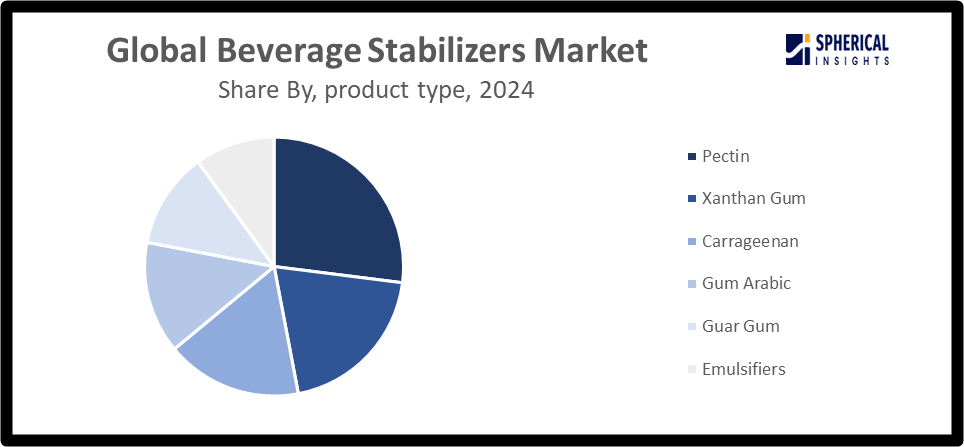
- The pectin segment accounted for the largest share in 2024, approximately 27%, and is anticipated to grow at a significant CAGR during the forecast period.
Based on the product type, the global beverage stabilizers market is divided into xanthan gum, pectin, carrageenan, gum arabic, guar gum, and emulsifiers. Among these, the pectin segment accounted for the largest share in 2024, approximately 27%, and is anticipated to grow at a significant CAGR during the forecast period. This is because pectin is derived from natural sources and aligns with clean-label trends. It offers excellent stability, texture, and mouthfeel in beverages. Its effectiveness in acidic and fruit-based drinks, along with increasing demand for plant-based and functional beverages, further supports its widespread adoption globally.
Get more details on this report -
- The thickening segment accounted for the highest market revenue in 2024, approximately 38%, and is anticipated to grow at a significant CAGR during the forecast period.
Based on the function, the global beverage stabilizers market is divided into thickening, emulsification, and suspension stabilization. Among these, the thickening segment accounted for the highest market revenue in 2024, approximately 38%, and is anticipated to grow at a significant CAGR during the forecast period. This is because thickening agents improve viscosity, texture, and mouthfeel, making beverages more appealing to consumers. They are essential in dairy, plant-based, and functional drinks to maintain consistency and stability. Additionally, their ability to enhance sensory properties without altering flavor or nutritional value drives widespread adoption, supporting high market revenue and significant growth during the forecast period.
- The fruit drink segment dominated the market in 2024, approximately 32%, and is projected to grow at a substantial CAGR during the forecast period.
Based on the application, the global beverage stabilizers market is divided into fruit drinks, carbonated drinks, energy drinks, alcoholic drinks, and others. Among these, the fruit drink segment dominated the market in 2024, approximately 32%, and is projected to grow at a substantial CAGR during the forecast period. The dominance is driven by the growing popularity of fruit-based beverages, which require stabilizers to maintain consistency, prevent pulp separation, and enhance texture. Rising consumer preference for natural, healthy, and functional drinks further supports demand. Additionally, the expansion of ready-to-drink fruit juices and flavored beverages globally, along with clean-label trends, has increased the adoption of stabilizers to ensure product quality and longer shelf life.
Regional Segment Analysis of the Global Beverage Stabilizers Market
- North America (U.S., Canada, Mexico)
- Europe (Germany, France, U.K., Italy, Spain, Rest of Europe)
- Asia-Pacific (China, Japan, India, Rest of APAC)
- South America (Brazil and the Rest of South America)
- The Middle East and Africa (UAE, South Africa, Rest of MEA)
Asia Pacific is anticipated to hold the largest share of the global beverage stabilizers market over the predicted timeframe.

Get more details on this report -
Asia Pacific is anticipated to hold the largest share of the global beverage stabilizers market over the predicted timeframe, approximately 31% market share. The growth is driven by rapid urbanization and changing lifestyles, which have increased demand for convenient and ready-to-drink beverages. Rising disposable incomes allow consumers to spend more on premium and functional drinks. Expanding middle-class populations in countries like China and India are fueling consumption. Additionally, the region’s growing food and beverage industry and focus on clean-label, natural stabilizers further support market expansion.
The Middle East & Africa region is expected to grow at the fastest rate during the forecast period, with approximately 7% market share. The market growth is fueled by increasing adoption of functional and fortified beverages, especially among urban populations. Rising disposable incomes and changing consumer preferences encourage the consumption of premium and ready-to-drink drinks. Beverage manufacturers are expanding production capacities, while the growing demand for natural and clean-label stabilizers ensures product quality and stability, driving strong market growth across the region.
Competitive Analysis:
The report offers the appropriate analysis of the key organizations/companies involved within the global beverage stabilizers market, along with a comparative evaluation primarily based on their product offering, business overviews, geographic presence, enterprise strategies, segment market share, and SWOT analysis. The report also provides an elaborative analysis focusing on the current news and developments of the companies, which includes product development, innovations, joint ventures, partnerships, mergers & acquisitions, strategic alliances, and others. This allows for the evaluation of the overall competition within the market.
List of Key Companies
• Cargill, Incorporated
• Tate & Lyle PLC
• Ingredion Incorporated
• Kerry Group plc
• DuPont de Nemours, Inc.
• BASF SE
• CP Kelco U.S., Inc.
• Archer Daniels Midland Company
• Palsgaard A/S
• Ashland Global Holdings Inc.
• Chemelco International B.V.
• Advanced Food Systems, Inc.
• Glanbia Nutritionals
• Nexira
• Royal DSM N.V.
• Others
Key Target Audience
- Market Players
- Investors
- End-users
- Government Authorities
- Consulting and Research Firm
- Venture capitalists
- Value-Added Resellers (VARs)
Recent Development
• In January 2026, Japan’s Ministry of Health, Labour and Welfare (MHLW) continued to update its food additive safety standards and monitoring programs, including oversight of approved additives used in drinks and beverages
. • In August 2025, T. Hasegawa launched HASECITRUS, a natural citrus flavour technology designed to improve shelf life and stability in beverages by preventing oxidation.
• In January 2025, Jellatech delivered its first human Type I collagen samples, with the initial delivery occurring in December 2024 and a subsequent delivery in January 2025, marking a milestone in the company’s development of bio identical human collagen.
Market Segment
This study forecasts revenue at global, regional, and country levels from 2020 to 2035. Spherical Insights has segmented the beverage stabilizers market based on the below-mentioned segments:
Global Beverage Stabilizers Market, By Product Type
- Xanthan Gum
- Pectin
- Carrageenan
- Gum Arabic
- Guar Gum
- Emulsifiers
Global Beverage Stabilizers Market, By Function
- Thickening
- Emulsification
- Suspension Stabilization
Global Beverage Stabilizers Market, By Application
- Fruit Drinks
- Carbonated Drinks
- Energy Drinks
- Alcoholic Drinks
- Others
Global Beverage Stabilizers Market, By Regional Analysis
- North America
- US
- Canada
- Mexico
- Europe
- Germany
- UK
- France
- Italy
- Spain
- Russia
- Rest of Europe
- Asia Pacific
- China
- Japan
- India
- South Korea
- Australia
- Rest of Asia Pacific
- South America
- Brazil
- Argentina
- Rest of South America
- Middle East & Africa
- UAE
- Saudi Arabia
- Qatar
- South Africa
- Rest of the Middle East & Africa
Frequently Asked Questions (FAQ)
-
1. Which types of stabilizers are commonly used in beverages?A: Common stabilizers include hydrocolloids like pectin, xanthan gum, guar gum, carrageenan, gum arabic, and certain emulsifiers. Each has specific functionality, such as thickening or suspension support.
-
2. What are the key applications of beverage stabilizers?A: Stabilizers are used in a wide range of beverages including fruit drinks, carbonated drinks, energy drinks, alcoholic drinks, dairy and dairy‑alternative beverages, and other ready‑to‑drink formats.
-
3. What factors are driving growth in this market?A: Growth is driven by rising demand for convenience and ready‑to‑drink beverages, increasing consumption of plant‑based and functional drinks, and greater focus on product quality, texture, and shelf stability.
-
4. What challenges does the beverage stabilizers market face?A: Challenges include fluctuating prices of raw materials, strict regulatory approval requirements for additives in different regions, and growing consumer preference for clean‑label ingredients which can restrict synthetic stabilizer use.
-
5. How are clean‑label trends affecting the market?A: Clean‑label trends are encouraging manufacturers to use natural and plant‑derived stabilizers like pectin and gum arabic. This has boosted demand for alternative stabilizers that meet consumer expectations for minimal processing and natural sources.
Need help to buy this report?