Global Baseboard IBC Heaters Market Size, Share, and Analysis, By Product Type (Electric Baseboard Heaters, Steam/Hot Water Baseboard IBC Heaters, and Others), By Power Rating (Low Power (<1 kW), Medium Power (1-3 kW), and High Power (>3 kW)), By End-Use (Food & Beverages, Chemicals & Petrochemicals, Pharmaceuticals, and Others), and By Region (North America, Europe, Asia-Pacific, Latin America, Middle East, and Africa), Analysis and Forecast 2025 - 2035.
Industry: Semiconductors & Electronics
Global Baseboard IBC Heaters Market Insights Forecasts to 2035
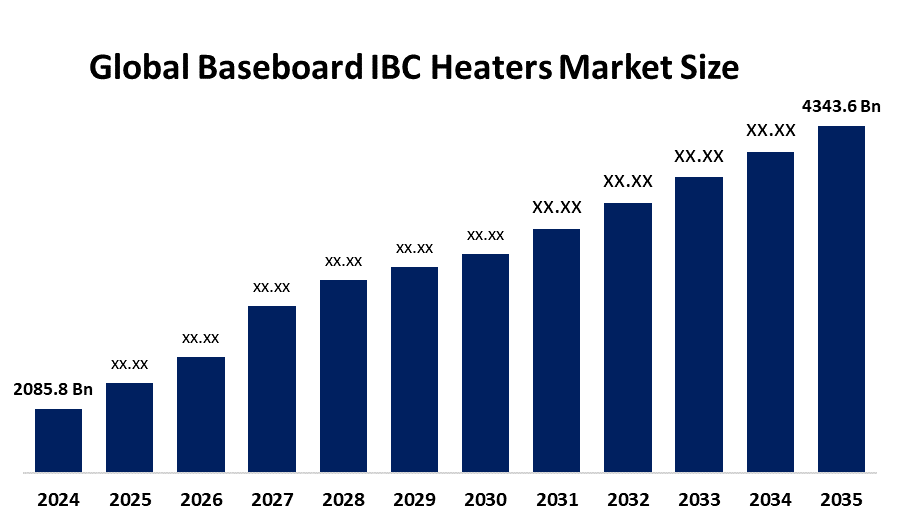
- The Global Baseboard IBC Heaters Market Size Was Estimated at USD 2085.8 Million in 2024
- The Market Size is Expected to Grow at a CAGR of around 6.9% from 2025 to 2035
- The Worldwide Baseboard IBC Heaters Market Size is Expected to Reach USD 4343.6 Million by 2035
- North America is expected to grow the fastest during the forecast period.
Get more details on this report -
According to a research report published by Spherical Insights and Consulting, The Global Baseboard IBC Heaters Market Size was worth around USD 2085.8 Million in 2024 and is predicted to Grow to around USD 4343.6 Million by 2035 with a compound annual growth rate (CAGR) of 6.9% from 2025 to 2035. The baseboard IBC heaters market is expanding swiftly, due to industrial growth, heightened demand for precise temperature management in chemical and food industries, stringent safety standards, increased bulk liquid transport, adoption of energy-efficient smart technologies, and viscosity control requirements in colder regions.
Report Coverage
This research report categorizes the baseboard IBC heaters market based on various segments and regions, forecasts revenue growth, and analyzes trends in each submarket. The report analyses the key growth drivers, opportunities, and challenges influencing the baseboard IBC heaters market. Recent market developments and competitive strategies, such as expansion, type launch, development, partnership, merger, and acquisition, have been included to draw the competitive landscape in the market. The report strategically identifies and profiles the key market players and analyses their core competencies in each sub-segment of the baseboard IBC heaters market.
Global Baseboard IBC Heaters Market Report Coverage
| Report Coverage | Details |
|---|---|
| Base Year: | 2024 |
| Market Size in 2024: | USD 2085.8 Million |
| Forecast Period: | 2024-2035 |
| Forecast Period CAGR 2024-2035 : | CAGR of 6.9% |
| 2035 Value Projection: | USD 4343.6 Million |
| Historical Data for: | 2020-2023 |
| No. of Pages: | 210 |
| Tables, Charts & Figures: | 95 |
| Segments covered: | By Type, By Application |
| Companies covered:: | Glen Dimplex Group, Stelpro Design Inc., Ouellet Canada Inc., Marley Engineered Products, Cadet Manufacturing, King Electric Manufacturing Co., Slant/Fin Corporation, Dirac Industries, Kuhlmann Electro Heat A/S, LMK Thermosafe, TPI Corporation, Stiebel Eltron, Others, and |
| Pitfalls & Challenges: | COVID-19 Empact, Challenge, Future, Growth, & Analysis |
Get more details on this report -
Driving Factors
The global baseboard IBC heaters market is primarily driven by rising demand for efficient temperature control in industries like food & beverage, chemicals, and petrochemicals, ensuring product quality and preventing solidification during storage or transport. Rapid industrialization and urbanization increase the need for reliable heating solutions. Technological advancements, such as energy-efficient heating elements and smart controllers, enhance performance and safety. Additionally, stringent regulatory standards on temperature maintenance and energy consumption encourage the adoption of high-quality heaters. Growing awareness of operational cost reduction and sustainable energy use further supports market expansion, with applications across residential, commercial, and industrial sectors.
Restraining Factors
The global baseboard IBC heaters market faces restraints from high initial investment costs, complex installation requirements, and maintenance challenges. Limited awareness in emerging regions and competition from alternative heating technologies, such as steam or electric blanket systems, also hinder widespread adoption despite growing industrial demand.
Market Segmentation
The baseboard IBC heaters market share is classified into product type, power rating and end-use.
- The electric baseboard heaters segment dominated the market in 2024, approximately 57% and is projected to grow at a substantial CAGR during the forecast period.
Based on the product type, the baseboard IBC heaters market is divided into electric baseboard heaters, steam/hot water baseboard IBC heaters, and others. Among these, the electric baseboard heaters segment dominated the market in 2024 and is projected to grow at a substantial CAGR during the forecast period. The segment dominance is attributed to their easy installation, low maintenance, and precise temperature control. Rising demand in residential and commercial spaces, energy-efficient designs, and compatibility with modern smart heating systems further boosted adoption, making electric baseboard heaters the preferred choice for consistent, reliable, and cost-effective space heating globally
The medium power (1-3 kW) segment accounted for the largest share in 2024, approximately 52% and is anticipated to grow at a significant CAGR during the forecast period.
Based on the power rating, the baseboard IBC heaters market is divided into low power (<1 kW), medium power (1-3 kW), and high power (>3 kW). Amongthese, the medium power (1-3 kW) segment accounted for the largest share in 2024 and is anticipated to grow at a significant CAGR during the forecast period. The segment growth is driven by its versatility in residential and commercial applications, providing efficient heating for small to medium-sized spaces. Its optimal balance between energy consumption and performance, compatibility with standard electrical systems, and cost-effectiveness have driven widespread adoption and preference among consumers and industries alike.
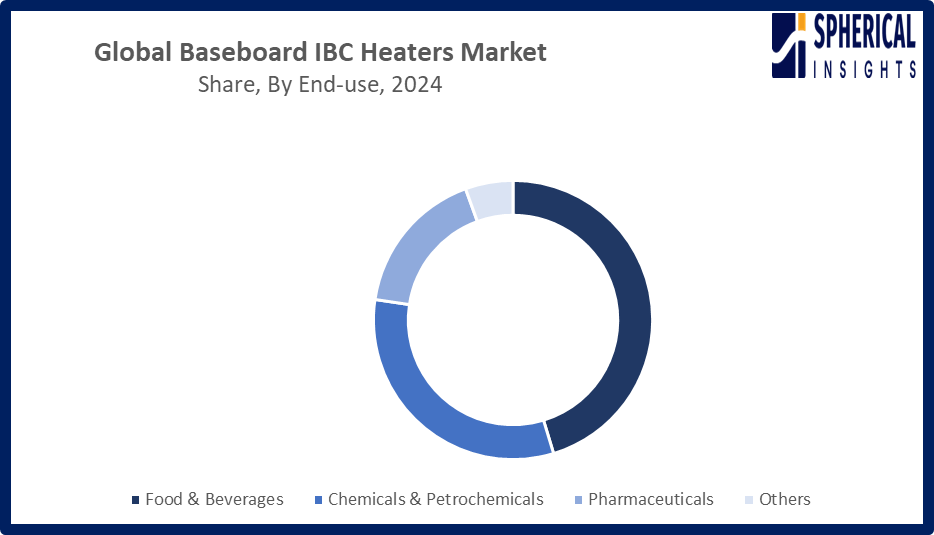
- The food & beverages segment accounted for the highest market revenue in 2024, approximately 45% and is anticipated to grow at a significant CAGR during the forecast period.
Based on the end-use, the baseboard IBC heaters market is divided into food & beverages, chemicals & petrochemicals, pharmaceuticals, and others. Among these, the food & beverages segment accounted for the highest market revenue in 2024 and is anticipated to grow at a significant CAGR during the forecast period. The food & beverages segment market growth is due to the critical need to maintain temperature-sensitive products, ensuring consistent viscosity, quality, and safety during storage and transport. Rising global demand, expanding cold-chain logistics, and stringent hygiene and regulatory standards further drive the adoption of baseboard IBC heaters in processing, storage, and distribution operations.
Get more details on this report -
Regional Segment Analysis of the Baseboard IBC Heaters Market
- North America (U.S., Canada, Mexico)
- Europe (Germany, France, U.K., Italy, Spain, Rest of Europe)
- Asia-Pacific (China, Japan, India, Rest of APAC)
- South America (Brazil and the Rest of South America)
- The Middle East and Africa (UAE, South Africa, Rest of MEA)
Asia Pacific is anticipated to hold the largest share of the baseboard IBC heaters market over the predicted timeframe.
Asia Pacific is anticipated to hold the 45% share of the baseboard IBC heaters market over the predicted timeframe. Asia Pacific is dominant in the baseboard IBC heaters market due to rapid industrialization, expanding chemical and food processing sectors, and growing bulk liquid trade. Countries like China, India, and Japan lead adoption, driven by increasing demand for temperature-sensitive product storage, cold-chain logistics, and energy-efficient heating solutions. The region’s abundant manufacturing base, rising industrial investments, and focus on improving supply chain efficiency further support market growth, making Asia Pacific the dominant market for baseboard IBC heaters globally.
North America is expected to grow at a rapid CAGR in the baseboard IBC heaters market during the forecast period. The region's growth is driven by expanding chemical, pharmaceutical, and food & beverage industries, along with rising adoption of energy-efficient and IoT-enabled heating solutions. The United States and Canada lead this growth, supported by stringent regulations for temperature-sensitive material handling, increasing cold-chain logistics, and rising awareness of product quality and safety, fueling demand for reliable baseboard IBC heating systems across industrial and commercial applications. In January 2026, Georgia updated the NEC 2023, requiring GFCI protection for certain appliance circuits and outdoor outlets. However, listed HVAC equipment is exempt, allowing traditional electric heating systems to continue, balancing enhanced safety measures with the preservation of conventional residential and commercial heating installations.
Europe’s baseboard IBC heaters market is growing due to stringent regulations on industrial safety, energy efficiency, and temperature-controlled storage. Countries like Germany, France, and the UK drive demand, supported by advanced chemical, pharmaceutical, and food processing industries. Rising adoption of smart and energy-efficient heating solutions, along with expanding logistics and cold-chain infrastructure, further boosts market growth across the region. In December 2024, new UK proposals aim to boost heating appliance efficiency, cutting energy bills and carbon emissions. Gas boilers could save households up to £30 annually (£450 over 15 years), while heat pumps may reduce costs by £22 per year from 2029, offsetting higher upfront expenses.
Competitive Analysis:
The report offers the appropriate analysis of the key organizations/companies involved within the baseboard IBC heaters market, along with a comparative evaluation primarily based on their type of offering, business overviews, geographic presence, enterprise strategies, segment market share, and SWOT analysis. The report also provides an elaborative analysis focusing on the current news and developments of the companies, which includes type development, innovations, joint ventures, partnerships, mergers & acquisitions, strategic alliances, and others. This allows for the evaluation of the overall competition within the market.
List of Key Companies
- Glen Dimplex Group
- Stelpro Design Inc.
- Ouellet Canada Inc.
- Marley Engineered Products
- Cadet Manufacturing
- King Electric Manufacturing Co.
- Slant/Fin Corporation
- Dirac Industries
- Kuhlmann Electro Heat A/S
- LMK Thermosafe
- TPI Corporation
- Stiebel Eltron
- Others
Key Target Audience
- Market Players
- Investors
- End-users
- Government Authorities
- Consulting and Research Firm
- Venture capitalists
- Value-Added Resellers (VARs)
Recent Development
- In February 2026, King Electric launched the KB & KBP PlatinumX BMS Unit Heaters, next-generation commercial heaters compatible with Building Management Systems. Designed for workshops, storage, and commercial spaces, they offer high-output electric heat, advanced scheduling, zone control, and energy-saving features like occupancy and window/door sensors.
- In January 2026, Stiebel Eltron intensified its presence in India with rapid product launches, nationwide visibility campaigns, and Comfort Gallery openings. Sales Director Andrea Klein, alongside local leadership, engaged with channel partners, architects, and customers to highlight the brand’s aggressive expansion strategy in the Indian water-heating and ventilation market.
- In April 2025, Marley Engineered Products (MEP), LLC. launched its new Explosion-Proof Unit Heaters under QMark and Berko brands. Designed for hazardous industrial environments, the GUX and RUX Series feature corrosion-resistant, powder-coated steel cabinets that meet stringent safety standards for chemical plants, oil refineries, grain elevators, and other high-risk locations.
Market Segment
This study forecasts revenue at global, regional, and country levels from 2020 to 2035. Spherical Insights has segmented the baseboard IBC heaters market based on the below-mentioned segments:
Global Baseboard IBC Heaters Market, By Product Type
- Electric Baseboard Heaters
- Steam/Hot Water Baseboard IBC Heaters
- Others
Global Baseboard IBC Heaters Market, By Power Rating
- Low Power (<1 kW)
- Medium Power (1-3 kW)
- High Power (>3 kW)
Global Baseboard IBC Heaters Market, By End-Use
- Food & Beverages
- Chemicals & Petrochemicals
- Pharmaceuticals
- Others
Global Baseboard IBC Heaters Market, By Regional Analysis
- North America
- US
- Canada
- Mexico
- Europe
- Germany
- UK
- France
- Italy
- Spain
- Russia
- Rest of Europe
- Asia Pacific
- China
- Japan
- India
- South Korea
- Australia
- Rest of Asia Pacific
- South America
- Brazil
- Argentina
- Rest of South America
- Middle East & Africa
- UAE
- Saudi Arabia
- Qatar
- South Africa
- Rest of the Middle East & Africa
Frequently Asked Questions (FAQ)
-
1.How is the adoption of baseboard IBC heaters impacting energy consumption in industrial storage?The adoption of baseboard IBC heaters reduces energy consumption by 15-20% in industrial storage, ensuring efficient temperature maintenance, minimizing heat loss, and lowering operational costs across chemical, food, and pharmaceutical industries.
-
2.How are IoT-enabled and smart temperature controls shaping market trends?IoT-enabled and smart temperature controls are boosting market efficiency, reducing energy usage by up to 18%, enabling real-time monitoring, predictive maintenance, and precise heating, driving adoption in industrial baseboard IBC heating systems.
-
3.What economic factors influence the pricing and adoption of baseboard IBC heaters?Economic factors such as raw material price volatility (±10-15%), energy costs, and capital expenditure influence baseboard IBC heater pricing and adoption, with higher initial costs slowing uptake despite long‑term operational savings.
-
4.How do regulatory standards for temperature-sensitive products affect market growth?Regulatory standards for temperature-sensitive products, such as FDA and EU GMP guidelines, drive baseboard IBC heater adoption, with over 70% of industrial users complying to ensure product quality and prevent spoilage.
-
5.What role do sustainable and eco-friendly designs play in market expansion?Sustainable, eco-friendly baseboard IBC heater designs drive market expansion, with over 60% of new industrial installations in 2024 favoring energy-efficient, low-emission systems to meet environmental regulations and reduce operational costs.
-
6.How is cold-chain logistics growth influencing the baseboard IBC heaters market?The growth of cold-chain logistics is driving demand for baseboard IBC heaters, as temperature-sensitive products like food, pharmaceuticals, and chemicals require precise heating. The global cold-chain market, valued at over $860 billion, supports widespread heater adoption.
-
7.What recent technological innovations are driving efficiency in baseboard IBC heaters?Recent innovations like advanced PID controls and high‑efficiency heating elements have improved baseboard IBC heater performance, reducing energy use by 15-20% while enhancing temperature uniformity and system reliability across industrial applications.
Need help to buy this report?