Global Barware Market Size, Share, By Material (Glass, Ceramic, Plastic, Steel, and Wood), By Product (Glassware, Bar Tools & Accessories, Serveware, Decanters, and Others), By Application (Commercial and Residential), By Distribution Channel (Online Retail and Offline Retail), and By Region (North America, Europe, Asia-Pacific, Latin America, Middle East, and Africa), Analysis and Forecast 2026 - 2035
Industry: Consumer Goods
Global Barware Market Insights Forecasts to 2035
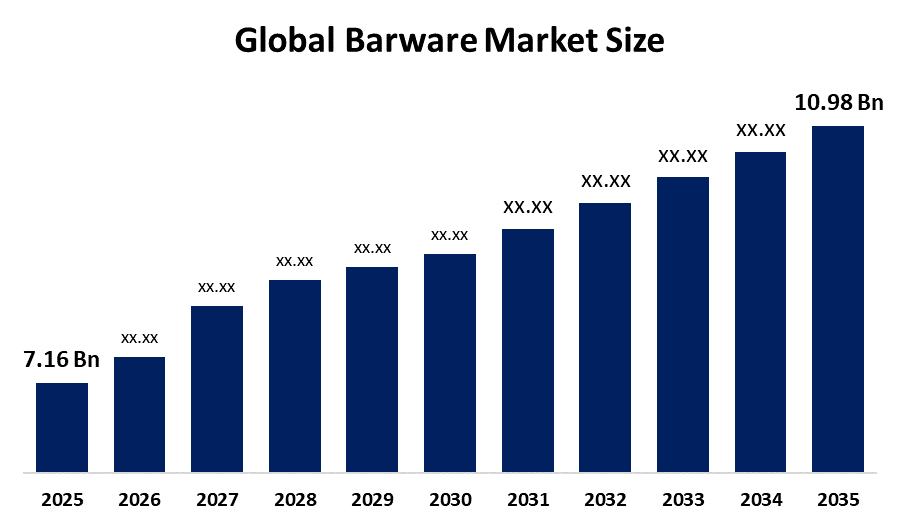
- The Global Barware Market Size Was Estimated at USD 7.16 Billion in 2025
- The Market Size is Expected to Grow at a CAGR of around 4.37% from 2025 to 2035
- The Worldwide Barware Market Size is Expected to Reach USD 10.98 Billion by 2035
- Asia Pacific is expected to grow the fastest during the forecast period.
Get more details on this report -
According to a research report published by Spherical Insights and Consulting, the global barware market size was worth around USD 7.16 billion in 2025 and is predicted to grow to around USD 10.98 billion by 2035 with a compound annual growth rate (CAGR) of 4.37% from 2025 to 2035. The global barware market is driven by rising home entertainment trends, increasing consumer interest in mixology, growing hospitality and restaurant sectors, expansion of e-commerce platforms, and demand for premium and customized barware products globally.
Market Overview
The global barware market refers to the industry encompassing tools, equipment, and glassware used for the preparation, serving, and consumption of alcoholic and non-alcoholic beverages. Barware includes products such as cocktail shakers, jiggers, strainers, muddlers, and specialized glassware, including wine glasses, tumblers, and martini glasses, designed to enhance beverage presentation and user experience. These products are widely used across commercial establishments such as bars, restaurants, hotels, and lounges, as well as in residential settings driven by rising home entertaining trends. The scope of the market spans premium, mass, and artisanal segments, catering to diverse consumer preferences globally. The market is driven by expanding hospitality infrastructure, increasing disposable incomes, and evolving lifestyle patterns. In November 2024, the recovery of the global hospitality sector significantly increased bulk procurement of commercial-grade barware, particularly in tourism-driven economies. In August 2024, rising home mixology trends boosted consumer spending on barware products across residential settings. Technological innovations such as lead-free crystal and durable glass materials are enhancing product performance, while sustainability trends are promoting recyclable materials. Future opportunities lie in premiumization, customization, and e-commerce expansion, supported by urbanization and changing consumption behavior.
Report Coverage
This research report categorizes the barware market based on various segments and regions, forecasts revenue growth, and analyzes trends in each submarket. The report analyses the key growth drivers, opportunities, and challenges influencing the barware market. Recent market developments and competitive strategies, such as expansion, product launch, development, partnership, merger, and acquisition, have been included to draw the competitive landscape in the market. The report strategically identifies and profiles the key market players and analyses their core competencies in each sub-segment of the Barware market.
Global Barware Market Report Coverage
| Report Coverage | Details |
|---|---|
| Base Year: | 2025 |
| Market Size in 2025: | USD 7.16 Billion |
| Forecast Period: | 2026-2035 |
| Forecast Period CAGR 2026-2035 : | 4.37% |
| 2035 Value Projection: | USD 10.98 Billion |
| Historical Data for: | 2025-2026 |
| No. of Pages: | 220 |
| Tables, Charts & Figures: | 110 |
| Segments covered: | By Material, By Application |
| Companies covered:: | Libbey Inc., Arc International, Bormioli Rocco S.p.A., Zwiesel Kristallglas AG, Riedel Crystal, Steelite International, Anchor Hocking, Luigi Bormioli, Schott Zwiesel, Nachtmann, Waterford Crystal, Villeroy & Boch AG, Noritake Co., Ltd., Pasabahce |
| Pitfalls & Challenges: | COVID-19 Empact, Challenge, Future, Growth, & Analysis |
Get more details on this report -
Driving Factors
Rising global consumption of alcoholic and non-alcoholic beverages and the expanding cocktail culture are significantly driving demand for barware products. Growth in the hospitality sector, including hotels, bars, and restaurants, is increasing the bulk procurement of durable and premium barware. In 2025, companies such as Arc International and Bormioli Rocco S.p.A. strengthened sustainability initiatives and product innovation strategies, supporting the shift toward eco-friendly and high-quality materials.
In 2025, Libbey Inc. continued portfolio expansion and strategic developments to enhance market presence. Increasing disposable incomes and lifestyle upgrades are encouraging investment in premium glassware, while home mixology trends and e-commerce expansion are further accelerating global market growth.
Restraining Factors
High costs of premium materials and production limit affordability and mass adoption of barware products. Fluctuating raw material prices, particularly glass and steel, impact profit margins. Intense market competition and availability of low-cost alternatives further restrict pricing power, while changing consumer preferences and economic uncertainties affect discretionary spending on non-essential barware items.
Market Segmentation
The barware market share is classified into material, product, application, and distribution channel.
- The glass segment dominated the market in 2025, approximately 46.82%, and is projected to grow at a substantial CAGR during the forecast period.
Based on material, the barware market is divided into glass, ceramic, plastic, steel, and wood. Among these, the glass segment dominated the market in 2025, approximately 46.82%, and is projected to grow at a substantial CAGR during the forecast period. Glass maintains dominance due to its non-reactive properties preserving beverage taste purity, superior transparency enhancing drink presentation, compatibility with both hot and cold beverages, recyclability advantages, and strong preference among premium hospitality brands requiring consistent visual appeal standards globally.
- The glassware segment accounted for the largest share in 2025, approximately 42.61%, and is anticipated to grow at a significant CAGR during the forecast period.
Based on product, the barware market is divided into glassware, bar tools & accessories, serveware, decanters, and others. Among these, the glassware segment accounted for the largest share in 2025, approximately 42.61%, and is projected to grow at a substantial CAGR during the forecast period. Glassware leads due to category specific designs like wine, beer, and cocktail glasses enhancing aroma and flavor profiles, standardized serving practices in hospitality, increasing consumer awareness of drink specific vessels, and continuous product innovation in shape, thickness, and ergonomic usability features.
- The commercial segment accounted for the largest share in 2025, approximately 67.34%, and is anticipated to grow at a significant CAGR during the forecast period.
Based on application, the barware market is divided into commercial and residential. Among these, the commercial segment accounted for the largest share in 2025, approximately 67.34%, and is projected to grow at a substantial CAGR during the forecast period. Commercial segment growth is supported by bulk procurement cycles, standardized replacement demand due to frequent breakage, strict service quality norms in hospitality chains, and continuous upgrading of bar presentation formats to align with evolving consumer dining and nightlife experience expectations.
- The offline retail segment accounted for the highest market revenue in 2025, approximately 68.49%, and is anticipated to grow at a significant CAGR during the forecast period.
Based on distribution channel, the barware market is divided into offline retail and online retail. Among these, the offline retail segment accounted for the highest market revenue in 2025, approximately 68.49%, and is projected to grow at a substantial CAGR during the forecast period. Offline dominance is driven by immediate product availability, tactile evaluation of weight, finish, and durability, retailer assisted selection for bulk or specialized purchases, and strong institutional supply networks serving hotels, bars, and restaurants through direct procurement relationships and distributor channels.

Get more details on this report -
Regional Segment Analysis of the Barware Market
- North America (U.S., Canada, Mexico)
- Europe (Germany, France, U.K., Italy, Spain, Rest of Europe)
- Asia-Pacific (China, Japan, India, Rest of APAC)
- South America (Brazil and the Rest of South America)
- The Middle East and Africa (UAE, South Africa, Rest of MEA)
Europe is anticipated to hold the largest share of the barware market over the predicted timeframe.

Get more details on this report -
Europe is anticipated to hold the largest share of the barware market over the predicted timeframe. Strong premium beverage culture, a well-established hospitality industry, and high consumer spending on lifestyle and dining products are key factors propelling Europe. The region’s dominance is further reinforced by sustainability-driven regulations such as the Packaging and Packaging Waste Regulation (PPWR) and the Single-Use Plastics Directive (SUPD), which are accelerating the shift toward recyclable and high-quality glass barware. Additionally, rising import tariffs on low-cost products are supporting local artisanal manufacturers across countries such as Germany, Italy, and the UK, strengthening regional production and premiumization trends.
Asia Pacific is expected to grow at a rapid CAGR in the barware market during the forecast period. Growth is driven by strong hospitality and tourism expansion in countries such as India, increasing procurement demand for commercial barware, and rising mixology training driving specialized tool adoption. China is strengthening its manufacturing ecosystem through quality-focused production, while Japan and South Korea are promoting premium artisanal glass and ceramic barware. Sustainability regulations, including plastic reduction policies, are accelerating the shift toward reusable materials such as glass and steel. Additionally, rapid e-commerce expansion and increasing urbanization are further supporting demand for both residential and commercial barware across the region.
Competitive Analysis:
The report offers the appropriate analysis of the key organizations/companies involved within the barware market, along with a comparative evaluation primarily based on their product of offering, business overviews, geographic presence, enterprise strategies, segment market share, and SWOT analysis. The report also provides an elaborative analysis focusing on the current news and developments of the companies, which includes product development, innovations, joint ventures, partnerships, mergers & acquisitions, strategic alliances, and others. This allows for the evaluation of the overall competition within the market.
List of Key Companies
- Libbey Inc.
- Arc International
- Bormioli Rocco S.p.A.
- Zwiesel Kristallglas AG
- Riedel Crystal
- Steelite International
- Anchor Hocking
- Luigi Bormioli
- Schott Zwiesel
- Nachtmann
- Waterford Crystal
- Villeroy & Boch AG
- Noritake Co., Ltd.
- Pasabahce
- Others
Key Target Audience
- Market Players
- Investors
- End-users
- Government Authorities
- Consulting and Research Firm
- Venture capitalists
- Value-Added Resellers (VARs)
Recent Development
- In October 2025, sustainability regulations across Europe and Asia accelerated the shift toward recyclable glass, stainless steel, and lead-free crystal in barware manufacturing, prompting companies to redesign products with eco-friendly materials and lightweight structures to meet evolving environmental standards and consumer preferences.
- In July 2025, leading barware manufacturers expanded premium and artisanal product lines, including handcrafted glassware and designer collections, to cater to rising demand for luxury dining experiences, craft cocktails, and high-end hospitality settings across developed regions such as North America and Europe.
- In March 2025, barware companies strengthened e-commerce and direct-to-consumer distribution channels, enhancing global product accessibility, enabling customization offerings, and improving profit margins by reducing dependency on traditional retail networks while effectively targeting digitally engaged consumers across emerging and developed markets.
Market Segment
This study forecasts revenue at global, regional, and country levels from 2020 to 2035. Spherical Insights has segmented the barware market based on the below-mentioned segments:
Global Barware Market, By Material
- Glass
- Ceramic
- Plastic
- Steel
- Wood
Global Barware Market, By Product
- Glassware
- Bar Tools & Accessories
- Serveware
- Decanters
- Others
Global Barware Market, By Application
- Commercial
- Residential
Global Barware Market, By Distribution Channel
- Online Retail
- Offline Retail
Global Barware Market, By Regional Analysis
- North America
- US
- Canada
- Mexico
- Europe
- Germany
- UK
- France
- Italy
- Spain
- Russia
- Rest of Europe
- Asia Pacific
- China
- Japan
- India
- South Korea
- Australia
- Rest of Asia Pacific
- South America
- Brazil
- Argentina
- Rest of South America
- Middle East & Africa
- UAE
- Saudi Arabia
- Qatar
- South Africa
- Rest of the Middle East & Africa
Frequently Asked Questions (FAQ)
-
1. What factors influence consumer preference in barware product selection?Consumer preference is influenced by design aesthetics, material quality, durability, brand perception, and compatibility with specific beverages. Additionally, trends such as minimalistic designs, premium finishes, and multifunctional tools are shaping purchasing decisions across both residential and commercial users.
-
2. How is premiumization impacting the barware market?Premiumization is driving demand for high-end glassware, artisanal designs, and branded collections. Consumers are increasingly willing to pay higher prices for visually appealing, durable, and experience-enhancing products, particularly in luxury hospitality settings and upscale home environments.
-
3. What role does product design play in barware demand?Product design plays a critical role in enhancing beverage aroma, taste perception, and presentation. Ergonomic shapes, precision measurements, and specialized glass structures contribute to improved user experience, making design innovation a key competitive factor in the market.
-
4. How are distribution strategies evolving in the barware industry?Manufacturers are increasingly adopting omnichannel strategies, combining traditional retail with digital platforms. Direct-to-consumer models, online marketplaces, and brand-owned websites are enabling broader reach, improved margins, and personalized customer engagement.
-
5. What challenges do manufacturers face in scaling barware production?Manufacturers face challenges such as maintaining product consistency, managing fragile inventory, ensuring cost efficiency, and adapting to fluctuating raw material prices. Additionally, meeting sustainability standards while maintaining product quality adds complexity to production processes.
-
6. How is urbanization influencing barware consumption patterns?Urbanization is driving lifestyle changes, increased social gatherings, and higher spending on home décor and dining experiences. This shift is boosting demand for stylish and functional barware products, particularly among younger and middle-income consumer groups.
Need help to buy this report?