Global Barrier Shrink Films Market Size, Share, and COVID-19 Impact Analysis, By Material Type (Polyethylene, Polypropylene, Polyvinyl Chloride, and Polyester), By Application (Food & Beverage Packaging, Pharmaceutical Packaging, Consumer Goods Packaging, and Industrial Packaging), By End Use (Food & Beverage, Pharmaceutical, Cosmetics, Electronics, and Others), and By Region (North America, Europe, Asia-Pacific, Latin America, Middle East, and Africa), Analysis and Forecast 2025 - 2035.
Industry: Chemicals & Materials
Global Barrier Shrink Films Market Insights Forecasts to 2035
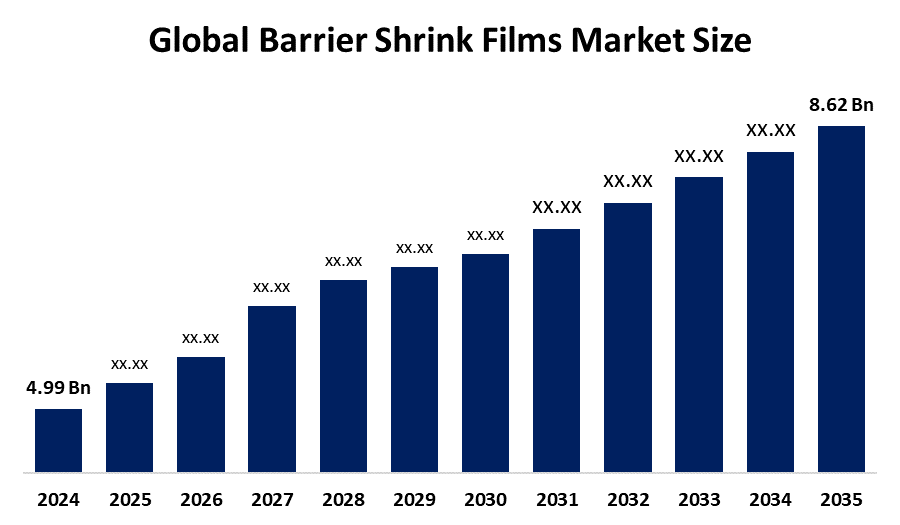
- The Global Barrier Shrink Films Market Size Was Estimated at USD 4.99 Billion in 2024
- The Market Size is Expected to Grow at a CAGR of around 5.1% from 2025 to 2035
- The Worldwide Barrier Shrink Films Market Size is Expected to Reach USD 8.62 Billion by 2035
- Asia Pacific is expected to grow the fastest during the forecast period.
Get more details on this report -
According to a research report published by Spherical Insights and Consulting, The Global Barrier Shrink Films Market Size Was Worth Around USD 4.99 Billion In 2024 And Is Predicted To Grow To Around USD 8.62 Billion By 2035 With A Compound Annual Growth Rate (CAGR) Of 5.1% From 2025 To 2035. Global expansion of multilayer and co-extrusion processes, bio-based and recyclable materials, improved barrier properties, smart packaging features like oxygen scavengers and antimicrobial additives, and digital quality control are all driving opportunities in the barrier shrink films market.
Market Overview
The barrier shrink films market refers to the global industry that produces and supplies specialized plastic films engineered to tightly conform around products, and protect them from oxygen, moisture, light, and contaminants, thereby extending shelf life, maintaining quality, and enhancing visual appeal. The market includes multilayer and co-extrusion techniques, advanced barrier resins and film structures that use bio-based materials, complete recyclability and nano composite additives, and smart packaging technologies which feature oxygen scavengers, antimicrobial agents, and printable sensing elements. The new technologies improve operational efficiency and environmental responsibility while enabling companies to decrease their production costs and material requirements, which helps businesses to thrive in the markets.
The market experiences growth with government support, this trend through regulations which aim to decrease plastic waste, promote recycling, and provide financial incentives for using sustainable materials, which results in wider adoption of high barrier recyclable and compostable shrink film products. For instance, in April 2025, India’s Plastic Park Scheme provides investment of up to INR 40 crore per park, with examples including INR 36 crore in Madhya Pradesh and Odisha, INR 35.73 crore in Assam, and INR 22 crore in Tamil Nadu. The funding supports the development of modern plastic processing facilities, enabling fast production, research, development, and implementation of innovative, sustainable, energy-efficient barrier shrink films.
In January 2022, the U.S. DOE announced an investment of USD 13.4 million to support the development of next-generation plastic films, including barrier-type flexible films used in packaging applications such as shrink films.
Report Coverage
This research report categorizes the barrier shrink films market based on various segments and regions, forecasts revenue growth, and analyzes trends in each submarket. The report analyses the key growth drivers, opportunities, and challenges influencing the barrier shrink films market. Recent market developments and competitive strategies, such as expansion, product launch, development, partnership, merger, and acquisition, have been included to draw the competitive landscape in the market. The report strategically identifies and profiles the key market players and analyses their core competencies in each sub-segment of the barrier shrink films market.
Global Barrier Shrink Films Market Report Coverage
| Report Coverage | Details |
|---|---|
| Base Year: | 2024 |
| Market Size in 2024: | USD 4.99 Billion |
| Forecast Period: | 2025-2035 |
| Forecast Period CAGR 2025-2035 : | 5.1% |
| 2035 Value Projection: | USD 8.62 Billion |
| Historical Data for: | 2021-2023 |
| No. of Pages: | 220 |
| Tables, Charts & Figures: | 110 |
| Segments covered: | By Material Type, By Application |
| Companies covered:: | Amcor plc, Sealed Air Corporation, Berry Global Inc., Mondi Group, Winpek Ltd., Coveris Holdings S.A., Constantia Flexibles, Uflex Limited, Jindal Poly Films Ltd., Cosmo Films Ltd., Klockner Pentaplast Group, Toray Industries, Inc., Polyplex Corporation Ltd., Toppan Inc., Flexopack S.A., Others |
| Pitfalls & Challenges: | COVID-19 Empact, Challenge, Future, Growth, & Analysis |
Get more details on this report -
Driving Factors
Rapid technological innovation is one of the main drivers of the barrier shrink films market's growth. Advancements in multilayer and co-extrusion technologies, development of high-barrier resins and nanomaterials, and the rise of recyclable, bio-based, and lightweight film solutions that improve sustainability and cost efficiency, which is the main factor driving the barrier market, are shrinking films. In this field, innovation and investment are driven by the growing demand for extended shelf life and safe packaging, and the expansion of e-commerce and global supply chains increases the need for durable and protective packaging. Strong government support through stricter environmental regulations, plastic waste reduction policies, recycling initiatives, and incentives for eco-friendly materials also plays a crucial role in pushing manufacturers toward sustainable barrier shrink film solutions, collectively driving market growth.
In November 2019, the U.S. DOE officially launched the Plastics Innovation Challenge, a nationwide program aimed at accelerating innovation in plastic materials, including flexible and barrier films used in packaging applications such as shrink films.
Restraining Factors
High production and raw material costs, complex recycling challenges, limited recycling infrastructure, stringent environmental regulations on plastic usage, fluctuations in petrochemical prices, supply chain disruptions, and difficulty in balancing barrier properties with flexibility and clarity are the main factors restricting the barrier shrink films market.
Market Segmentation
The barrier shrink films market share is classified into material type, application, and end user.
- The polyethylene segment dominated the market in 2024, approximately 38%, and is projected to grow at a substantial CAGR during the forecast period.
Based on the material type, the barrier shrink films market is divided into polyethylene, polypropylene, polyvinyl chloride, and polyester. Among these, the polyethylene segment dominated the market in 2024, approximately 38%, and is projected to grow at a substantial CAGR during the forecast period. Offers cost-effectiveness, versatility, and easily processed packaging material, providing excellent moisture barrier properties, good mechanical strength, and is widely recyclable and compatible with multilayer structures, which is driving the polyethylene industry.
- The food & beverage packaging segment accounted for the largest share in 2024, approximately 48%, and is anticipated to grow at a significant CAGR during the forecast period.
Based on the application, the barrier shrink films market is divided into food & beverage packaging, pharmaceutical packaging, consumer goods packaging, and industrial packaging. Among these, the food & beverage packaging segment accounted for the largest share in 2024, approximately 48%, and is anticipated to grow at a significant CAGR during the forecast period. Effective protection against moisture, oxygen, and contaminants, growing demand for convenient, ready-to-eat, and packaged food, and strict food safety regulations are driving the food & beverage packaging industry.
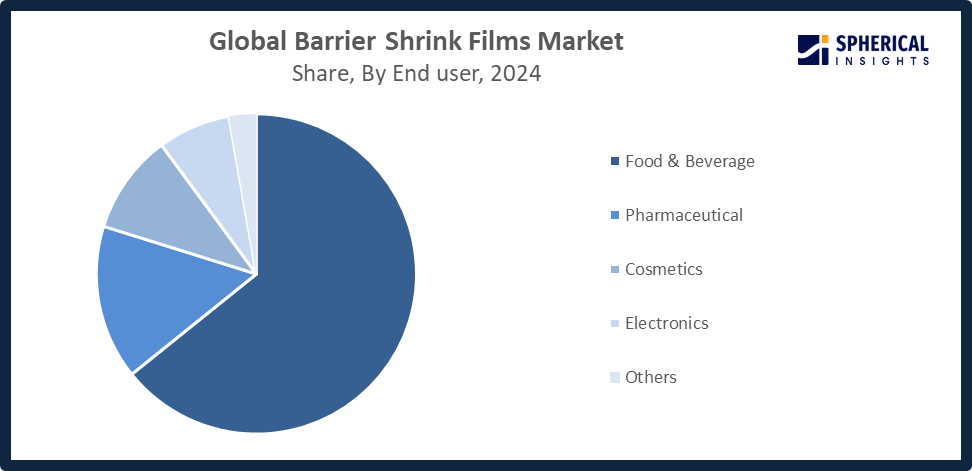
- The food & beverage segment accounted for the highest market revenue in 2024, approximately 64%, and is anticipated to grow at a significant CAGR during the forecast period.
Based on the end user, the barrier shrink films market is divided into food & beverage, pharmaceutical, cosmetics, electronics, and others. Among these, the food & beverage segment accounted for the highest market revenue in 2024, approximately 64%, and is anticipated to grow at a significant CAGR during the forecast period. Extensive use to protect products from moisture, oxygen, and contamination, ensuring longer shelf life, maintaining freshness, and stringent food safety and hygiene standards is bolstering the food & beverage market.
Get more details on this report -
Regional Segment Analysis of the Barrier Shrink Films Market
- North America (U.S., Canada, Mexico)
- Europe (Germany, France, U.K., Italy, Spain, Rest of Europe)
- Asia-Pacific (China, Japan, India, Rest of APAC)
- South America (Brazil and the Rest of South America)
- The Middle East and Africa (UAE, South Africa, Rest of MEA)
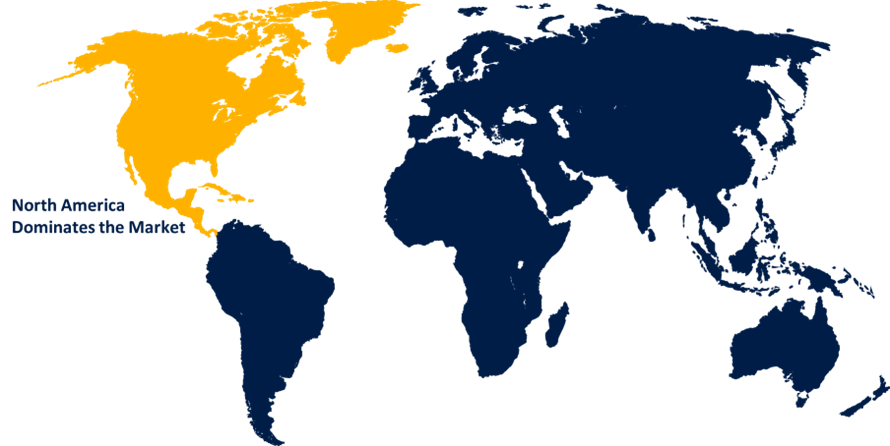
North America is anticipated to hold the largest share of the barrier shrink films market over the predicted timeframe.
Get more details on this report -
North America is anticipated to hold the largest share of the barrier shrink films market over the predicted timeframe. Strong government backing for high barrier and recyclable films, strong R & D initiatives, and support for sustainable packaging solutions, are what propel North America. The region's position is further reinforced by established food and beverage sector, advanced packaging technology systems, its complete food safety regulations, and quality control requirements. The growing need for fresh, easy to use and ready to eat products has led to the widespread implementation of barrier shrink films which extended product shelf life and preserve product quality in North America
.
Asia Pacific is expected to grow at a rapid CAGR in the barrier shrink films market during the forecast period. China, India, and Japan are among the nations making significant investments in manufacturing infrastructure, expanding food processing industries, and growing awareness of food safety and quality standards. The demand for sophisticated barrier shrink films is further accelerated by the region's industrial growth, increased consumer need for packaged foods and the retail, and e-commerce market expansion which have turned Asia Pacific into the world's most rapidly expanding market.
Government Launches include China’s January 2026 Solid Waste Action Plan supports better collection, sorting, and recycling of plastic packaging, indirectly promoting recyclable and sustainable barrier shrink films and June 2022, Japan’s Program for Plastic Resource Circulation launched by MOE for improving collection, sorting, and recycling of plastic packaging, the program addresses key challenges associated with multilayer barrier and shrink films,
Competitive Analysis:
The report offers the appropriate analysis of the key organizations/companies involved within the barrier shrink films market, along with a comparative evaluation primarily based on their product of offering, business overviews, geographic presence, enterprise strategies, segment market share, and SWOT analysis. The report also provides an elaborative analysis focusing on the current news and developments of the companies, which includes product development, innovations, joint ventures, partnerships, mergers & acquisitions, strategic alliances, and others. This allows for the evaluation of the overall competition within the market.
List of Key Companies
- Amcor plc
- Sealed Air Corporation
- Berry Global Inc.
- Mondi Group
- Winpek Ltd.
- Coveris Holdings S.A.
- Constantia Flexibles
- Uflex Limited
- Jindal Poly Films Ltd.
- Cosmo Films Ltd.
- Klockner Pentaplast Group
- Toray Industries, Inc.
- Polyplex Corporation Ltd.
- Toppan Inc.
- Flexopack S.A.
- Others
Key Target Audience
- Market Players
- Investors
- End-users
- Government Authorities
- Consulting and Research Firm
- Venture capitalists
- Value-Added Resellers (VARs)
Recent Development
- In January 2026, Sealed Air’s CRYOVAC brand celebrated its 85th anniversary, highlighting its long history of innovation with shrink films, shrink bags, vacuum skin packaging, and other protective film solutions used in food packaging across global markets.
- In April 2025, Berry Global published a company news article on its Printed Shrink Film Team, emphasizing its expertise in shrink film technology, including durable printed shrink films that support brand visibility and sustainability goals using recycled content polymers.
- In April 2025, Pregis expanded manufacturing capacity for ethylene vinyl alcohol barrier films at its blown film plant in South Carolina, strengthening supply for high-performance films used in demanding packaging applications. This supports growth in recyclable or high barrier packaging material adoption.
- In May 2025, Innovia Films Ltd. started a new film coating line at its western Mexico facility to enhance production of barrier films with improved protective properties for packaging applications.
- In December 2024, Berry Global and VOID Technologies announced a collaboration to launch a new high performance, sustainable polyethylene film with improved toughness and recyclability for packaging applications, which includes shrink-compatible films.
- June 2024, Berry Global officially launched its Recycle-Ready barrier shrink film series, designed to offer enhanced recyclability while maintaining strong oxygen and moisture barrier performance for food packaging applications.
Market Segment
This study forecasts revenue at global, regional, and country levels from 2020 to 2035. Spherical Insights has segmented the barrier shrink films market based on the below-mentioned segments:
Global Barrier Shrink Films Market, By Material Type
- Polyethylene
- Polypropylene
- Polyvinyl Chloride
- Polyester
Global Barrier Shrink Films Market, By Application
- Food & Beverage Packaging
- Pharmaceutical Packaging
- Consumer Goods Packaging
- Industrial Packaging
Global Barrier Shrink Films Market, By End User
- Food & Beverage
- Pharmaceutical
- Cosmetics
- Electronics
- Others
Global Barrier Shrink Films Market, By Regional Analysis
- North America
- US
- Canada
- Mexico
- Europe
- Germany
- UK
- France
- Italy
- Spain
- Russia
- Rest of Europe
- Asia Pacific
- China
- Japan
- India
- South Korea
- Australia
- Rest of Asia Pacific
- South America
- Brazil
- Argentina
- Rest of South America
- Middle East & Africa
- UAE
- Saudi Arabia
- Qatar
- South Africa
- Rest of the Middle East & Africa
Frequently Asked Questions (FAQ)
-
1. What technologies or innovations do barrier shrink films support?Barrier shrink films incorporate technologies like multilayer co-extrusion, EVOH or PA barrier layers, recyclable mono-material structures, metalized or coated films, and sustainable biodegradable or compostable polymers.
-
2. What types of materials are most commonly used in barrier shrink films?Barrier shrink films are typically made from polyethylene, polypropylene, polyvinyl chloride, polyester, and EVOH-based composites. Advanced formulations may combine these to provide enhanced mechanical strength and barrier properties for food, beverage, and industrial packaging.
-
3. What is the role of multilayer and high-barrier films in packaging?Multilayer and high-barrier films protect products from oxygen, moisture, UV light, and contaminants, extending shelf life and maintaining product quality. They are widely used in food, beverage, pharmaceutical, and consumer goods packaging.
-
4. What is the importance of recyclability and sustainable films?Sustainable and recyclable films reduce environmental impact, comply with government regulations and EPR policies, and meet increasing consumer demand for eco-friendly packaging.
-
5. What industries benefit most from barrier shrink films?Industries such as food & beverage, pharmaceuticals, cosmetics, electronics, and industrial goods rely on barrier shrink films for product protection, shelf life extension, and branding/labelling solutions.
-
6. What is the expected commercialization timeline for barrier shrink films?The barrier shrink films market is expected to continue growing strongly through the late 2020s and into the 2030s, driven by rising demand for sustainable packaging, high-barrier protection, and innovations in recyclable film technologies.
Need help to buy this report?