Global Bamboo Engineered Wood Flooring Market Size, Share, and Analysis By Flooring Type (Vertical Bamboo Flooring and Horizontal Bamboo Flooring), By Product Type (Laminated Bamboo, Reconstituted Densified Bamboo, and Bamboo Boards), By End-use (Residential, Commercial, and Industrial), and By Region (North America, Europe, Asia-Pacific, Latin America, Middle East, and Africa), Analysis and Forecast 2025 - 2035.
Industry: Chemicals & Materials
Global Bamboo Engineered Wood Flooring Market Insights Forecasts to 2035
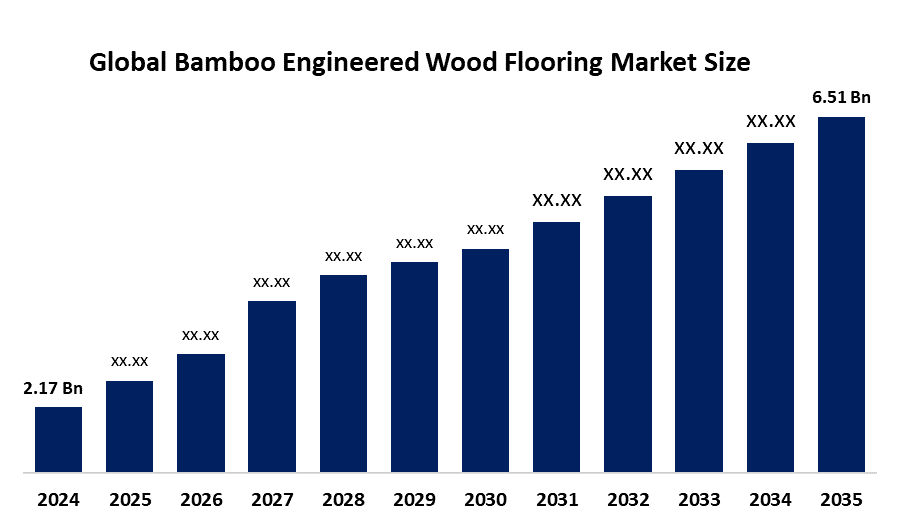
- The Global Bamboo Engineered Wood Flooring Market Size Was Estimated at USD 2.17 Billion in 2024
- The Market Size is Expected to Grow at a CAGR of around 10.5% from 2025 to 2035
- The Worldwide Bamboo Engineered Wood Flooring Market Size is Expected to Reach USD 6.51 Billion by 2035
- North America is expected to grow the fastest during the forecast period.
Get more details on this report -
According to a research report published by Spherical Insights and Consulting, The Global Bamboo Engineered Wood Flooring Market Size was worth around USD 2.17 Billion in 2024 and is predicted to Grow to around USD 6.51 Billion by 2035 with a compound annual growth rate (CAGR) of 10.5% from 2025 to 2035. The market for bamboo engineered wood flooring is expanding as demand rises for sustainable, durable substitutes to traditional hardwood. Growth is driven by bamboo’s fast renewability, strong moisture resistance, affordability, and advanced manufacturing technologies, enhancing strength, appearance, and ease of installation.
Bamboo Engineered Wood Flooring Market Key Takeaways
- Asia Pacific accounted for the largest market share in 2024.
- North America is expected to grow at the fastest CAGR during the forecast period.
- By flooring type, the vertical bamboo flooring segment held a dominant share of the market in 2024.
- By flooring type, the horizontal bamboo flooring segment is expected to grow at the fastest CAGR in the market between 2024 and 2035.
- By product type, the reconstituted densified bamboo segment led the global market in 2024.
- By product type, the laminated bamboo segment is expected to grow with the highest CAGR in the market during the studied years.
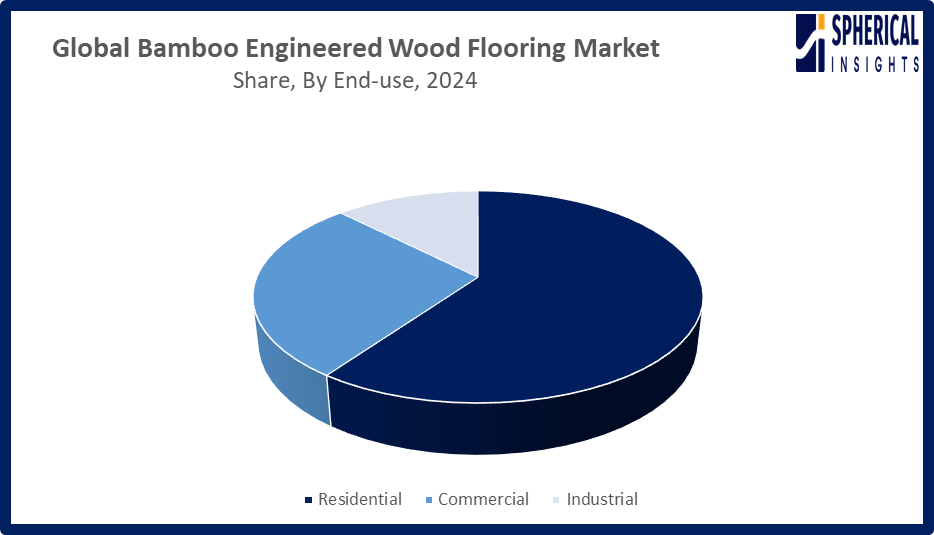
- By end-use, the residential segment registered its dominance in the market in 2024.
- By end-use, the commercial segment is expected to witness the fastest growth in the market over the forecast period.
Market Overview
The global bamboo engineered wood flooring market includes multi-layer flooring solutions created by bonding thin bamboo layers, such as strand-woven or compressed forms, with a core base and protective wear layer. These products are designed to deliver greater dimensional stability, improved moisture resistance, and easier installation compared to solid bamboo or traditional hardwood flooring. They are widely used in residential and commercial settings, including living areas, kitchens, offices, and retail spaces, offering natural aesthetics along with durability in high-traffic and variable humidity conditions.
Market expansion is fueled by increasing demand for sustainable construction materials, with over 40% of projects globally incorporating eco-friendly products. Bamboo’s rapid renewability, with a 3-5-year harvest cycle, further strengthens its appeal. Opportunities arise from a rising eco-conscious consumer base growing above 6% annually, along with innovations like strand-woven bamboo, which enhances durability up to two to three times compared to conventional hardwoods, supported by favorable green building policies. In January 2026, India launched Rs. 82.5 crore bamboo industrial projects led by Jyotiraditya Scindia. The initiatives include engineered bamboo manufacturing, modernization of artisan clusters, and development of 1,000 hectares of certified plantations to promote sustainable timber alternatives and strengthen the Northeast’s bamboo economy.
Bamboo Engineered Wood Flooring Market Trends
- Rising demand for sustainable & green materials: One of the strongest trends is the growing preference for eco-friendly construction materials. Bamboo’s rapid renewability and low environmental impact make it highly attractive for green buildings. Increasing awareness of sustainability and government support for green construction are accelerating adoption globally.
- Technological advancements in manufacturing: Innovations such as strand-woven bamboo, low-VOC adhesives, and advanced lamination techniques are improving durability, moisture resistance, and strength. These advancements have enhanced product lifespan and performance, making bamboo flooring a competitive alternative to hardwood and synthetic materials.
- Evolving Design & Product Innovation: Manufacturers are introducing wider planks, modern textures, and finishes that mimic premium hardwood. Customization, modular panels, and easy-install click-lock systems are also gaining popularity, improving aesthetics and convenience for both residential and commercial users.
Report Coverage
This research report categorizes the bamboo engineered wood flooring market based on various segments and regions, forecasts revenue growth, and analyzes trends in each submarket. The report analyses the key growth drivers, opportunities, and challenges influencing the bamboo engineered wood flooring market. Recent market developments and competitive strategies, such as expansion, type launch, development, partnership, merger, and acquisition, have been included to draw the competitive landscape in the market. The report strategically identifies and profiles the key market players and analyses their core competencies in each sub-segment of the bamboo engineered wood flooring market.
Global Bamboo Engineered Wood Flooring Market Report Coverage
| Report Coverage | Details |
|---|---|
| Base Year: | 2024 |
| Market Size in 2024: | USD 2.17 Billion |
| Forecast Period: | 2024-2035 |
| Forecast Period CAGR 2024-2035 : | CAGR of 10.5% |
| 2035 Value Projection: | USD 6.51 Billion |
| Historical Data for: | 2020-2023 |
| No. of Pages: | 210 |
| Tables, Charts & Figures: | 95 |
| Segments covered: | By Flooring Type, By Product Type |
| Companies covered:: | MOSO International B.V., Smith & Fong Co., Teragren LLC, Cali Bamboo, LLC, Mutha Industries, Ambient Bamboo Products, Dasso Group Co., Ltd., Bamboo Hardwoods, Inc., Home Legend, LLC, Lotus Kaleen Private Limited, EcoPlanet Bamboo Group, Wellmade Floor Coverings International, Xylos Arteriors India Private Limited, Hawa Bamboo Flooring Trading Corp., Others, and |
| Pitfalls & Challenges: | COVID-19 Empact, Challenge, Future, Growth, & Analysis |
Get more details on this report -
Driving Factors
The global bamboo engineered wood flooring market is expanding due to increasing demand for sustainable building materials, with more than 49% of consumers favoring eco-friendly options. Bamboo’s rapid renewability, with a growth cycle of 3-5 years, significantly supports its adoption. Rising urbanization, as over 56% of the global population lives in cities, is driving construction across residential and commercial sectors. Renovation and remodeling activities also play a key role, contributing nearly 40% of flooring demand in developed regions. Furthermore, bamboo flooring offers a cost advantage, being 20-30% cheaper than hardwood. Technological improvements enhancing durability and moisture resistance have extended product lifespan by 15-20%, boosting overall market growth.
Restraining Factors
The global bamboo engineered wood flooring market is constrained by moisture-related issues in lower-quality products, along with fluctuating costs of raw materials and adhesives. Limited awareness in developing regions and strong competition from cheaper options like laminate and vinyl flooring also restrict growth. Moreover, concerns regarding formaldehyde emissions and inconsistent product quality continue to challenge broader market acceptance.
Market Segmentation
Flooring Type Insights
Why does vertical bamboo flooring hold the largest share in the bamboo engineered wood flooring industry?
The vertical bamboo flooring segment led the market, holding a major 47% share in 2024. The segment growth is due to its superior strength, durability, and uniform linear grain appearance, making it suitable for both residential and commercial applications. It offers better dimensional stability and resistance to wear compared to other types. Additionally, its modern aesthetic, cost-effectiveness, and wide availability further drive strong consumer and builder preference globally.
The horizontal bamboo flooring segment is expected to show the fastest growth over the forecast period. The growth is owing to its natural grain appearance, visible nodes, and strong aesthetic appeal. Increasing consumer preference for decorative, eco-friendly interiors and rising demand in residential renovations are further accelerating its adoption globally.
Product Type Insights
How has reconstituted densified bamboo emerged as the dominant segment globally?
The reconstituted densified bamboo segment held the 43% market share in 2024. The segment dominance is attributed to its exceptional hardness, durability, and resistance to moisture and wear, outperforming traditional wood. Its suitability for high-traffic areas, longer lifespan, and consistent quality drive demand. Additionally, growing preference for sustainable, high-performance flooring and advancements in densification technology further strengthen its widespread adoption.
The laminated bamboo segment is expected to gain the highest market share between 2024 and 2035. Market growth due to its cost-effectiveness, attractive finishes, and design flexibility. Increasing demand for aesthetic flooring, easy installation, and eco-friendly materials in residential and commercial interiors is driving its rapid adoption globally.
End-use Insights
Which end-use segment dominated the bamboo engineered wood flooring market?
The residential segment contributed 60% of the market share in 2024. Market growing due to rising housing construction, increasing home renovation activities, and growing consumer preference for eco-friendly, durable flooring solutions. Bamboo flooring’s aesthetic appeal, affordability, and easy maintenance make it ideal for homes. Additionally, increasing urbanization and higher disposable incomes are encouraging homeowners to adopt sustainable and stylish flooring options.
The commercial segment is expected to expand rapidly in the market in the coming years, as increasing adoption in offices, retail spaces, and hospitality sectors. Growing emphasis on sustainable construction, high footfall durability requirements, and green building certifications is driving demand for bamboo engineered wood flooring in commercial applications.
Get more details on this report -
Regional Segment Analysis of the Bamboo Engineered Wood Flooring Market
- North America (U.S., Canada, Mexico)
- Europe (Germany, France, U.K., Italy, Spain, Rest of Europe)
- Asia-Pacific (China, Japan, India, Rest of APAC)
- South America (Brazil and the Rest of South America)
- The Middle East and Africa (UAE, South Africa, Rest of MEA)
What factors have led to Asia Pacific’s dominance in the bamboo engineered wood flooring market?
Asia Pacific dominated the bamboo engineered wood flooring market by holding the largest share of 55% in 2024. The region is driven by abundant raw material availability, particularly in China, India, and Southeast Asia. Rapid urbanization and large-scale construction activities increase demand. The region benefits from low manufacturing costs, strong export capabilities, and government support for sustainable materials. Additionally, growing domestic consumption and well-established supply chains further strengthen its leading market position globally. In August 2025, India strengthened its bamboo sector through the National Bamboo Mission, enhancing value chains and market infrastructure. The Bureau of Indian Standards set quality norms, while Assam mandated 5% bamboo use in public construction to boost sustainable industry growth.
China Bamboo Engineered Wood Flooring Market Trends
China’s bamboo engineered wood flooring market is witnessing strong growth driven by abundant bamboo resources, large-scale manufacturing capacity, and government support for green construction. The market is supported by exports, urban construction demand, and the rising adoption of sustainable materials in residential and commercial projects. In March 2026, China launched two national standard revisions for glued laminated bamboo flooring and bamboo-wood composite flooring under plans 20261293-T-432 and 20261289-T-432. Led by the National Forestry and Grassland Administration, the updates aim to enhance product quality over a 16-month cycle.
Why is North America the fastest-growing region in the bamboo engineered wood flooring market?
North America is expected to experience the fastest growth over the forecast period, with approximate 30% market share. The region is rapidly growing the bamboo engineered wood flooring market due to rising consumer preference for sustainable, eco-friendly building materials and increasing adoption in residential and commercial construction. Growth is further supported by green building certifications, higher disposable incomes, and the availability of premium bamboo flooring products. Urban renovation projects and emphasis on stylish, durable, and environmentally responsible flooring solutions also drive rapid market expansion.
U.S. Bamboo Engineered Wood Flooring Market Trends
The U.S. bamboo engineered wood flooring market is expanding due to rising demand for sustainable materials, growing green building initiatives, and increasing residential and commercial renovations. Enhanced durability, design variety, and consumer preference for eco-friendly alternatives are driving market growth.
How is the opportunistic rise of Europe in the bamboo engineered wood flooring market?
Europe’s bamboo engineered wood flooring market is rising opportunistically due to increasing demand for sustainable and eco-friendly materials, strict environmental regulations, and growing adoption in residential and commercial interiors. Rising awareness of green building certifications, premium design preferences, and urban renovation projects is driving market growth, creating opportunities for manufacturers to expand regionally. In October 2024, the European Union enforced registration of multilayered wood flooring imports from China under an anti-dumping investigation via Implementing Regulation (EU) 2024/2733. Effective October 26, the rule excludes bamboo-layered panels and aims to monitor import volumes during the ongoing trade probe
Competitive Analysis:
The report offers the appropriate analysis of the key organizations/companies involved within the bamboo engineered wood flooring market, along with a comparative evaluation primarily based on their type of offering, business overviews, geographic presence, enterprise strategies, segment market share, and SWOT analysis. The report also provides an elaborative analysis focusing on the current news and developments of the companies, which includes type development, innovations, joint ventures, partnerships, mergers & acquisitions, strategic alliances, and others. This allows for the evaluation of the overall competition within the market.
List of Key Companies
- MOSO International B.V.
- Smith & Fong Co.
- Teragren LLC
- Cali Bamboo, LLC
- Mutha Industries
- Ambient Bamboo Products
- Dasso Group Co., Ltd.
- Bamboo Hardwoods, Inc.
- Home Legend, LLC
- Lotus Kaleen Private Limited
- EcoPlanet Bamboo Group
- Wellmade Floor Coverings International
- Xylos Arteriors India Private Limited
- Hawa Bamboo Flooring Trading Corp.
- Others
Key Target Audience
- Market Players
- Investors
- End-users
- Government Authorities
- Consulting and Research Firm
- Venture capitalists
- Value-Added Resellers (VARs)
Recent Development
- In January 2026, the European Union implemented Decision (EU) 2026/66, extending EU Ecolabel validity for wood, cork, and bamboo-based flooring until December 31, 2029. The move ensures regulatory stability, supports certified products’ market continuity, and allows alignment of updated criteria with broader sustainability and product policy frameworks.
- In November 2025, Nepal approved national bamboo construction guidelines, formally recognizing bamboo as a structural material. Backed by Kulman Ghising and advocacy from Tirtha Raj Bhattarai, the rules enable engineered, earthquake resistant bamboo buildings and standardize design, treatment, and usage practices.
- In May 2025, Iloilo partnered with Rizome Bamboo to develop a bamboo-based green economy. The proposal includes an engineered bamboo plant, carbon credit initiatives, and export expansion via VICT, aiming to position Iloilo as Southeast Asia’s bamboo hub by 2030 while boosting local livelihoods.
- In December 2024, the World Bamboo Organization and World Bamboo Foundation released the 2024 Global Bamboo Plantation Survey report. Covering 68 countries and 2.36 million hectares, findings highlight bamboo’s growing importance in sustainable development, addressing key economic, social, and environmental challenges worldwide.
Market Segment
This study forecasts revenue at global, regional, and country levels from 2020 to 2035. Spherical Insights has segmented the bamboo engineered wood flooring market based on the below-mentioned segments:
Global Bamboo Engineered Wood Flooring Market, By Flooring Type
- Vertical Bamboo Flooring
- Horizontal Bamboo Flooring
Global Bamboo Engineered Wood Flooring Market, By Product Type
- Laminated Bamboo
- Reconstituted Densified Bamboo
- Bamboo Boards
Global Bamboo Engineered Wood Flooring Market, By End-use
- Residential
- Commercial
- Industrial
Global Bamboo Engineered Wood Flooring Market, By Regional Analysis
- North America
- US
- Canada
- Mexico
- Europe
- Germany
- UK
- France
- Italy
- Spain
- Russia
- Rest of Europe
- Asia Pacific
- China
- Japan
- India
- South Korea
- Australia
- Rest of Asia Pacific
- South America
- Brazil
- Argentina
- Rest of South America
- Middle East & Africa
- UAE
- Saudi Arabia
- Qatar
- South Africa
- Rest of the Middle East & Africa
Frequently Asked Questions (FAQ)
-
1.What innovative manufacturing techniques are enhancing the durability of bamboo engineered flooring?Innovative techniques like strand‑weaving (30-35% stronger), multi‑layer lamination, and advanced UV/AC coatings enhance bamboo engineered flooring durability, increasing resistance to wear, moisture, and impacts versus traditional bamboo flooring.
-
2.How are eco-friendly certifications influencing consumer preference for bamboo flooring?Eco‑friendly certifications significantly boost consumer preference for bamboo flooring: about 70% of buyers are willing to pay more for sustainably certified products with clear labels, and 90% of homeowners prefer eco‑friendly materials if readily available, driving purchase decisions in favor of certified bamboo options.
-
3.What are the current design and aesthetic trends in bamboo engineered wood flooring?Current design trends in bamboo engineered wood flooring include wide‑plank formats (30% rise), natural and smoked finishes, and textured surfaces, driven by demand for contemporary, high‑end aesthetics in residential and commercial interiors.
-
4.What economic benefits do bamboo flooring industries provide to local communities and artisans?Bamboo flooring industries generate employment for over 2 million artisans globally, support rural livelihoods, increase income by 15-20%, and stimulate local economies through manufacturing, processing, and value-added product development.
-
5.How is technological advancement improving the moisture resistance and dimensional stability of bamboo floors?Technological advances, like strand‑woven and engineered composites, improve moisture resistance by up to 40% and dimensional stability by 25%, enhancing bamboo flooring performance in varied climates and reducing warping and expansion issues.
-
6.What role do government incentives play in promoting bamboo-based construction materials?Government incentives, such as subsidies and plantation support (e.g., India’s ₹50,000 crore bamboo policy targeting 5 lakh jobs), boost bamboo cultivation, processing, and adoption in construction, accelerating sustainable material use and industry growth.
-
7.What is the impact of bamboo flooring on reducing carbon footprint in construction projects?Bamboo flooring reduces carbon footprint by sequestering up to 1.8 tonnes of CO₂ per hectare annually and growing faster than hardwood, contributing to lower embodied carbon in buildings and supporting green construction targets.
-
8.What are the key challenges limiting the adoption of bamboo engineered wood flooring in developing regions?Key challenges include limited awareness (40% of builders are unfamiliar with bamboo products), inconsistent quality standards, higher upfront costs, and a lack of skilled installers, restricting adoption in developing regions despite growing sustainability demand.
-
9.How are export and trade policies shaping the global bamboo engineered flooring market?Export and trade policies, like China’s 60% share in global bamboo flooring exports, influence pricing, supply chains, and market access, boosting international trade while affecting competitiveness and tariffs in importing regions.
Need help to buy this report?