Global Backup Power Systems Market Size, Share, and COVID-19 Impact Analysis, By Technology (Diesel Generators, Gas Generators, Uninterruptible Power Supply (UPS), Battery Energy Storage Systems (BESS), Hybrid Power Solutions, Fuel-Cell Backup Systems, and Portable Power Stations), By Power Rating (Up to 50 kVA, 51 to 280 kVA, 281 to 500 kVA, 501 to 2,000 kVA, and Above 2,000 kVA), By Application (Standby/Emergency Power, Prime/Continuous Power, Peak Shaving and Load Management, and Off-Grid and Remote Power), and By Region (North America, Europe, Asia-Pacific, Latin America, Middle East, and Africa), Analysis and Forecast 2025 - 2035
Industry: Energy & Power
Global Backup Power Systems Market Insights Forecasts to 2035
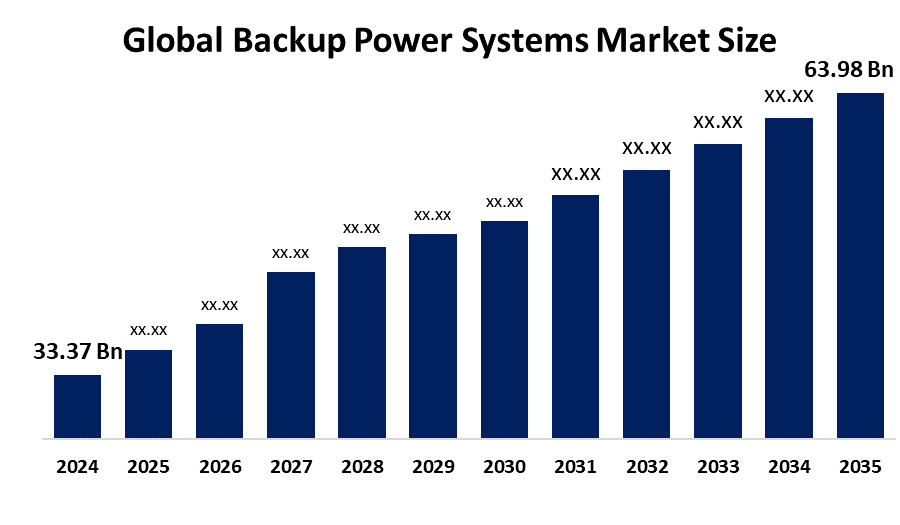
- The Global Backup Power Systems Market Size Was Estimated at USD 33.37 Billion in 2024
- The Market Size is Expected to Grow at a CAGR of around 6.1% from 2025 to 2035
- The Worldwide Backup Power Systems Market Size is Expected to Reach USD 63.98 Billion by 2035
- North America is expected to grow the fastest during the forecast period.
Get more details on this report -
According to a research report published by Spherical Insights and Consulting, the global backup power systems market size was worth around USD 33.37 billion in 2024 and is predicted to grow to around USD 63.98 billion by 2035 with a compound annual growth rate CAGR of 6.1% from 2025 to 2035. The backup power systems market is expanding due to increasing power outages, aging electrical grids, and growing demand from data centers. Furthermore, rapid urbanization, industrial automation, and the need for renewable energy integration are driving adoption across critical and commercial sectors.
Market Overview
The global backup power systems market refers to the industry providing devices and solutions that ensure uninterrupted power supply during outages, including uninterruptible power supplies UPS generators, and energy storage systems. These systems are widely used across data centers, hospitals, manufacturing facilities telecommunication networks, and residential setups to prevent operational disruptions, data loss, and equipment damage In January 2026, the U.S. DOE issued emergency orders allowing PJM and Duke Energy to deploy backup generation to prevent blackouts in the Mid Atlantic and Carolinas after Winter Storm Fern. With over of backup capacity nationwide, the move ensures grid resilience and reduces costs amid extreme winter conditions.
Market growth is primarily driven by rising power outages, increasing reliance on critical infrastructure, and expanding industrialization worldwide. For instance, the International Energy Agency reports that power interruptions cost businesses approximately 12 of their annual revenue, highlighting the economic impact. Additionally, the surge in cloud computing, smart grids, and IoT applications is boosting demand for reliable backup solutions. Opportunities exist in renewable integrated backup systems, modular UPS, and lithium ion batterybased solutions, reflecting strong adoption across both emerging and developed regions.
Report Coverage
This research report categorizes the backup power systems market based on various segments and regions, forecasts revenue growth, and analyzes trends in each submarket. The report analyses the key growth drivers, opportunities, and challenges influencing the backup power systems market. Recent market developments and competitive strategies such as expansion, type launch, development, partnership, merger, and acquisition, have been included to draw the competitive landscape in the market. The report strategically identifies and profiles the key market players and analyses their core competencies in each sub-segment of the backup power systems market.
Global Backup Power Systems Market Report Coverage
| Report Coverage | Details |
|---|---|
| Base Year: | 2024 |
| Market Size in 2024: | USD 33.37 billion |
| Forecast Period: | 2025-2035 |
| Forecast Period CAGR 2025-2035 : | CAGR of 6.1% |
| 2035 Value Projection: | USD 63.98 billion |
| Historical Data for: | 2020-2023 |
| No. of Pages: | 240 |
| Tables, Charts & Figures: | 90 |
| Segments covered: | By Application,By Power Rating |
| Companies covered:: | Cummins,Generac,Eaton, And Others Players |
| Pitfalls & Challenges: | COVID-19 Empact, Challenges, Future, Growth, & Analysis |
Get more details on this report -
Driving Factors
The global backup power systems market is driven by increasing power outages, with over 1.5 billion people worldwide affected annually, emphasizing the need for reliable electricity. Rising adoption of digital infrastructure, data centers, and telecommunication networks demands uninterrupted power, fueling UPS and generator deployment. Renewable energy integration, particularly solar and wind, requires backup storage systems, boosting lithium-ion and hybrid solutions. Government regulations for grid reliability and industrial continuity further accelerate market growth
Restraining Factors
Key restraining factors for the global backup power systems market include high initial costs, expensive maintenance, and the limited lifespan of diesel generators. Additionally, environmental regulations restricting emissions impact adoption. In 2024, approximately 30 of small enterprises cited cost and compliance challenges as barriers to implementing backup power solutions. Paraphrase this content.
Market Segmentation
The backup power systems market share is classified into technology, power rating, and application.
- The diesel generators segment dominated the market in 2024, approximately 39% and is projected to grow at a substantial CAGR during the forecast period.
Based on the technology, the backup power systems market is divided into diesel generators, gas generators, uninterruptible power supply UPS battery energy storage systems BESS hybrid power solutions, fuel-cell backup systems, and portable power stations. Among these, the diesel generators segment dominated the market in 2024 and is projected to grow at a substantial CAGR during the forecast period. The dominance of growth is attributed to their high reliability, fuel availability, and lower upfront costs compared to alternative backup systems. They are preferred for critical applications like healthcare, data centers, and industrial facilities requiring uninterrupted power during extended outages. Despite environmental concerns, their established supply chain, scalability, and proven performance continue to drive market dominance globally.
- 501 to 2,000 kVA segment accounted for the largest share in 2024, approximately 32% and is anticipated to grow at a significant CAGR during the forecast period.
Based on the power rating, the backup power systems market is divided into up to 50 kVA, 51 to 280 kVA, 281 to 500 kVA, 501 to 2,000 kVA, and above 2,000 kVA. Among these, the 501 to 2,000 kVA segment accounted for the largest share in 2024 and is anticipated to grow at a significant CAGR during the forecast period. This is due to its optimal balance of power output and operational flexibility, making it ideal for data centers, hospitals, manufacturing plants, and commercial complexes. These systems provide sufficient capacity for critical infrastructure while maintaining fuel efficiency and manageable footprint, driving widespread adoption across diverse industrial applications globally
.
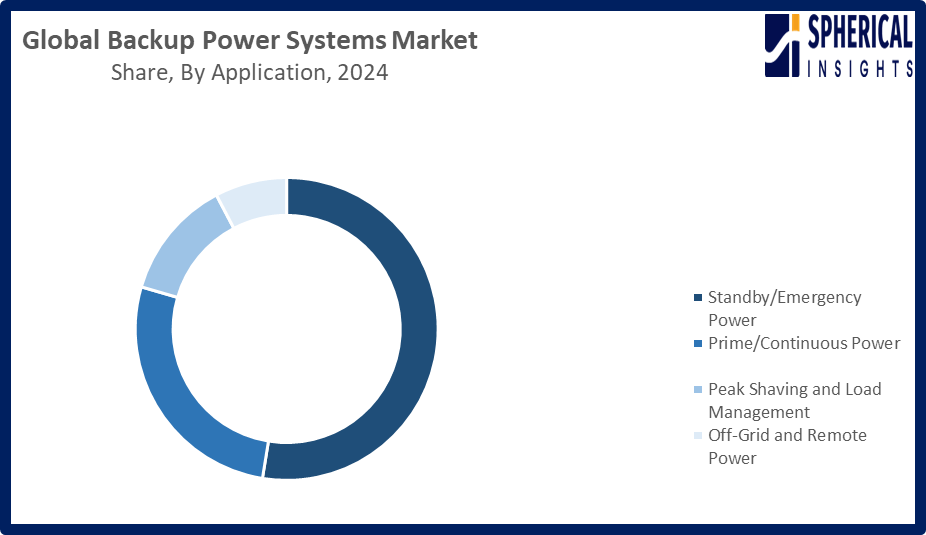
- The standby/emergency power segment accounted for the highest market revenue in 2024, approximately 53% and is anticipated to grow at a significant CAGR during the forecast period.
Based on the application, the backup power systems market is divided into standby emergency power, prime/continuous power, peak shaving and load management, and off-grid and remote power. Among these, the standby/emergency power segment accounted for the highest market revenue in 2024 and is anticipated to grow at a significant CAGR during the forecast period. The market growth is owing to rising frequency of grid outages from extreme weather events and aging infrastructure. Critical facilities such as hospitals, data centers, and telecommunications networks require instantaneous power backup to prevent operational disruptions and revenue losses. Regulatory mandates for emergency preparedness further drive demand for reliable standby systems globally.
Get more details on this report -
Regional Segment Analysis of the Backup Power Systems Market
- North America U.S., Canada, Mexico
- Europe Germany, France, U.K., Italy, Spain, Rest of Europe
- Asia-Pacific China, Japan, India, Rest of APAC
- South America Brazil and the Rest of South America
- The Middle East and Africa UAE, South Africa, Rest of MEA
Asia Pacific is anticipated to hold the largest share of the backup power systems market over the predicted timeframe.
Asia Pacific is anticipated to hold the 47 share of the backup power systems market over the predicted timeframe. The region's growth is due to rapid industrialisation, urbanization, and increasing power demand across countries like China, India, and Japan. Frequent power outages, aging grid infrastructure, and expanding data centers and telecommunication networks further drive adoption. China leads with la
Get more details on this report -
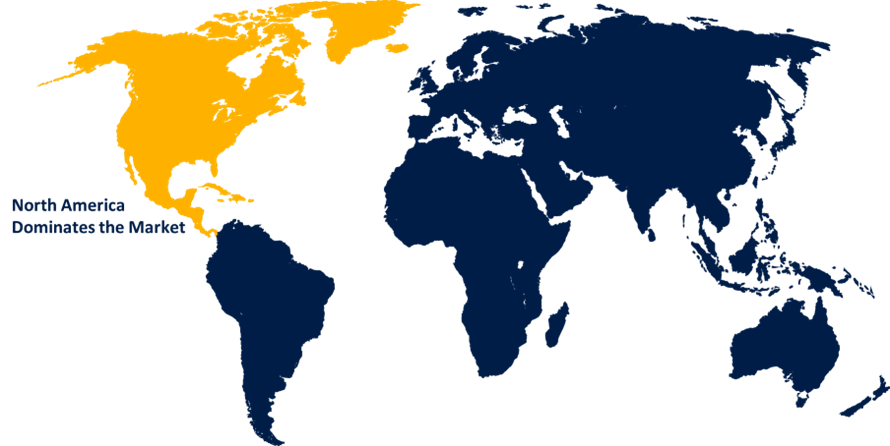
North America is expected to grow at a rapid CAGR in the backup power systems market during the forecast period. North America is rapidly growing in the backup power systems market due to increasing extreme weather events, aging grid infrastructure, and rising demand for reliable power across critical sectors. The United States leads growth with strong investments in data centers, healthcare facilities, and industrial backup systems. Canada supports expansion through renewable energy integration and remote power needs, while Mexico drives demand through industrialization and infrastructure development, collectively boosting regional market growth
Europes backup power systems market is growing due to strict energy regulations, rising renewable energy integration, and increasing grid instability concerns. Germany leads with strong industrial demand and energy transition initiatives, while United Kingdom focuses on data centers and grid resilience. France supports growth through nuclear backed stability and renewable expansion collectively driving demand for reliable backup power solutions across the region.
Competitive Analysis:
The report offers the appropriate analysis of the key organizations companies involved within the backup power systems market, alongwith a comparative evaluation primarily based on their type of offering, business overviews, geographic presence, enterprise strategies, segment market share, and SWOT analysis. The report also provides an elaborative analysis focusing on the current news and developments of the companies, which includes type development, innovations, joint ventures, partnerships, mergers & acquisitions, strategic alliances, and others. This allows for the evaluation of the overall competition within the market.
List of Key Companies
- Cummins Inc.
- Generac Holdings Inc.
- Caterpillar Inc.
- Eaton Corporation
- Tesla
- Kohler Co.
- ABB Ltd
- Atlas Copco AB
- Nidec
- Schneider Electric SE
- Vertiv Co.
- Emerson Electric Co.
- Toshiba Corporation
- Mitsubishi Heavy Industries
- Others
Key Target Audience
- Market Players
- Investors
- End-users
- Government Authorities
- Consulting and Research Firm
- Venture capitalists
- Value-Added Resellers (VARs)
Recent Development
- In November 2025, Caterpillar Inc. launched a 31 MW power node for its G3520 Fast Response gas generator, enhancing standby and microgrid support. Integrated with DERMS like Cat AMP, it enables demand response participation, helping users optimize energy use and generate additional revenue during peak demand periods.
- In July 2025, Sunrun partnered with Tesla Energy to launch a home energy plan in Texas, combining solar and battery backup. The plan offers fixed electricity rates, competitive solar sellback, enhanced outage protection, and improved energy independence for residential customers.
- In July 2025, Atlas Copco launched the ZBC 1000 1200 its largest containerized energy storage system, delivering 1 MW output and 1.2 MWh capacity. Designed for construction, mining, and emergency use, it reduces emissions by up to 90 while ensuring reliable power and cost savings.
- In June 2025, Cummins India Limited launched Battery Energy Storage Systems BESS under its Destination Zero strategy, supporting India’s clean energy transition. The solution enhances renewable integration, improves power reliability, and enables industries like manufacturing and data centers to optimize energy costs through peak shaving and energy shifting.
Market Segment
This study forecasts revenue at global, regional, and country levels from 2020 to 2035. Spherical Insights has segmented the backup power systems market based on the below-mentioned segments:
Global Backup Power Systems Market, By Technology
- Diesel Generators
- Gas Generators
- Uninterruptible Power Supply (UPS)
- Battery Energy Storage Systems (BESS)
- Hybrid Power Solutions
- Fuel-Cell Backup Systems
- Portable Power Stations
Global Backup Power Systems Market, By Power Rating
- Up to 50 kVA
- 51 to 280 kVA
- 281 to 500 kVA
- 501 to 2,000 kVA
- Above 2,000 kVA
Global Backup Power Systems Market, By Application
- Standby/Emergency Power
- Prime/Continuous Power
- Peak Shaving and Load Management
- Off-Grid and Remote Power
Global Backup Power Systems Market, By Regional Analysis
- North America
- US
- Canada
- Mexico
- Europe
- Germany
- UK
- France
- Italy
- Spain
- Russia
- Rest of Europe
- Asia Pacific
- China
- Japan
- India
- South Korea
- Australia
- Rest of Asia Pacific
- South America
- Brazil
- Argentina
- Rest of South America
- Middle East & Africa
- UAE
- Saudi Arabia
- Qatar
- South Africa
- Rest of the Middle East & Africa
Frequently Asked Questions (FAQ)
-
1.How is the growing frequency of power outages impacting demand in the global backup power systems market?Rising power outages, impacting 350 million+ people globally and increasing by 25% in some regions, are significantly boosting demand for backup power systems, as businesses and households seek reliable, uninterrupted electricity.
-
2. What economic factors are affecting investment in backup power infrastructure globally?Rising economic losses from outages, costing $28, $169 billion annually and up to $1 million per hour for industries, along with $177 billion in grid upgrade needs by 2030, are key factors driving global investment in backup power infrastructure.
-
3. How are technological innovations like lithium-ion batteries and hybrid systems reshaping backup power solutions?Technological innovations like lithium-ion batteries, whose costs have fallen 85-89% since 2010, and hybrid systems with 42% adoption growth are enhancing efficiency, enabling renewable integration, and delivering 35% higher performance, transforming backup power solutions into smarter, cost-effective, and scalable systems.
-
4. What role do government policies and regulations play in shaping market growth and innovation?Government policies and regulations significantly drive market growth by offering subsidies, mandates, and tax incentives, e.g., India’s ₹91 billion funding and 40% capital support schemes, reducing costs, boosting investment, and accelerating innovation in backup power and energy storage solutions globally.
-
5. How are advancements in smart grids and IoT influencing backup power system efficiency and demand?Advancements in smart grids and IoT are improving backup power efficiency by reducing outage durations by 40-60%, lowering energy use by 5-15%, and cutting costs by 25-30%, thereby increasing demand for intelligent, automated backup power systems.
-
6. What are the major cost challenges impacting small and medium enterprises in adopting backup power systems?High upfront costs and maintenance expenses significantly hinder SMEs, with 35-37% citing installation costs and 29-40% reporting maintenance burdens. Additionally, battery replacements every 3-5 years and skilled labor costs increase total ownership, limiting the adoption of backup power systems.
-
7. How is the shift toward clean energy solutions affecting traditional diesel generator demand?The shift toward clean energy is reducing diesel generator demand, with zero-carbon sources exceeding 40% of global electricity in 2023 and diesel genset sales declining by 10% annually, as solar, wind, and storage replace fossil-based backup solutions.
-
8. What future innovations are expected to transform the economic and operational landscape of backup power systems?Future innovations such as AI-enabled energy management, advanced lithium-ion and solid-state batteries (improving efficiency by 30-40%), and hybrid microgrids, used in 78% of systems, are transforming backup power by reducing costs, enhancing reliability, and enabling scalable, intelligent energy solutions globally
Need help to buy this report?