Global Aviation Biofuel Market Size, Share, and COVID-19 Impact Analysis, By Type of Biofuel (Alcohol-to-Jet (ATJ), Fischer-Tropsch (FT), Hydro Processed Esters & Fatty Acids (HEFA), Hydrotreated Vegetable Oil (HVO), and Synthetic Iso-Paraffins (SIP)), By Type of Application (Commercial and Military), and By Region (North America, Europe, Asia-Pacific, Latin America, Middle East, and Africa), Analysis and Forecast 2025 - 2035.
Industry: Energy & Power
Global Aviation Biofuel Market Insights Forecasts to 2035
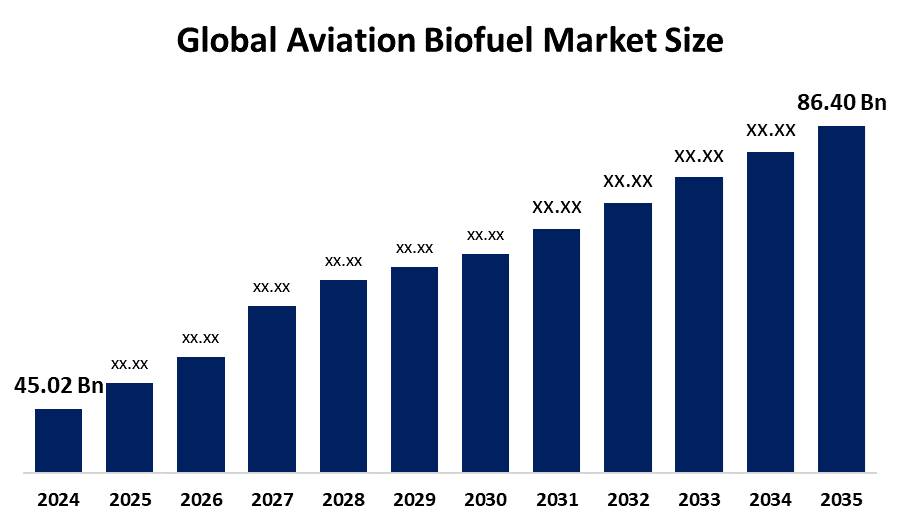
- The Global Aviation Biofuel Market Size Was Estimated at USD 45.02 Billion in 2024
- The Market Size is Expected to Grow at a CAGR of around 6.11% from 2025 to 2035
- The Worldwide Aviation Biofuel Market Size is Expected to Reach USD 86.40 Billion by 2035
Get more details on this report -
Key Takeaways -
- North America dominated the market with the largest share in 2024.
- Asia Pacific is expected to grow the fastest during the forecast period.
- By type of biofuel, the hydro processed esters & fatty acids (HEFA) segment dominates the market with the largest share of about 45.0%, while the Fischer-Tropsch (FT) is the rapidly growing segment in the market.
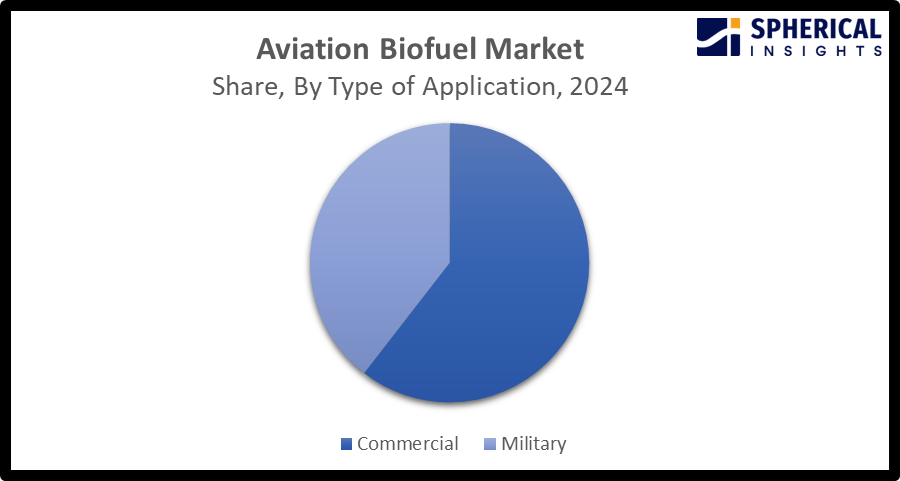
- By type of application, the commercial segment is anticipated to hold the dominant share of about 60.5%, on the other hand, the military segment is the fastest growing segment with 7.8% in the aviation biofuel market.
According to a research report published by Spherical Insights and Consulting, the Global Aviation Biofuel Market size was worth around USD 45.02 Billion in 2024 and is predicted to grow to around USD 86.40 Billion by 2035 with a compound annual growth rate (CAGR) of 6.11% from 2025 and 2035. The market for aviation biofuel has a number of opportunities to grow due to feedstock innovation, scaling production technologies, and long-term airline offtake agreements.
Market Overview
The global aviation biofuel industry is the market that focuses on producing renewable, sustainable aviation fuel (SAF) from biomass (waste oils, agricultural residues) to reduce aviation’s carbon footprint. Aviation biofuel is a renewable jet fuel produced from sustainable sources used to power aircraft. The International Air Transport Association (IATA) considers it a key element in reducing the environmental impact of aviation. Aviation biofuel is used to decarbonize medium and long-haul air travel.
Major industries increasing investment to fulfil industrial needs are driving the market expansion. It is expected that sustainable aviation fuel demand will reach 17 million tonnes per annum (Mt/a), representing 4-5% of total jet fuel consumption at a global pace. To meet likely demand in 2030 needs an additional 5.8 Mt of capacity is needed, which would need to secure final investment decisions by 2026.
Report Coverage
This research report categorizes the Aviation Biofuel market based on various segments and regions, forecasts revenue growth, and analyzes trends in each submarket. The report analyses the key growth drivers, opportunities, and challenges influencing the Aviation Biofuel market. Recent market developments and competitive strategies such as expansion, type launch, development, partnership, merger, and acquisition have been included to draw the competitive landscape in the market. The report strategically identifies and profiles the key market players and analyses their core competencies in each sub-segment of the Aviation Biofuel market.
Global Aviation Biofuel Market Report Coverage
| Report Coverage | Details |
|---|---|
| Base Year: | 2024 |
| Market Size in 2024: | USD 45.02 Billion |
| Forecast Period: | 2025-2035 |
| Forecast Period CAGR 2025-2035 : | CAGR of 6.11% |
| 2035 Value Projection: | USD 86.40 billion |
| Historical Data for: | 2020-2023 |
| No. of Pages: | 240 |
| Tables, Charts & Figures: | 100 |
| Segments covered: | By Type of Biofuel, By Type of Application |
| Companies covered:: | Neste, SkyNRG, Geno, Inc., Honeywell, TotalEnergies, Shell, World Energy, Chevron, LanzaJet, BP Inc., Exxon Mobil Corporation, and Others |
| Pitfalls & Challenges: | COVID-19 Empact, Challenge, Future, Growth, & Analysis |
Get more details on this report -
Driving Factors
Airline commitments to sustainability
Regulatory requirements, industry pledges, and increasing urgency for cleaner transportation options are enabling progress in SAF technology, which is a renewable alternative to traditional jet fuel with substantially lower carbon emissions. Several airlines have announced ambitious targets to achieve net-zero emissions by 2050, with biofuels playing an important role in the plan. For instance, airlines are expected to purchase over 5 billion gallons of sustainable aviation fuel by 2030, indicating a robust market potential.
Collaborative efforts and technological innovation
Collaboration between airlines, fuel producers, and research institutions is facilitating the development and commercialization of biofuels to overcome the challenges associated with biofuel production and distribution. Further, innovation in production processes, like the development of advanced fermentation techniques and the use of waste feed stocks for enhancing the efficiency and cost-effectiveness of biofuel production, is propelling the aviation biofuel market.
Environmental concerns and government policies & incentives
Biofuels derived from renewable resources provide a viable alternative to traditional fossil fuels, potentially reducing carbon emissions by up to 80%, reflecting a broader commitment to sustainability. In addition, supportive government frameworks encourage the adoption of biofuels in aviation.
Restraining Factors
Increased cost and complex regulatory framework
An increased cost of biofuel compared to traditional jet fuels is a challenging factor in the market. Sustainable aviation fuel, also called aviation biofuel, generally costs 2 to 5 times more than conventional fossil jet fuel, with prices ranging from approximately €1,461 to over €7,695 per tonne depending on production technology (biofuels vs. e-fuels). Additionally, policy and regulatory frameworks impact biofuel production in the aviation industry, ultimately restricting market growth.
Market Segmentation
The Aviation Biofuel Market share is classified into type of biofuel and type of application.
- The hydro processed esters & fatty acids (HEFA) segment dominated the market with the largest share of about 45.0% in 2024 and is projected to grow at a substantial CAGR during the forecast period.
Based on the type of biofuel, the aviation biofuel market is divided into alcohol-to-jet (ATJ), fischer-tropsch (FT), hydro processed esters & fatty acids (HEFA), hydrotreated vegetable oil (HVO), and synthetic iso-paraffins (SIP). Among these, the hydro processed esters & fatty acids (HEFA) segment dominated the market with the largest share of about 45.0% in 2024 and is projected to grow at a substantial CAGR during the forecast period. This is due to increasing investment and supportive government policies. HEFA is considered the most mature, commercialized, and cost-effective pathway for producing sustainable aviation fuel (SAF), converting renewable fats, oils, and greases into bio-jet fuel. While the Fischer-Tropsch (FT) segment is the rapidly growing segment in the aviation biofuel market, due to its use across a broad range of renewable and waste-based feedstocks, such as municipal solid waste and biomass residues.
- The commercial segment accounted for the dominant market share of about 60.5% in 2024 and is projected to grow at a substantial CAGR during the forecast period.
Based on the type of application, the aviation biofuel market is divided into commercial and military. Among these, the commercial segment accounted for the dominant market share of about 60.5% in 2024 and is projected to grow at a substantial CAGR during the forecast period. The segment primarily includes commercial passenger airlines, air cargo & logistics, and general & charter aviation. The growing emphasis on sustainability and cost-efficiency to meet 2050 net-zero goals contributes to driving market growth. Further, the military segment is the fastest segment with a CAGR of about 7.8%, driven by a preference for energy security, fuel versatility, and performance, often using high-blend ratios or 100% synthetic fuels like JP8 derived from waste.
Get more details on this report -
Regional Segment Analysis of the Aviation Biofuel Market
- North America (U.S., Canada, Mexico)
- Europe (Germany, France, U.K., Italy, Spain, Rest of Europe)
- Asia-Pacific (China, Japan, India, Rest of APAC)
- South America (Brazil and the Rest of South America)
- The Middle East and Africa (UAE, South Africa, Rest of MEA)
North America is anticipated to hold the largest share of the Aviation Biofuel market over the predicted timeframe.
North America is anticipated to hold the largest share of about 42.5% in the aviation biofuel market over the predicted timeframe. The market ecosystem in North America is strong, due to government incentives and airline decarbonization goals. The U.S. is leading the North America Aviation Biofuel market, holding over 47.0% regional share in 2024, due to robust federal mandates such as the Renewable Fuel Standards and the Inflation Reduction Act tax credits.

Get more details on this report -
Asia Pacific is expected to grow at a rapid CAGR in the aviation biofuel market during the forecast period. The Asia Pacific area has a thriving market for aviation biofuels due to the increasing demand for decarbonization, as well as strict environmental regulations & net zero goals. India is the fastest-growing country in the Asia Pacific aviation biofuel market, owing to rapid aviation growth along with increasing investments and upcoming SAF mandates.
Competitive Analysis:
The report offers the appropriate analysis of the key organizations/companies involved within the aviation biofuel market, along with a comparative evaluation primarily based on their type of offering, business overviews, geographic presence, enterprise strategies, segment market share, and SWOT analysis. The report also provides an elaborative analysis focusing on the current news and developments of the companies, which includes type development, innovations, joint ventures, partnerships, mergers & acquisitions, strategic alliances, and others. This allows for the evaluation of the overall competition within the market.
List of Key Companies
- Neste
- SkyNRG
- Geno, Inc.
- Honeywell
- TotalEnergies
- Shell
- World Energy
- Chevron
- LanzaJet
- BP Inc.
- Exxon Mobil Corporation
- Others
Key Target Audience
- Market Players
- Investors
- End-users
- Government Authorities
- Consulting And Research Firm
- Venture capitalists
- Value-Added Resellers (VARs)
Recent Development
In March 2026, Clariant, a sustainability-focused specialty chemical company, announced a strategic collaboration with Vertimass LLC, aiming to accelerate the development and commercialization of advanced zeolite catalysts for the catalytic conversion of biobased alcohols via Vertimass Consolidated Alcohols Deoxygenation and Oligomerization (CADO) process.
In November 2025, Lootah Biofuels and SimpliFlying signed a memorandum of understanding (MoU) aimed at strengthening collaboration in the field of sustainability across the aviation sector, with a focus on developing and promoting the use of sustainable aviation fuel (SAF).
In November 2025, Mena Biofuels advances UAE’s first commercial sustainable aviation fuel plant in Fujairah. The facility would convert used cooking oil and waste-based feedstocks into certified sustainable aviation fuel meeting international standards.
In August 2024, as the world grapples with the urgent need to reduce carbon emissions, the aviation industry has come under increasing scrutiny due to its significant contribution to global greenhouse gas emissions.
Market Segment
This study forecasts revenue at global, regional, and country levels from 2020 to 2035. Spherical Insights has segmented the Aviation Biofuel Market based on the below-mentioned segments:
Global Aviation Biofuel Market, By Type of Biofuel
- Alcohol-to-Jet (ATJ)
- Fischer-Tropsch (FT)
- Hydro Processed Esters & Fatty Acids (HEFA)
- Hydrotreated Vegetable Oil (HVO)
- Synthetic Iso-Paraffins (SIP)
Global Aviation Biofuel Market, By Type of Application
- Commercial
- Military
Global Aviation Biofuel Market, By Regional Analysis
- North America
- US
- Canada
- Mexico
- Europe
- Germany
- UK
- France
- Italy
- Spain
- Russia
- Rest of Europe
- Asia Pacific
- China
- Japan
- India
- South Korea
- Australia
- Rest of Asia Pacific
- South America
- Brazil
- Argentina
- Rest of South America
- Middle East & Africa
- UAE
- Saudi Arabia
- Qatar
- South Africa
- Rest of the Middle East & Africa
Frequently Asked Questions (FAQ)
-
1. What is the market size of the aviation biofuel market?The global aviation biofuel market size is expected to grow from USD 45.02 Billion in 2024 to USD 86.40 Billion by 2035, at a CAGR of 6.11% during the forecast period 2025-2035.
-
2. Which region holds the largest share of the aviation biofuel market?North America is anticipated to hold the largest share of the aviation biofuel market over the predicted timeframe.
-
3. What is the forecasted CAGR of the Global Aviation Biofuel Market from 2024 to 2035?The market is expected to grow at a CAGR of around 6.11% during the period 2024–2035.
-
4. Who are the top companies that are involved in the Global Aviation Biofuel Market?Key players include Neste, SkyNRG, Geno, Inc., Honeywell, TotalEnergies, Shell, World Energy, Chevron, LanzaJet, BP Inc., and Exxon Mobil Corporation.
-
5. What are the main drivers in the aviation biofuel market?Airline commitments to sustainability, collaborative efforts, technological innovation, environmental concerns, and government policies & incentives are major market growth drivers of the Aviation Biofuel market.
-
6. What challenges are limiting the adoption of Aviation Biofuel?Factors like an increased cost and complex regulatory framework remain key restraints in the Aviation Biofuel market.
-
7. What are the key trends in the aviation biofuel market?The inclination towards waste-based feedstocks like used cooking oil and agricultural waste, as well as the increasing strategic collabs between airlines and producers for securing supply, are major key trends in the aviation biofuel market.
Need help to buy this report?