Global Automotive Components Forging Market Size, Share, and COVID-19 Impact Analysis, By Product (Closed Die Forgings, Open Die Forgings, and Rolling Rings Forgings), By Application (Power Train Components, Chassis Components, Transmission Parts, and Other Parts), and By Region (North America, Europe, Asia-Pacific, Latin America, Middle East, and Africa), Analysis and Forecast 2025 - 2035.
Industry: Automotive & Transportation
Global Automotive Components Forging Market Insights Forecasts to 2035
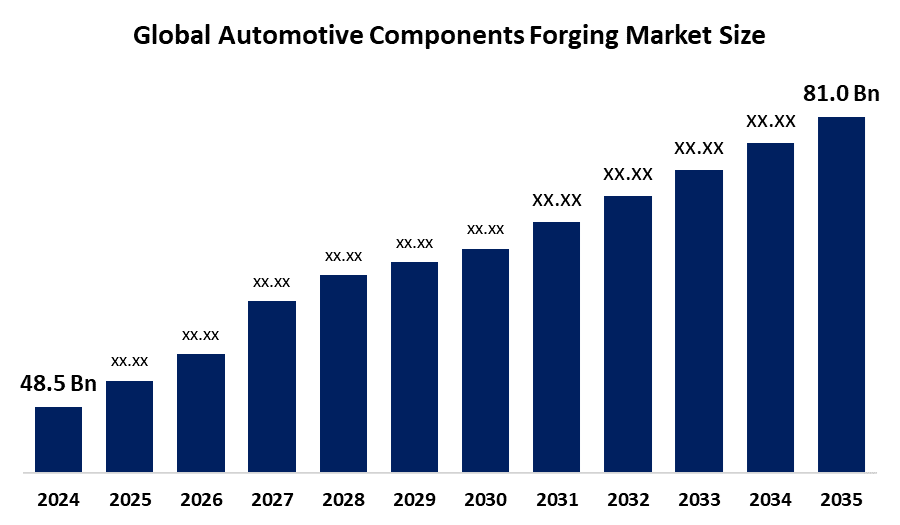
- The Global Automotive Components Forging Market Size Was Estimated at USD 48.5 Billion in 2024
- The Market Size is Expected to Grow at a CAGR of around 4.77% from 2025 to 2035
- The Worldwide Automotive Components Forging Market Size is Expected to Reach USD 81.0 Billion by 2035
Get more details on this report -
Key Takeaways -
- North America dominated the market with the largest share in 2024.
- Asia Pacific is expected to grow the fastest during the forecast period.
- By product, the closed die forgings segment dominates the automotive components forging market, while the open die forgings segment is the emerging segment in the market.
- By application, the power train components segment is anticipated to hold the dominant share, on the other hand, the chassis components segment is emerging in the automotive components forging market.
According to a research report published by Spherical Insights and Consulting, the Global Automotive Components Forging Market size was worth around USD 48.5 Billion in 2024 and is predicted to grow to around USD 81.0 Billion by 2035 with a compound annual growth rate (CAGR) of 4.77% from 2025 and 2035. The market for automotive components forging has a number of opportunities to grow due to the production of aluminum-forged parts for weight reduction, the use of precision/near-net-shape techniques, and the adoption of AI-powered automation for reducing manufacturing defects.
Market Overview
The global automotive components forging industry involves producing high-strength metal parts- such as crankshafts, connecting rods, and gears using compressive forces to shape steel or aluminum. The market is driven by the need for durable, lightweight components that improve vehicle fuel efficiency, performance, and safety. Automotive components forging is a manufacturing process that uses localized compressive forces to shape metal (typically steel, aluminum, or titanium) into durable, high-strength parts for vehicles. In the automotive sector, forged parts are crucial for vehicles’ structural integrity and performance. Components like crankshafts, connecting rods, steering knuckles, and axles are typically forged to withstand extreme stresses.
Innovation and market expansion are anticipated as a result of major players' growing R&D expenditures and expanding partnerships. For instance, in May 2025, the Abu Dhabi Investment Office (ADIO) announced the launch of a major economic programme targeting the establishment of an end-to-end automotive ecosystem.
Report Coverage
This research report categorizes the automotive components forging market based on various segments and regions, forecasts revenue growth, and analyzes trends in each submarket. The report analyses the key growth drivers, opportunities, and challenges influencing the Automotive Components Forging market. Recent market developments and competitive strategies such as expansion, type launch, development, partnership, merger, and acquisition have been included to draw the competitive landscape in the market. The report strategically identifies and profiles the key market players and analyses their core competencies in each sub-segment of the automotive components forging market.
Global Automotive Components Forging Market Report Coverage
| Report Coverage | Details |
|---|---|
| Base Year: | 2024 |
| Market Size in 2024: | USD 48.5 billion |
| Forecast Period: | 2025-2035 |
| Forecast Period CAGR 2025-2035 : | CAGR of 4.77% |
| 2035 Value Projection: | USD 81.0 billion |
| Historical Data for: | 2020-2023 |
| No. of Pages: | 240 |
| Tables, Charts & Figures: | 120 |
| Segments covered: | By Product, By Application |
| Companies covered:: | ThyssenKrupp, FAW, Arconic, Bharat Forge Limited, Nippon Steel & Sumitomo Metal, Aichi Steel, Farinia Group, AAM Forge, KOBELCO, Wanxiang, Mahindra Forgings Europe, Longcheng Forging, NTN Corporation, American Axle and Manufacturing Inc., and Others |
| Pitfalls & Challenges: | COVID-19 Empact, Challenge, Future, Growth, & Analysis |
Get more details on this report -
Driving Factors
Demand from automobile sector
An increasing urbanization and middle-class population in developing countries is driving the demand for automobiles with lower emissions and better fuel economy. Due to aluminum lightweight, high strength, long durability, corrosion resistance, and temperature handling capability, vehicle parts made of aluminum alloys reduce energy loss due to friction and enhance operating efficiency.
Industrialization & infrastructure development
Forgings are suitable for applications requiring high load-bearing capacities and resistance to fatigue due to their ability to exhibit excellent strength and durability, due to the alignment of the metal’s grain structure during the forging process. It can be done on various metals like steel, aluminum, titanium, and some alloys, as per the specific components' needs.
Innovation in forging technology
Innovation is the key driver of the industry. Precision forging, additive manufacturing, smart equipment, sustainability initiatives, and collaborative efforts within the industry are some advancements that not only ensure competitiveness but also contribute to a more sustainable and efficient future for the forging industry.
Restraining Factors
Inclination towards electric vehicles
Decreased need for fewer forged parts, volatility in raw material prices, and intense competition with cheaper manufacturing alternatives like casting
Increased capital investment and strict environmental regulations
Significant investment in high-tonnage presses, heat treatment facilities, and tooling is challenging the market. The increased cost of machinery, energy prices, is creating entry barriers for key players, which leads to high-capital requirements, like Ramkrishna Forgings acquisition of JMT Auto. Further, associated environmental regulations in automotive component forging are challenging the market growth.
Market Segmentation
The Automotive Components Forging Market share is classified into product and application.
- The closed die forgings segment dominated the market with the largest share of about 67.0% in 2024 and is projected to grow at a substantial CAGR during the forecast period.
Based on the product, the automotive components forging market is divided into closed die forgings, open die forgings, and rolling rings forgings. Among these, the closed die forgings segment dominated the market with the largest share of about 67.0% in 2024 and is projected to grow at a substantial CAGR during the forecast period. This is due to its cost-effectiveness, and capability to forge any metal. In closed die forging, metal is shaped at high temperature using a die. Closed die forging is different from open die forging, in which the workpiece is contained in a set of dies which shape it through the application of pressure. While the open die forgings segment is the emerging segment in the automotive components forging market, due to its improved microstructure, decreased voids, and smoother grain movement.
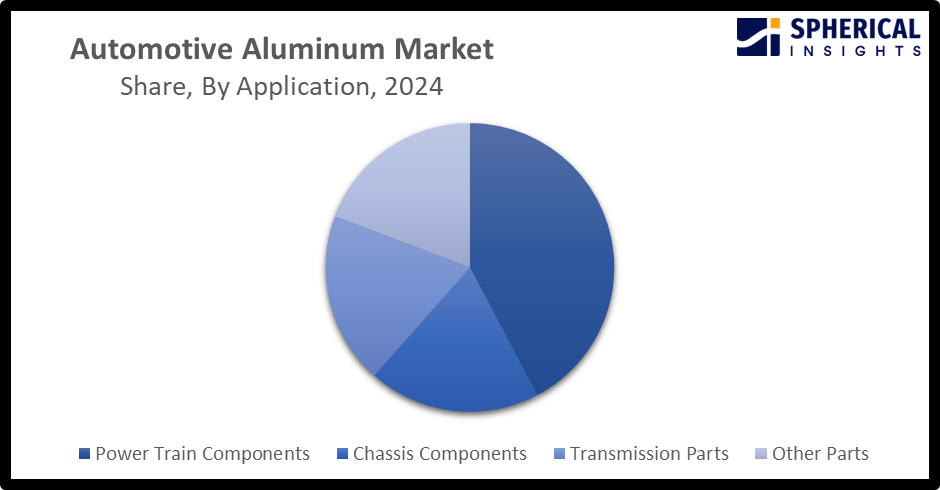
- The power train components segment accounted for the dominant market share of about 44.0% in 2024 and is projected to grow at a substantial CAGR during the forecast period.
Based on the application, the automotive components forging market is divided into power train components, chassis components, transmission parts, and other parts. Among these, the power train components segment accounted for the dominant market share of about 44.0% in 2024 and is projected to grow at a substantial CAGR during the forecast period. The increased demand for forged gears, connecting rods, and crankshafts for ensuring torque transmission and mechanical efficiency contributes to driving the segmental market growth. Further, the chassis components segment is a rapidly growing segment driven by advancements in vehicle suspension systems, steering mechanisms, and braking systems that needs increased strength and precision-forged parts.
Get more details on this report -
Regional Segment Analysis of the Automotive Components Forging Market
- North America (U.S., Canada, Mexico)
- Europe (Germany, France, U.K., Italy, Spain, Rest of Europe)
- Asia-Pacific (China, Japan, India, Rest of APAC)
- South America (Brazil and the Rest of South America)
- The Middle East and Africa (UAE, South Africa, Rest of MEA)
North America is anticipated to hold the largest share of the Automotive Components Forging market over the predicted timeframe.
North America is anticipated to hold the largest share of about 30.0% in the Automotive Components Forging market over the predicted timeframe. The market demand for automotive components forgings has been driven by the region's increasing demand for lightweight high-strength parts, due to stringent fuel efficiency standards and the rapid growth of electric vehicles. The U.S. is leading the North America automotive components forging market with about 80.0% region’s share, due to EV transition, material trends, regional production, and closed die forging technology.

Get more details on this report -
Asia Pacific is expected to grow at a rapid CAGR of approximately 3.7% in the automotive components forging market during the forecast period. The Asia Pacific area has a thriving market for automotive components forgings due to the increasing vehicle production volumes and demand for high-strength, lightweight components for fuel efficiency and vehicle performance. China is the leading country in the region’s market, holding about 50.0% of the regional market, owing to increasing strategic partnerships.
Competitive Analysis:
The report offers the appropriate analysis of the key organizations/companies involved within the automotive components forging market, along with a comparative evaluation primarily based on their type of offering, business overviews, geographic presence, enterprise strategies, segment market share, and SWOT analysis. The report also provides an elaborative analysis focusing on the current news and developments of the companies, which includes type development, innovations, joint ventures, partnerships, mergers & acquisitions, strategic alliances, and others. This allows for the evaluation of the overall competition within the market.
List of Key Companies
- ThyssenKrupp
- FAW
- Arconic
- Bharat Forge Limited
- Nippon Steel & Sumitomo Metal
- Aichi Steel
- Farinia Group
- AAM Forge
- KOBELCO
- Wanxiang
- Mahindra Forgings Europe
- Longcheng Forging
- NTN Corporation
- American Axle and Manufacturing Inc.
- Others
Key Target Audience
- Market Players
- Investors
- End-users
- Government Authorities
- Consulting And Research Firm
- Venture capitalists
- Value-Added Resellers (VARs)
Recent Development
In November 2025, Ramkrishna Forgings drive toward diversification and expansion, aggressively repositioning itself from a traditional automotive supplier to a diversified, global metal processing powerhouse.
In July 2025, Gurugram-based auto component maker Sona BLW Precision Forgings Ltd. (Sona Comstar) is entering China’s booming EV market through a joint venture with Jinnaite Machinery Co., Ltd (JNT), the company announced.
In July 2025, Auto parts maker Sona BLW Precision Forgings Ltd (Sona Comstar) entered into a joint venture with China-based Jinnaite Machinery Co Ltd (JNT) to make a strategic foray into the Chinese electric vehicle market.
Market Segment
This study forecasts revenue at global, regional, and country levels from 2020 to 2035. Spherical Insights has segmented the Automotive Components Forging Market based on the below-mentioned segments:
Global Automotive Components Forging Market, By Product
- Closed Die Forgings
- Open Die Forgings
- Rolling Rings Forgings
Global Automotive Components Forging Market, By Application
- Power Train Components
- Chassis Components
- Transmission Parts
- Other Parts
Global Automotive Components Forging Market, By Regional Analysis
- North America
- US
- Canada
- Mexico
- Europe
- Germany
- UK
- France
- Italy
- Spain
- Russia
- Rest of Europe
- Asia Pacific
- China
- Japan
- India
- South Korea
- Australia
- Rest of Asia Pacific
- South America
- Brazil
- Argentina
- Rest of South America
- Middle East & Africa
- UAE
- Saudi Arabia
- Qatar
- South Africa
- Rest of the Middle East & Africa
Frequently Asked Questions (FAQ)
-
1. What is the market size of the automotive components forging market?The global automotive components forging market size is expected to grow from USD 48.5 Billion in 2024 to USD 81.0 Billion by 2035, at a CAGR of 4.77% during the forecast period 2025-2035.
-
2. Which region holds the largest share of the automotive components forging market?North America is anticipated to hold the largest share of the automotive components forging market over the predicted timeframe.
-
3. What is the forecasted CAGR of the Global Automotive Components Forging Market from 2024 to 2035?The market is expected to grow at a CAGR of around 4.77% during the period 2024–2035.
-
4. Who are the top companies that are involved in the Global Automotive Components Forging Market?Key players include ThyssenKrupp, FAW, Arconic, Bharat Forge Limited, Nippon Steel & Sumitomo Metal, Aichi Steel, Farinia Group, AAM Forge, KOBELCO, Wanxiang, Mahindra Forgings Europe, Longcheng Forging, NTN Corporation, and American Axle and Manufacturing Inc.
-
5. What are the main drivers in the automotive components forging market?An increasing demand from the automotive sector, industrialization & infrastructure development, and an advancement in forging technology are major market growth drivers of the Automotive Components Forging market.
-
6. What challenges are limiting the adoption of Automotive Components Forging?Factors like an increased capital investment, strict environmental regulations, and inclination towards electric vehicles remain key restraints in the Automotive Components Forging market.
-
7. What are the key trends in the automotive components forging market?The integration of AI-driven automation, additive manufacturing and sustainable practices, are major key trends in the automotive components forging market.
Need help to buy this report?