Global Autologous Fat Grafting Market Size, Share, and COVID-19 Impact Analysis, By Product Type (Fat Harvesting & Aspiration Systems, Fat Processing/Purification Systems, Integrated Fat Transfer Systems, and Accessories & Consumables (Cannulas, Tubing)), By Application (Breast Augmentation & Reconstruction, Facial Fat Grafting/Rejuvenation, Buttock Augmentation (BBL), and Hand Rejuvenation & Others), By End-User (Hospitals, Clinics & Plastic Surgery Centers, and Medical Spas), and By Region (North America, Europe, Asia-Pacific, Latin America, Middle East, and Africa), Analysis and Forecast 2025 - 2035
Industry: Healthcare
Global Autologous Fat Grafting Market Insights Forecasts to 2035
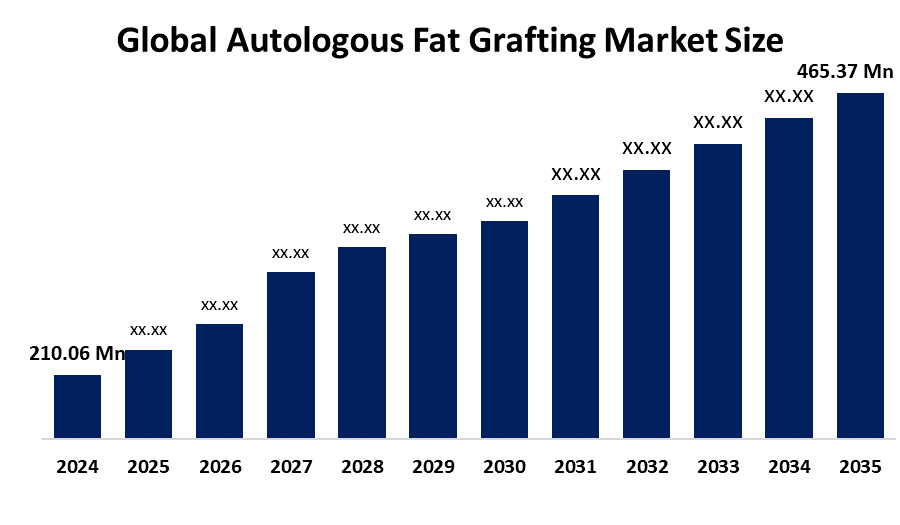
- The Global Autologous Fat Grafting Market Size Was Estimated at USD 210.06 Million in 2024
- The Market Size is Expected to Grow at a CAGR of around 7.5% from 2025 to 2035
- The Worldwide Autologous Fat Grafting Market Size is Expected to Reach USD 465.37 Million by 2035
- Asia Pacific is expected to grow the fastest during the forecast period.
Get more details on this report -
According to a research report published by Spherical Insights and Consulting, the global autologous fat grafting market size was worth around USD 210.06 million in 2024 and is predicted to grow to around USD 465.37 million by 2035 with a compound annual growth rate (CAGR) of 7.5% from 2025 to 2035. The autologous fat grafting market is growing due to rising demand for minimally invasive, natural-looking aesthetic procedures, advanced fat-processing technologies, and increased use in reconstructive surgery. High adoption of buttock/breast augmentation and improved safety profiles drive this expansion.
Autologous Fat Grafting Market Key Takeaways
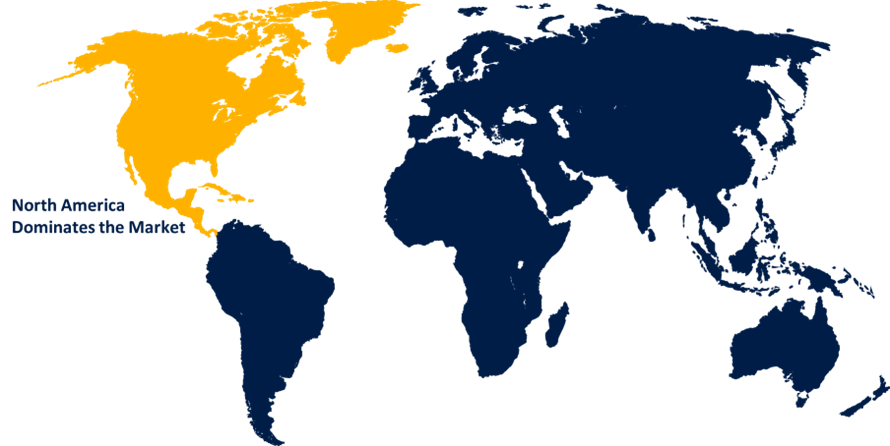
- By region, North America held the largest market share of 39 in 2024.
- By region, Asia Pacific is expected to grow at the fastest CAGR during the foreseeable period.
- By product type, the fat harvesting and aspiration systems segment led the global autologous fat grafting market with a share of approximately 34 in 2024.
- By product type, the integrated fat transfer systems segment is expected to grow at the fastest CAGR in the market between 2024 and 2035.
- By application, the breast augmentation and reconstruction segment contributed the biggest revenue share of approximately 39 in the market in 2024.
- By application, buttock argumentation (BBL) segment is projected to grow at the fastest CAGR during the foreseeable period.
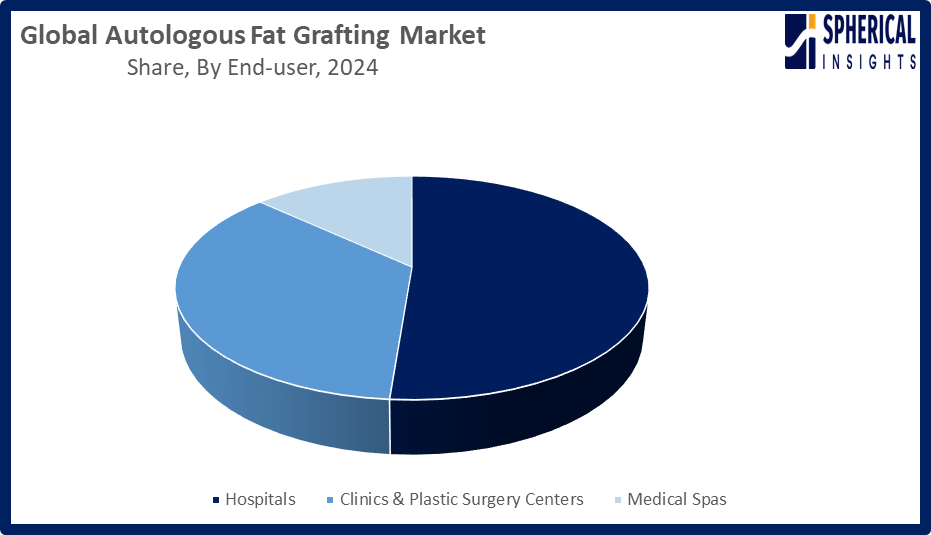
- By the user, the hospitals segment contributed the biggest revenue share of approximately 51 in the market in 2024.
- By end user, the clinics and plastic surgery centers segment is projected to grow at the fastest CAGR during the foreseeable period.
Market Overview
The global autologous fat grafting market refers to a medical and aesthetic procedure in which a patient’s own fat is harvested, processed, and reinjected into targeted areas to restore volume, enhance contours, or repair tissue damage. Widely used in breast augmentation, facial rejuvenation, buttock enhancement, and reconstructive surgeries, the technique offers natural results with minimal risk of rejection. Key drivers include rising demand for minimally invasive cosmetic procedures, increasing aesthetic awareness, and technological advancements in fat processing systems. Additionally, the growing ageing population and the preference for natural alternatives to synthetic fillers are accelerating adoption.
Opportunities lie in regenerative medicine applications and in expanding medical tourism, particularly in emerging economies, thereby supporting sustained global market expansion. Anthem Blue Cross and Blue Shield implemented an updated clinical guideline, CG-SURG-123, on August 1, 2025, for autologous fat grafting and injectable fillers. The revision includes administrative updates, notably the addition of dental code D9914, reflecting ongoing refinement of procedure classification, coding, and prior authorisation processes within private insurance systems.
What is the role of AI in the autologous fat grafting market?
Artificial intelligence is transforming the autologous fat grafting market by refining surgical planning, assessing fat viability, and more accurately predicting outcomes. Machine learning models enhance graft placement and improve retention rates, while AI-driven imaging ensures precise volume measurement. It also enables personalised treatment approaches, minimises procedural risks, and improves efficiency, ultimately improving patient outcomes.
What Are the Trends in the Autologous Fat Grafting Market?
- Expansion of stem cell-enriched fat grafting: The integration of adipose-derived stem cells is enhancing regenerative capabilities, improving tissue healing, and expanding applications beyond aesthetics into reconstructive and therapeutic procedures.
- Growing preference for natural, minimally invasive procedures: Patients are increasingly choosing treatments that use their own body fat because they offer safer, biocompatible, and more natural-looking results compared with synthetic implants.
- Advancements in fat processing technologies: Innovations in harvesting, purification, and injection techniques are improving fat retention rates, procedural precision, and overall clinical outcomes, encouraging wider adoption among surgeons and healthcare providers.
Report Coverage
This research report categorizes the autologous fat grafting market based on various segments and regions, forecasts revenue growth, and analyzes trends in each submarket. The report analyses the key growth drivers, opportunities, and challenges influencing the autologous fat grafting market. Recent market developments and competitive strategies, such as expansion, type launch, development, partnership, merger, and acquisition, have been included to draw the competitive landscape in the market. The report strategically identifies and profiles the key market players and analyses their core competencies in each sub-segment of the autologous fat grafting market.
Global Autologous Fat Grafting Market Report Coverage
| Report Coverage | Details |
|---|---|
| Base Year: | 2024 |
| Market Size in 2024: | USD 210.06 million |
| Forecast Period: | 2025-2035 |
| Forecast Period CAGR 2025-2035 : | CAGR of 7.5% |
| 2035 Value Projection: | USD 465.37 million |
| Historical Data for: | 2020-2023 |
| No. of Pages: | 240 |
| Tables, Charts & Figures: | 90 |
| Segments covered: | By Product Type, By Application |
| Companies covered:: | Allergan,MicroAire,Genesis,Integra,Cytori,Ranfac And Others Players |
| Pitfalls & Challenges: | COVID-19 Empact, Challenges, Future, Growth, & Analysis |
Get more details on this report -
Driving Factors
The global autologous fat grafting market is driven by an increasing demand for minimally invasive, natural procedures that use a patients own tissue, reducing allergy risks and improving safety. Key drivers include the rising popularity of body contouring and fat transfer, notably in buttock augmentation (Brazilian Butt Lift) and breast reconstruction, alongside growing demand for facial rejuvenation among an aging population. Advancements in harvesting and processing technologies have enhanced graft survival rates and precision, thereby increasing the popularity of the procedure. Additionally, social media influence, rising disposable incomes in emerging markets, and reduced recovery times are significantly propelling market growth.
Restraining Factors
The global autologous fat grafting market is constrained by high procedural costs and inconsistent fat retention rates, with 30-50% of transferred fat often reabsorbed. Limited reimbursement policies and regulatory complexities further hinder adoption. Additionally, risks such as infection and multiple-session requirements reduce patient acceptance, especially in cost-sensitive emerging markets.
Market Segmentation
Product Type Insights
Which product type segment dominated the autologous fat grafting market?
The fat harvesting and aspiration systems segment held a dominant position in the market with a share of approximately 34% in 2024, due to increasing demand for efficient, safe, and minimally invasive fat extraction techniques. Technological advancements improving cell viability and procedural precision, along with rising cosmetic and reconstructive surgeries, have significantly driven adoption, ensuring consistent growth and widespread clinical preference globally.
The integrated fat transfer systems segment is expected to show the fastest growth over the forecast period. These systems enable aspiration, filtration, and processing in a closed environment, minimizing contamination and reducing cell damage. Their all in one design shortens procedure time and transforms manual techniques into reliable, high yield, and advanced processes with consistent clinical outcomes.
Application Insights
How does the breast augmentation & reconstruction segment lead the autologous fat grafting market?
The breast augmentation & reconstruction segment held the largest revenue share of approximately 39 in the market in 2024. Rising breast cancer incidence and increasing mastectomy procedures are driving strong demand for breast reconstruction. Growing emphasis on quality of life, body image, and self confidence further supports adoption. Additionally, heightened awareness of genetic mutations has increased prophylactic mastectomies, while societal focus on appearance and femininity continues to boost demand for breast augmentation procedures globally.
The buttock augmentation BBL segment is expected to witness the fastest growth in the market over the forecast period. Demand is rapidly rising as it removes excess fat via liposuction while enhancing buttock volume and shape. Advanced, safer techniques, such as subcutaneous fat injection, reduce complications, enabling precise sculpting, lifting, and contouring according to patient preferences, improving safety and aesthetic outcomes.
End-user Insights
What made hospitals the dominant segment in the autologous fat grafting market?
The hospitals segment accounted for the highest revenue share of approximately 51 in the market in 2024. Hospitals play a vital role by offering a safe, sterile, and highly specialized environment for autologous fat grafting procedures. They ensure strict infection control, precise tissue handling, and readiness to manage rare complications like fat or pulmonary embolism. Additionally, hospitals provide advanced processing equipment, including centrifugation systems and specialized cannulas, essential for achieving reliable and long lasting outcomes.
The clinics & plastic surgery centers segment is expected to expand rapidly in the market in the coming years. They offer a specialized, patient-centric environment focused on cosmetic and reconstructive enhancements. Clinics provide personalized care in a comfortable, private setting while reducing the risk of hospital-acquired infections, making them an attractive option for patients seeking safer, tailored aesthetic procedures.
Get more details on this report -
Regional Segment Analysis of the Autologous Fat Grafting Market
- North America U.S., Canada, Mexico
- Europe Germany, France, U.K., Italy, Spain, Rest of Europe
- Asia-Pacific China, Japan, India, Rest of APAC
- South America Brazil and the Rest of South America
- The Middle East and Africa UAE, South Africa, Rest of MEA
Why has North America dominated the autologous fat grafting market?
Get more details on this report -
North America dominated the autologous fat grafting market by holding the largest share of The regions dominance is due to its advanced healthcare infrastructure, high adoption of aesthetic procedures, and strong presence of skilled plastic surgeons. The region benefits from high patient awareness and willingness to spend on cosmetic enhancements, supported by higher disposable incomes. Additionally, the United States leads in technological innovations and regulatory approvals encouraging early adoption of advanced fat grafting techniques. A large volume of reconstructive surgeries, especially post-breast cancer, and the presence of key market players further strengthen regional dominance. In Oregon Senate Bill signed on
U.S. Autologous Fat Grafting Market Trends
The U.S. autologous fat grafting market is experiencing strong growth driven by rising demand for minimally invasive and natural aesthetic procedures, along with increasing reconstructive surgeries. Additionally, growing preference for biocompatible treatments and expanding applications in breast augmentation and facial rejuvenation are key trends accelerating market expansion in the U.S.
Why is Asia Pacific the fastest-growing region in the autologous fat grafting market?
Asia Pacific is expected to experience the fastest growth during the predicted timeframe. The region in the autologous fat grafting market growth is attributed to rising disposable incomes, increasing beauty consciousness, and rapid urbanization. Expanding medical tourism in countries like India, South Korea, and Thailand attracts international patients seeking affordable procedures. Additionally, improving healthcare infrastructure, a growing number of cosmetic clinics, and increasing adoption of advanced aesthetic technologies are accelerating market growth across the region.
India Autologous Fat Grafting Market Trends
India’s autologous fat grafting market is witnessing strong growth driven by rising aesthetic awareness, expanding middle-class income, and increasing demand for minimally invasive procedures. Additionally, growth is supported by medical tourism, affordable treatment costs, and the increasing number of skilled cosmetic surgeons and advanced clinics across the country.
Competitive Analysis:
The report offers the appropriate analysis of the key organizations/companies involved within the autologous fat grafting market, along with a comparative evaluation primarily based on their type of offering, business overviews, geographic presence, enterprise strategies, segment market share, and SWOT analysis. The report also provides an elaborative analysis focusing on the current news and developments of the companies, which includes type development, innovations, joint ventures, partnerships, mergers & acquisitions, strategic alliances, and others. This allows for the evaluation of the overall competition within the market.
List of Key Companies
- Allergan plc (AbbVie Inc.)
- MicroAire Surgical Instruments, LLC
- Genesis Biosystems, Inc.
- Human Med AG
- Sisram Medical Ltd
- Integra LifeSciences
- Bimini Health Tech
- Cytori Therapeutics, Inc.
- HK Surgical Inc.
- Ranfac Corp
- Bausch Health Companies
- Tulip Medical Inc.
- Sterimedix Ltd
- Lipogems International S.p. A.
- Others
Key Target Audience
- Market Players
- Investors
- End-users
- Government Authorities
- Consulting and Research Firm
- Venture capitalists
- Value-Added Resellers (VARs)
Recent Development
- In February 2026, Bimini Health Tech received clearance for its Puregraft SYNC system, a single use fat transfer device that streamlines fat processing, enhances workflow efficiency, ensures high quality grafts, and supports faster, safer, and more convenient autologous fat grafting procedures.
- In January 2025, MicroAire Surgical Instruments acquired NEOSYAD, integrating its AdiMate and Adipure technology to enhance automated adipose tissue processing, optimize operating times, and strengthen MicroAire’s leadership in fat grafting and tissue engineering innovation.
- In May 2024, Bimini Health Tech received US FDA approval for its rebranded Puregraft Serene Breast Implants, expanding its portfolio in plastic and reconstructive surgery and offering advanced, multi-shell implants that enhance safety, aesthetics, and patient outcomes globally.
Market Segment
This study forecasts revenue at global, regional, and country levels from 2020 to 2035. Spherical Insights has segmented the autologous fat grafting market based on the below-mentioned segments:
Global Autologous Fat Grafting Market, By Product Type
- Fat Harvesting & Aspiration Systems
- Fat Processing/Purification Systems
- Integrated Fat Transfer Systems
- Accessories & Consumables (Cannulas, Tubing)
Global Autologous Fat Grafting Market, By Application
- Breast Augmentation & Reconstruction
- Facial Fat Grafting/Rejuvenation
- Buttock Augmentation (BBL)
- Hand Rejuvenation & Others
Global Autologous Fat Grafting Market, By End-user
- Hospitals
- Clinics & Plastic Surgery Centers
- Medical Spas
Global Autologous Fat Grafting Market, By Regional Analysis
- North America
- US
- Canada
- Mexico
- Europe
- Germany
- UK
- France
- Italy
- Spain
- Russia
- Rest of Europe
- Asia Pacific
- China
- Japan
- India
- South Korea
- Australia
- Rest of Asia Pacific
- South America
- Brazil
- Argentina
- Rest of South America
- Middle East & Africa
- UAE
- Saudi Arabia
- Qatar
- South Africa
- Rest of the Middle East & Africa
Frequently Asked Questions (FAQ)
-
1. What role do technological innovations in fat processing systems play in market growth?Technological innovations in fat-processing systems significantly drive market growth by increasing graft survival rates from 25%- 50% to 80%- 90%, thereby enhancing efficiency, consistency, and clinical outcomes. These advancements reduce variability, increase procedure success, and boost adoption across aesthetic and reconstructive applications globally.
-
2. How are regenerative medicine applications influencing the adoption of autologous fat grafting?Regenerative medicine boosts adoption by enhancing fat graft outcomes through adipose-derived stem cells, which improve retention by 26.8% and support tissue regeneration. These advancements increase clinical success, expanding applications in reconstructive and aesthetic procedures.
-
3. What are the key economic factors driving demand in developed and emerging markets?Key economic factors driving demand include rising disposable incomes, e.g., U.S. per capita income exceeding USD 62,000, and rapid middle-class growth in emerging economies, enabling affordability of aesthetic procedures, alongside medical tourism expansion and urbanization boosting access and spending.
-
4. How is medical tourism contributing to the growth of the autologous fat grafting market?Medical tourism is fueling autologous fat grafting growth, with countries like India and Thailand attracting over 5 million international patients annually, offering cost-effective, high-quality procedures, increasing global procedure volumes and market adoption.
-
5. What impact do regulatory frameworks and reimbursement policies have on market dynamics?Regulatory frameworks and reimbursement policies significantly shape market dynamics; for instance, 65% of insurers require prior authorization for fat grafting procedures, influencing accessibility, coding practices, and provider adoption by affecting cost coverage and clinical utilization.
-
6. How are advancements in AI and imaging technologies improving procedural outcomes?Advancements in AI and imaging enhance autologous fat grafting outcomes by improving precision planning and retention prediction, with AI-based tools increasing accuracy by 20-30%, reducing complications and improving consistency across procedures
-
7. What innovations are improving graft retention rates and long-term results?Innovations like ADSC enhanced grafts significantly improve retention, showing an average 26.8% higher survival versus conventional methods, and advanced processing technologies like PWAS boost volume retention to 73% compared with 46% traditionally, enhancing long‑term results.
-
8. How is the increasing aging population influencing demand for aesthetic enhancements?The aging population drives demand for aesthetic enhancements, as over 16% of the global population was aged 65+ in 2024, increasing interest in minimally invasive procedures like autologous fat grafting to restore youthfulness
Need help to buy this report?