Australia Spatial Transcriptomics Market Size, Share, By Workflow (Sample Preparation, Instrumental Analysis, and Data Analysis), By End Use (Translational Research, Academic Customers, Diagnostic Customers, and Pharmaceutical Manufacturers), Australia Spatial Transcriptomics Market Insights, Industry Trend, Forecasts to 2035.
Industry: Healthcare
Australia Spatial Transcriptomics Market Insights Forecasts to 2035
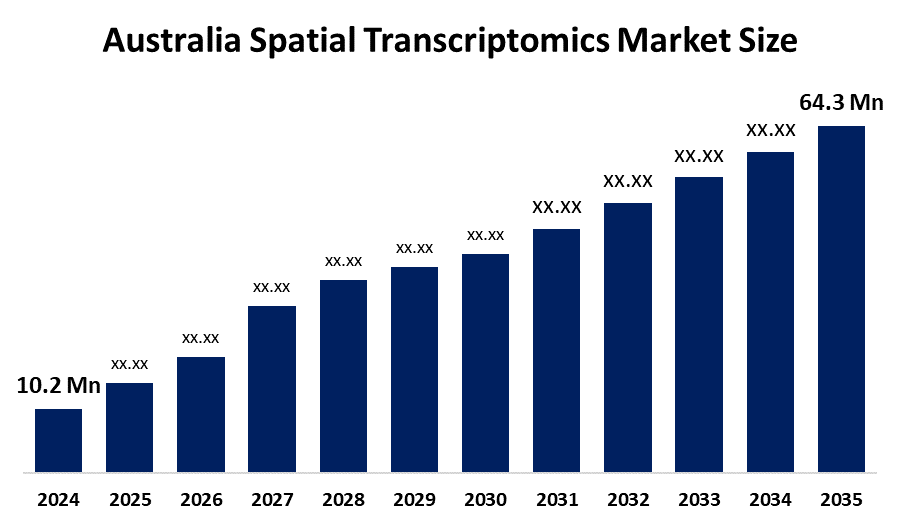
- Australia Spatial Transcriptomics Market Size 2024: USD 10.2 Mn
- Australia Spatial Transcriptomics Market Size 2035: USD 64.3 Mn
- Australia Spatial Transcriptomics Market CAGR 2024: 18.22%
- Australia Spatial Transcriptomics Market Segments: Workflow and End Use
Get more details on this report -
The Australian spatial transcriptomics market integrates novel technologies, sells chemicals, uses machines, and offers services to conduct the analysis of gene expression in living tissue samples without losing their spatial context. This method provides more information about the cellular relationships in diseased conditions. The market is growing because of increased precision medicine investments, more frequent use of single-cell and spatial biology studies, solid partnerships between academia and clinics, and the increasing number of applications in oncology, neuroscience, immunology, and drug discovery within the Australian biomedical research ecosystem.
Australia's spatial transcriptomics market profits from substantial governmental backing through the initiatives of genomics. The Medical Research Future Fund's Genomics Health Futures Mission (approximately AUD 500 million over 10 years), NHMRC genomics grants, and precision medicine funding (over AUD 140 million for cancer research) are some of the programs that facilitate advanced molecular research, infrastructure development, and clinical translation that are relevant to spatial transcriptomics.
Spatial transcriptomics is, moreover, progressing in Australia due to the innovations made by research-based companies and institutions like CSL, Garvan Institute, and local biotech startups. These developments include the unification of spatial transcriptomics with single-cell sequencing, the building of AI-based data analysis platforms, and the use of high-resolution tissue mapping that benefits oncology, neuroscience, and precision medicine research.
Australia Spatial Transcriptomics Market Report Coverage
| Report Coverage | Details |
|---|---|
| Base Year: | 2024 |
| Market Size in 2024: | USD 10.2 Million |
| Forecast Period: | 2025-2035 |
| Forecast Period CAGR 2025-2035 : | CAGR Of 18.22% |
| 2035 Value Projection: | USD 64.3 Million |
| Historical Data for: | 2020-2023 |
| No. of Pages: | 188 |
| Tables, Charts & Figures: | 120 |
| Segments covered: | By Workflow, By End Use |
| Companies covered:: | South Australian Genomics Centre (SAGC), Griffith University Spatial Omics Facility, Australian Regenerative Medicine Institute (ARMI) Lab, University of Queensland, WEHI (Walter and Eliza Hall Institute), Integrated Sciences Pty Ltd, Queensland Spatial Biology Centre (QSBC), Microscopy Australia, Bioinformatics Australia / QCIF Collaborations, Australian Biosearch, Others, and |
| Pitfalls & Challenges: | COVID-19 Empact, Challenge, Future, Growth, & Analysis |
Get more details on this report -
Market Dynamics of the Australia Spatial Transcriptomics Market:
The Australia spatial transcriptomics market is driven by the increase in funding allocated to genomics and precision medicine, and very good collaboration between the academic institutions and the biopharmaceutical industry, as well as the growing use of sophisticated molecular profiling for cancer and neuroscience research. These factors, combined with government support for life-science research, the progression of biobanks in terms of infrastructure, and the need for high-resolution tissue analysis to back drug discovery and personalized therapies, are further fueling the market.
The Australia spatial transcriptomics market is restrained by the high prices of technology and instruments, the scarcity of skilled professionals, the complexity of data analysis requirements, as well as the dependence on bioinformatics infrastructure, which can slow down the adoption in smaller research institutions and clinical laboratories.
The future of the Australia spatial transcriptomics market holds the promise of AI-based data analysis, integration with single-cell multiomics, proliferation of high-throughput platforms, and deeper clinical applications in oncology and neurodegenerative diseases. Besides, the precision medicine market will expand thanks to the concerted research initiatives and government financial assistance that led to innovation and commercial growth.
Market Segmentation
The Australia spatial transcriptomics market share is classified into workflow and end use.
By Workflow:
The Australia spatial transcriptomics market is divided by workflow into sample preparation, instrumental analysis, and data analysis. Among these, the instrumental analysis segment dominated the share in 2024 and is anticipated to grow at a remarkable CAGR during the forecast period. The high cost and broad use of sophisticated imaging systems, spatial sequencing platforms, and analytical tools, which constitute the biggest capital investment for research institutes and biotechnology firms and continue to propel robust market growth, are the reasons for this dominance.
By End Use:
The Australia spatial transcriptomics market is divided by end use into translational research, academic customers, diagnostic customers, and pharmaceutical manufacturers. Among these, the academic customers segment accounted for the largest share in 2024 and is projected to grow at a significant CAGR during the forecast period. Strong institutional and government financing for university-based genomics research, the widespread use of cutting-edge spatial biology technologies in academic labs, and active partnerships with biotech firms and hospitals that support long-term market growth are the main drivers of this supremacy.
Competitive Analysis:
The report offers the appropriate analysis of the key organisations/companies involved within the Australia spatial transcriptomics market, along with a comparative evaluation primarily based on their product offering, business overviews, geographic presence, enterprise strategies, segment market share, and SWOT analysis. The report also provides an elaborative analysis focusing on the current news and developments of the companies, which includes product development, innovations, joint ventures, partnerships, mergers & acquisitions, strategic alliances, and others. This allows for the evaluation of the overall competition within the market.
Top Key Companies in Australia Spatial Transcriptomics Market:
- South Australian Genomics Centre (SAGC)
- Griffith University Spatial Omics Facility
- Australian Regenerative Medicine Institute (ARMI) Lab
- University of Queensland
- WEHI (Walter and Eliza Hall Institute)
- Integrated Sciences Pty Ltd
- Queensland Spatial Biology Centre (QSBC)
- Microscopy Australia
- Bioinformatics Australia / QCIF Collaborations
- Australian Biosearch
- Others
Recent Developments in Australia Spatial Transcriptomics Market:
In September 2025, October 2025 – The “Spatial Conversations” webinar series presented local knowledge regarding the performance of Xenium in Situ and Visium HD spatial transcriptomics.
In October 2025, the Australian BioCommons organized a Spatial Omics workshop teaching users how to analyze spatial transcriptomics data.
In April 2025, Researchers from ANU released a study using spatial transcriptomics, which showed gene expression changes in retinal degeneration that are specific to regions.
In March 2025, Integrated Sciences declared the successful Vizgen MERSCOPE Spatial Transcriptomics Grant recipients who are applying the use of advanced spatial technology in Australia.
Key Target Audience
- Market Players
- Investors
- End-users
- Government Authorities
- Consulting and Research Firm
- Venture capitalists
- Value-Added Resellers (VARs)
Market Segment
This study forecasts revenue at the Australia, regional, and country levels from 2020 to 2035.Spherical Insights has segmented the Australia spatial transcriptomics market based on the below-mentioned segments:
Australia Spatial Transcriptomics Market, By Workflow
- Sample Preparation
- Instrumental Analysis
- Data Analysis
Australia Spatial Transcriptomics Market, By End Use
- Translational Research
- Academic Customers
- Diagnostic Customers
- Pharmaceutical Manufacturers
Frequently Asked Questions (FAQ)
-
Q: What is the Australia spatial transcriptomics market size?A: Australia spatial transcriptomics market is expected to grow from USD 10.2 million in 2024 to USD 64.3 million by 2035, growing at a CAGR of 18.22% during the forecast period 2025-2035.
-
Q: What are the key growth drivers of the market?A: Market growth is driven by the increase in funding allocated to genomics and precision medicine, and very good collaboration between the academic institutions and the biopharmaceutical industry, as well as the growing use of sophisticated molecular profiling for cancer and neuroscience research. These factors, combined with government support for life-science research, the progression of biobanks in terms of infrastructure, and the need for high-resolution tissue analysis to back drug discovery and personalized therapies, are further fueling the market.
-
Q: What factors restrain the Australia spatial transcriptomics market?A: Constraints include the high prices of technology and instruments, the scarcity of skilled professionals, the complexity of data analysis requirements, as well as the dependence on bioinformatics infrastructure, which can slow down the adoption in smaller research institutions and clinical laboratories.
-
Q: How is the market segmented by workflow?A: The market is segmented into sample preparation, instrumental analysis, and data analysis.
-
Q: Who are the key players in the Australia spatial transcriptomics market?A: Key companies include South Australian Genomics Centre (SAGC), Griffith University Spatial Omics Facility, Australian Regenerative Medicine Institute (ARMI) Lab, University of Queensland, WEHI (Walter and Eliza Hall Institute), Integrated Sciences Pty Ltd, Queensland Spatial Biology Centre (QSBC), Microscopy Australia, Bioinformatics Australia / QCIF Collaborations, Australian Biosearch, and Others.
-
Q: Who are the target audiences for this market report?A: The report targets market players, investors, end-users, government authorities, consulting and research firms, venture capitalists, and value-added resellers (VARs).
Need help to buy this report?