Australia Heparin Market Size, Share, and COVID-19 Impact Analysis, By Type (Low Molecular Weight Heparin, Ultra-low Molecular Weight Heparin, and Unfractionated Heparin), By Application (Venous Thromboembolism, Coronary Artery Disease, Renal Impairment, Atrial Fibrillation, and Others), and Australia Heparin Market Insights, Industry Trend, Forecasts to 2035
Industry: Healthcare
Australia Heparin Market Insights Forecasts to 2035
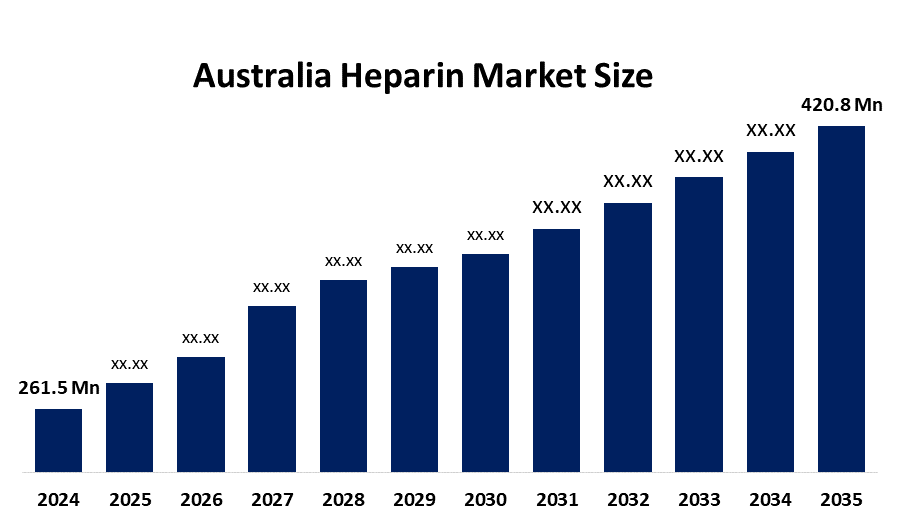
- The Australia Heparin Market Size Was Estimated at USD 261.5 Million in 2024
- The Market Size is Expected to Grow at a CAGR of Around 4.42% from 2025 to 2035
- The Australia Heparin Market Size is Expected to Reach USD 420.8 Million by 2035
Get more details on this report -
According to a research report published by Spherical Insights & Consulting, The Australia Heparin Market Size is anticipated to reach USD 420.8 Million by 2035, Growing at a CAGR of 4.42% from 2025 to 2035. The heparin market in Australia is driven by rising cardiovascular illnesses, more surgeries, an ageing population, more hospital admissions, and a greater need for anticoagulants for dialysis and thrombosis prophylaxis.
Market Overview
The Australia heparin market includes the production, distribution, and use of heparin as an anticoagulant. Heparin is commonly found in hospitals and other facilities that treat patients for deep vein thrombosis and pulmonary embolism; it is also used while performing surgeries and/or administering dialysis. In addition to being used during these surgical or procedural events, heparin can be utilised in the treatment of patients with cardiac diseases and in intensive care units to treat problems associated with forming clots, as well as to help facilitate the safe movement of blood within the body and reduce the risk of developing thromboses.
The PBS (Pharmaceutical Benefits Scheme) is an initiative taken by the Australian Federal Government that subsidises about 230 million prescriptions for heparin at a cost of nearly AUD 17 billion from 2022-2023. Additionally, in the Federal Budget for 2025, the Government will provide AUD 1.8 billion ($2.2 billion) for new PBS listings and AUD 784.6 million to lower co-payments. There is also an ongoing commitment by the Government to fund research and innovation in the cardiovascular space, through the AUD20 billion Medical Research Future Fund.
The Australia heparin market has introduced new supply tracking procedures and quality assessment methods, which the Therapeutic Goods Administration uses to verify secure product standards. The companies work to enhance their distribution of low-molecular-weight heparin products. The research institutions investigate potential new medical treatments, which include respiratory disease solutions. Biopharmaceuticals, synthetic medication alternatives and modern drug distribution technologies represent future business opportunities.
Report Coverage
This research report categorizes the market for the Australia heparin market based on various segments and regions, and forecasts revenue growth and analyses trends in each submarket. The report analyses the key growth drivers, opportunities, and challenges influencing the Australia heparin market. Recent market developments and competitive strategies, such as expansion, product launch, development, partnership, merger, and acquisition, have been included to draw the competitive landscape in the market. The report strategically identifies and profiles the key market players and analyses their core competencies in each sub-segment of the Australia heparin market.
Australia Heparin Market Report Coverage
| Report Coverage | Details |
|---|---|
| Base Year: | 2024 |
| Market Size in 2024: | USD 261.5 Million |
| Forecast Period: | 2025-2035 |
| Forecast Period CAGR 2025-2035 : | CAGR of 4.42% |
| 2035 Value Projection: | USD 420.8 Million |
| Historical Data for: | 2020-2023 |
| No. of Pages: | 210 |
| Tables, Charts & Figures: | 95 |
| Segments covered: | By Type, By Application |
| Companies covered:: | Pfizer Australia Pty Ltd, Sanofi-Aventis Australia Pty Ltd, Fresenius Kabi Australia, B. Braun Australia Pty Ltd, Aspen Pharmacare Australia, Hospira, Sandoz, Mylan, Pfizer Wyeth, Baxter Healthcare Pty Ltd, Others, and Key Players |
| Pitfalls & Challenges: | COVID-19 Empact, Challenge, Future, Growth, & Analysis |
Get more details on this report -
Driving Factors
The heparin market in Australia is driven by the people developing more cardiovascular diseases, together with more deep vein thrombosis cases and pulmonary embolism cases, and the elderly population keeps growing in size. The demand for healthcare services increases because more surgical procedures, dialysis treatments and hospital admissions occur. The market experiences continuous expansion because the Pharmaceutical Benefits Scheme (PBS) provides government backing, and low-molecular-weight heparin products receive advancements.
Restraining Factors
The heparin market in Australia is mostly constrained by the strict regulatory standards, potential bleeding risks, disruptions in raw material supply chains and a high need for animal-based materials and growing market competition from direct oral anticoagulants (DOACs).
Market Segmentation
The Australia heparin market share is classified into type and application.
- The low molecular weight heparin segment accounted for the largest revenue market share in 2024 and is expected to grow at a significant CAGR during the forecast period.
The Australia heparin market is segmented by type into low molecular weight heparin, ultra-low molecular weight heparin, and unfractionated heparin. Among these, the low molecular weight heparin segment accounted for the largest revenue market share in 2024 and is expected to grow at a significant CAGR during the forecast period. Compared to unfractionated heparin, LMWH is favoured because of its predictable anticoagulant effect, longer half-life, decreased risk of bleeding problems, and decreased requirement for routine monitoring. The biggest revenue share and ongoing increase are driven by its extensive use in outpatient treatment, post-surgical care, and thrombosis prophylaxis.
- The venous thromboembolism segment dominated the share in 2024 and is anticipated to grow at a remarkable CAGR during the forecast period.
The Australia heparin market is segmented by application into venous thromboembolism, coronary artery disease, renal impairment, atrial fibrillation, and others. Among these, the venous thromboembolism segment dominated the share in 2024 and is anticipated to grow at a remarkable CAGR during the forecast period. This is because pulmonary embolism and deep vein thrombosis are very common, especially in hospitalised and post-operative patients. Heparin is the main clinical application, accounting for the biggest market share and sustained growth due to its widespread usage in the prevention and treatment of VTE.
Competitive Analysis:
The report offers the appropriate analysis of the key organizations/companies involved within the Australia heparin market, along with a comparative evaluation primarily based on their product offering, business overviews, geographic presence, enterprise strategies, segment market share, and SWOT analysis. The report also provides an elaborate analysis focusing on the current news and developments of the companies, which includes product development, innovations, joint ventures, partnerships, mergers & acquisitions, strategic alliances, and others. This allows for the evaluation of the overall competition within the market.
List of Key Companies
- Pfizer Australia Pty Ltd
- Sanofi-Aventis Australia Pty Ltd
- Fresenius Kabi Australia
- B. Braun Australia Pty Ltd
- Aspen Pharmacare Australia
- Hospira
- Sandoz
- Mylan
- Pfizer Wyeth
- Baxter Healthcare Pty Ltd
- Others
Key Target Audience
- Market Players
- Investors
- End-users
- Government Authorities
- Consulting and Research Firm
- Venture capitalists
- Value-Added Resellers (VARs)
Recent Developments:
- In August 2025, to assess the quality and adherence to pharmacopeial standards of heparin products on the Australian market, the Therapeutic Goods Administration (TGA) conducted a thorough survey.
- In July 2024, the TGA issued the Australian Public Assessment Report for Heparin InterPharma (heparin sodium), a new registered biological entity that expands the list of approved anticoagulant medicines.
Market Segment
This study forecasts revenue at the Australia, regional, and country levels from 2020 to 2035. Spherical Insights has segmented the Australia heparin market based on the below-mentioned segments:
Australia Heparin Market, By Type
- Low Molecular Weight Heparin
- Ultra-low Molecular Weight Heparin
- Unfractionated Heparin
Australia Heparin Market, By Application
- Venous Thromboembolism
- Coronary Artery Disease
- Renal Impairment
- Atrial Fibrillation
- Others
Frequently Asked Questions (FAQ)
-
Q: What is the Australia heparin market size?A: Australia heparin market size is expected to grow from USD 261.5 million in 2024 to USD 420.8 million by 2035, growing at a CAGR of 4.42% during the forecast period 2025-2035.
-
Q: What are the key growth drivers of the market?A: Market growth is driven by the people developing more cardiovascular diseases, together with more deep vein thrombosis cases and pulmonary embolism cases, and the elderly population keeps growing in size. The demand for healthcare services increases because more surgical procedures, dialysis treatments and hospital admissions occur.
-
Q: What factors restrain the Australia heparin market?A: Constraints include the strict regulatory standards, potential bleeding risks, disruptions in raw material supply chains and a high need for animal-based materials.
-
Q: How is the market segmented by type?A: The market is segmented into low molecular weight heparin, ultra-low molecular weight heparin, and unfractionated heparin.
-
Q: Who are the key players in the Australia heparin market?A: Key companies include Pfizer Australia Pty Ltd, Sanofi-Aventis Australia Pty Ltd, Fresenius Kabi Australia, B. Braun Australia Pty Ltd, Aspen Pharmacare Australia, Hospira, Sandoz, Mylan, Pfizer Wyeth, Baxter Healthcare Pty Ltd, and Others.
-
Q: Who are the target audiences for this market report?A: The report targets market players, investors, end-users, government authorities, consulting and research firms, venture capitalists, and value-added resellers (VARs).
Need help to buy this report?