Australia Heat Exchanger Market Size, Share, By Product Type (Shell and Tube, Plate and Frame, Air Cooled, and Others), By End Use (Chemical & Petrochemical, Oil & Gas, HVAC & refrigeration, Power Generation, Food & Beverage, Pulp & Paper, and Others), Australia Heat Exchanger Market Insights, Industry Trend, Forecasts to 2035
Industry: Energy & Power
Australia Heat Exchanger Market Insights Forecasts to 2035
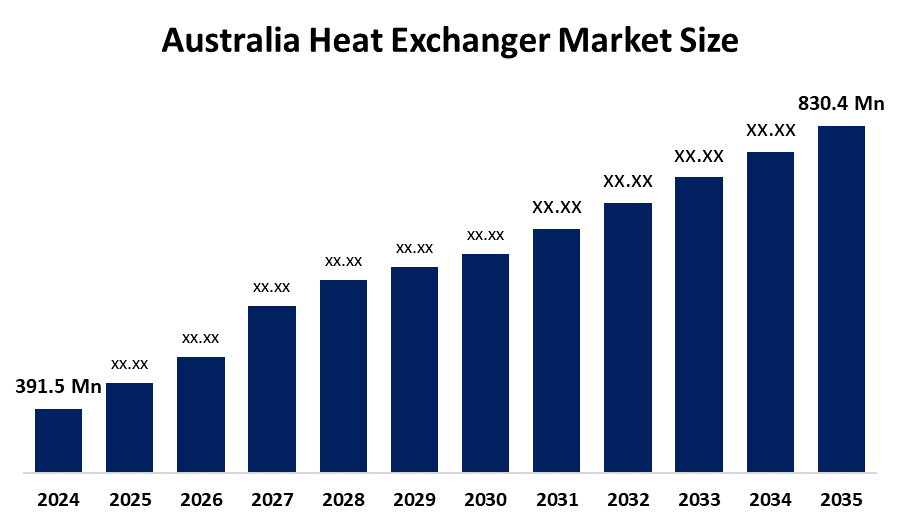
- Australia Heat Exchanger Market Size 2024: USD 391.5 Mn
- Australia Heat Exchanger Market Size 2035: USD 830.4 Mn
- Australia Heat Exchanger Market CAGR 2024: 7.07%
- Australia Heat Exchanger Market Segments: Product Type and End Use
Get more details on this report -
The Market of heat exchangers in Australia is an industry that has complete control of heat exchange systems manufacturing, selling, and installation. These systems make use of heat transfer between different kinds of fluids in industrial, commercial, residential, and energy applications, thus improving thermal management and energy efficiency through various sectors like HVAC, power generation, and manufacturing. The Australia market for heat exchangers is on the rise due to industrial growth, urbanization, increasing demand for HVAC systems, renewable energy adoption, and enhanced focus on energy efficiency and sustainability in the power, manufacturing, and building sectors.
Australia is backing the heat exchanger market by means of cold-up and energy-efficiency programs. Among the measures are the Energy Efficiency Grants for SMEs, which are worth AUD 41 million, the Powering the Regions Fund with a total of AUD 330 million, and the ARENA funding for industrial heat recovery and process efficiency projects, which is more than AUD 12 million, all of which are driving the adoption of advanced heat exchanger technologies.
The latest news regarding the heat exchanger market in Australia is the rebranding and integration of Genovex’s boilers, the introduction of SonFlow’s energy-saving plate exchangers, the takeover by Heat Exchangers WA of Boilertronics, and the financial backing of USD 11 million granted by Conflux Technology for the production of eco-friendly and 3D-printed heat exchangers.
Australia Heat Exchanger Market Report Coverage
| Report Coverage | Details |
|---|---|
| Base Year: | 2024 |
| Market Size in 2024: | USD 391.5 Million |
| Forecast Period: | 2025-2035 |
| Forecast Period CAGR 2025-2035 : | 7.07% |
| 2035 Value Projection: | USD 830.4 Million |
| Historical Data for: | 2020-2023 |
| No. of Pages: | 190 |
| Tables, Charts & Figures: | 95 |
| Segments covered: | By Product Type, By End Use |
| Companies covered:: | Genovex Group, Thornhill Australia Pty Ltd, Hipex, InKorr Pty Ltd, Teralba Industries, Fluid Dynamics Australia, Caman Engineering Pty Ltd, Airmaster Australia, and others key players |
| Pitfalls & Challenges: | Covid 19 Impact Challanges, Future, Growth and Analysis |
Get more details on this report -
Market Dynamics of the Australia Heat Exchanger Market:
The Australia heat exchanger market is driven by the high costs related to the capital investment needed for high-end and made-to-order heat exchanger systems; thus, their use is not spreading much among small and medium-sized businesses. Moreover, difficult installation, operation, and maintenance procedures consume a lot of resources and create operational difficulties. Moreover, competition from other cooling and heating technologies and varying prices of raw materials add to the cost pressures of the manufacturers. The innovators' compliance with regulations and the industry standards in terms of safety and performance are also among the factors that limit the market; thus, the manufacturers are not able to deploy their cooling and heating solutions broadly in the industrial and commercial sectors.
The Australia heat exchanger market is restrained by the high initial investment costs, complex installation requirements, maintenance difficulties, and competition from alternative cooling and heating technologies, which limit the adoption, mainly among small and medium-sized enterprises and cost-sensitive industries.
The Australian heat exchanger market is expected to witness the introduction of advanced heat recovery systems, compact and high-efficiency designs, and smart, IoT-enabled thermal management solutions as the main opportunities in the future. Additive manufacturing (3D-printed heat exchangers) and advanced materials (e.g., corrosion-resistant alloys and nanostructured surfaces) are two innovations that can potentially enhance performance and greatly increase the life span of a product. In addition, the rapid expansion of renewable energy, waste-heat recovery, and decarbonization projects is going to create high demand for the latest heat exchanger technologies.
Market Segmentation
The Australia Heat Exchanger Market share is classified into product type and end use.
By Product Type:
The Australia heat exchanger market is divided by product type into shell and tube, plate and frame, air cooled, and others. Among these, the shell and tube segment dominated the share in 2024 and is anticipated to grow at a remarkable CAGR during the forecast period. It is widely used in the power generation, chemical, oil and gas, and industrial sectors because of its adaptability, high heat transfer efficiency, durability, and capacity to withstand high-pressure and temperature conditions. Its demonstrated dependability and ease of upkeep also support ongoing demand, making it the industry's top product category.
By End Use:
The Australia heat exchanger market is divided by end use into chemical & petrochemical, oil & gas, HVAC & refrigeration, power generation, food & beverage, pulp & paper, and others. Among these, the chemical & petrochemical segment accounted for the largest share in 2024 and is projected to grow at a significant CAGR during the forecast period. The need for dependable and effective heat exchanger solutions is fueled by the fact that these industries operate in high-pressure, high-temperature environments and necessitate large-scale heat transfer systems for operations like cooling, heating, and condensation. The preference for cutting-edge heat exchanger technologies is further supported by these industries' strict process efficiency and safety regulations.
Competitive Analysis:
The report offers the appropriate analysis of the key organisations/companies involved within the Australia heat exchanger market, along with a comparative evaluation primarily based on their product offering, business overviews, geographic presence, enterprise strategies, segment market share, and SWOT analysis. The report also provides an elaborative analysis focusing on the current news and developments of the companies, which includes product development, innovations, joint ventures, partnerships, mergers & acquisitions, strategic alliances, and others. This allows for the evaluation of the overall competition within the market.
Top Key Companies in Australia Heat Exchanger Market:
- Genovex Group
- Thornhill Australia Pty Ltd
- Hipex
- InKorr Pty Ltd
- Teralba Industries
- Fluid Dynamics Australia
- Caman Engineering Pty Ltd
- Airmaster Australia
- Others
Recent Developments in Australia Heat Exchanger Market:
In December 2025, Heat Exchangers WA changed its name to Genovex, thus not only unveiling its new identity as a complete thermal energy solutions provider but also keeping the expert services in heat exchangers as one of its offers.
In October 2024, Conflux Technology (Geelong, Australia) obtained 11 million USD in Series B financing to speed up the production of heat exchangers using additive manufacturing and to enlarge the tenable production capacities.
Key Target Audience
- Market Players
- Investors
- End-users
- Government Authorities
- Consulting and Research Firm
- Venture capitalists
- Value-Added Resellers (VARs)
Market Segment
This study forecasts revenue at the Australia, regional, and country levels from 2020 to 2035. Spherical insights has segmented the Australia heat exchanger market based on the below-mentioned segments:
Australia Heat Exchanger Market, By Product Type
- Shell and Tube
- Plate and Frame
- Air Cooled
- Others
Australia Heat Exchanger Market, By End Use
- Chemical & Petrochemical
- Oil & Gas
- HVAC & refrigeration
- Power Generation
- Food & Beverage
- Pulp & Paper
- Others
Frequently Asked Questions (FAQ)
-
Q: What is the Australia heat exchanger market size?A: Australia heat exchanger market is expected to grow from USD 391.5 million in 2024 to USD 830.4 million by 2035, growing at a CAGR of 7.07% during the forecast period 2025-2035.
-
Q: What are the key growth drivers of the market?A: Market growth is driven by the high costs related to the capital investment needed for high-end and made-to-order heat exchanger systems; thus, their use is not spreading much among small and medium-sized businesses. Moreover, difficult installation, operation, and maintenance procedures consume a lot of resources and create operational difficulties. Moreover, competition from other cooling and heating technologies and varying prices of raw materials add to the cost pressures of the manufacturers.
-
Q: What factors restrain the Australia heat exchanger market?A: Constraints include the high initial investment costs, complex installation requirements, maintenance difficulties, and competition from alternative cooling and heating technologies, which limit the adoption, mainly among small and medium-sized enterprises and cost-sensitive industries.
-
Q: How is the market segmented by product type?A: The market is segmented into shell and tube, plate and frame, air cooled, and others.
-
Q: Who are the key players in the Australia heat exchanger market?A: Key companies include Genovex Group, Thornhill Australia Pty Ltd, Hipex, InKorr Pty Ltd, Teralba Industries, Fluid Dynamics Australia, Caman Engineering Pty Ltd, Airmaster Australia, and Others.
-
Q: Who are the target audiences for this market report?A: The report targets market players, investors, end-users, government authorities, consulting and research firms, venture capitalists, and value-added resellers (VARs).
Need help to buy this report?