Global Atrial Fibrillation Market Size, Share, and COVID-19 Impact Analysis, By Product (Antiarrhythmic Drugs, Anticoagulant Drugs, Vitamin K Antagonists, and Novel Oral Anticoagulants), By Type (Paroxysmal, Persistent, and Permanent), By End User (Cardiac Centers, Ambulatory Surgical Centers, and Others), and By Region (North America, Europe, Asia-Pacific, Latin America, Middle East, and Africa), Analysis and Forecast 2025 - 2035.
Industry: Healthcare
Global Atrial Fibrillation Market Insights Forecasts to 2035
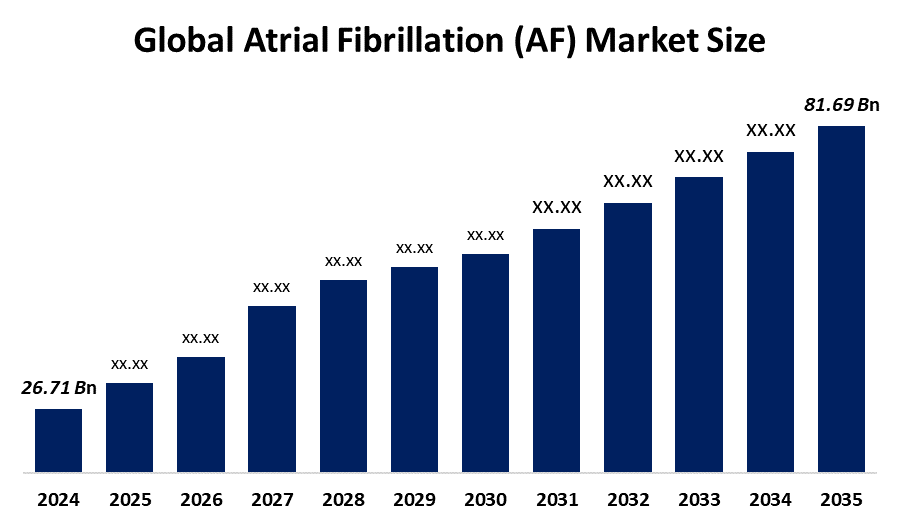
- The Global Atrial Fibrillation Market Size Was Estimated at USD 26.71 Billion in 2024
- The Market Size is Expected to Grow at a CAGR of around 10.7% from 2025 to 2035
- The Worldwide Atrial Fibrillation Market Size is Expected to Reach USD 81.69 Billion by 2035
- Asia Pacific is expected to grow the fastest during the forecast period.
Get more details on this report -
According to a research report published by Spherical Insights and Consulting, the global atrial fibrillation market size was worth around USD 26.71 billion in 2024 and is predicted to grow to around USD 81.69 billion by 2035 with a compound annual growth rate (CAGR) of 10.7% from 2025 to 2035. Global innovations in advanced cardiac monitoring devices, early detection and continuous tracking of AF episodes, minimally invasive ablation technologies, telemedicine platforms, and remote patient monitoring solutions are all driving opportunities in the atrial fibrillation market.
Market Overview
The atrial fibrillation market refers to the global industry dedicated to diagnosing and treating atrial fibrillation which is a common heart rhythm disorder that causes irregular heartbeats and results in stroke and heart failure. It includes medications together with medical equipment, testing instruments, and remote monitoring systems for healthcare management. The market provides major business prospects through technological innovations which include AI-based diagnostic systems, advanced ablation methods, and portable cardiac monitoring devices that enable earlier disease identification, customized treatment plans, and ongoing patient assessment.
The governments support market expansion through financial backing of cardiovascular studies, creation of health education initiatives, development of clinical treatment standards, and establishment of regulatory systems which promote innovation while maintaining patient safety. For example, in January 2023, Japan’s Ministry of Health, Labour and Welfare provided funding of 5 million yen for research that developed standardized atrial fibrillation ablation treatment methods.
In July 2022, the U.S. NIH awarded a USD 14.2 million research grant to the Cleveland Clinic that focus on creating new atrial fibrillation treatments through genomic research and therapeutic advancements. The five year NIH grant supports creation of advanced atrial fibrillation detection methods and treatment solutions. The quick speed of technological advancement is one of the main drivers of the atrial fibrillation market's expansion.
Report Coverage
This research report categorizes the atrial fibrillation market based on various segments and regions, forecasts revenue growth, and analyzes trends in each submarket. The report analyses the key growth drivers, opportunities, and challenges influencing the atrial fibrillation market. Recent market developments and competitive strategies, such as expansion, product launch, development, partnership, merger, and acquisition, have been included to draw the competitive landscape in the market. The report strategically identifies and profiles the key market players and analyses their core competencies in each sub-segment of the atrial fibrillation market.
Global Atrial Fibrillation (AF) Market Report Coverage
| Report Coverage | Details |
|---|---|
| Base Year: | 2024 |
| Market Size in 2024: | USD 26.71 Billion |
| Forecast Period: | 2025-2035 |
| Forecast Period CAGR 2025-2035 : | 10.7% |
| 2035 Value Projection: | USD 81.69 Billion |
| Historical Data for: | 2021-2023 |
| No. of Pages: | 198 |
| Tables, Charts & Figures: | 110 |
| Segments covered: | By Product, By End User |
| Companies covered:: | Medtronic, Abbott Laboratories, Johnson & Johnson, Boston Scientific Corporation, AtriCure Inc., Biosense Webster Inc., CardioFocus Inc., Boehringer Ingelheim, Bristol-Myers Squibb, Pfizer Inc., Sanofi, Bayer AG, Daiichi Sankyo, Eisai Co., Ltd., Biotronik, Others |
| Pitfalls & Challenges: | COVID-19 Empact, Challenge, Future, Growth, & Analysis |
Get more details on this report -
Driving Factors
Rapid technological innovation is one of the main drivers of the atrial fibrillation market's growth. Rising prevalence of cardiovascular diseases and an aging global population increase the incidence of AF, fueling demand for diagnosis and treatment, which is the main factor driving the market for atrial fibrillation. In this field, innovation and investment are driven by the rising worldwide incidence of cardiovascular diseases combined with the increasing number of elderly people, higher need for atrial fibrillation diagnosis and treatment. The field of research experiences both innovation advancements and increased funding in widespread adoption of telemedicine, remote patient monitoring, growing use of wearable ECG devices, implantable loop recorders, AI diagnostic tools, and minimally invasive ablation catheters. Governments play a crucial role by funding cardiovascular research, providing grants for AF studies, implementing clinical guidelines, and supporting public health initiatives, all of which foster innovation, regulatory support, and market growth.
Restraining Factors
High development and deployment costs, limited patient awareness, stringent regulatory requirements and lengthy approval processes, reimbursement challenges, inconsistent insurance coverage, and risk of misdiagnosis in early detection are the main factors restricting the atrial fibrillation market.
Market Segmentation
The atrial fibrillation market share is classified into product, type, and end user.
- The novel oral anticoagulants segment dominated the market in 2024, approximately 45%, and is projected to grow at a substantial CAGR during the forecast period.
Based on the product, the atrial fibrillation market is divided into antiarrhythmic drugs, anticoagulant drugs, vitamin K antagonists, and novel oral anticoagulants. Among these, the novel oral anticoagulants segment dominated the market in 2024, approximately 45%, and is projected to grow at a substantial CAGR during the forecast period. Superior safety profile, fewer dietary restrictions, predictable pharmacokinetics, growing physician preference, guideline recommendations, and increased patient adherence is driving the novel oral anticoagulants industry.
- The paroxysmal segment accounted for the largest share in 2024, approximately 40%, and is anticipated to grow at a significant CAGR during the forecast period.
Based on the type, the atrial fibrillation market is divided into paroxysmal, persistent, and permanent. Among these, the paroxysmal segment accounted for the largest share in 2024, approximately 40%, and is anticipated to grow at a significant CAGR during the forecast period. Higher detection rates through wearable monitors, early intervention strategies, ECG monitors and routine screenings, intermittent nature encourages timely medical intervention, and minimally invasive procedures, is driving the paroxysmal industry.
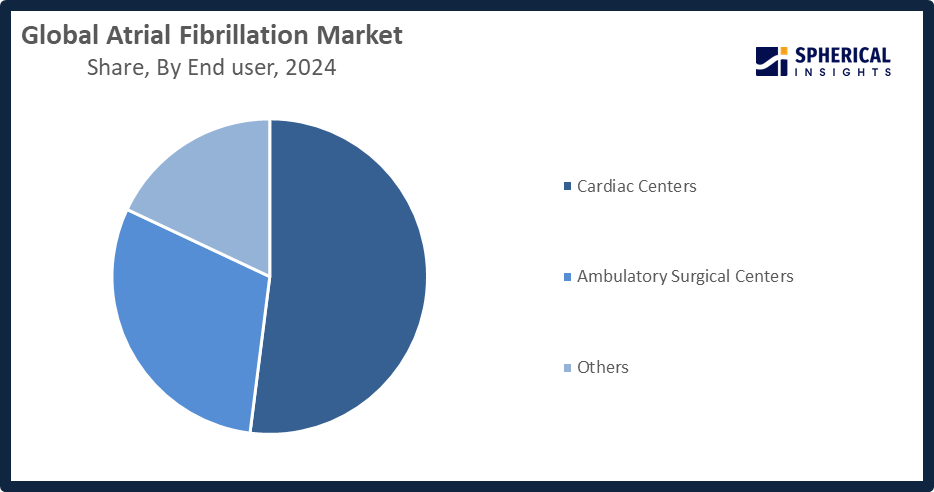
- The cardiac centers segment accounted for the highest market revenue in 2024, approximately 55%, and is anticipated to grow at a significant CAGR during the forecast period.
Based on the end user, the atrial fibrillation market is divided into cardiac centers, ambulatory surgical centers, and others. Among these, the cardiac centers segment accounted for the highest market revenue in 2024, approximately 55%, and is anticipated to grow at a significant CAGR during the forecast period. Increased demand for advanced diagnostics, ablation procedures, long-term patient management, easy access to specialized cardiologists, and high patient volumes is bolstering cardiac centers market.
Get more details on this report -
Regional Segment Analysis of the Atrial Fibrillation Market
- North America (U.S., Canada, Mexico)
- Europe (Germany, France, U.K., Italy, Spain, Rest of Europe)
- Asia-Pacific (China, Japan, India, Rest of APAC)
- South America (Brazil and the Rest of South America)
- The Middle East and Africa (UAE, South Africa, Rest of MEA)
North America is anticipated to hold the largest share of the atrial fibrillation market over the predicted timeframe.

Get more details on this report -
North America is anticipated to hold the largest share of the atrial fibrillation market over the predicted timeframe. Strong government backing for advanced healthcare infrastructure, widespread adoption of wearable and implantable cardiac monitoring devices, minimally invasive ablation technologies, and AI-based diagnostic tools, enabling better disease management are what propel North America. The region's position is further reinforced by government programs promoting supportive regulatory frameworks, and favourable reimbursement policies further encourage the adoption of AF therapies. In addition, robust clinical guidelines, a high number of specialized cardiac centers, and extensive patient education programs collectively enhance detection rates and treatment compliance, reinforcing the North America’s dominance in the atrial fibrillation market.
Government initiatives include Canada’s Public Health Agency provides an official atrial fibrillation information and guidance outlining AF risk factors, health effects, treatment, and surveillance as part of its national heart health resources and U.S. USPSTF, January 2022, issued a recommendation statement on AF screening reviewing evidence on preventive AF screening in older adults.
Asia Pacific is expected to grow at a rapid CAGR in the atrial fibrillation market during the forecast period. China, Japan, and India are among the nations making significant investments in healthcare systems through infrastructure development, growing use of advanced diagnostic equipment, ablation methods, and increasing understanding of atrial fibrillation complications which include stroke and heart failure. The demand for sophisticated atrial fibrillation is further accelerated by the region's developing cardiovascular diseases and urban expansion creates conditions that lead to increased atrial fibrillation cases. Government programs, healthcare funding, and private sector funding support both atrial fibrillation diagnosis and treatment accessibility and technological progress, making Asia-Pacific the fastest-growing region in the global AF market.
Government initiatives include Japan’s Ministry of Health, Labour and Welfare (MHLW) approving the VARIPULSE pulsed field ablation platform in January 2024 for the treatment of symptomatic atrial fibrillation, marking a regulated expansion of advanced AF treatment options in the country. Additionally, in 2024, the Indian Council of Medical Research (ICMR) incorporated atrial fibrillation into its Standard Treatment Workflows for cardiology, further strengthening structured clinical management of AF in India.
Competitive Analysis:
The report offers the appropriate analysis of the key organizations/companies involved within the atrial fibrillation market, along with a comparative evaluation primarily based on their product of offering, business overviews, geographic presence, enterprise strategies, segment market share, and SWOT analysis. The report also provides an elaborative analysis focusing on the current news and developments of the companies, which includes product development, innovations, joint ventures, partnerships, mergers & acquisitions, strategic alliances, and others. This allows for the evaluation of the overall competition within the market.
List of Key Companies
- Medtronic
- Abbott Laboratories
- Johnson & Johnson
- Boston Scientific Corporation
- AtriCure Inc.
- Biosense Webster Inc.
- CardioFocus Inc.
- Boehringer Ingelheim
- Bristol-Myers Squibb
- Pfizer Inc.
- Sanofi
- Bayer AG
- Daiichi Sankyo
- Eisai Co., Ltd.
- Biotronik
- Others
Key Target Audience
- Market Players
- Investors
- End-users
- Government Authorities
- Consulting and Research Firm
- Venture capitalists
- Value-Added Resellers (VARs)
Recent Development
- In March 2026, Johnson & Johnson introduced its pulsed field ablation technology in Peru to treat patients who have drug-refractory paroxysmal atrial fibrillation, which enables more patients to access advanced atrial fibrillation treatment options.
- In February 2026, Abbott received positive clinical results from its Volt PFA system and TactiFlex Duo ablation catheter which demonstrated their successful use as atrial fibrillation treatment solutions while supporting future product adoption.
- In October 2024, The FDA approved the Affera Mapping and Ablation System with Sphere-9 Catheter, which Medtronic developed as an advanced dual-energy system that uses pulsed field and radiofrequency ablation to treat AF.
- In January 2024, Biosense Webster announced that Japanese authorities gave their official endorsement for the VARIPULSE Pulsed Field Ablation system, which functions as a complete treatment solution for patients with symptomatic atrial fibrillation.
Market Segment
This study forecasts revenue at global, regional, and country levels from 2020 to 2035. Spherical Insights has segmented the atrial fibrillation market based on the below-mentioned segments:
Global Atrial Fibrillation Market, By Product
- Antiarrhythmic Drugs
- Anticoagulant Drugs
- Vitamin K Antagonists
- Novel Oral Anticoagulants
Global Atrial Fibrillation Market, By Type
- Paroxysmal
- Persistent
- Permanent
Global Atrial Fibrillation Market, By End User
- Cardiac Centers
- Ambulatory Surgical Centers
- Others
Global Atrial Fibrillation Market, By Regional Analysis
- North America
- US
- Canada
- Mexico
- Europe
- Germany
- UK
- France
- Italy
- Spain
- Russia
- Rest of Europe
- Asia Pacific
- China
- Japan
- India
- South Korea
- Australia
- Rest of Asia Pacific
- South America
- Brazil
- Argentina
- Rest of South America
- Middle East & Africa
- UAE
- Saudi Arabia
- Qatar
- South Africa
- Rest of the Middle East & Africa
Frequently Asked Questions (FAQ)
-
What technologies support the atrial fibrillation market?The AF market is supported by technologies such as wearable ECG monitors, implantable loop recorders, AI-based diagnostics, catheter ablation systems (including pulsed field ablation), and remote patient monitoring platforms.
-
What diagnostic methods are used in atrial fibrillation detection?AF diagnosis involves ECG testing, Holter monitoring, event recorders, implantable cardiac monitors, and advanced digital health tools that enable continuous and real-time heart rhythm tracking.
-
What is the role of remote monitoring in AF management?Remote monitoring allows continuous tracking of heart rhythm through wearable and implantable devices, enabling early detection of AF episodes, timely intervention, and improved long-term disease management.
-
What is catheter ablation in atrial fibrillation treatment?Catheter ablation is a minimally invasive procedure that uses energy sources like radiofrequency, cryotherapy, or pulsed field ablation to destroy abnormal heart tissue causing irregular rhythms.
-
What industries benefit from atrial fibrillation market advancements?Healthcare providers, medical device manufacturers, pharmaceutical companies, telemedicine platforms, and digital health firms benefit from AF advancements, along with sectors like insurance and home healthcare.
-
What is the expected growth outlook for the atrial fibrillation market?The AF market is expected to grow steadily through the next decade, driven by increasing disease prevalence, technological advancements, rising healthcare investments, and growing adoption of minimally invasive treatments and digital health solutions.
Need help to buy this report?