Asia Pacific Solar Tracker Market Size, Share, and COVID-19 Impact Analysis, By Technology (PV, CSP), By Application (Residential, Commercial & Industrial), and Asia Pacific Solar Tracker Market Insights, Industry Trends, Forecast to 2035
Industry: Advanced Materials
Asia Pacific Solar Tracker Market Insights Forecasts to 2035
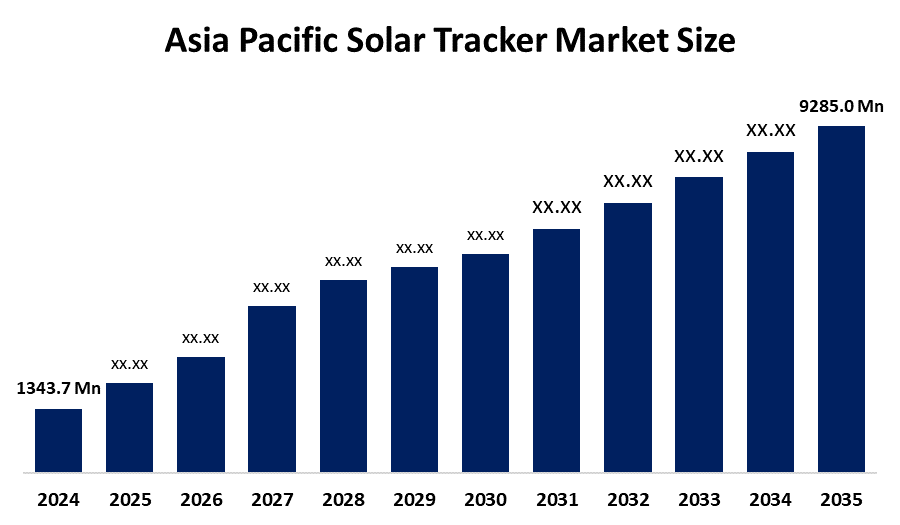
- The Asia Pacific Solar Tracker Market Size Was Estimated at USD 1343.7 Million in 2024
- The Market Size is Expected to Grow at a CAGR of Around 19.21% from 2025 to 2035
- The Asia Pacific Solar Tracker Market Size is Expected to Reach USD 9285.0 Million by 2035
Get more details on this report -
According to a research report published by Spherical Insights & Consulting, the Asia Pacific Solar Tracker Market size is anticipated to reach USD 9285.0 Million by 2035, growing at a CAGR of 19.21% from 2025 to 2035. The market is driven by surging energy demand, strong government backing (subsidies, renewable targets in China, India), declining PV costs, and tech advancements boosting efficiency
Market Overview
The Asia Pacific solar tracker market involves the development, manufacturing and sales of devices that automatically orient solar panels towards the sun to maximize energy capture in countries such as China, India, Japan and Australia. This market is experiencing rapid growth due to high demand for renewable energy, decreasing cost of solar panels, supportive government policies, and technological advancements in single-axis and dual-axis tracking systems for utility-scale, commercial, and residential projects. Asia-Pacific is expected to dominate the global market. Asia Pacific's solar tracker market offers huge opportunities due to rising solar demand, supportive government policies and increasing focus on energy efficiency in countries such as China and India along with growing interest in Southeast Asia. Key growth areas include integrating trackers with bifacial panels, developing cost-effective single-axis and dual-axis systems, digitalization (AI/IoT) and local manufacturing to improve the supply chain, creating strong demand for higher energy yields.
Report Coverage
This research report categorizes the market for the Asia Pacific solar tracker market based on various segments and regions, and forecasts revenue growth and analyses trends in each submarket. The report analyses the key growth drivers, opportunities, and challenges influencing the Asia Pacific Solar Tracker market. Recent market developments and competitive strategies, such as expansion, Technology launch, development, partnership, merger, and acquisition have been included to draw the competitive landscape in the market. The report strategically identifies and profiles the key market players and analyses their core competencies in each sub-segment of the Asia Pacific Solar Tracker market.
Asia Pacific Solar Tracker Market Report Coverage
| Report Coverage | Details |
|---|---|
| Base Year: | 2024 |
| Market Size in 2024: | 1343.7 Million |
| Forecast Period: | 2025-2035 |
| Forecast Period CAGR 2025-2035 : | 19.21% |
| 2035 Value Projection: | 9285.0 Million |
| Historical Data for: | 2020-2023 |
| No. of Pages: | 160 |
| Tables, Charts & Figures: | 120 |
| Segments covered: | By Technology, By Application |
| Companies covered:: | Nextracker, Array Technologies, Arctech Solar, Soltec, Trina Solar, PV Hardware, Antaisolar, and others key players |
| Pitfalls & Challenges: | COVID-19 Empact, Challenge, Future, Growth, & Analysis |
Get more details on this report -
Driving Factors
The Asia Pacific solar tracker market is driven by surging renewable energy demand, strong government support (policies, subsidies), rapid urbanization, and the need for greater solar efficiency, with countries like China and India leading adoption for utility-scale projects. Key factors include falling solar tech costs, climate change mitigation goals, and technological innovation (IoT, better tracking logic), all pushing for higher energy yields and reduced carbon footprints.
Restraining Factors
Key restraining factors for the Asia-Pacific solar tracker market include the high initial capital investment and installation costs, the need for significant land/space, potential lack of adequate local infrastructure, rising material costs (like steel), maintenance complexities, and competition from simpler/cheaper solar solutions, despite strong growth drivers like government support and increasing renewable energy demand.
Market Segmentation
The Asia Pacific solar tracker market share is categorised into technology and application.
- The PV segment accounted for the largest revenue market share in 2024 and is expected to grow at a significant CAGR during the forecast period.
The Asia Pacific solar tracker market is segmented by technology into PV, CSP. Among these, the PV segment accounted for the largest revenue market share in 2024 and is expected to grow at a significant CAGR during the forecast period. It is due to its widespread adoption, falling costs, versatility for various applications (utility-scale to residential), easier integration with trackers, and massive global manufacturing capacity, making it more accessible and cost-effective than Concentrated Solar Power (CSP) for general energy needs
- The commercial & industrial segment dominated the market in 2024 and is projected to grow at a substantial CAGR during the forecast period.
Based on application, the Asia Pacific solar tracker market is segmented into residential, commercial & industrial. Among these, the commercial & industrial segment dominated the market in 2024 and is projected to grow at a substantial CAGR during the forecast period. primarily because businesses adopt trackers to cut operational costs and meet sustainability goals, with residential use remaining minimal because of space constraints.
Competitive Analysis:
The report offers the appropriate analysis of the key organizations/companies involved within the Asia Pacific solar tracker market, along with a comparative evaluation primarily based on their Technology offering, business overviews, geographic presence, enterprise strategies, segment market share, and SWOT analysis. The report also provides an elaborate analysis focusing on the current news and developments of the companies, which includes Technology development, innovations, joint ventures, partnerships, mergers & acquisitions, strategic alliances, and Solar Tracker. This allows for the evaluation of the overall competition within the market.
List of Key Companies
- Nextracker
- Array Technologies
- Arctech Solar
- Soltec
- Trina Solar
- PV Hardware
- Antaisolar
- Others
Key Target Audience
- Market Players
- Investors
- End-users
- Government Authorities
- Consulting and Research Firm
- Venture capitalists
- Value-Added Resellers (VARs)
Market Segment
This study forecasts revenue at the Asia Pacific, regional, and country levels from 2020 to 2035. Spherical Insights has segmented the Asia Pacific solar tracker market based on the below-mentioned segments:
Asia Pacific Solar Tracker Market, By Technology
- PV
- CSP
Asia Pacific Solar Tracker Market, By Application
- Residential
- Commercial & Industrial
Frequently Asked Questions (FAQ)
-
Q: What is the Asia Pacific solar tracker market size?A: The Asia Pacific solar tracker market size is expected to grow from USD 1343.7 million in 2024 to USD 9285.0 million by 2035, growing at a CAGR of 19.21% during the forecast period 2025-2035
-
Q: What are the key growth drivers of the market?A: The Asia Pacific solar tracker market is driven by surging renewable energy demand, strong government support (policies, subsidies), rapid urbanization, and the need for greater solar efficiency, with countries like China and India leading adoption for utility-scale projects. Key factors include falling solar tech costs, climate change mitigation goals, and technological innovation (IoT, better tracking logic), all pushing for higher energy yields and reduced carbon footprints.
-
Q: What factors restrain the Asia Pacific solar tracker market?A: Key restraining factors for the Asia-Pacific solar tracker market include the high initial capital investment and installation costs, the need for significant land/space, potential lack of adequate local infrastructure, rising material costs (like steel), maintenance complexities, and competition from simpler/cheaper solar solutions, despite strong growth drivers like government support and increasing renewable energy demand.
-
Q: How is the market segmented by application?A: The market is segmented into residential and commercial & industrial.
Need help to buy this report?