Asia Pacific Polyethylene Glycol Market Size, Share, and COVID-19 Impact Analysis, By Grade (PEG 200, PEG 300, PEG 400, PEG 600, PEG 1000, PEG 3350, PEG 4000, PEG 6000, PEG 8000, PEG 10000, and PEG 20000), By Form (Opaque Liquid, White Waxy Solid, and Flakes/ Powder), and Asia Pacific Polyethylene Glycol Market Insights, Industry Trends, Forecast to 2035
Industry: Chemicals & Materials
Asia Pacific Polyethylene Glycol Market Size Insights Forecasts to 2035
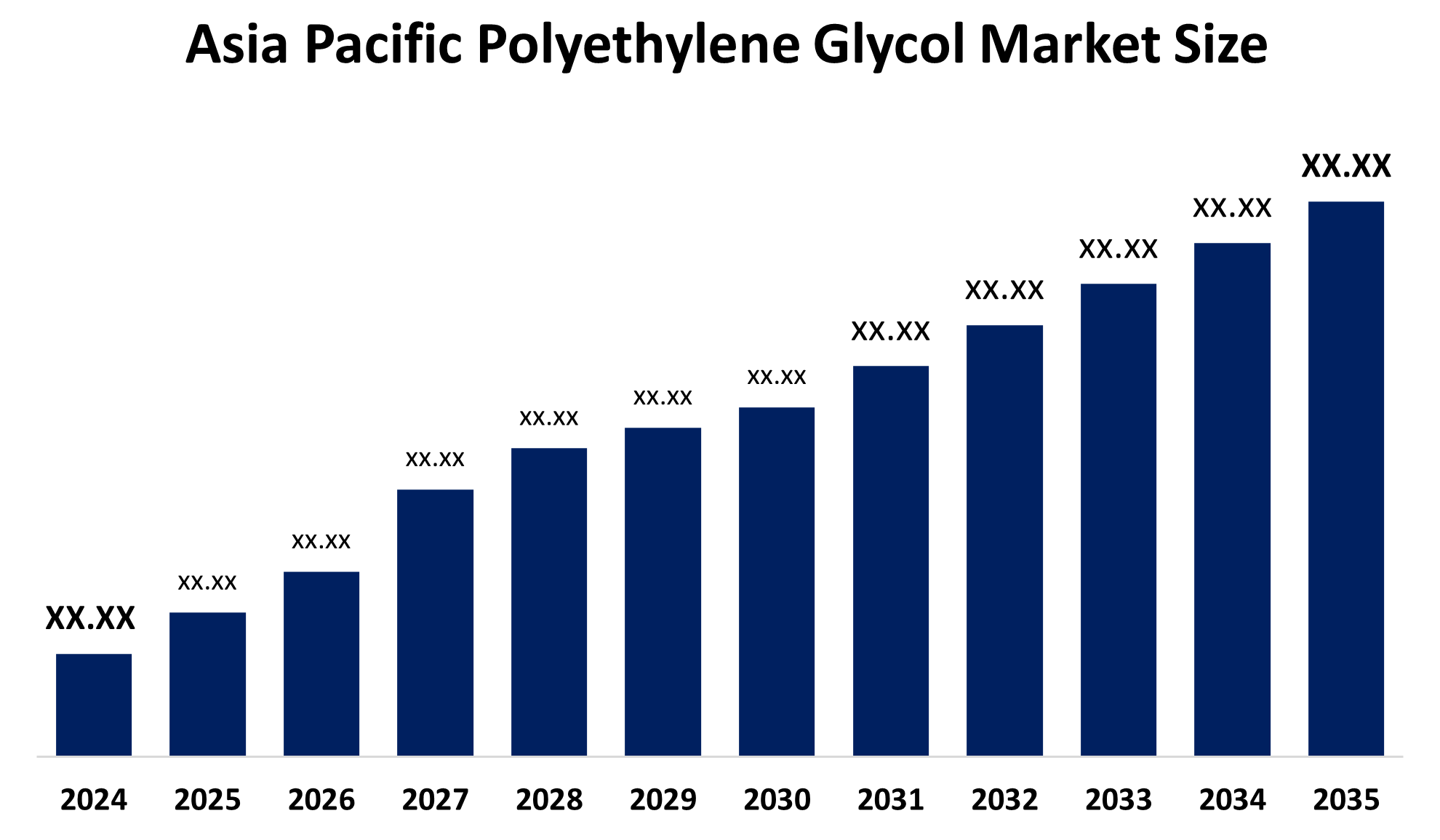
- The Asia Pacific Polyethylene Glycol Market Size Is Expected to Grow at a CAGR of Around 7.4% from 2025 to 2035.
- The Asia Pacific Polyethylene Glycol Market Size Is Expected to Reach a Significant Share by 2035
Get more details on this report -
According to a research report published by Spherical Insights & Consulting, The Asia Pacific Polyethylene Glycol Market Size is Expected to Grow 7.4% CAGR from 2025 to 2035 is Expected to Reach a significant share by 2035. The market is driven by rapid industrialization, surging demand in key sectors (healthcare, cosmetics, food), rising disposable incomes, and supportive government policies, particularly in China, India, and South Korea, driving expansion in pharmaceutical formulations (like extended-release drugs), personal care products, and industrial applications.
Market Overview
Polyethylene glycol (PEG) is a versatile, water-soluble synthetic polymer composed of repeating ethylene oxide units, highly valued for its non-toxicity, safety, and unique physicochemical properties. It is characterized by its exceptional solubility, varying viscosity levels, and stability across different thermal environments, making it indispensable in medicines and cosmetics. Current market trends show a significant pivot toward "green chemistry," with manufacturers increasingly developing bio-based PEG variants to meet the growing consumer preference for sustainable and environmentally responsible chemical solutions.
Government and private initiatives are actively steering the market's trajectory across the region. In India, the government's "Mega Textile Parks" initiative is significantly boosting the demand for PEG-based lubricants and finishing agents. Simultaneously, private sector giants are making massive moves; for example, SABIC recently invested USD 6.4 billion in a petrochemical complex in China to expand downstream production of PEG derivatives, while Clariant and India Glycols established a joint venture specifically to scale renewable ethylene oxide derivatives.
Technological advancement in the PEG market is currently centered on PEGylation technology, which is being refined to enhance the therapeutic half-life and stability of complex biopharmaceuticals. Innovations in manufacturing now allow for the production of highly specialized, homogeneous polymer variants, such as PEG-400 for advanced ophthalmic solutions and high-molecular-weight PEG-3350 for chronic constipation treatments. Furthermore, the integration of PEG into 3D-printing resins for patient-specific medical implants represents a breakthrough in high-margin healthcare technology.
Report Coverage
This research report categorizes the market for the based on various segments and regions Asia Pacific Polyethylene Glycol Market Size, and forecasts revenue growth and analyses trends in each submarket. The report analyses the key growth drivers, opportunities, and challenges influencing the Asia Pacific Polyethylene Glycol Market Size. Recent market developments and competitive strategies, such as expansion, product launch, development, partnership, merger, and acquisition have been included to draw the competitive landscape in the market. The report strategically identifies and profiles the key market players and analyses their core competencies in each sub-segment of the Asia Pacific polyethylene glycol market.
Asia Pacific Polyethylene Glycol Market Report Coverage
| Report Coverage | Details |
|---|---|
| Base Year: | 2024 |
| Forecast Period: | 2025-2035 |
| Forecast Period CAGR 2025-2035 : | 7.4% |
| Historical Data for: | 2020-2023 |
| No. of Pages: | 195 |
| Tables, Charts & Figures: | 102 |
| Segments covered: | By Grade, By Form |
| Companies covered:: | Lotte Chemical Corporation, Sanyo Chemical Industries, Ltd., India Glycols Limited, Indorama Ventures Public Company Limited, NOF Corporation, Kao Corporation, PETRONAS Chemicals Group Berhad, Mitsui Chemicals, Inc., Liaoning Oxiranchem Inc., Liaoning Kelong Fine Chemical, and Other Key Players |
| Pitfalls & Challenges: | and COVID-19 Impact Analysis |
Get more details on this report -
Driving Factors
The Asia Pacific Polyethylene Glycol Market Size is primarily driven by the robust growth of the pharmaceutical and personal care sectors in China and India. PEG is increasingly used as a vital excipient to enhance the solubility and bioavailability of modern medications, including vaccines and biologics. Additionally, the booming textile industry utilizes PEG as an antistatic agent and lubricant, while the construction sector adopts it as a self-curing agent to improve material performance in rapid urbanization projects.
Restraining Factors
The primary restraint is the high out-of-pocket cost associated with NIPT, which remains unaffordable for many families in developing APAC nations. Furthermore, complex regulatory frameworks and a lack of skilled laboratory personnel hinder widespread implementation in rural areas.
Market Segmentation
The Asia Pacific polyethylene glycol market share is categorised into grade and form.
- The PEG 4000 segment accounted for the largest revenue market share in 2024 and is expected to grow at a significant CAGR during the forecast period.
The Asia Pacific Polyethylene Glycol Market Size is segmented by grade into PEG 200, PEG 300, PEG 400, PEG 600, PEG 1000, PEG 3350, PEG 4000, PEG 6000, PEG 8000, PEG 10000, and PEG 20000. Among these, the PEG 4000 segment accounted for the largest revenue market share in 2024 and is expected to grow at a significant CAGR during the forecast period. It is due to its versatility in pharmaceuticals (binders, controlled release) and cosmetics, balancing properties well, while PEG 3350 is a rapidly growing segment, especially in laxatives, and PEG 400/200 leads in liquid formulations (solvents, humectants) for fast-growing personal care, showing dominance varies by specific application focus, with PEG 4000 generally holding a strong position across industries.
- The flakes/ powder segment dominated the market in 2024 and is projected to grow at a substantial CAGR during the forecast period.
Based on form, the Asia Pacific Polyethylene Glycol Market Size is segmented into opaque liquid, white waxy solid, and flakes/ powder. Among these, the flakes/ powder segment dominated the market in 2024 and is projected to grow at a substantial CAGR during the forecast period. It is driven by ease of handling, storage, and uniform mixing in dry formulations for pharmaceuticals, personal care, and textiles.
Competitive Analysis:
The report offers the appropriate analysis of the key organizations/companies involved within the Asia Pacific Polyethylene Glycol Market Size, along with a comparative evaluation primarily based on their product offering, business overviews, geographic presence, enterprise strategies, segment market share, and SWOT analysis. The report also provides an elaborate analysis focusing on the current news and developments of the companies, which includes product development, innovations, joint ventures, partnerships, mergers & acquisitions, strategic alliances, and Polyethylene Glycol. This allows for the evaluation of the overall competition within the market.
List of Key Companies
- Lotte Chemical Corporation
- Sanyo Chemical Industries, Ltd.
- India Glycols Limited
- Indorama Ventures Public Company Limited
- NOF Corporation
- Kao Corporation
- PETRONAS Chemicals Group Berhad
- Mitsui Chemicals, Inc.
- Liaoning Oxiranchem Inc.
- Liaoning Kelong Fine Chemical
- Others
Key Target Audience
- Market Players
- Investors
- End-users
- Government Authorities
- Consulting and Research Firm
- Venture capitalists
- Value-Added Resellers (VARs)
Market Segment
This study forecasts revenue at the Asia Pacific, regional, and country levels from 2020 to 2035. Spherical Insights has segmented the Asia Pacific Polyethylene Glycol Market Size based on the below-mentioned segments:
Asia Pacific Polyethylene Glycol Market, By Grade
- PEG 200
- PEG 300
- PEG 400
- PEG 600
- PEG 1000
- PEG 3350
- PEG 4000
- PEG 6000
- PEG 8000
- PEG 10000
- PEG 20000
Asia Pacific Polyethylene Glycol Market, By Form
- Opaque Liquid
- White Waxy Solid
- Flakes/ Powder
Frequently Asked Questions (FAQ)
-
Q: What is the Asia Pacific polyethylene glycol market size?A: The Asia Pacific polyethylene glycol market size is expected to grow 7.4% CAGR from 2025 to 2035 is expected to reach a significant share by 2035.
-
Q: What are the key growth drivers of the market?A: The Asia Pacific polyethylene glycol market is primarily driven by the robust growth of the pharmaceutical and personal care sectors in China and India. PEG is increasingly used as a vital excipient to enhance the solubility and bioavailability of modern medications, including vaccines and biologics.
-
Q: What factors restrain the Asia Pacific polyethylene glycol market?A: Market growth is significantly challenged by the high volatility of raw material prices, as PEG is traditionally derived from petrochemical-based ethylene oxide. Furthermore, increasing regulatory scrutiny regarding the biodegradability and environmental persistence of synthetic polymers forces manufacturers to comply with strict safety standards, which can increase production costs and limit entry for smaller regional players.
-
Q: How is the market segmented by form?A: The market is segmented into opaque liquid, white waxy solid, and flakes/ powder.
Need help to buy this report?