Asia Pacific Hearing Aids Market Size, Share, and COVID-19 Impact Analysis, By Patient Type (Adults and Pediatrics), By Distribution Channel (OTC, Medical Channel, and Private Practices), and Asia Pacific Hearing Aids Market Insights, Industry Trends, Forecast to 2035
Industry: Healthcare
Asia Pacific Hearing Aids Market Size Insights Forecasts to 2035
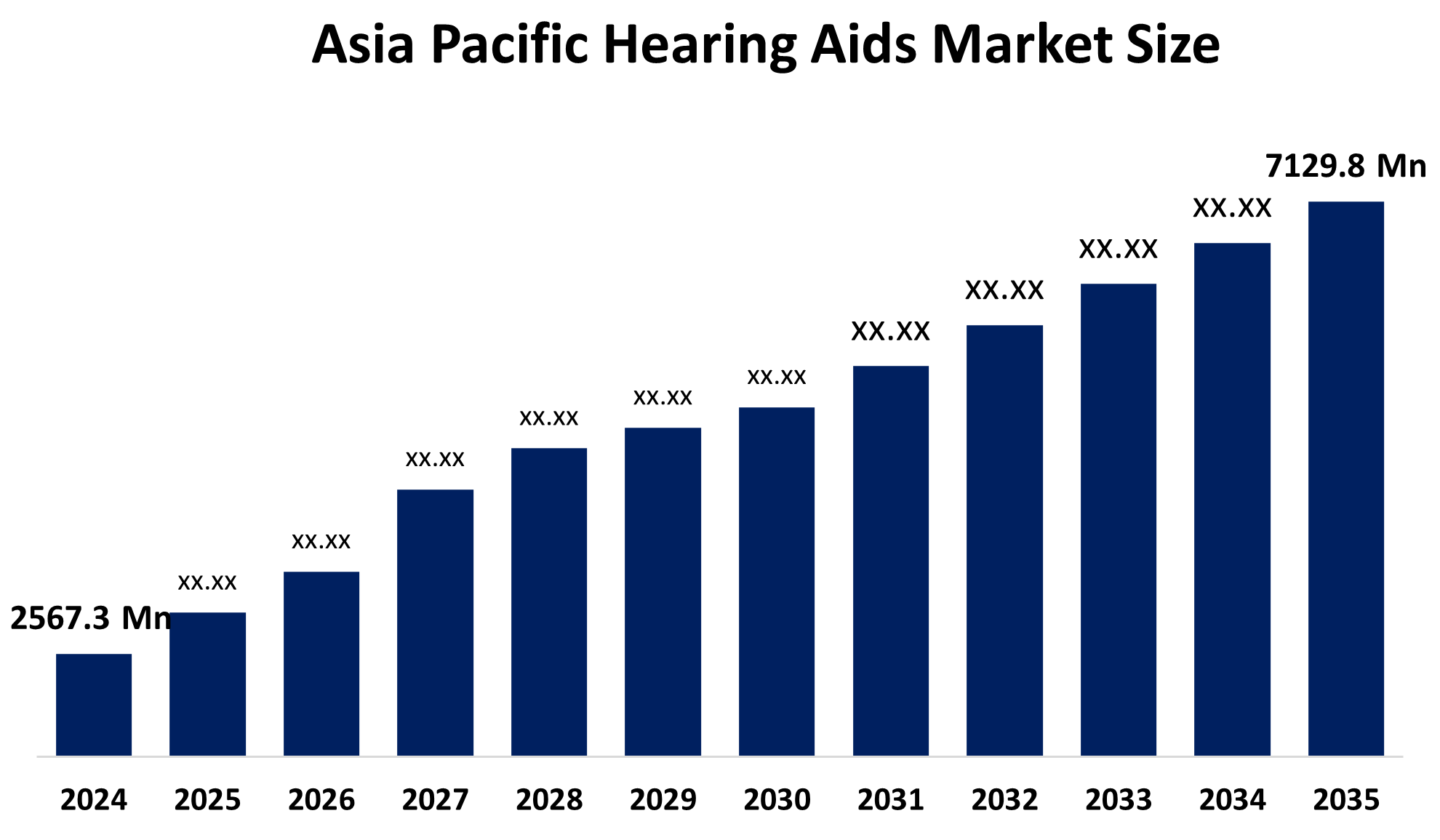
- The Asia Pacific Hearing Aids Market Size Was Estimated at USD 2567.3 Million in 2024.
- The Market Size is Expected to Grow at a CAGR of Around 9.73% from 2025 to 2035.
- The Asia Pacific Hearing Aids Market Size is Expected to Reach USD 7129.8 Million by 2035.
Get more details on this report -
According to a research report published by Spherical Insights & Consulting, The Asia Pacific Hearing Aids Market Size is Anticipated to Reach USD 7129.8 Million by 2035, Growing at a CAGR of 9.73% from 2025 to 2035. The market is driven by an aging population, rising hearing loss prevalence, increasing healthcare spending, and technological advancements like AI and Bluetooth connectivity, with China and Japan leading demand, and countries like the Philippines emerging as production hubs.
Market Overview
The Asia Pacific Hearing Aids Market Size refers to the industry focused on electronic devices designed to improve hearing by making sound audible to individuals with hearing loss. These devices are characterized by their sophisticated sound processing capabilities, varying form factors like behind-the-ear (BTE) or in-the-canal (ITC), and increasing integration of digital technology. Key trends in the Asia Pacific region include a shift toward miniaturized, invisible designs, the rising popularity of rechargeable batteries, and a growing consumer preference for smart, connected devices that sync with smartphones and other digital wearables.
Government and private initiatives are playing a critical role in expanding the market across the Asia Pacific. Many regional governments are implementing hearing loss awareness campaigns and newborn screening procedures to ensure early intervention. Private sector involvement includes strategic acquisitions, such as Sonova's purchase of HYSOUND Group in China, to improve clinical access. Additionally, collaborative efforts between NGOs and private firms are establishing hearing care centers in underserved and remote areas to bridge the gap in service accessibility.
Technological advancements are revolutionizing the market with the introduction of AI-powered sound processing and tele-audiology services. Artificial intelligence now allows devices to automatically adapt sound levels based on environmental cues and offer real-time health monitoring features. Innovations also include Bluetooth-enabled streaming for seamless connectivity with TVs and mobile phones, as well as the development of tele-audiology platforms that allow for remote device programming and virtual consultations with hearing care professionals.
Report Coverage
This research report categorizes the market for the Asia Pacific hearing aids market based on various segments and regions, and forecasts revenue growth and analyses trends in each submarket. the report analyses the key growth drivers, opportunities, and challenges influencing the Asia Pacific hearing aids market. recent market developments and competitive strategies, such as expansion, product launch, development, partnership, merger, and acquisition have been included to draw the competitive landscape in the market. the report strategically identifies and profiles the key market players and analyses their core competencies in each sub-segment of the Asia Pacific hearing aids market.
Asia Pacific Hearing Aids Market Report Coverage
| Report Coverage | Details |
|---|---|
| Base Year: | 2024 |
| Market Size in 2024: | USD 2567.3 Million |
| Forecast Period: | 2025-2035 |
| Forecast Period CAGR 2025-2035 : | 9.73% |
| 2035 Value Projection: | USD 7129.8 Million |
| Historical Data for: | 2020-2023 |
| No. of Pages: | 225 |
| Tables, Charts & Figures: | 102 |
| Segments covered: | By Patient Type, By Distribution Channel |
| Companies covered:: | Cochlear Ltd. (Australia), Signia (operations in Singapore), RION Co., Ltd. (Japan), Arphi Electronics Private Limited (India), Sound One India (India), iFLYTEK (China), Abid Hearing Instruments Ltd., Zhenphen Hearing Care, HYSOUND Group, Neurosensory (Australia), and Other Key Players |
| Pitfalls & Challenges: | and COVID-19 Impact Analysis |
Get more details on this report -
Driving Factors
The market is primarily driven by the rapidly growing geriatric population in countries like China, Japan, and India, which creates a massive demand for age-related hearing loss treatments. Increasing noise pollution and industrial activities are also contributing to higher rates of hearing impairment among younger demographics. Furthermore, regulatory shifts allowing for over-the-counter (OTC) sales have lowered barriers to entry, making devices more affordable and accessible to millions with mild-to-moderate hearing loss.
Restraining Factors
Market growth is hindered by the high cost of advanced, AI-powered hearing aids and limited insurance reimbursement policies in many emerging economies. Additionally, the persistent social stigma associated with wearing visible hearing devices often leads to low adoption rates among adults. Supply chain disruptions and specialized manufacturing requirements also pose challenges for regional players.
Market Segmentation
The Asia Pacific hearing aids market share is categorised into patient type and fruit type.
- The adults segment accounted for the largest revenue market share in 2024 and is expected to grow at a significant CAGR during the forecast period.
The Asia Pacific Hearing Aids Market Size is segmented by patient type into adults and pediatrics. Among these, the adults segment accounted for the largest revenue market share in 2024 and is expected to grow at a significant CAGR during the forecast period. primarily due to the high prevalence of age-related hearing loss (presbycusis) in the region's rapidly aging populations (China, Japan, India), coupled with greater awareness and disposable income for these devices, though pediatric cases also see growth due to increasing screening and awareness.
- The medical channel segment dominated the market in 2024 and is projected to grow at a substantial CAGR during the forecast period.
Based on distribution channel, the Asia Pacific Hearing Aids Market Size is segmented into OTC (Over-the-Counter), medical channel, and private practices. Among these, the medical channel segment dominated the market in 2024 and is projected to grow at a substantial CAGR during the forecast period. driven by increased ENT consultations, favorable reimbursements for implants, and the need for professional fitting, with private practices also gaining traction with greater access to devices.
Competitive Analysis:
The report offers the appropriate analysis of the key organizations/companies involved within the Asia Pacific Hearing Aids Market Size, along with a comparative evaluation primarily based on their product offering, business overviews, geographic presence, enterprise strategies, segment market share, and SWOT analysis. The report also provides an elaborate analysis focusing on the current news and developments of the companies, which includes product development, innovations, joint ventures, partnerships, mergers & acquisitions, strategic alliances, and others. This allows for the evaluation of the overall competition within the market.
List of Key Companies
- Cochlear Ltd. (Australia)
- Signia (operations in Singapore)
- RION Co., Ltd. (Japan)
- Arphi Electronics Private Limited (India)
- Sound One India (India)
- iFLYTEK (China)
- Abid Hearing Instruments Ltd.
- Zhenphen Hearing Care
- HYSOUND Group
- Neurosensory (Australia)
- Others
Key Target Audience
- Market Players
- Investors
- End-users
- Government Authorities
- Consulting and Research Firm
- Venture capitalists
- Value-Added Resellers (VARs)
Market Segment
This study forecasts revenue at the Asia Pacific, regional, and country levels from 2020 to 2035. Spherical Insights has segmented the Asia Pacific Hearing Aids Market Size based on the below-mentioned segments:
Asia Pacific Hearing Aids Market, By Patient Type
- Adults
- Pediatrics
Asia Pacific Hearing Aids Market, By Distribution Channel
- OTC (Over-the-Counter)
- Medical Channel
- Private Practices.
Frequently Asked Questions (FAQ)
-
Q: What is the Asia Pacific hearing aids market size?The Asia Pacific hearing aids market size is expected to grow from USD 2567.3 Million in 2024 to USD 7129.8 Million by 2035, growing at a CAGR of 9.73% during the forecast period 2025-2035.
-
Q: What are the key growth drivers of the market?The market is primarily driven by the rapidly growing geriatric population in countries like China, Japan, and India, which creates a massive demand for age-related hearing loss treatments. Increasing noise pollution and industrial activities are also contributing to higher rates of hearing impairment among younger demographics.
-
Q: What factors restrain the Asia Pacific hearing aids market?Market growth is hindered by the high cost of advanced, AI-powered hearing aids and limited insurance reimbursement policies in many emerging economies.
-
Q: How is the market segmented by distribution channel?A: The market is segmented into OTC (Over-the-Counter), medical channel, and private practices.
Need help to buy this report?