Asia-Pacific General Aviation Market Size, Share, and COVID-19 Impact Analysis, By Aircraft Type (Business Jets, and Others), By Application (Business/Corporate Transport, Personal and Leisure Flying, and Others), and Asia-Pacific General Aviation Market Insights, Industry Trend, Forecasts to 2035
Industry: Aerospace & Defense
Asia-Pacific General Aviation Market Insights Forecasts to 2035
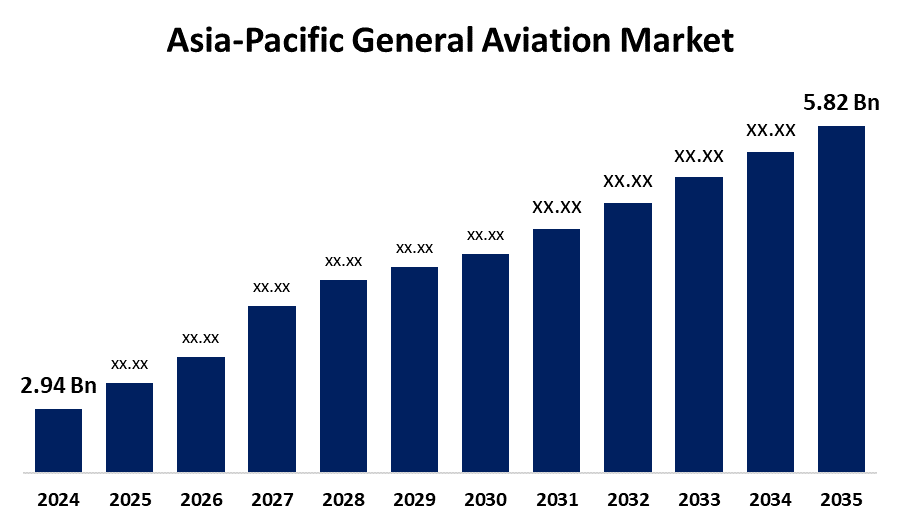
- The Asia-Pacific General Aviation Market Size Was Estimated at USD 2.94 Billion in 2024
- The Market Size is Expected to Grow at a CAGR of Around 6.4% from 2025 to 2035
- The Asia-Pacific General Aviation Market Size is Expected to Reach USD 5.82 Billion by 2035
Get more details on this report -
According to a research report published by Spherical Insights & Consulting, The Asia-Pacific General Aviation Market Size Is Anticipated To Reach USD 5.82 Billion By 2035, Growing At A CAGR Of 6.4% From 2025 To 2035. Opportunities in the general aviation market include the growing demand for business jets, the expansion of pilot training, the increase in air ambulance services, regional connectivity initiatives, technical improvements, the acceptance of sustainable aviation fuels, and the development of emerging market infrastructure.
Market Overview
The general aviation market refers to the segment of the global aviation industry encompassing all civil aviation operations other than scheduled commercial airline services and military aviation. The industry includes business aviation and private flying and pilot training and air charter services and aerial surveying and agricultural aviation and air ambulance operations and recreational flying. General aviation aircraft typically comprise fixed-wing airplanes and helicopters and turboprops and business jets, gliders and other specialized aircraft which fly without scheduled routes.
In September 2025, Soracle Corporation launched a strategic collaboration with Osaka Prefecture and Osaka City to accelerate eVTOL commercialization, strengthening advanced air mobility infrastructure, regulatory coordination, and urban air transport development initiatives in Osaka. The desire for private air travel, advancements in avionics and safety systems, expanded pilot training programs, the rise in business and corporate aviation, and rising airport infrastructure investments are some of the reasons propelling the general aviation market's
Report Coverage
This research report categorizes the market for the Asia-Pacific general aviation market based on various segments and regions, and forecasts revenue growth and analyses trends in each submarket. The report analyses the key growth drivers, opportunities, and challenges influencing the Asia-Pacific general aviation market. Recent market developments and competitive strategies, such as expansion, product launch, development, partnership, merger, and acquisition, have been included to draw the competitive landscape in the market. The report strategically identifies and profiles the key market players and analyses their core competencies in each sub-segment of the Asia-Pacific general aviation market.
Asia-Pacific General Aviation Market Report Coverage
| Report Coverage | Details |
|---|---|
| Base Year: | 2024 |
| Market Size in 2024: | USD 2.94 Billion |
| Forecast Period: | 2025-2035 |
| Forecast Period CAGR 2025-2035 : | 6.4% |
| 2035 Value Projection: | USD 5.82 Billion |
| Historical Data for: | 2020-2023 |
| No. of Pages: | 210 |
| Tables, Charts & Figures: | 114 |
| Segments covered: | By Aircraft Type, By Application |
| Companies covered:: | Airbus SE, Textron Inc., Robinson Helicopter Company, Embraer S.A., Gulfstream Aerospace Corporation, Others |
| Pitfalls & Challenges: | COVID-19 Empact, Challenge, Future, Growth, & Analysis |
Get more details on this report -
Driving Factors
The market for general aviation is expanding because of the growing airport infrastructure, which makes it easier to reach, safer, and more efficient for both private and commercial aircraft. Growing desire for individualized air travel propels market expansion by increasing sales of small aircraft and private jets, which provide convenience and flexibility to both business and leisure travelers globally. Growing airport infrastructure expenditures increase accessibility and operational effectiveness, drawing in more general aviation operations and promoting regional market expansion. Large-cabin jet and long-range turboprop purchases are being viewed as productivity instruments that connect sparse networks of commercial airlines rather than as discretionary expenditures.
Restraining Factors
High aircraft acquisition and maintenance costs, strict regulatory compliance requirements, limited airport infrastructure, fluctuating fuel prices, pilot shortages, economic volatility, financing constraints, and growing environmental regulations that impact operational efficiency and profitability are some of the factors that are restricting the general aviation market.
Market Segmentation
The Asia-Pacific general aviation market share is classified into aircraft type and application.
- The business jets segment accounted for the largest revenue market share in 2024 and is expected to grow at a significant CAGR during the forecast period.
The Asia-Pacific general aviation market is segmented by aircraft type into business jets and others. Among these, the business jets segment accounted for the largest revenue market share in 2024 and is expected to grow at a significant CAGR during the forecast period. The growing need for effective, adaptable, and time-sensitive corporate travel solutions is the main factor driving the business jet market. The rise in cross-border business, the growth of multinational firms, and the number of high-net-worth individuals. The category is also influenced by favorable financing choices, developing airport infrastructure, and the increasing popularity of fractional ownership and charter services.
- The business/corporate transport segment dominated the share in 2024 and is anticipated to grow at a remarkable CAGR during the forecast period.
The Asia-Pacific general aviation market is segmented by application into business/corporate transport, personal and leisure flying, and others. Among these, the business/corporate transport segment dominated the share in 2024 and is anticipated to grow at a remarkable CAGR during the forecast period. The business/corporate transport market is a result of high-net-worth individuals and corporate leaders' growing need for effective, adaptable, and time-sensitive travel options. The need for private aviation services has increased because to the rapid economic growth of nations like China, India, and Japan, which has sped up regional company expansion and cross-border trade.
Competitive Analysis:
The report offers the appropriate analysis of the key organizations/companies involved within the Asia-Pacific General Aviation market, along with a comparative evaluation primarily based on their product offering, business overviews, geographic presence, enterprise strategies, segment market share, and SWOT analysis. The report also provides an elaborate analysis focusing on the current news and developments of the companies, which includes product development, innovations, joint ventures, partnerships, mergers & acquisitions, strategic alliances, and others. This allows for the evaluation of the overall competition within the market.
List of Key Companies
- Airbus SE
- Textron Inc.
- Robinson Helicopter Company
- Embraer S.A.
- Gulfstream Aerospace Corporation
- Others
Key Target Audience
- Market Players
- Investors
- End-users
- Government Authorities
- Consulting and Research Firm
- Venture capitalists
- Value-Added Resellers (VARs)
Recent Developments:
- In August 2025, Shanghai-based TCab Tech launched a USD 1 billion agreement with Autocraft to supply 350 E20 eVTOL aircraft, strengthening advanced air mobility deployment across Middle East and North Africa markets.
- In October 2023, Textron Aviation launched a strategic purchase agreement with Fly Alliance for up to 20 Cessna Citation business jets, including options for 16 additional aircraft, expanding fleet modernization initiatives.
Market Segment
This study forecasts revenue at the Australia, regional, and country levels from 2020 to 2035. Spherical Insights has segmented the Asia-Pacific general aviation market based on the below-mentioned segments:
Asia-Pacific General Aviation Market, By Aircraft Type
- Business Jets
- Others
Asia-Pacific General Aviation Market, By Application
- Business/Corporate Transport
- Personal and Leisure Flying
- Others
Frequently Asked Questions (FAQ)
-
Q: What is the Asia-Pacific general aviation market size?A: Asia-Pacific general aviation market size is expected to grow from USD 2.94 billion in 2024 to USD 5.82 billion by 2035, growing at a CAGR of 6.4% during the forecast period 2025-2035.
-
Q: What are the key growth drivers of the market?Key growth drivers include rising corporate travel demand, increasing high-net-worth individuals, expanding regional connectivity, growth in charter and fractional ownership services, pilot training demand, infrastructure development, and technological advancements in aircraft efficiency and safety systems.
-
Q: What factors restrain the Asia-Pacific general aviation market?The market is restrained by high aircraft acquisition and maintenance costs, stringent regulatory requirements, limited airport infrastructure, pilot shortages, fluctuating fuel prices, environmental compliance pressures, and economic uncertainties across emerging economies.
-
Q: How is the market segmented by aircraft type?The market is segmented by aircraft type into business jets and others, which include turboprops, piston aircraft, helicopters, and specialized utility aircraft.
-
Q: Who are the key players in the Asia-Pacific general aviation market?Key players include Airbus SE, Textron Inc., Embraer S.A., Gulfstream Aerospace Corporation, and Robinson Helicopter Company.
-
Q: Who are the target audiences for this market report?Target audiences include aircraft manufacturers, component suppliers, MRO service providers, aviation investors, regulatory authorities, airport operators, leasing companies, and strategic planners seeking insights into regional aviation growth opportunities.
Need help to buy this report?