Asia Pacific Fruit Snacks Market Size, Share, and COVID-19 Impact Analysis, By Product Type (Sweet and Savory Chips, Fresh Cuts and Slices, Candies and Bars, Dairy-Based, and Others), By Fruit Type (Apple, Mango, Banana, Pineapple, Berries, Mixed, and Others), and Asia Pacific Fruit Snacks Market Insights, Industry Trends, Forecast to 2035
Industry: Food & Beverages
Asia Pacific Fruit Snacks Market Size Insights Forecasts to 2035
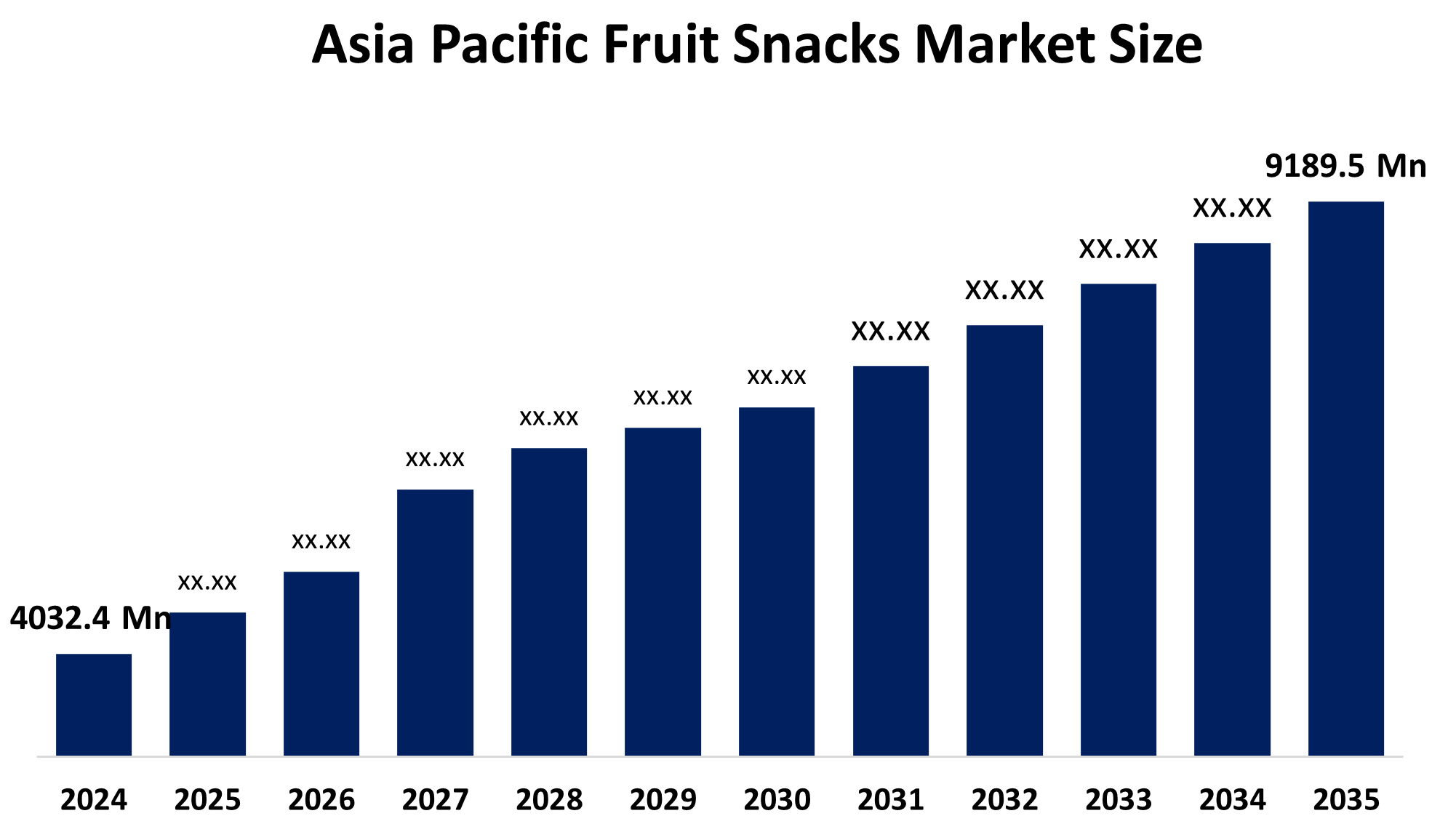
- The Asia Pacific Fruit Snacks Market Size Was Estimated at USD 4032.4 Million in 2024.
- The Market Size is Expected to Grow at a CAGR of Around 7.78% from 2025 to 2035.
- The Asia Pacific Fruit Snacks Market Size is Expected to Reach USD 9189.5 Million by 2035.
Get more details on this report -
According to a research report published by Spherical Insights & Consulting, The Asia Pacific Fruit Snacks Market Size is Anticipated to Reach USD 9189.5 Million by 2035, Growing at a CAGR of 7.78% from 2025 to 2035. The market is driven by rapid industrialization, massive infrastructure & construction projects, booming automotive production, and a strong Fruit Snacks industry.
Market Overview
Fruit snacks are processed food products primarily derived from fruits, typically presented in convenient, portable formats such as dried pieces, fruit bars, or purees designed for on-the-go consumption. These products are characterized by their high nutritional value, containing natural vitamins, minerals, and fiber, and are increasingly marketed as "clean-label" or "better-for-you" alternatives to traditional confectionery. Current market trends in the Asia Pacific region show a significant shift toward organic, plant-based, and functional fruit snacks that offer added benefits such as probiotics, immunity-boosting extracts, and reduced sugar content. Additionally, there is a rising demand for exotic fruit flavors and innovative textures, such as freeze-dried fruit chunks and fruit-infused savory snacks, catering to a diverse and health-conscious consumer base.
Government and private initiatives are playing a critical role in shaping the Asia Pacific Fruit Snacks Market Size landscape. Several governments in the region have implemented public health policies, such as Singapore’s Nutri-Grade labeling and India’s front-of-pack warnings for high fat, sugar, and salt (HFSS) products, which encourage manufacturers to reformulate their snacks with healthier fruit ingredients. Private sector players are responding by investing in "clean-label" product lines and forming strategic alliances to expand their reach in emerging markets like China and India. Furthermore, subsidies for cold-chain infrastructure by various APAC governments are enhancing the distribution of fresh-cut and frozen fruit snacks, ensuring better product quality and accessibility.
Technological advancements in food processing and packaging are further propelling market growth. Innovations in dehydration techniques, particularly freeze-drying and vacuum drying, have enabled manufacturers to retain the original nutritional profile, flavor, and texture of fresh fruits while extending shelf life. Advanced agri-tech, including tissue culture and bioreactor systems, is also being utilized to improve the quality and yield of raw materials, thereby reducing production costs over time. Moreover, the integration of smart and sustainable packaging technologies such as biodegradable pouches and vacuum-sealed formats is helping to maintain product freshness and appeal to environmentally conscious consumers across the region.
Report Coverage
This research report categorizes the market for the Asia Pacific Fruit Snacks Market Size based on various segments and regions, and forecasts revenue growth and analyses trends in each submarket. the report analyses the key growth drivers, opportunities, and challenges influencing the Asia pacific fruit snacks market. recent market developments and competitive strategies, such as expansion, product launch, development, partnership, merger, and acquisition have been included to draw the competitive landscape in the market. the report strategically identifies and profiles the key market players and analyses their core competencies in each sub-segment of the Asia pacific fruit snacks market.
Asia Pacific Fruit Snacks Market Report Coverage
| Report Coverage | Details |
|---|---|
| Base Year: | 2024 |
| Market Size in 2024: | USD 4032.4 Million |
| Forecast Period: | 2025-2035 |
| Forecast Period CAGR 2025-2035 : | 7.78% |
| 2035 Value Projection: | USD 9189.5 Million |
| Historical Data for: | 2020-2023 |
| No. of Pages: | 195 |
| Tables, Charts & Figures: | 102 |
| Segments covered: | By Product Type, By Fruit Type |
| Companies covered:: | ITC Limited (India), Haldiram Snacks Food Pvt. Ltd. (India), Dabur India Ltd., Balaji Wafers Pvt. Ltd., Lotte Corporation (South Korea), Calbee Inc., Meiji Holdings Co. Ltd. (Japan), Orion Corp, Britannia Industries Limited (India), Bikaji Foods International Limited (India), and Other Key Players |
| Pitfalls & Challenges: | and COVID-19 Impact Analysis |
Get more details on this report -
Driving Factors
The Asia Pacific Fruit Snacks Market Size is primarily driven by rising health consciousness among consumers seeking nutrient-dense alternatives to sugary confectionery. Urbanization and hectic lifestyles have increased the demand for convenient, portable on-the-go snack formats. Rapid growth in e-commerce and retail infrastructure, especially in India and China, has made diverse fruit snack varieties highly accessible. Additionally, increasing disposable income allows consumers to opt for premium, organic, and functional snack products.
Restraining Factors
Market growth is hindered by high production costs associated with advanced drying technologies like freeze-drying. Volatility in raw material prices due to climate changes and seasonal variations also poses a challenge. Furthermore, stringent and varied regulatory standards across different APAC countries complicate compliance for manufacturers. Competition from fresh fruits and price sensitivity in certain regional segments further restrain widespread adoption.
Market Segmentation
The Asia Pacific fruit snacks market share is categorised into product type and fruit type.
- The sweet and savory chips segment accounted for the largest revenue market share in 2024 and is expected to grow at a significant CAGR during the forecast period.
The Asia Pacific Fruit Snacks Market Size is segmented by product type into sweet and savory chips, fresh cuts and slices, candies and bars, dairy-based, and others. Among these, the sweet and savory chips segment accounted for the largest revenue market share in 2024 and is expected to grow at a significant CAGR during the forecast period. It driven by consumer demand for convenience, diverse flavors, and healthier alternatives, with sweet/savory chips appealing for their texture and perceived naturalness, while bars and gummies satisfy cravings with innovation and ease of consumption, balancing indulgence and health trends across the region.
- The mango segment dominated the market in 2024 and is projected to grow at a substantial CAGR during the forecast period.
Based on fruit type, the Asia Pacific Fruit Snacks Market Size is segmented into apple, mango, banana, pineapple, berries, mixed, and others. Among these, the mango segment dominated the market in 2024 and is projected to grow at a substantial CAGR during the forecast period. While Mango often dominates in the broader Asia-Pacific fruit snacks market due to deep cultural ties and regional production, recent trends also highlight Mixed fruits and Apple as major contenders, with Mixed offering variety and Apple gaining traction for its perceived health benefits (low calorie, good shelf life), driven by urbanization and health-conscious consumers seeking convenient, natural options.
Competitive Analysis:
The report offers the appropriate analysis of the key organizations/companies involved within the Asia Pacific Fruit Snacks Market Size, along with a comparative evaluation primarily based on their product offering, business overviews, geographic presence, enterprise strategies, segment market share, and SWOT analysis. The report also provides an elaborate analysis focusing on the current news and developments of the companies, which includes product development, innovations, joint ventures, partnerships, mergers & acquisitions, strategic alliances, and Titanium Dioxide. This allows for the evaluation of the overall competition within the market.
List of Key Companies
- ITC Limited (India)
- Haldiram Snacks Food Pvt. Ltd. (India)
- Dabur India Ltd.
- Balaji Wafers Pvt. Ltd.
- Lotte Corporation (South Korea)
- Calbee Inc.
- Meiji Holdings Co. Ltd. (Japan)
- Orion Corp
- Britannia Industries Limited (India)
- Bikaji Foods International Limited (India)
- Others
Key Target Audience
- Market Players
- Investors
- End-users
- Government Authorities
- Consulting and Research Firm
- Venture capitalists
- Value-Added Resellers (VARs)
Market Segment
This study forecasts revenue at the Asia Pacific, regional, and country levels from 2020 to 2035. Spherical Insights has segmented the Asia Pacific Fruit Snacks Market Size based on the below-mentioned segments:
Asia Pacific Fruit Snacks Market, By Product Type
- Sweet and Savory Chips
- Fresh Cuts and Slices
- Candies and Bars
- Dairy-Based
- Others
Asia Pacific Fruit Snacks Market, By Fruit type
- Apple
- Mango
- Banana
- Pineapple
- Berries
- Mixed
- Others
Frequently Asked Questions (FAQ)
-
Q: What is the Asia Pacific fruit snacks market size?The Asia Pacific fruit snacks market size is expected to grow from USD 4032.4 Million in 2024 to USD 9189.5 Million by 2035, growing at a CAGR of 7.78% during the forecast period 2025-2035.
-
Q: What are the key growth drivers of the market?A: The Asia Pacific fruit snacks market is primarily driven by rising health consciousness among consumers seeking nutrient-dense alternatives to sugary confectionery.
-
Q: What factors restrain the Asia Pacific fruit snacks market?A: Market growth is hindered by high production costs associated with advanced drying technologies like freeze-drying. Volatility in raw material prices due to climate changes and seasonal variations also poses a challenge.
-
Q: How is the market segmented by fruit type?A: The market is segmented into apple, mango, banana, pineapple, berries, mixed, and others.
Need help to buy this report?