Asia Pacific Fatty Methyl Ester Sulfonate Market Size, Share, and COVID-19 Impact Analysis, By Type (Industrial Grade, Pharmaceutical Grade, Other), By Application (Laundry Detergents, Personal Care, Other), and Asia Pacific Fatty Methyl Ester Sulfonate Market Insights, Industry Trends, Forecast to 2035
Industry: Chemicals & Materials
Asia Pacific Fatty Methyl Ester Sulfonate Market Insights Forecasts To 2035
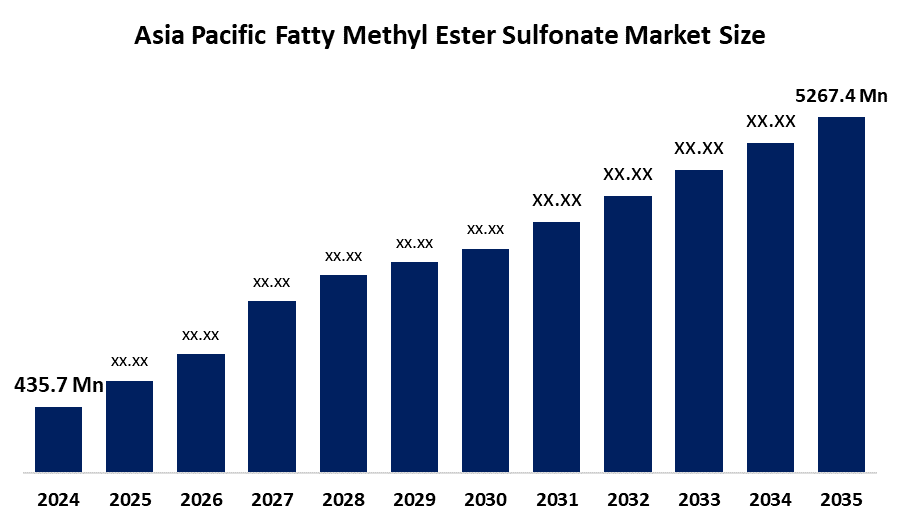
- The Asia Pacific Fatty Methyl Ester Sulfonate Market Size Was Estimated At USD 435.7 Million In 2024.
- The Market Size Is Expected To Grow At A CAGR Of Around 25.43% From 2025 To 2035.
- The Asia Pacific Fatty Methyl Ester Sulfonate Market Size Is Expected To Reach USD 5267.4 Million By 2035.
Get more details on this report -
According To A Research Report Published By Spherical Insights & Consulting, The Asia Pacific Fatty Methyl Ester Sulfonate Market Size Is Anticipated To Reach USD 5267.4 Million By 2035, Growing At A CAGR Of 25.43% From 2025 To 2035. The market is driven by booming detergent & personal care industries in China, India, and Southeast Asia, alongside abundant raw materials (palm/coconut oil) and a strong push for eco-friendly, biodegradable surfactants.
Market Overview
Fatty Methyl Ester Sulfonate (FMES) Is An Eco-Friendly Anionic Surfactant Derived From Natural Vegetable Oils Such As Palm Oil And Coconut Oil Through A Process Of Sulfonation. It is characterized by high detergency, excellent hard water tolerance, and rapid biodegradability, making it a superior alternative to petroleum-based surfactants. Current market trends highlight a significant shift toward "green" chemistry and sustainable manufacturing, as consumers increasingly prefer mild, skin-safe, and biodegradable ingredients in their daily hygiene products.
Government And Private Initiatives Are Playing A Crucial Role In Accelerating FMES Adoption Across The Asia Pacific. Many regional governments have implemented stringent environmental regulations and subsidies to promote bio-based chemicals and reduce reliance on non-biodegradable synthetic substances. In the private sector, major chemical manufacturers are significantly expanding their production capacities and entering strategic partnerships with consumer goods companies to secure sustainable supply chains and co-develop high-purity FMES grades for premium applications.
Technological Advancements In The Field Are Focused On Refining The Sulfonation And Bleaching Processes To Improve Product Purity And Minimize The Formation Of Unwanted By-Products Like Disodium Salts. Innovations include the adoption of falling film reactor technologies and the development of water-free production systems that prevent FMES hydrolysis. Additionally, research into using non-edible feedstocks, such as used cooking oil, for FMES synthesis is emerging as a promising sustainable approach in line with circular economy principles.
Report Coverage
This Research Report Categorizes The Market Size For The Asia Pacific Fatty Methyl Ester Sulfonate Market Based On Various Segments And Regions, And Forecasts Revenue Growth And Analyses Trends In Each Submarket. the report analyses the key growth drivers, opportunities, and challenges influencing the Asia Pacific fatty methyl ester sulfonate market. recent market developments and competitive strategies, such as expansion, product launch, development, partnership, merger, and acquisition have been included to draw the competitive landscape in the market. the report strategically identifies and profiles the key market players and analyses their core competencies in each sub-segment of the Asia Pacific fatty methyl ester sulfonate market.
Asia Pacific Fatty Methyl Ester Sulfonate Market Report Coverage
| Report Coverage | Details |
|---|---|
| Base Year: | 2024 |
| Market Size in 2024: | USD 435.7 Million |
| Forecast Period: | 2020-2023 |
| Forecast Period CAGR 2020-2023 : | 25.43% |
| 2023 Value Projection: | USD 5267.4 Million |
| Historical Data for: | 2020-2023 |
| No. of Pages: | 180 |
| Tables, Charts & Figures: | 120 |
| Segments covered: | By Type, By Application |
| Companies covered:: | KLK OLEO, Wilmar International Ltd., Lion Corporation, Zanyu Technology Group Co., Ltd., PT Ecogreen Oleochemicals, Sinopec Jinling Petrochemical, Jinchang Chemical, Henan Surface Chemical Industry Co., Ltd., Godrej Industries Limited, KPL International Ltd., and Others, Key Players |
| Pitfalls & Challenges: | COVID-19 Empact, Challenge, Future, Growth, & Analysis |
Get more details on this report -
Driving Factors
The Market Size Is Primarily Driven By The Rising Demand For Biodegradable And Eco-Friendly Cleaning Solutions As Environmental Awareness Grows Among Asia Pacific Consumers. The superior performance of FMES in hard water conditions makes it an ideal choice for laundry detergents in regions with high mineral content. Additionally, the rapid expansion of the personal care industry and increasing disposable income in emerging economies like China and India are significantly boosting the consumption of mild surfactants for shampoos and skin-care products.
Restraining Factors
Market Size Growth Is Hindered By The Volatility Of Raw Material Prices, Particularly For Palm And Coconut Oils, Which Are Subject To Environmental Concerns And Global Trade Shifts. Furthermore, high production costs and technological complexities in maintaining product color and purity compared to traditional synthetic surfactants remain a significant challenge for some regional manufacturers.
Market Segmentation
The Asia Pacific fatty methyl ester sulfonate Market share is categorised into type and application.
- The industrial grade segment accounted for the largest revenue market share in 2024 and is expected to grow at a significant CAGR during the forecast period.
The Asia Pacific Fatty Methyl Ester Sulfonate Market Size Is Segmented By Type Into Industrial Grade, Pharmaceutical Grade, And Other. Among these, the industrial grade segment accounted for the largest revenue market share in 2024 and is expected to grow at a significant CAGR during the forecast period. Industrial grade dominates due to massive demand from the detergent industry (laundry, dishwashing) for its superior cleaning power and cost-effectiveness as a renewable alternative to petroleum-based surfactants.
- The personal care segment dominated the market in 2024 and is projected to grow at a substantial CAGR during the forecast period.
Based On Application, The Asia Pacific Fatty Methyl Ester Sulfonate Market Size Is Segmented Into Laundry Detergents, Personal Care, And Other. Among these, the personal care segment dominated the market in 2024 and is projected to grow at a substantial CAGR during the forecast period. Personal care (shampoos, body washes) shows the fastest growth as consumers seek milder, bio-based products, driven by rising incomes, hygiene awareness, and eco-trends. The dominance of detergents stems from their cost-effectiveness and superior performance in washing, but Personal Care's rapid rise highlights a shift towards premium, sustainable ingredients in APAC.
Competitive Analysis:
The Report Offers The Appropriate Analysis Of The Key Organizations/Companies Involved Within The Asia Pacific Fatty Methyl Ester Sulfonate Market Size, along with a comparative evaluation primarily based on their product offering, business overviews, geographic presence, enterprise strategies, segment market share, and SWOT analysis. The report also provides an elaborate analysis focusing on the current news and developments of the companies, which includes product development, innovations, joint ventures, partnerships, mergers & acquisitions, strategic alliances, and Titanium Dioxide. This allows for the evaluation of the overall competition within the market.
List of Key Companies
- KLK OLEO
- Wilmar International Ltd.
- Lion Corporation
- Zanyu Technology Group Co., Ltd.
- PT Ecogreen Oleochemicals
- Sinopec Jinling Petrochemical
- Jinchang Chemical
- Henan Surface Chemical Industry Co., Ltd.
- Godrej Industries Limited
- KPL International Ltd.
- Others
Key Target Audience
- Market Players
- Investors
- End-users
- Government Authorities
- Consulting and Research Firm
- Venture capitalists
- Value-Added Resellers (VARs)
Market Segment
This Study Forecasts Revenue At The Asia Pacific, regional, and country levels from 2020 to 2035. Spherical Insights has segmented the Asia Pacific fatty methyl ester sulfonate market based on the below-mentioned segments:
Asia Pacific Fatty Methyl Ester Sulfonate Market, By Type
- Industrial Grade
- Pharmaceutical Grade
- Other
Asia Pacific Fatty Methyl Ester Sulfonate Market, By Applications
- Laundry Detergents
- Personal Care
- Other
Frequently Asked Questions (FAQ)
-
What is the Asia Pacific fatty methyl ester sulfonate market size?The Asia Pacific fatty methyl ester sulfonate market size is expected to grow from USD 435.7 Million in 2024 to USD 5267.4 Million by 2035, growing at a CAGR of 25.43% during the forecast period 2025-2035.
-
What are the key growth drivers of the market?The market is primarily driven by the rising demand for biodegradable and eco-friendly cleaning solutions as environmental awareness grows among Asia Pacific consumers. The superior performance of FMES in hard water conditions makes it an ideal choice for laundry detergents in regions with high mineral content. Additionally, the rapid expansion of the personal care industry and increasing disposable income in emerging economies like China and India are significantly boosting the consumption of mild surfactants for shampoos and skin-care products.
-
What factors restrain the Asia Pacific fatty methyl ester sulfonate market?Market growth is hindered by the volatility of raw material prices, particularly for palm and coconut oils, which are subject to environmental concerns and global trade shifts. Furthermore, high production costs and technological complexities in maintaining product color and purity compared to traditional synthetic surfactants remain a significant challenge for some regional manufacturers.
-
How is the market segmented by application?The market is segmented into laundry detergents, personal care, and other.
Need help to buy this report?