Asia Pacific Facial Recognition Market Size, Share, and COVID-19 Impact Analysis, By Organisation Size (Large Enterprises, Small & Medium Enterprises), By Deployment (Cloud, On-Premise), and Asia Pacific Facial Recognition Market Insights, Industry Trends, Forecast to 2035
Industry: Electronics, ICT & Media
Asia Pacific Facial Recognition Market Insights Forecasts to 2035
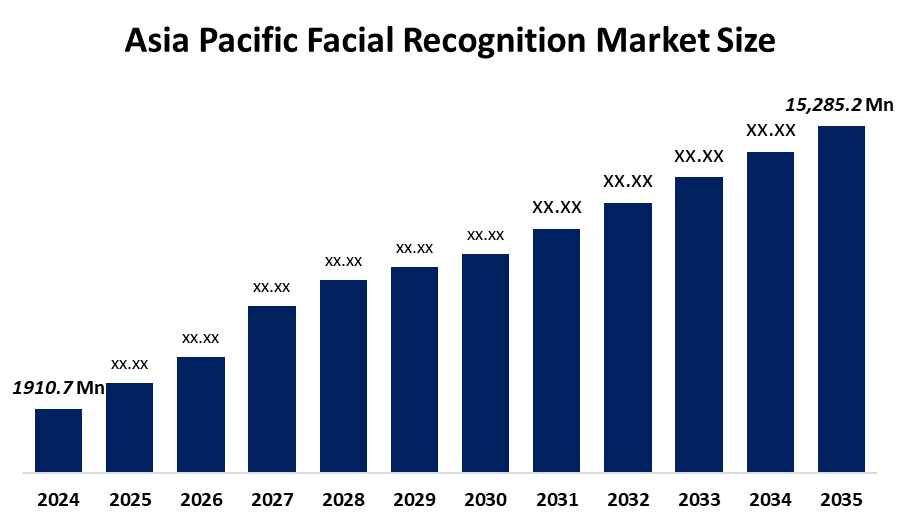
- The Asia Pacific Facial Recognition Market Size Was Estimated at USD 1910.7 Million in 2024
- The Market Size is Expected to Grow at a CAGR of Around 20.85% from 2025 to 2035
- The Asia Pacific Facial Recognition Market Size is Expected to Reach USD 15,285.2 Million by 2035
Get more details on this report -
According to a research report published by Spherical Insights & Consulting, The Asia Pacific Facial Recognition Market Size is anticipated to reach USD 15,285.2 Million by 2035, Growing at a CAGR of 20.85% from 2025 to 2035. The market is driven by rapid urbanization, digital adoption (especially smartphones), and significant government investment in security, smart cities, and digital ID.
Market Overview
The Asia Pacific facial recognition market refers to the regional industry that is dedicated to the development, sale, and implementation of technology that identifies or verifies individuals by analyzing their unique facial features from digital images or videos. This market is a key component of the broader image recognition and biometrics industries. The Asia-Pacific facial recognition market presents major opportunities driven by rapid digitalization, rising security needs, government initiatives (smart cities, national IDs in China/India) and rapidly growing retail/fintech sectors. Key growth areas include public surveillance, identity verification in banking (fintech), frictionless payments, workforce management, and border control, which are in high demand in China (leader), India (fastest CAGR), Southeast Asia (smart cities), and Australia/NZ (privacy-focused tech). Opportunities lie in advanced AI integration (deep learning), 3D recognition and privacy-preserving solutions to meet diverse regional needs.
According to Chinese government data, the Chinese smart home sector experienced a substantial growth rate of about 20 percent annually from 2016 to 2021, rising from 260 billion yuan ($36.25 billion) to 580 billion yuan. By 2025, the value of the smart home sector in Zhejiang province is projected to reach 500 billion yuan. Additionally, the Government of India has launched various initiatives and programs to modernize the country's security infrastructure and effectively deal with security threats. The Smart City Mission, Safe City Project and Integrated Check Post (ICP) Project emphasize on deploying advanced facial recognition technologies to enhance surveillance, law enforcement and border security capabilities. Thus, the growing smart home and security sector in the Asia Pacific region will drive the expansion of the regional market.
Government initiatives in the Asia-Pacific facial recognition market focus heavily on security, public safety, and smart city development, with China leading the way with mass surveillance (Skynet, Sharp Eyes), India deploying for smart cities and law enforcement (Smart Cities Mission, DigiYatra for seamless travel), and Japan integrating AI for elder care and contactless services (NEC Hospital Check-in). Countries such as Japan and Australia are also developing AI ethics frameworks, balancing innovation with privacy concerns, while regulations in China aim to balance innovation with user rights, promoting market growth in surveillance, border control and e-government applications.
Report Coverage
This research report categorizes the market for the Asia Pacific facial recognition market based on various segments and regions, and forecasts revenue growth and analyses trends in each submarket. The report analyses the key growth drivers, opportunities, and challenges influencing the Asia Pacific facial recognition market. Recent market developments and competitive strategies, such as expansion, product launch, development, partnership, merger, and acquisition have been included to draw the competitive landscape in the market. The report strategically identifies and profiles the key market players and analyses their core competencies in each sub-segment of the Asia Pacific facial recognition market.
Asia Pacific Facial Recognition Market Report Coverage
| Report Coverage | Details |
|---|---|
| Base Year: | 2024 |
| Market Size in 2024: | USD 1910.7 Million |
| Forecast Period: | 2024-2035 |
| Forecast Period CAGR 2024-2035 : | CAGR of 20.85% |
| 2035 Value Projection: | USD 15,285.2 Million |
| Historical Data for: | 2020-2023 |
| No. of Pages: | 210 |
| Tables, Charts & Figures: | 90 |
| Segments covered: | By Deployment |
| Companies covered:: | NEC Corporation, Huawei, SenseTime, Megvii (Face++), Panasonic, Samsung, and Other key players |
| Pitfalls & Challenges: | COVID-19 Empact, Challenge, Future, Growth, & Analysis |
Get more details on this report -
Driving Factors
The Asia Pacific facial recognition market is driven by rapid industrialization, surging demand for cost reduction and operational efficiency, and the widespread adoption of IoT, AI, and Machine Learning for real-time asset monitoring and failure prediction, fueling growth across manufacturing, energy, and transportation sectors, supported by government initiatives like Industry 4.0.
Restraining Factors
Restraining factors for the Asia-Pacific facial recognition (PdM) market include skill gaps (shortage of trained personnel for complex systems), high initial investment costs, data security/privacy concerns, integration challenges with legacy systems, and lack of standardized data protocols, despite massive growth driven by industrialization, IoT adoption, and government support for Industry 4.0.
Market Segmentation
The Asia Pacific facial recognition market share is categorised into organisation size and deployment.
- The large enterprises segment accounted for the largest revenue market share in 2024 and is expected to grow at a significant CAGR during the forecast period.
The Asia Pacific facial recognition market is segmented by organisation size into large enterprises, small & medium enterprises. Among these, the large enterprises segment accounted for the largest revenue market share in 2024 and is expected to grow at a significant CAGR during the forecast period. It is due to significant investment in advanced security, SMEs are rapidly gaining traction, with their segment showing strong growth driven by increased affordability, user-friendliness, and the need to streamline operations and enhance customer experience across various industries.
- The cloud segment dominated the market in 2024 and is projected to grow at a substantial CAGR during the forecast period.
Based on deployment, the Asia Pacific facial recognition market is segmented into cloud, on-premise. Among these, the cloud segment dominated the market in 2024 and is projected to grow at a substantial CAGR during the forecast period. It is due to scalability, cost-effectiveness, and AI support, on-premise deployment often holds a larger share, especially for large enterprises and governments, due to strong data control, security, and latency needs, though edge computing also offers a hybrid approach for real-time edge processing. Cloud's dominance is increasing for SMEs and general surveillance, while on-premise/edge serves critical sectors like banking and public safety, with hybrid models gaining traction for privacy and speed.
Competitive Analysis:
The report offers the appropriate analysis of the key organizations/companies involved within the Asia Pacific facial recognition market, along with a comparative evaluation primarily based on their product offering, business overviews, geographic presence, enterprise strategies, segment market share, and SWOT analysis. The report also provides an elaborate analysis focusing on the current news and developments of the companies, which includes product development, innovations, joint ventures, partnerships, mergers & acquisitions, strategic alliances, and others. This allows for the evaluation of the overall competition within the market.
List of Key Companies
- NEC Corporation
- Huawei
- SenseTime
- Megvii (Face++)
- Panasonic
- Samsung
- Others
Key Target Audience
- Market Players
- Investors
- End-users
- Government Authorities
- Consulting and Research Firm
- Venture capitalists
- Value-Added Resellers (VARs)
Market Segment
This study forecasts revenue at the Asia Pacific, regional, and country levels from 2020 to 2035. Spherical Insights has segmented the Asia Pacific facial recognition market based on the below-mentioned segments:
Asia Pacific Facial Recognition Market, By Organisation Size
- Large Enterprises
- Small & Medium Enterprises
Asia Pacific Facial Recognition Market, By Deployment
- Cloud
- On-premise
Frequently Asked Questions (FAQ)
-
What is the Asia Pacific facial recognition market size?The Asia Pacific facial recognition market size is expected to grow from USD 1910.7 million in 2024 to USD 15,285.2 million by 2035, growing at a CAGR of 20.85% during the forecast period 2025-2035
-
What are the key growth drivers of the market?The Asia Pacific facial recognition market is driven by rapid industrialization, surging demand for cost reduction and operational efficiency, and the widespread adoption of IoT, AI, and Machine Learning for real-time asset monitoring and failure prediction, fueling growth across manufacturing, energy, and transportation sectors, supported by government initiatives like Industry 4.0
-
What factors restrain the Asia Pacific facial recognition market?Restraining factors for the Asia-Pacific facial recognition (PdM) market include skill gaps (shortage of trained personnel for complex systems), high initial investment costs, data security/privacy concerns, integration challenges with legacy systems, and lack of standardized data protocols, despite massive growth driven by industrialization, IoT adoption, and government support for Industry 4.0
-
How is the market segmented by deployment?The market is segmented into cloud and on-premise.
Need help to buy this report?