Asia Pacific Electronics Chemicals Market Size, Share, and COVID-19 Impact Analysis, By Product Type (Atmospheric & Specialty Gases, Photoresist Chemicals, Wet Chemicals & Solvents, and Others), By Applications (Integrated Circuits & Semiconductor, Flat Panel Displays & Light Emitting Diodes, Photovoltaic, Printed Circuit Boards, and Others), and Asia Pacific Electronics Chemicals Market Insights, Industry Trends, Forecast to 2035
Industry: Chemicals & Materials
Asia Pacific Electronics Chemicals Market Insights Forecasts to 2035
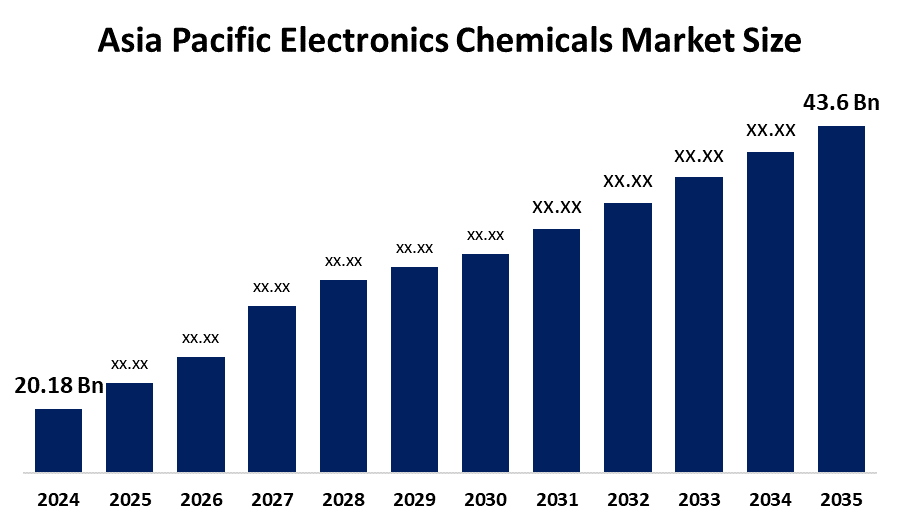
- The Asia Pacific Electronics Chemicals Market Size Was Estimated at USD 20.18 Billion in 2024
- The Market Size is Expected to Grow at a CAGR of Around 7.25% from 2025 to 2035
- The Asia Pacific Electronics Chemicals Market Size is Expected to Reach USD 43.6 Billion by 2035
Get more details on this report -
According to a research report published by Spherical Insights & Consulting, The Asia Pacific Electronics Chemicals Market Size Is Anticipated To Reach USD 43.6 Thousand Tonnes By 2035, Growing At A CAGR Of 7.25% From 2025 To 2035. The market is driven by the increasing demand for advanced electronic devices and the ongoing miniaturization of components. Growing emphasis on sustainability and environmental regulations is prompting manufacturers to adopt greener practices.
Market Overview
The Asia Pacific electronics chemicals market refers to the regional industry that produces and supplies high-purity chemical materials used in manufacturing electronic components such as semiconductors, printed circuit boards (PCBs), displays, and advanced packaging. Electronic chemicals serve as essential components for manufacturing processes in electronics production through their provision of specialised ultra-high-purity materials which include gases, photoresists, wet chemicals and solvents that manufacturers use for etching, cleaning, doping and patterning operations.
BASF established its high-performance dispersant production facility at Jiangbei New Material Technology Park in Nanjing, China during November 2025. The investment allows local factories to manufacture cutting-edge dispersants through the use of Controlled Free Radical Polymerization (CFRP) technology.
The Taiwanese government announced an unprecedented $500 billion total support package which included $250 billion for direct chip investment and $250 billion in credit guarantees to maintain its global leadership in semiconductor manufacturing. The Indian government has dedicated about Rs 62,900 crore which equals 97% of the Rs 65,000 crore fund, as incentives for semiconductor production. The available funds will only support a small number of projects because there is limited funding. Japan established new export controls that restrict advanced goods and technology exports, including high-purity chemicals and semiconductor equipment, due to dual-use risk management.
Report Coverage
This research report categorises the Asia Pacific electronics chemicals market based on various segments and regions, and forecasts revenue growth and analyses trends in each submarket. The report analyses the key growth drivers, opportunities, and challenges influencing the Asia Pacific electronics chemicals market. Recent market developments and competitive strategies, such as expansion, product launch, development, partnership, merger, and acquisition have been included to draw the competitive landscape in the market. The report strategically identifies and profiles the key market players and analyses their core competencies in each sub-segment of the Asia Pacific electronics chemicals market.
Asia Pacific Electronics Chemicals Market Report Coverage
| Report Coverage | Details |
|---|---|
| Base Year: | 2024 |
| Market Size in 2024: | USD 20.18 Billion |
| Forecast Period: | 2025-2035 |
| Forecast Period CAGR 2025-2035 : | 7.25% |
| 2035 Value Projection: | USD 43.6 Billion |
| Historical Data for: | 2020-2023 |
| No. of Pages: | 210 |
| Tables, Charts & Figures: | 108 |
| Segments covered: | By Product Type, By Applications |
| Companies covered:: | FUJIFILM Holdings Corp, Songwon Industrial Co Ltd, PVS Chemical Solutions Inc, Hitachi High-Tech Corp, Solvay SA, BASF SE, Linde plc, Honeywell International Inc, RBP Chemical Technology Inc, Esprix Technologies LP, Others |
| Pitfalls & Challenges: | COVID-19 Empact, Challenge, Future, Growth, & Analysis |
Get more details on this report -
Driving Factors
The electronics chemicals market in Asia Pacific is driven by the rising disposable income levels of developing markets such as India and China, which drive their consumers to purchase smartphones, laptops and wearable devices which depend on advanced electronic materials and chemical components. The automotive industry in APAC needs to adopt electric-powered vehicles because this new technology requires advanced battery systems, sensor technologies and power semiconductor components which generate fresh income opportunities for specialty chemical producers.
Restraining Factors
The electronics chemicals market in the Asia Pacific is restrained by the growing international and local demands for sustainable practices compel manufacturers to adopt more expensive, environmentally friendly products and complete waste management systems. The process of miniaturization needs ultra-high-purity chemicals, which present challenges in both development and manufacturing because these substances require special handling and face significant production cost hurdles for industrial use.
Market Segmentation
The Asia Pacific electronics chemicals market share is categorised into product type and application.
- The photoresist chemicals segment accounted for the largest share in 2024 and is expected to grow at a significant CAGR during the forecast period.
The Asia Pacific electronics chemicals market is segmented by product type into atmospheric & specialty gases, photoresist chemicals, wet chemicals & solvents, and others. Among these, the photoresist chemicals segment accounted for the largest share in 2024 and is expected to grow at a significant CAGR during the forecast period. The segmental growth is driven by demand for miniaturization in electronics technology strengthens the market position of the company. The company requires these materials because they serve fundamental functions in both photolithography and semiconductor fabrication processes. The importance of these technologies has increased because modern electronics manufacturing needs require both precise operations and efficient production methods.
- The integrated circuits & semiconductor segment dominated the market in 2024 and is projected to grow at a substantial CAGR during the forecast period.
Based on application, the Asia Pacific electronics chemicals market is segmented into integrated circuits & semiconductor, flat panel displays & light emitting diodes, photovoltaic, printed circuit boards, and others. Among these, the integrated circuits & semiconductor segment dominated the market in 2024 and is projected to grow at a substantial CAGR during the forecast period. The segmental growth is driven by the process of miniaturizing electronic components through its core responsibilities and the process of boosting computing performance through its functions. The system uses advanced chemical methods to create ultra-pure materials which serve as vital components needed to manufacture microchips.
Competitive Analysis:
The report offers the appropriate analysis of the key organizations/companies involved within the Asia Pacific electronics chemicals market, along with a comparative evaluation primarily based on their product offering, business overviews, geographic presence, enterprise strategies, segment market share, and SWOT analysis. The report also provides an elaborate analysis focusing on the current news and developments of the companies, which includes product development, innovations, joint ventures, partnerships, mergers & acquisitions, strategic alliances, and others. This allows for the evaluation of the overall competition within the market.
List of Key Companies
- FUJIFILM Holdings Corp
- Songwon Industrial Co Ltd
- PVS Chemical Solutions Inc
- Hitachi High-Tech Corp
- Solvay SA
- BASF SE
- Linde plc
- Honeywell International Inc
- RBP Chemical Technology Inc
- Esprix Technologies LP
- Others
Key Target Audience
- Market Players
- Investors
- End-users
- Government Authorities
- Consulting and Research Firm
- Venture capitalists
- Value-Added Resellers (VARs)
Recent Development
In December 2025, Merck launched the Kaohsiung semiconductor flagship campus, targeting AI and silicon photonics. Merck Group's Kaohsiung semiconductor technology flagship campus officially completed phase one in December, marking Merck's first large-scale semiconductor materials technology campus worldwide. It has invested a total of EUR500 million.
Market Segment
This study forecasts revenue at the Asia Pacific, regional, and country levels from 2020 to 2035. Spherical Insights has segmented the Asia Pacific electronics chemicals market based on the below-mentioned segments:
Asia Pacific Electronics Chemicals Market, By Product Type
- Atmospheric & Specialty Gases
- Photoresist Chemicals
- Wet Chemicals & Solvents
- Others
Asia Pacific Electronics Chemicals Market, By Application
- Integrated Circuits & Semiconductor
- Flat Panel Displays & Light Emitting Diodes
- Photovoltaic
- Printed Circuit Boards
- Others
Frequently Asked Questions (FAQ)
-
Q: What is the Asia Pacific electronics chemicals market size?A: Asia Pacific electronics chemicals market size is expected to grow from USD 20.18 billion in 2024 to USD 43.6 billion by 2035, growing at a CAGR of 7.25% during the forecast period 2025-2035.
-
Q: What are electronics chemicals, and their primary use?A: The Asia Pacific electronics chemicals market refers to the regional industry that produces and supplies high-purity chemical materials used in manufacturing electronic components such as semiconductors, printed circuit boards (PCBs), displays, and advanced packaging.
-
Q: What are the key growth drivers of the market?A: Market growth is driven by the rising disposable income levels of developing markets such as India and China, which drive their consumers to purchase smartphones, laptops and wearable devices which depend on advanced electronic materials and chemical components.
-
Q: What factors restrain the Asia Pacific electronics chemicals market?A: The market is restrained by the growing international and local demands for sustainable practices compel manufacturers to adopt more expensive, environmentally friendly products and complete waste management systems
-
Q: How is the market segmented by product type?A: The market is segmented into atmospheric & specialty gases, photoresist chemicals, wet chemicals & solvents, and others.
-
Q: Who are the key players in the Asia Pacific electronics chemicals market?A: Key companies include FUJIFILM Holdings Corp, Songwon Industrial Co Ltd, PVS Chemical Solutions Inc, Hitachi High-Tech Corp, Solvay SA, BASF SE, Linde plc, Honeywell International Inc, RBP Chemical Technology Inc, and Esprix Technologies LP.
Need help to buy this report?