Global Artificial Organs and Bionics Market Size, Share, and COVID-19 Impact Analysis, By Product (Artificial Organs and Artificial Bionics), By Technology (Mechanical and Electronic), and By Region (North America, Europe, Asia-Pacific, Latin America, Middle East, and Africa), Analysis and Forecast 2025 - 2035.
Industry: Healthcare
Global Artificial Organs and Bionics Market Insights Forecasts to 2035
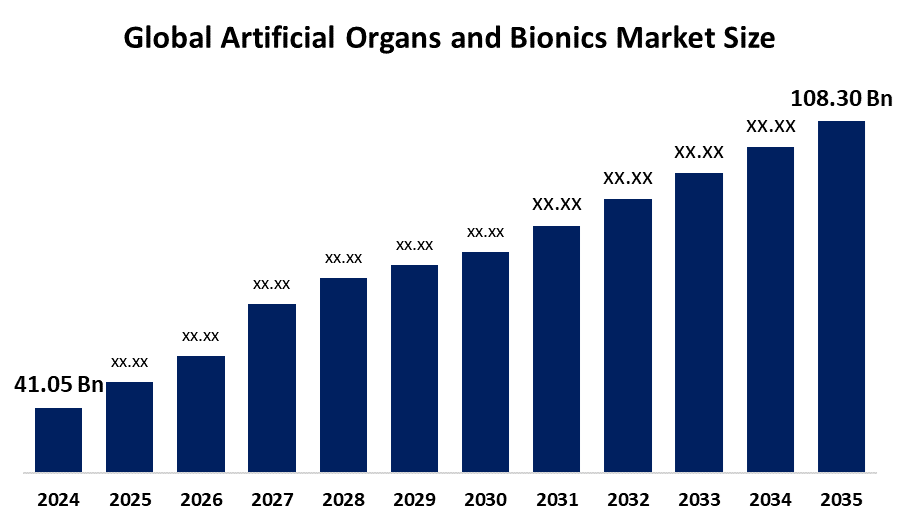
- The Global Artificial Organs and Bionics Market Size Was Estimated at USD 41.05 Billion in 2024
- The Market Size is Expected to Grow at a CAGR of around 9.22% from 2025 to 2035
- The Worldwide Artificial Organs and Bionics Market Size is Expected to Reach USD 108.30 Billion by 2035
Get more details on this report -
Key Takeaways
- North America dominated the market with the largest share in 2024.
- Asia Pacific is expected to grow the fastest during the forecast period.
- By product, the artificial organs segment dominates the market with the largest share of about 71.0%, while the artificial bionics segment is an emerging segment growing at a substantial CAGR of 10.72% in the market.
- By technology, the mechanical segment is anticipated to hold the dominant share of about 67.5% in 2024, on the other hand, the electronic segment is emerging in the artificial organs and bionics market with 9.0% CAGR during the forecast period.
According to a research report published by Spherical Insights and Consulting, the Global Artificial Organs and Bionics Market size was worth around USD 41.05 Billion in 2024 and is predicted to grow to around USD 108.30 Billion by 2035 with a compound annual growth rate (CAGR) of 9.22% from 2025 and 2035. The market for artificial organs and bionics has a number of opportunities to grow due to the development of advanced bionic limbs, the development of wearable devices and artificial organ technologies, particularly in the emerging markets.
Key Trends in Artificial Organs and Bionics Market
- Wearable artificial kidneys
- Intelligent prosthetics with neural interfaces
- Emergence of “organ-on-chips” for drug testing
Market Overview
The global artificial organs and bionics industry is the market of devices designed to replace, augment, or repair damaged or missing human body parts and organs. Artificial organs are engineered devices or tissues implanted to replace, support, or augment failed natural organs, while bionics integrates advanced technology, electronics, and robotics with biological systems, creating hybrid devices to restore functionality. With over 100,000 Americans currently on organ transplant waiting lists and a global organ shortage, artificial organs provide a vital bridge to transplantation or serve as permanent therapeutic solutions for end-stage organ failure patients. In regenerative medicine, damaged organs are repaired using biological components, including growth factors and stem cells. The advancement of tissue engineering, which aims to harness the inherent regenerative potential of human body organs for rebuilding normal biological function, greatly benefitted from the use of biomaterials.
Report Coverage
This research report categorizes the artificial organs and bionics market based on various segments and regions, forecasts revenue growth, and analyzes trends in each submarket. The report analyses the key growth drivers, opportunities, and challenges influencing the artificial organs and bionics market. Recent market developments and competitive strategies such as expansion, type launch, development, partnership, merger, and acquisition have been included to draw the competitive landscape in the market. The report strategically identifies and profiles the key market players and analyses their core competencies in each sub-segment of the artificial organs and bionics market.
Global Artificial Organs and Bionics Market Report Coverage
| Report Coverage | Details |
|---|---|
| Base Year: | 2024 |
| Market Size in 2024: | USD 41.05 billion |
| Forecast Period: | 2025-2035 |
| Forecast Period CAGR 2025-2035 : | CAGR of 9.22% |
| 2035 Value Projection: | USD 108.30 billion |
| Historical Data for: | 2020-2023 |
| No. of Pages: | 240 |
| Tables, Charts & Figures: | 110 |
| Segments covered: | By Product, By Technology |
| Companies covered:: | ABIOMED, Berlin Heart, Zimmer Biomet, Boston Scientific Corporation, Cochlear Ltd., Edwards Lifesciences Corporation, Ekso Bionics, Medtronic, Jarvik Heart, Inc, SynCardia Systems, LLC, and Others |
| Pitfalls & Challenges: | COVID-19 Empact, Challenges, Future, Growth, & Analysis |
Get more details on this report -
Driving Factors
Increasing number of transplants
As per the data from the Global Observatory on Donation and Transplantation (GODT), it was recorded that 173,727 solid organ transplants were performed worldwide in 2024, representing a 2% increase in global transplant activity compared to 2023. Artificial organs and bionics are advancing rapidly to address donor shortages, offering mechanical or bioengineered replacements for failed organs.
Critical shortage of donor organs
It was estimated that over 104,000 people are on U.S. waiting lists. Technological advancements in bioartificial kidneys, ventricular assist devices, and bionics are fulfilling the requirement for organ transplantation. The critical, global shortage of donor organs creates a profound crisis in transplant medicine, driving research and investment in artificial organs and bioengineering solutions, which ultimately contribute to propelling the market.
Restraining Factors
An increased equipment cost, lack of skilled professionals, number of surgeries, and uncertain policies are challenging the market growth of artificial organs and bionics.
Market Segmentation
The Artificial Organs and Bionics Market share is classified into product and technology.
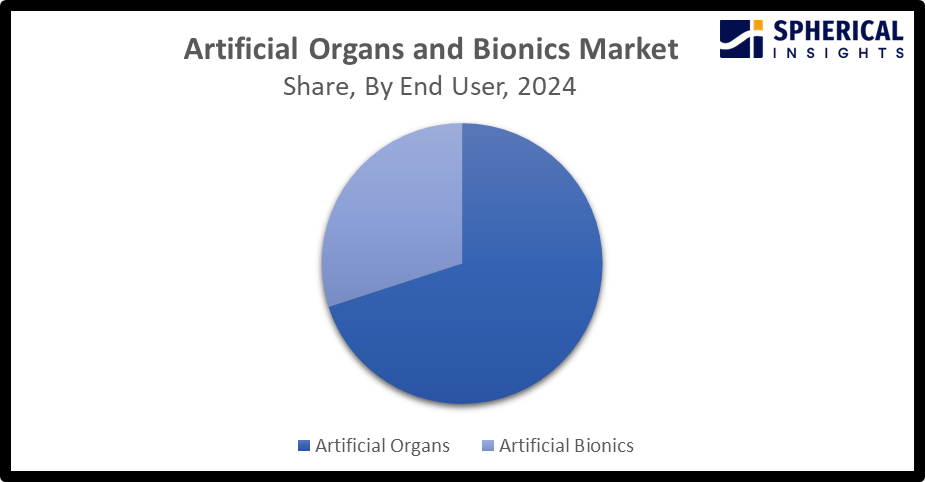
- The artificial organs segment dominated the market with the largest share of about 71.0% in 2024 and is projected to grow at a substantial CAGR during the forecast period.
Based on the product, the artificial organs and bionics market is divided into artificial organs and artificial bionics. Among these, the artificial organs segment dominated the market with the largest share of about 71.0% in 2024 and is projected to grow at a substantial CAGR during the forecast period. This is due to increased emphasis on replacing internal organ function (hearts, kidneys) using biocompatible materials or tissue engineering. While the artificial bionics segment is growing at a substantial CAGR of about 10.72%, due to increased adoption of bionic devices among healthcare providers, along with an increasing number of individuals experiencing limb loss.
Get more details on this report -
- The mechanical segment accounted for the largest market share of about 67.5% in 2024 and is projected to grow at a substantial CAGR during the forecast period.
Based on the technology, the artificial organs and bionics market is divided into mechanical and electronic. Among these, the mechanical segment accounted for the largest market share of about 67.5% in 2024 and is projected to grow at a substantial CAGR during the forecast period. The growing prevalence of chronic diseases, organ failure, and technological advancement in implants and prosthetics are driving the segmental market growth. Further, the electronics segment is the emerging segment, accounting for about 9.0% CAGR, driven by advanced miniaturized electronics and 3D printing.
Regional Segment Analysis of the Artificial Organs and Bionics Market
- North America (U.S., Canada, Mexico)
- Europe (Germany, France, U.K., Italy, Spain, Rest of Europe)
- Asia-Pacific (China, Japan, India, Rest of APAC)
- South America (Brazil and the Rest of South America)
- The Middle East and Africa (UAE, South Africa, Rest of MEA)
North America is anticipated to hold the largest share of the artificial organs and bionics market over the predicted timeframe.
North America is anticipated to hold the largest share of about 45.0% in the artificial organs and bionics market over the predicted timeframe. The market ecosystem in North America is strong, due to increasing transplant waiting lists and the number of organ failures, driving the need for artificial organs and bionics. The demand for artificial organs and bionics has been driven by the rapid technological advancements in biomedical engineering, like 3D printing and neural-integrated prosthetics. The U.S. is leading the North America artificial organs and bionics market with nearly 45.0% share, due to ongoing R&D by leading companies like Medtronic, a strong funding ecosystem, and an advanced healthcare system.

Get more details on this report -
Asia Pacific is expected to grow at a rapid CAGR of approximately 11.0% in the artificial organs and bionics market during the forecast period. The Asia Pacific area has a thriving market for artificial organs and bionics due to the increasing ageing population, chronic disease prevalence, and medical tourism in countries like India, China, and Japan. Due to the increased number of road accidents and technological advancements that lead to enhanced applications, the market is expected to grow. India is anticipated to hold a significant share in the region’s market, due to the number of healthcare institutions engaging in R&D programs for developing artificial organs.
Competitive Analysis:
The report offers the appropriate analysis of the key organizations/companies involved within the Artificial Organs and Bionics Market, along with a comparative evaluation primarily based on their type of offering, business overviews, geographic presence, enterprise strategies, segment market share, and SWOT analysis. The report also provides an elaborative analysis focusing on the current news and developments of the companies, which includes type development, innovations, joint ventures, partnerships, mergers & acquisitions, strategic alliances, and others. This allows for the evaluation of the overall competition within the market.
List of Key Companies
- ABIOMED
- Berlin Heart
- Zimmer Biomet
- Boston Scientific Corporation
- Cochlear Ltd.
- Edwards Lifesciences Corporation
- Ekso Bionics
- Medtronic
- Jarvik Heart, Inc
- SynCardia Systems, LLC
- Others
Key Target Audience
- Market Players
- Investors
- End-users
- Government Authorities
- Consulting And Research Firm
- Venture capitalists
- Value-Added Resellers (VARs)
Recent Development
In January 2026, UT Southwestern Medical Center received an award from the Advanced Research Projects Agency for Health (ARPA-H) to develop livers using patients’ own cells and an innovative three-dimensional (3D) printing approach.
In August 2025, Scientists have created the first artificial tongue that can sense and identify flavors entirely in liquid environments, mimicking how human taste buds work. The achievement described in the journal PNAS may lead to automated systems for food safety and early detection of diseases via chemical analysis.
In September 2023, the Kidney Project finds a breakthrough for an artificial organ device, scientists announce. Developers have reached a crucial step with a device that could serve as a potential artificial kidney and dramatically improve the outcome of those on dialysis or with end-stage kidney disease.
In April 2023, U.P. amends the Govt. Servants (Medical Care) Rules include an oxygen concentrator as an artificial organ. This would enable serving and retired employees of the State government to claim reimbursement after buying the device.
In September 2022, the Bionic pancreas improved type 1 diabetes management compared to standard insulin delivery methods. A device known as a bionic pancreas, which uses next-generation technology to automatically deliver insulin, was more effective at maintaining blood glucose levels within normal range than standard-of-care management among people with type 1 diabetes.
In January 2022, the School of Medical Research and Technology (SMRT), IIT Kanpur, a platform of interdisciplinary teaching and research in diverse areas of medical science and technology, announced the launch of Hridyantra, a grand challenge-based program to develop the world’s most advanced Artificial Heart or a Left Ventricular Assist device (LVAD).
Market Segment
This study forecasts revenue at global, regional, and country levels from 2020 to 2035. Spherical Insights has segmented the Artificial Organs and Bionics Market based on the below-mentioned segments:
Global Artificial Organs and Bionics Market, By Product
- Artificial Organs
- Artificial Bionics
Global Artificial Organs and Bionics Market, By Technology
- Mechanical
- Electronic
Global Artificial Organs and Bionics Market, By Regional Analysis
- North America
- US
- Canada
- Mexico
- Europe
- Germany
- UK
- France
- Italy
- Spain
- Russia
- Rest of Europe
- Asia Pacific
- China
- Japan
- India
- South Korea
- Australia
- Rest of Asia Pacific
- South America
- Brazil
- Argentina
- Rest of South America
- Middle East & Africa
- UAE
- Saudi Arabia
- Qatar
- South Africa
- Rest of the Middle East & Africa
Frequently Asked Questions (FAQ)
-
1. What is the market size of the artificial organs and bionics market?The global Artificial Organs and Bionics market size is expected to grow from USD 41.05 Billion in 2024 to USD 108.30 Billion by 2035, at a CAGR of 9.22% during the forecast period 2025-2035.
-
2. Which region holds the largest share of the artificial organs and bionics market?North America is anticipated to hold the largest share of the artificial organs and bionics market over the predicted timeframe.
-
3. What is the forecasted CAGR of the Global Artificial Organs and Bionics Market from 2024 to 2035?The market is expected to grow at a CAGR of around 9.22% during the period 2024–2035.
-
4. Who are the top companies that are involved in the Global Artificial Organs and Bionics Market?Key players include ABIOMED, Berlin Heart, Zimmer Biomet, Boston Scientific Corporation, Cochlear Ltd., Edwards Lifesciences Corporation, Ekso Bionics, Medtronic, Jarvik Heart, Inc, and SynCardia Systems, LLC.
-
5. What are the main drivers in the artificial organs and bionics market?An increasing number of transplants and critical shortage of donor organs, are major market growth drivers of the artificial organs and bionics market.
-
6. What challenges are limiting the adoption of Artificial Organs and Bionics?Factors like the increased equipment cost, lack of skilled professionals, number of surgeries, and complex regulatory policies remain key restraints in the artificial organs and bionics market.
-
7. What are the key trends in the artificial organs and bionics market?The wearable artificial kidneys, intelligent prosthetics with neural interfaces, and the emergence of “organ-on-chips” for drug testing are major key trends in the artificial organs and bionics market.
Need help to buy this report?