Global ARM Microcontrollers Market Size, Share, By Core Complexity (Cortex-M, Cortex-R, and Cortex-A), By Type (Less than 80 Pins, 80 to 120 Pins, and More than 120 Pins), By Power Profile (Ultra Low Power, Low Power, and Performance Optimized), and By Region (North America, Europe, Asia-Pacific, Latin America, Middle East, and Africa), Analysis and Forecast 2025 - 2035.
Industry: Semiconductors & Electronics
Global ARM Microcontrollers Market Insights Forecasts to 2035
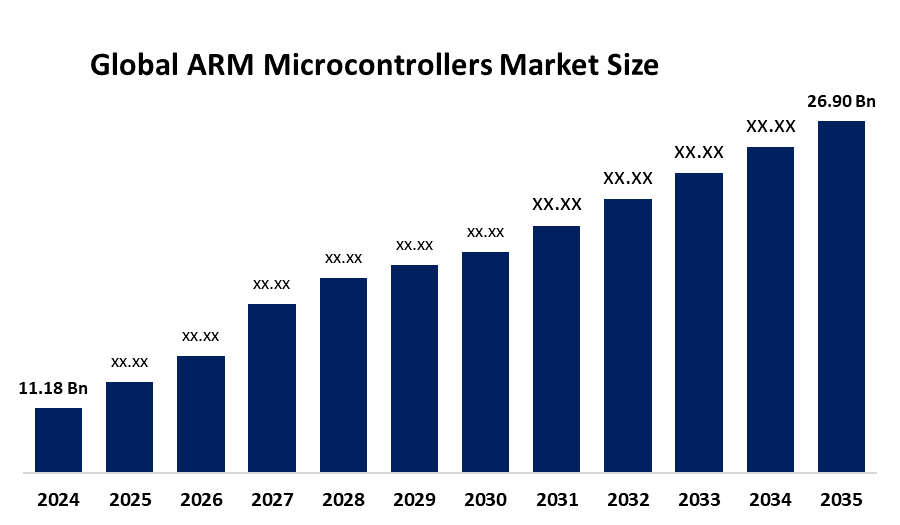
- The Global ARM Microcontrollers Market Size Was Estimated at USD 11.18 Billion in 2024
- The Market Size is Expected to Grow at a CAGR of around 8.31% from 2025 to 2035
- The Worldwide ARM Microcontrollers Market Size is Expected to Reach USD 26.90 Billion by 2035
- Asia Pacific is expected to grow the fastest during the forecast period.
Get more details on this report -
According to a research report published by Spherical Insights, The Global ARM Microcontrollers Market Size was worth around USD 11.18 Billion in 2024 and is predicted to Grow to around USD 26.90 Billion by 2035 with a compound annual growth rate (CAGR) of 8.31% from 2025 to 2035. The global ARM microcontrollers market is driven by growing IoT adoption, rising demand in automotive electronics, expanding industrial automation, increasing use in consumer devices, and the need for energy-efficient processing solutions.
Report Coverage
This research report categorizes the global ARM microcontrollers market based on various segments and regions, forecasts revenue growth, and analyzes trends in each submarket. The report analyses the key growth drivers, opportunities, and challenges influencing the global ARM microcontrollers market. Recent market developments and competitive strategies, such as expansion, product launch, development, partnership, merger, and acquisition, have been included to draw the competitive landscape in the market. The report strategically identifies and profiles the key market players and analyzes their core competencies in each sub-segment of the ARM microcontrollers market.
Global ARM Microcontrollers Market Report Coverage
| Report Coverage | Details |
|---|---|
| Base Year: | 2024 |
| Market Size in 2024: | USD 11.18 Billion |
| Forecast Period: | 2024-2035 |
| Forecast Period CAGR 2024-2035 : | CAGR of 8.31% |
| 2035 Value Projection: | USD 26.90 Billion |
| Historical Data for: | 2020-2023 |
| No. of Pages: | 210 |
| Tables, Charts & Figures: | 105 |
| Segments covered: | By Core Complexity, By Type |
| Companies covered:: | NXP Semiconductors, STMicroelectronics, Renesas Electronics, Texas Instruments, Microchip Technology, Infineon Technologies, Cypress Semiconductor, Silicon Labs, Analog Devices, Maxim Integrated, Nordic Semiconductor, Toshiba Electronic Devices & Storage, Nuvoton Technology, ZiLOG, Qualcomm Technologies, Others, and |
| Pitfalls & Challenges: | COVID-19 Empact, Challenge, Future, Growth, & Analysis |
Get more details on this report -
Driving Factors
The ARM microcontrollers market is primarily driven by the rapid growth of the Internet of Things, where billions of connected devices require low-power and efficient processing. The automotive sector has experienced increasing demand for electric vehicles, advanced driver assistance systems, and in-vehicle connectivity. The expansion of industrial automation and Industry 4.0 requires businesses to adopt reliable embedded systems that operate in real time. The growing demand for consumer electronics products, which include wearables, smart home devices, and portable gadgets, drives market expansion. The energy-efficient architecture of ARM, together with its scalability and cost-effective design, creates multiple applications that enhance global market demand for the technology.
Restraining Factors
The ARM microcontrollers market faces restrictions because high development expenses and complex design processes create difficulties for small and medium enterprises to develop their products. The market adoption of their solution faces two main obstacles, which include competition from other architectural designs and existing legacy systems. The ongoing semiconductor supply chain disruptions create unpredictable effects on production schedules. The deployment of connected devices in sensitive and mission-critical applications is restricted because people worry about the cybersecurity risks that these devices face.
Market Segmentation
The global ARM microcontrollers market share is classified into core complexity, type, and power profile.
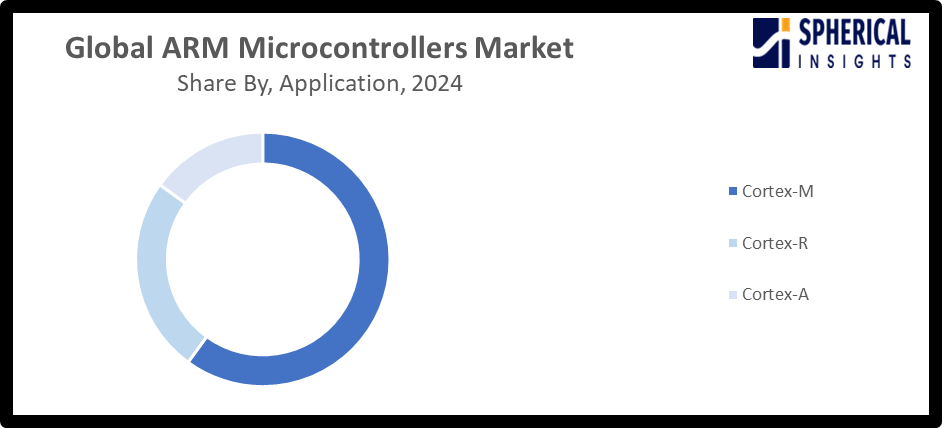
- The cortex-M segment accounted for the largest share in 2024, approximately 60%, and is anticipated to grow at a significant CAGR during the forecast period.
Based on the core complexity, the global ARM microcontrollers market is divided into Cortex-M, Cortex-R, and Cortex-A. Among these, the cortex-m segment accounted for the largest share in 2024, approximately 60%, and is anticipated to grow at a significant CAGR during the forecast period. This is because Cortex-M microcontrollers offer low power consumption, cost-effectiveness, and high efficiency, making them ideal for IoT devices, consumer electronics, and industrial applications. Their simple architecture, ease of development, and strong ecosystem support further drive widespread adoption across diverse embedded system applications globally.
Get more details on this report -
- The less than 80 pins segment accounted for the highest market revenue in 2024, approximately 55%, and is anticipated to grow at a significant CAGR during the forecast period.
Based on the type, the global ARM microcontrollers market is divided into less than 80 pins, 80 to 120 pins, and more than 120 pins. Among these, the less than 80 pins segment accounted for the highest market revenue in 2024, approximately 55%, and is anticipated to grow at a significant CAGR during the forecast period. This is because microcontrollers with less than 80 pins are ideal for simple and compact applications where space, cost, and power efficiency matter most. They are widely used in IoT devices, consumer electronics, and portable systems, where high performance is not required. Their easy design, lower complexity, and affordability make them a preferred choice for large-scale deployment across various industries.
- The low power segment dominated the market in 2024, approximately 50%, and is projected to grow at a substantial CAGR during the forecast period.
Based on the power profile, the global ARM microcontrollers market is divided into ultra-low power, low power, and performance-optimized. Among these, the low power segment dominated the market in 2024, approximately 50%, and is projected to grow at a substantial CAGR during the forecast period. The dominance is driven by the ability of low-power microcontrollers to offer an optimal balance between performance and energy consumption. They are widely used in applications like IoT devices, wearables, and smart home systems, where moderate processing power and longer battery life are both important. Their flexibility and cost efficiency make them suitable for large-scale deployment across multiple industries.
Regional Segment Analysis of the Global ARM Microcontrollers Market
- North America (U.S., Canada, Mexico)
- Europe (Germany, France, U.K., Italy, Spain, Rest of Europe)
- Asia-Pacific (China, Japan, India, Rest of APAC)
- South America (Brazil and the Rest of South America)
- The Middle East and Africa (UAE, South Africa, Rest of MEA)
North America is anticipated to hold the largest share of the global ARM microcontrollers market over the predicted timeframe.
North America is anticipated to hold the largest share of the global ARM Microcontrollers market over the predicted timeframe, approximately 40% market share. The growth is driven by the strong presence of leading semiconductor manufacturers, widespread adoption of IoT and industrial automation, and the increasing demand for advanced automotive electronics. Continuous investments in R&D enable the development of high-performance, energy-efficient ARM microcontrollers, while supportive government initiatives for digital transformation and smart infrastructure further accelerate market expansion across various industrial and consumer applications.
The Asia Pacific region is expected to grow at the fastest rate during the forecast period, approximately 35% market share. The market growth is fueled by rapidly expanding electronics manufacturing sector, which drives demand for ARM-based microcontrollers. Increasing automotive production, especially in electric and connected vehicles, further boosts adoption. The widespread implementation of IoT devices and smart technologies in homes and industries accelerates the need for embedded solutions. Additionally, strong government support for industrial digitization, technological infrastructure, and innovation creates favorable conditions for ARM microcontroller market expansion.
Competitive Analysis:
The report offers the appropriate analysis of the key organizations/companies involved within the global ARM microcontrollers market, along with a comparative evaluation primarily based on their product offering, business overviews, geographic presence, enterprise strategies, segment market share, and SWOT analysis. The report also provides an elaborative analysis focusing on the current news and developments of the companies, which includes product development, innovations, joint ventures, partnerships, mergers & acquisitions, strategic alliances, and others. This allows for the evaluation of the overall competition within the market.
List of Key Companies
- NXP Semiconductors
- STMicroelectronics
- Renesas Electronics
- Texas Instruments
- Microchip Technology
- Infineon Technologies
- Cypress Semiconductor
- Silicon Labs
- Analog Devices
- Maxim Integrated
- Nordic Semiconductor
- Toshiba Electronic Devices & Storage
- Nuvoton Technology
- ZiLOG
- Qualcomm Technologies
- Others
Key Target Audience
- Market Players
- Investors
- End-users
- Government Authorities
- Consulting and Research Firm
- Venture capitalists
- Value-Added Resellers (VARs)
Recent Development
• In March 2025, STMicroelectronics unveiled the STM32U3 microcontrollers, designed for ultra-low power consumption and ideal for remote sensing and long-term IoT applications. These microcontrollers are based on an Arm Cortex-M33 core and offer enhanced energy efficiency and advanced security features.
• In March 2025, Infineon Technologies AG announced plans to adopt RISC-V technology in its automotive microcontroller roadmap to complement its established AURIX and ARM-based TRAVEO families, thereby expanding its compute architecture options for future automotive applications.
• In November 2024, Renesas Electronics Corporation introduced the RA8E1 and RA8E2 microcontroller groups, delivering high performance comparable to the RA8 Series but with a reduced feature set for more cost-effective solutions. These microcontrollers are powered by the Arm Cortex-M85 processor with Helium technology and are well-suited for AIoT, industrial, healthcare, and consumer applications.
• In November 2024, Texas Instruments, Inc. launched two C2000 real-time microcontroller series: the 64-bit F29H85x, featuring C29 DSP cores, and the TMS320F28P55x, equipped with an integrated neural processor. These devices offer advanced safety, security, and performance for automotive and industrial applications, enabling faster and more efficient decision-making.
Global ARM Microcontrollers Market, By Core Complexity
- Cortex-M
- Cortex-R
- Cortex-A
Global ARM Microcontrollers Market, By Type
- Less than 80 Pins
- 80 to 120 Pins
- More than 120 Pins
Global ARM Microcontrollers Market, By Power Profile
- Ultra Low Power
- Low Power
- Performance Optimized
Global ARM Microcontrollers Market, By Regional Analysis
- North America
- US
- Canada
- Mexico
- Europe
- Germany
- UK
- France
- Italy
- Spain
- Russia
- Rest of Europe
- Asia Pacific
- China
- Japan
- India
- South Korea
- Australia
- Rest of Asia Pacific
- South America
- Brazil
- Argentina
- Rest of South America
- Middle East & Africa
- UAE
- Saudi Arabia
- Qatar
- South Africa
- Rest of the Middle East & Africa
Frequently Asked Questions (FAQ)
-
1. What are ARM microcontrollers?A: ARM microcontrollers (MCUs) are small computing devices built on ARM processor cores that provide low-power, cost-effective processing for embedded systems in IoT, automotive, consumer electronics, and industrial applications.
-
2. Why are ARM MCUs widely adopted in embedded systems?A: They are popular due to their energy efficiency, scalable architecture, broad ecosystem support, ease of programming, and flexibility across a wide range of applications.
-
3. What are the main types of ARM microcontrollers?A: ARM MCUs are categorized by core complexity (Cortex-M, Cortex-R, Cortex-A), pin count, and power profile (ultra-low power, low power, performance optimized).
-
4. Which industries use ARM microcontrollers the most?A: Key industries include automotive (for ADAS and infotainment), industrial automation, consumer electronics (wearables, smart home devices), and IoT-enabled smart devices.
-
5. What are the benefits of ARM-based MCUs over other architectures?A: They offer high energy efficiency, scalable performance, strong security features, extensive software libraries, and compatibility with a global development ecosystem.
-
6. What factors influence the growth of the ARM microcontroller market?A: Growth is driven by IoT adoption, electric and connected vehicles, industrial automation, wearable electronics, and government incentives supporting semiconductor manufacturing.
-
7. What challenges does the ARM MCU market face?A: Challenges include competition from alternative microcontroller architectures, supply chain constraints, high design complexity for advanced MCUs, and cybersecurity concerns in connected applications.
Need help to buy this report?