Global ARC Fault Circuit Interrupter (AFCI) Market Size, Share, and COVID-19 Impact Analysis, By Product Type (Combination AFCI (CAFCI), Branch & Feeder AFCI, and Outlet Circuit AFCI), By Application (Residential Sector and Commercial Sector), and By Region (North America, Europe, Asia-Pacific, Latin America, Middle East, and Africa), Analysis and Forecast 2025 - 2035.
Industry: Energy & Power
Global ARC Fault Circuit Interrupter (AFCI) Market Insights Forecasts to 2035
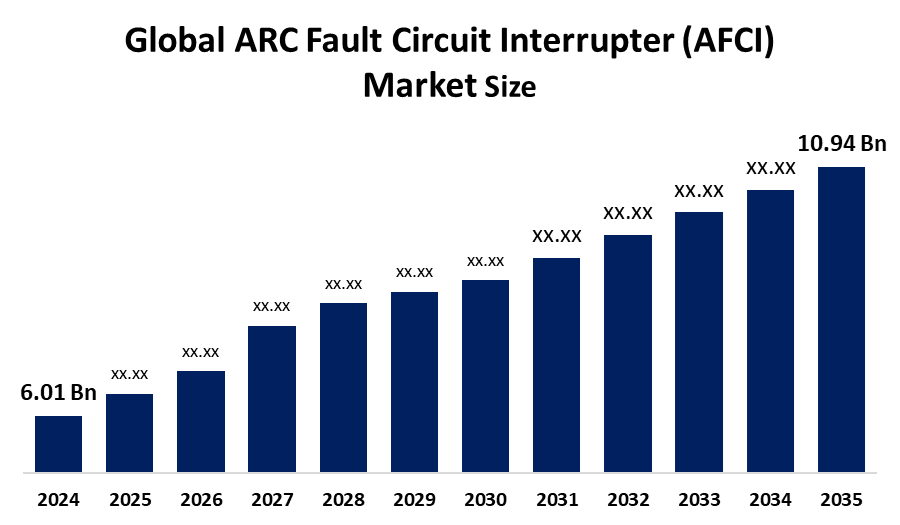
- The Global ARC Fault Circuit Interrupter (AFCI) Market Size Was Estimated at USD 6.01 Billion in 2024
- The Market Size is Expected to Grow at a CAGR of around 5.6% from 2025 to 2035
- The Worldwide ARC Fault Circuit Interrupter (AFCI) Market Size is Expected to Reach USD 10.94 Billion by 2035
- Asia Pacific is expected to grow the fastest during the forecast period.
Get more details on this report -
According to a research report published by Spherical Insights and Consulting, the global Arc fault circuit interrupter (AFCI) market size was worth around USD 6.01 billion in 2024 and is predicted to grow to around USD 10.94 billion by 2035 with a compound annual growth rate (CAGR) of 5.6% from 2025 to 2035. The arc fault circuit interrupter (AFCI) market is growing rapidly due to stringent government regulations mandating fire safety in new construction, rising awareness of electrical hazards, and the adoption of smart home technology.
ARC Fault Circuit Interrupter (AFCI) Market Key Takeaways
- North America accounted for the largest market share in 2024.
- The Asia Pacific is expected to grow at the fastest CAGR during the forecast period.
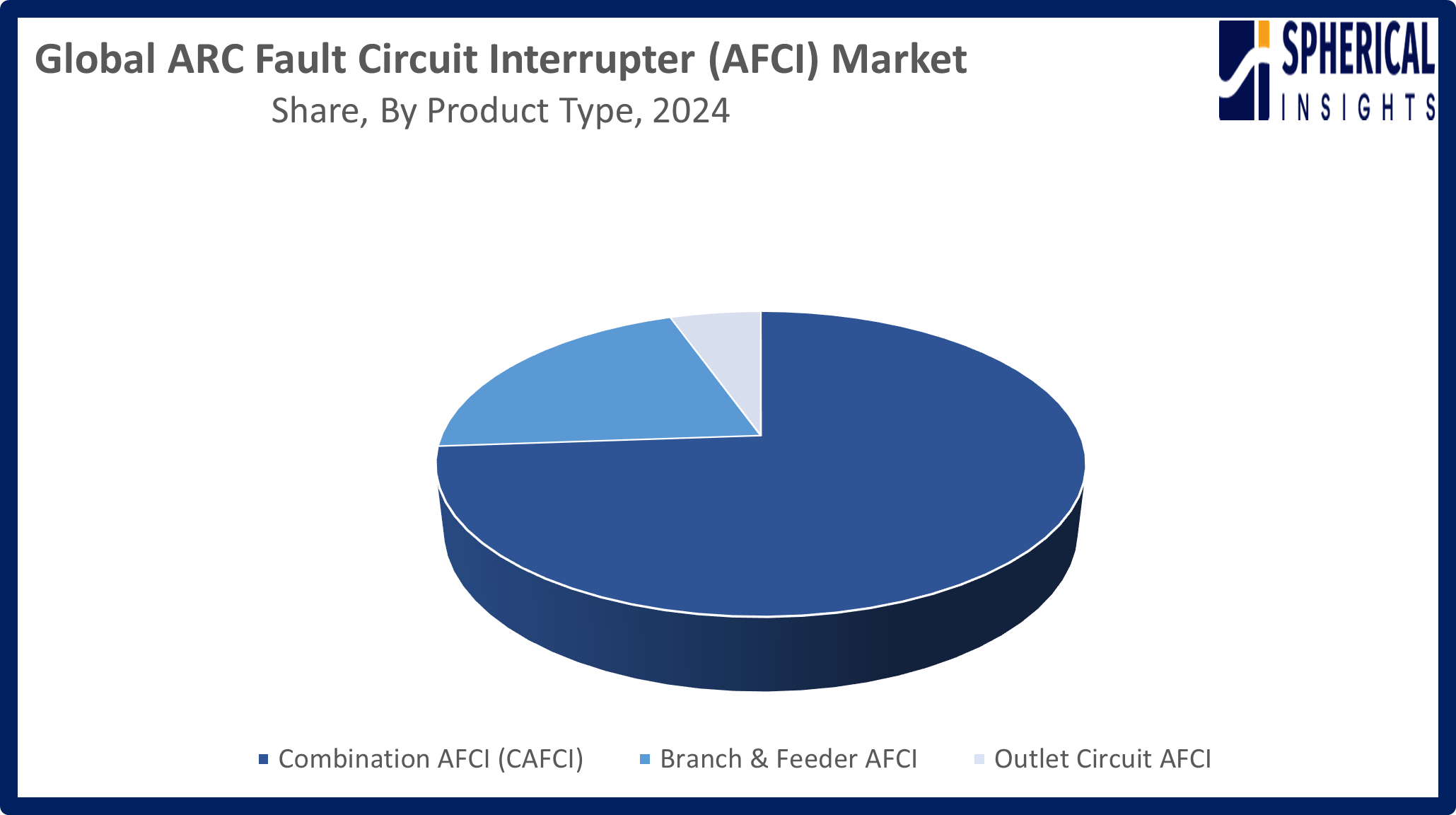
- By product type, the combination AFCI (CAFCI) segment held a dominant share of the market in 2024.
- By product type, the branch & feeder AFCI segment is expected to grow at the fastest CAGR in the market between 2024 and 2035.
- By application, the residential sector segment accounted for a considerable revenue share in the market in 2024.
- By application, the commercial sector segment is expected to grow at the highest CAGR in the market during the studied years.
Market Overview
The arc fault circuit interrupter (AFCI) market encompasses protective electrical devices that continuously monitor circuits for dangerous arcing faults (series and parallel arcs) caused by damaged wiring, loose connections, or insulation failure, and rapidly interrupt power to prevent electrical fires, far more effectively than standard circuit breakers. These devices are essential in residential, commercial, and industrial settings, safeguarding properties and ensuring compliance with stringent codes like the National Electrical Code (NEC). In January 2026, the United States advanced electrical safety under the National Electrical Code (NEC) 2026, expanding arc fault protection and arc-flash labelling rules. The updates encourage wider AFCI adoption across residential, commercial, and industrial sectors, improving fire prevention and regulatory compliance nationwide.
Primary market drivers are stringent electrical safety regulations and mandatory installation codes (e.g., NEC requirements in the US), rising awareness of arc-fault fire hazards, rapid urbanization and new construction activity, growing adoption of high-load appliances and electrification, and retrofitting demand in aging infrastructure. Opportunities lie in smart/AFCI-GFCI combination devices, integration with IoT-enabled home energy management systems, expansion in emerging markets with rising building standards, and development of advanced DC AFCIs for solar and battery storage applications. In March 2026, Canada’s Ontario Electrical Safety Code (OESC) 2024 came into force, enforced by the Electrical Safety Authority. The update significantly expands AFCI requirements, mandating protection on all 15A and 20A, 125V circuits across residential spaces beyond bedrooms, enhancing nationwide electrical fire safety standards.
ARC Fault Circuit Interrupter (AFCI) Market Trends
- Integration of smart & IoT-enabled AFCIs: Modern AFCIs are increasingly integrated with smart technologies, enabling real-time monitoring, diagnostics, and remote fault detection. Over 50% of new AFCI units now include advanced diagnostics, improving reliability and reducing troubleshooting time.
- growing adoption of combination AFCIs (CAFCIs): Combination AFCIs, which detect both series and parallel arc faults, are gaining traction due to enhanced safety. They account for nearly 55% of global installations, reflecting a shift toward comprehensive electrical protection solutions.
- expansion into renewable energy & EV applications: AFCIs are increasingly used in solar PV systems and electric vehicle charging infrastructure, especially DC-AFCIs. This emerging segment is driving new growth opportunities as electrification and renewable adoption accelerate globally.
How is AI influencing the Arc fault circuit interrupter (AFCI) market?
AI is enhancing AFCI systems by enabling real-time arc fault detection, predictive maintenance, and reduced false tripping through advanced pattern recognition. Machine learning improves accuracy in distinguishing dangerous arcs from normal electrical noise. This boosts reliability, supports smart grid integration, and accelerates adoption in residential, commercial, and renewable energy applications.
Report Coverage
This research report categorizes the arc fault circuit interrupter (AFCI) market based on various segments and regions, forecasts revenue growth, and analyzes trends in each submarket. The report analyses the key growth drivers, opportunities, and challenges influencing the arc fault circuit interrupter (AFCI) market. Recent market developments and competitive strategies, such as expansion, type launch, development, partnership, merger, and acquisition, have been included to draw the competitive landscape in the market. The report strategically identifies and profiles the key market players and analyses their core competencies in each sub-segment of the arc fault circuit interrupter (AFCI) market.
Global ARC Fault Circuit Interrupter (AFCI) Market Report Coverage
| Report Coverage | Details |
|---|---|
| Base Year: | 2014 |
| Market Size in 2014: | USD 6.01 billion |
| Forecast Period: | 2025 – 2035 |
| Forecast Period CAGR 2025 – 2035 : | 5.6% |
| 025 – 2035 Value Projection: | USD 10.94 billion |
| Historical Data for: | 2020-2023 |
| No. of Pages: | 210 |
| Tables, Charts & Figures: | 115 |
| Segments covered: | By Product Type, By Application |
| Companies covered:: | Eaton Corporation plc, General Electric (GE), ABB Ltd., Legrand SA, Schneider Electric SE, Leviton Manufacturing Co., Mitsubishi Electric, Siemens AG, Littelfuse Inc., Honeywell International Inc., Fonrich New Energy, Hager Group, CHINT Group Co., Ltd., Hubbell Incorporated, Others, and |
| Pitfalls & Challenges: | COVID-19 Empact, Challenge, Future, Growth, & Analysis |
Get more details on this report -
Driving Factors
The global AFCI market is primarily driven by increasing awareness of electrical fire hazards and stringent safety regulations in residential, commercial, and industrial sectors. Rising construction and renovation activities, particularly in North America and Europe, fuel demand for modern electrical safety solutions. Technological advancements, including combination AFCIs with ground-fault and surge protection, enhance reliability and broaden applications. Growing adoption of smart homes and IoT-integrated electrical systems further accelerates market growth by enabling real-time monitoring and diagnostics. Additionally, initiatives to retrofit older buildings with safer wiring infrastructure and mandatory compliance with National Electrical Code standards significantly support AFCI adoption worldwide. In February 2026, the Tyler City Council approved amendments to local electrical codes, removing GFCI requirements for large appliances like ranges and dryers. The update aligns with National Electrical Code (NEC) 2023, reducing nuisance tripping while maintaining safety standards.
Restraining Factors
The global AFCI market faces restraints from high installation and device costs, limited consumer awareness in emerging regions, and complex wiring compatibility issues. Additionally, the need for skilled electricians and resistance to retrofitting older buildings slow adoption, particularly in cost-sensitive residential and small commercial segments.
Market Segmentation
Product Type Insights
Why did the combination AFCI (CAFCI) segment lead the arc fault circuit interrupter (AFCI) market?
The combination AFCI (CAFCI) segment led the market while holding a major 74% in 2024, with an approximate share. The segment leading is attributed to its ability to detect both series and parallel arc faults, offering comprehensive protection against electrical fires. Increasing regulatory mandates, especially under updated electrical codes, favor CAFCIs for residential and commercial installations. Their enhanced safety, reliability, and broader application coverage drive higher adoption compared to conventional AFCI types globally.
The branch & feeder AFCI segment is expected to show the fastest growth over the forecast period. The segment is rapidly growing due to increasing adoption in retrofit projects, cost advantages, and rising electrical safety awareness. Expanding residential construction and demand in emerging markets further support its rapid CAGR growth compared to other AFCI types.
Get more details on this report -
Application Insights
Why did the residential sector segment dominate the market?
The residential sector segment dominated the arc fault circuit interrupter (AFCI) market with the 55% share in 2024. The segment dominance in the AFCI market is due to rising awareness of electrical fire safety and strict building code requirements mandating AFCI installation in homes. Rapid housing construction, renovation of ageing infrastructure, and increasing adoption of smart home systems further drive demand. Additionally, government regulations and safety standards in regions like North America strongly support widespread residential usage.
The commercial sector segment is expected to witness the fastest growth in the market over the forecast period. The commercial sector is growing due to the increasing adoption of advanced electrical safety systems in offices, malls, and healthcare facilities. Stricter regulations, infrastructure expansion, and rising investments in smart and energy-efficient buildings are key growth drivers.
Regional Segment Analysis of the ARC Fault Circuit Interrupter (AFCI) Market
- North America (U.S., Canada, Mexico)
- Europe (Germany, France, U.K., Italy, Spain, Rest of Europe)
- Asia-Pacific (China, Japan, India, Rest of APAC)
- South America (Brazil and the Rest of South America)
- The Middle East and Africa (UAE, South Africa, Rest of MEA)
Why has North America dominated the arc fault circuit interrupter (AFCI) market?
North America dominated the arc fault circuit interrupter (AFCI) market by holding the largest share of 40% in 2024. The region's growth is driven by strict and early adoption of electrical safety regulations, particularly under the National Electrical Code (NEC), which mandates AFCIs in most residential circuits. High awareness of electrical fire risks, strong enforcement of building codes, and advanced infrastructure further support demand. Additionally, widespread residential construction, renovation activities, and smart home adoption drive continuous installation. The presence of leading electrical equipment manufacturers and consistent regulatory updates also reinforces the region’s market leadership. In November 2024, Brazil announced new regulations under Inmetro requiring Arc Fault Circuit Interrupters (AFCIs) in photovoltaic inverters above 120 V and up to 20 A. Effective December 1, all locally manufactured or imported inverters must include AFCI protection to gain approval, enhancing electrical safety across the country’s rapidly growing solar energy market.
U.S. ARC Fault Circuit Interrupter (AFCI) Market Trends
The U.S. AFCI market is growing steadily due to strict enforcement of electrical codes, especially under NEC updates, which mandate arc fault protection across residential circuits. Rising solar PV installations, smart home adoption, and EV charging infrastructure are key trends. Additionally, increasing retrofit projects and demand for advanced, AI-enabled AFCIs are driving innovation and market expansion. In March 2026, the Texas Department of Licensing and Regulation proposed updates to electrician rules, including adopting the 2026 National Electrical Code (NEC) 2026. The changes also remove GFCI requirements for outdoor HVAC outlets to reduce equipment malfunctions and improve system reliability.
Why is Asia Pacific the fastest-growing region in the arc fault circuit interrupter (AFCI) market?
Asia Pacific is expected to experience the fastest growth over the forecast period. The region is rapidly growing in the AFCI market due to rapid urbanization, infrastructure development, and electrification in countries like China and India. Expanding residential and commercial construction, rising awareness of electrical fire safety, and increasing adoption of modern electrical standards drive demand. Government initiatives for smart cities and renewable energy projects, including solar installations, further accelerate AFCI adoption, supported by growing investments in advanced electrical infrastructure and safety technologies. In November 2025, Busan Metropolitan City launched a winter electrical fire prevention initiative to replace outdated circuit breakers with AFCIs in aging apartment complexes, targeting upgrades in 1,000 apartments by 2026 to enhance residential safety and reduce fire risks.
China ARC Fault Circuit Interrupter (AFCI) Market Trends
China’s AFCI market is witnessing strong growth driven by rapid solar PV expansion, industrial electrification, and infrastructure upgrades. Increasing adoption in photovoltaic systems and commercial applications is accelerating demand. The market is supported by rising safety awareness and modernization of electrical systems. In China, the new national standard GB/T 14048.25-2025 was issued on December 31, 2025, and will take effect July 1, 2026. It introduces requirements for optical-based arc fault detection and mitigation systems, aligning domestic regulations with international electrical safety practices.
How is the opportunistic rise of Europe in the arc fault circuit interrupter (AFCI) market?
Europe’s AFCI market is rising opportunistically due to tightening electrical safety regulations and growing emphasis on fire prevention under standards like BS 7671 Wiring Regulations. Increasing adoption in high-risk buildings, renovation projects, and smart infrastructure supports growth. Additionally, expanding renewable energy installations, particularly rooftop solar, and strong sustainability goals are creating new opportunities for AFCI integration across residential and commercial sectors.
UK ARC Fault Circuit Interrupter (AFCI) Market Trends
The UK AFCI (AFDD) market is growing steadily due to strict electrical safety regulations under BS 7671 Wiring Regulations, mandating use in high-risk buildings. Increasing adoption in HMOs, care homes, and commercial infrastructure, along with rising smart building integration and fire safety awareness, is driving demand. Additionally, retrofit projects and modernization of aging wiring systems are accelerating market expansion across residential and industrial sectors. In January 2026, the United Kingdom confirmed continued enforcement of Arc Fault Detection Device (AFDD) requirements under BS 7671 Wiring Regulations. AFDDs remain mandatory for socket circuits in high-risk buildings, HMOs, student housing, and care homes, reinforcing electrical fire safety standards nationwide.
Competitive Analysis:
The report offers the appropriate analysis of the key organizations/companies involved within the arc fault circuit interrupter (AFCI) market, along with a comparative evaluation primarily based on their type of offering, business overviews, geographic presence, enterprise strategies, segment market share, and SWOT analysis. The report also provides an elaborative analysis focusing on the current news and developments of the companies, which includes type development, innovations, joint ventures, partnerships, mergers & acquisitions, strategic alliances, and others. This allows for the evaluation of the overall competition within the market.
List of Key Companies
- Eaton Corporation plc
- General Electric (GE)
- ABB Ltd.
- Legrand SA
- Schneider Electric SE
- Leviton Manufacturing Co.
- Mitsubishi Electric
- Siemens AG
- Littelfuse Inc.
- Honeywell International Inc.
- Fonrich New Energy
- Hager Group
- CHINT Group Co., Ltd.
- Hubbell Incorporated
- Others
Key Target Audience
- Market Players
- Investors
- End-users
- Government Authorities
- Consulting and Research Firm
- Venture capitalists
- Value-Added Resellers (VARs)
Market Segment
This study forecasts revenue at global, regional, and country levels from 2020 to 2035. Spherical Insights has segmented the arc fault circuit interrupter (AFCI) market based on the below-mentioned segments:
Global ARC Fault Circuit Interrupter (AFCI) Market, By Product Type
- Combination AFCI (CAFCI)
- Branch & Feeder AFCI
- Outlet Circuit AFCI
Global ARC Fault Circuit Interrupter (AFCI) Market, By Application
- Residential Sector
- Commercial Sector
Global ARC Fault Circuit Interrupter (AFCI) Market, By Regional Analysis
- North America
- US
- Canada
- Mexico
- Europe
- Germany
- UK
- France
- Italy
- Spain
- Russia
- Rest of Europe
- Asia Pacific
- China
- Japan
- India
- South Korea
- Australia
- Rest of Asia Pacific
- South America
- Brazil
- Argentina
- Rest of South America
- Middle East & Africa
- UAE
- Saudi Arabia
- Qatar
- South Africa
- Rest of the Middle East & Africa
Frequently Asked Questions (FAQ)
-
1.How does the adoption of AFCIs impact residential electrical fire safety worldwide?Adoption of AFCIs significantly enhances residential fire safety, preventing up to 50% of electrical fires, while electrical fire incidents have declined to 25,000 annually, with 15% fewer deaths and 20% fewer injuries globally.
-
2.How does government regulation and building code enforcement impact AFCI market growth?Government regulations and building code enforcement significantly drive AFCI market growth, as AFCI requirements are mandated in 48 U.S. states, expanding installation across residential circuits; such policies increase adoption rates, standardize safety, and boost demand for compliant electrical protection devices.
-
3.What role does urbanization play in increasing the size of the AFCI market globally?Urbanization drives AFCI market growth as over 30 million urban housing units are built annually, requiring multiple protected circuits, while urban projects contribute 60%+ of demand in some regions, boosting adoption significantly.
-
4.How are innovations in smart AFCI technology influencing market expansion?Innovations in smart AFCI technology are expanding the market by enabling real-time monitoring, fault diagnostics, and remote control, improving safety, reducing maintenance time, and increasing adoption in smart homes and advanced electrical systems.
-
5.What is the economic impact of electrical fire incidents on AFCI adoption rates?Electrical fires cause over $1.4 billion annual property losses and 28,000 incidents in the U.S., prompting stricter safety codes; such economic damage significantly accelerates AFCI adoption despite higher upfront installation costs.
Need help to buy this report?