Global Apparel Management Software Market Size, Share, and COVID-19 Impact Analysis, By Function (Inventory Management, Order Management, Product Management, and Supply Chain Management), By Deployment (Cloud-Based and On-Premises), By End User (Retail, Apparel Manufacturing, Fashion Design, and Others), and By Region (North America, Europe, Asia-Pacific, Latin America, Middle East, and Africa), Analysis and Forecast 2025 - 2035
Industry: Information & Technology
Global Apparel Management Software Market Insights Forecasts to 2035
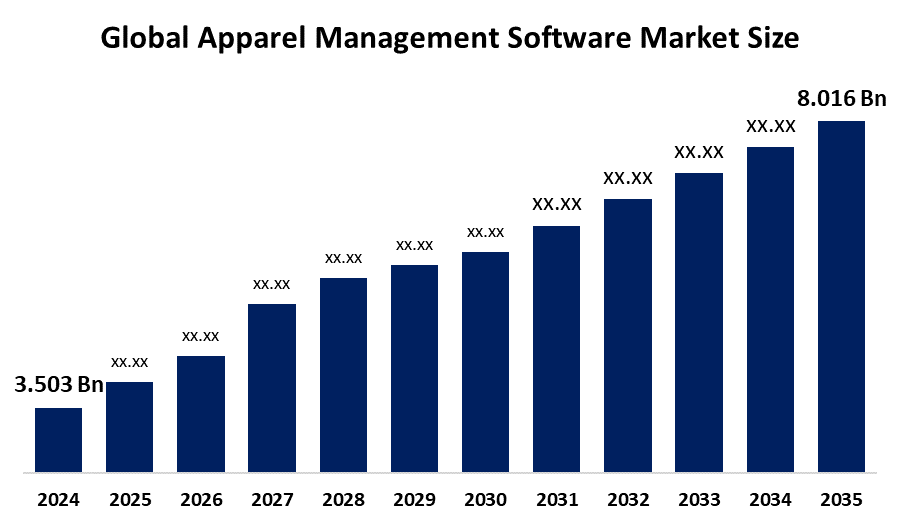
- The Global Apparel Management Software Market Size Was Estimated at USD 3.503 Billion in 2024
- The Market Size is Expected to Grow at a CAGR of around 7.82% from 2025 to 2035
- The Worldwide Apparel Management Software Market Size is Expected to Reach USD 8.016 Billion by 2035
- Asia Pacific is expected to grow the fastest during the forecast period.
Get more details on this report -
According to a research report published by Spherical Insights and Consulting, The Global Apparel Management Software Market Size Was Worth Around USD 3.503 Billion In 2024 And Is Predicted To Grow To Around USD 8.016 Billion By 2035 With A Compound Annual Growth Rate (CAGR) Of 7.82% From 2025 To 2035. Global expansion of AI design forecasting, cloud-based ERP adoption for supply chain transparency, automation to enhance operational efficiency, virtual fitting rooms, sustainability tracking, and on-demand manufacturing to reduce waste are all driving opportunities in the apparel management software market.
Market Overview
The apparel management software market defines the worldwide industry which develops software solutions used by clothing and fashion businesses to control their operations through one central platform that handles product design, inventory, supply chain, production planning, sales, and retail integration. The market achieved major development through organizations that use cloud computing, artificial intelligence, data analytics, e-commerce systems, and ERP system integration to obtain real-time tracking, demand prediction, and shortened product development cycles. The fashion industry now offers new growth opportunities because digital transformation has increased its presence, online retail sales have increased, consumers demand eco-friendly supply chains, and small and medium-sized businesses implement automation solutions. Digitalization receives government backing through policies which support technology adoption through incentives and subsidies while the government establishes compliance requirements for data protection and sustainability and invests in infrastructure development and workforce skill enhancement to boost apparel sector competitiveness.
For example, in 2023, the U.S. EDA grants financial assistance to textile facility modernization and technology implementation through its 2023 funding program which includes a USD 1.1 million grant that supports North Carolina textile technology center digital tool and software system implementation, which results in indirect growth for the apparel management software market.
The quick speed of technological advancement is one of the main drivers of the apparel management software market's expansion.
Report Coverage
This research report categorizes the apparel management software market based on various segments and regions, forecasts revenue growth, and analyzes trends in each submarket. The report analyses the key growth drivers, opportunities, and challenges influencing the apparel management software market. Recent market developments and competitive strategies, such as expansion, product launch, development, partnership, merger, and acquisition, have been included to draw the competitive landscape in the market. The report strategically identifies and profiles the key market players and analyses their core competencies in each sub-segment of the apparel management software market.
Global Apparel Management Software Market Report Coverage
| Report Coverage | Details |
|---|---|
| Base Year: | 2024 |
| Market Size in 2024: | USD 3.503 Billion |
| Forecast Period: | 2025-2035 |
| Forecast Period CAGR 2025-2035 : | 7.82% |
| 2035 Value Projection: | USD 8.016 Billion |
| Historical Data for: | 2020-2023 |
| No. of Pages: | 268 |
| Tables, Charts & Figures: | 113 |
| Segments covered: | By Function, By Deployment, By End User and By Region |
| Pitfalls & Challenges: | COVID-19 Impact, Challenges, Future, Growth, & Analysis |
Get more details on this report -
Driving Factors
Rapid technological innovation is one of the main drivers of the apparel management software market's growth. The fashion and textile industry experiences fast digital changes while e-commerce and omnichannel retailing practices drive the growth of apparel management software market. In the industry organizations drive their research and development activities through two factors which include need for real-time data integration and desire to build centralized management systems. The presence of government policies and incentives brings indirect benefits to technology adoption through investments in startup companies and enterprise software vendors while increasing the technology adoption rate among small and medium-sized enterprises which together with the global shift toward digital supply chain systems create a positive impact on the growth of the apparel management software market.
In March 2025, the Government of India’s Ministry of Textiles Annual Report 2024-25 has advanced digital adoption in textiles through ICT upgrades and e governance. The second phase of Maharashtra's e Textile portal enables industry stakeholders to digitize their process which leads to indirect adoption of apparel management software.
Restraining Factors
High development and deployment costs, lack of digital literacy, data security and privacy concerns, integration issues across supply chain, retail, and ERP systems, and frequent software updates and customization requirements challenges are the main factors restricting the apparel management software market.
Market Segmentation
The apparel management software market share is classified into function, deployment, and end user.
- The inventory management segment dominated the market in 2024, approximately 28%, and is projected to grow at a substantial CAGR during the forecast period.
Based on the function, the apparel management software market is divided into inventory management, order management, product development, and supply chain management. Among these, the inventory management segment dominated the market in 2024, approximately 28%, and is projected to grow at a substantial CAGR during the forecast period. The growing e-commerce platforms, need for multichannel sales, demand for real-time tracking, barcode scanning, and RFID technology to optimize supply chain efficiency, and enhanced profitability with cost effective solutions is driving the inventory management industry.
- The cloud-based segment accounted for the largest share in 2024, approximately 58%, and is anticipated to grow at a significant CAGR during the forecast period.
Based on the deployment, the apparel management software market is divided into cloud-based and on-premises. Among these, the cloud-based segment accounted for the largest share in 2024, approximately 58%, and is anticipated to grow at a significant CAGR during the forecast period. Massive ability to offer scalability, lower upfront costs, need for real-time data access, reduced stockouts and overstocking, and support for omnichannel operations is driving the cloud-based industry.
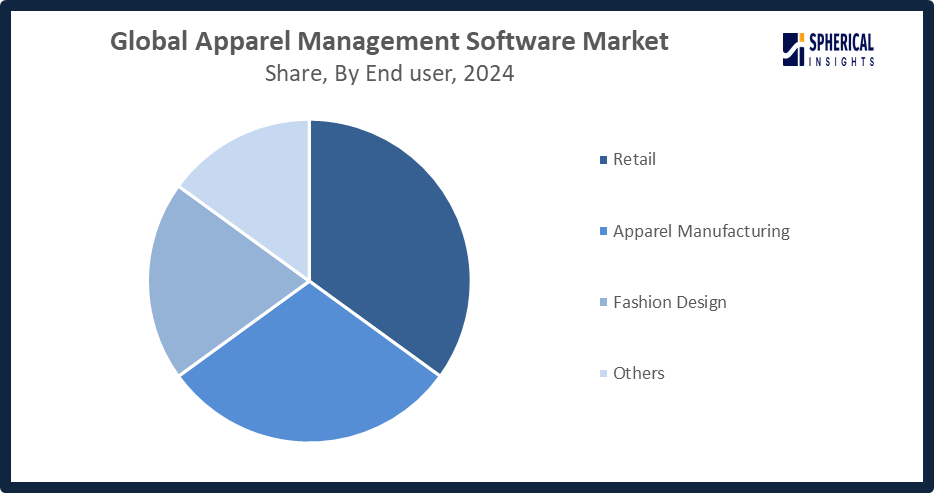
- The retail segment accounted for the highest market revenue in 2024, approximately 35%, and is anticipated to grow at a significant CAGR during the forecast period.
Based on the end user, the apparel management software market is divided into retail, apparel manufacturing, fashion design, and others. Among these, the retail segment accounted for the highest market revenue in 2024, approximately 35%, and is anticipated to grow at a significant CAGR during the forecast period. Increased demand for omnichannel retailing, the urgent need for real-time inventory accuracy, rapid adoption of cloud-based POS system, and increased investment in digital tools to unify in-store and online operations by retailers is bolstering retail market.
Get more details on this report -
Regional Segment Analysis of the Apparel Management Software Market
- North America (U.S., Canada, Mexico)
- Europe (Germany, France, U.K., Italy, Spain, Rest of Europe)
- Asia-Pacific (China, Japan, India, Rest of APAC)
- South America (Brazil and the Rest of South America)
- The Middle East and Africa (UAE, South Africa, Rest of MEA)
North America is anticipated to hold the largest share of the apparel management software market over the predicted timeframe.

Get more details on this report -
North America is anticipated to hold the largest share of the apparel management software market over the predicted timeframe. Strong government backing for digital manufacturing, robust IT service networks, and consumers demand both fast fashion and customized products are what propel North America. The region receives additional support from governmental initiatives that fund real-time inventory tracking, supply chain improvements, and omnichannel retail system development to boost operational performance and customer service delivery across countries like United States and Canada. The fashion and retail sectors of the country show strong market presence for digital systems operate throughout the nation and a high adoption rate of cloud-based and AI-integrated software solutions.
Government initiatives include the Canada’s CDAP, March 2022 funding of CA 4 billion which enables small and medium enterprises to adopt various digital solutions that include e commerce platforms and inventory management and software management systems and the U.S. Manufacturing USA network and AFFOA established their collaboration in February 2022 to support advanced manufacturing technologies which included automation and digital data-driven tool implementation in apparel and textile production processes.
Asia Pacific is expected to grow at a rapid CAGR in the apparel management software market during the forecast period. China, India, Japan, and Vietnam are among the nations making significant investments in adoption of cloud-based software, AI, and data analytics. The demand for sophisticated apparel management software is further accelerated by the region's major centers for textile and apparel manufacturing hubs due to rising production and worldwide market requirements through efficient inventory, supply chain, and production management systems. Government initiatives provide support for both modernization efforts and digital transformation initiatives. The growth of e-commerce and omnichannel retailing in the region makes it essential for businesses to adopt real-time tracking systems and demand forecasting tools and unified management platforms.
Government launches include China’s MIIT, September 2024, promoted digital transformation in manufacturing with smart tools and data-driven operations for textiles and apparel, Vietnam’s Digital and Industrial Strategies, June 2025, to enhance technology adoption and digital value chains across sectors like textiles sector, and Japan’s Digital Garden City policies provide tax incentives and subsidies for SMEs to adopt cloud services and IT systems, encouraging apparel manufacturers and retailers to use digital management solutions.
Competitive Analysis:
The report offers the appropriate analysis of the key organizations/companies involved within the apparel management software market, along with a comparative evaluation primarily based on their product of offering, business overviews, geographic presence, enterprise strategies, segment market share, and SWOT analysis. The report also provides an elaborative analysis focusing on the current news and developments of the companies, which includes product development, innovations, joint ventures, partnerships, mergers & acquisitions, strategic alliances, and others. This allows for the evaluation of the overall competition within the market.
Key Target Audience
- Market Players
- Investors
- End-users
- Government Authorities
- Consulting and Research Firm
- Venture capitalists
- Value-Added Resellers (VARs)
Recent Development
- In January 2026, Fluent Commerce introduced its new product Fluent Connect, which serves as an artificial intelligence-powered integration solution that streamlines order management process time through its ability to link distributed order management systems with external payment gateway and carrier and point of sale systems.
- In December 2025, Centric Software introduced AI powered retail performance solutions at NRF 2026 which help fashion and apparel companies improve their forecasting and assortment planning and product lifecycle management abilities.
- In March 2024, Datatex introduced its ERP software solution for the Bangladesh textile and apparel industry during an industry seminar which demonstrated how the platform functions as a technology stack that enables textile and garment manufacturers to enhance their data recording and analysis processes while achieving better operational visibility.
Market Segment
This study forecasts revenue at global, regional, and country levels from 2020 to 2035. Spherical Insights has segmented the apparel management software market based on the below-mentioned segments:
Global Apparel Management Software Market, By Function
- Inventory Management
- Order Management
- Product Development
- Supply Chain Management
Global Apparel Management Software Market, By Deployment
- Cloud-Based
- On-Premises
Global Apparel Management Software Market, By End User
- Retail
- Apparel Manufacturing
- Fashion Design
- Others
Global Apparel Management Software Market, By Regional Analysis
- North America
- US
- Canada
- Mexico
- Europe
- Germany
- UK
- France
- Italy
- Spain
- Russia
- Rest of Europe
- Asia Pacific
- China
- Japan
- India
- South Korea
- Australia
- Rest of Asia Pacific
- South America
- Brazil
- Argentina
- Rest of South America
- Middle East & Africa
- UAE
- Saudi Arabia
- Qatar
- South Africa
- Rest of the Middle East & Africa
Frequently Asked Questions (FAQ)
-
1. What are the key technologies used in apparel management software?Modern apparel management software uses cloud computing, AI & machine learning, IoT-enabled inventory tracking, RFID, data analytics, and mobile applications to improve efficiency, forecasting, and real-time operational insights
-
2. Which deployment models are available?Apparel management software is offered as cloud-based, on-premises, or hybrid solutions, allowing businesses to choose based on cost, scalability, security, and IT infrastructure.
-
3. What functionalities does apparel management software provide?Key functionalities include inventory management, order and supply chain management, production planning, demand forecasting, merchandising, retail analytics, and e-commerce integration
-
4. Who uses apparel management software?It is widely used by apparel manufacturers, fashion retailers, e-commerce businesses, wholesalers, and distributors to streamline operations, reduce costs, and improve customer experience
-
5. Which industries benefit most from apparel management software?Primarily fashion and apparel manufacturing, retail chains, e-commerce platforms, sports-wear brands, and luxury fashion houses benefit by improving efficiency, reducing stock-outs, and enhancing customer satisfaction.
-
6. What is the expected market trend for 2024–2035?The market is expected to grow steadily, with cloud-based and AI-enabled platforms seeing the fastest adoption. Demand is increasing for omnichannel retail solutions, sustainable supply chain management, and integrated PLM-ERP systems.
Need help to buy this report?