Global Anti-Glare Film Market Size, Share, and COVID-19 Impact Analysis, By Base Film (PET Films, Polycarbonate, Acrylic Films, and PET / PC Films), By Coating Technology (Matte Coatings, Nano Coatings, Light Diffusion Coatings, and Anti-Reflection Coatings), By Application (Display Protection, Automotive Glass, Mobile Devices, and Optical Displays), and By Region (North America, Europe, Asia-Pacific, Latin America, Middle East, and Africa), Analysis and Forecast 2025 - 2035
Industry: Chemicals & Materials
Global Anti-Glare Film Market Size Insights Forecasts to 2035
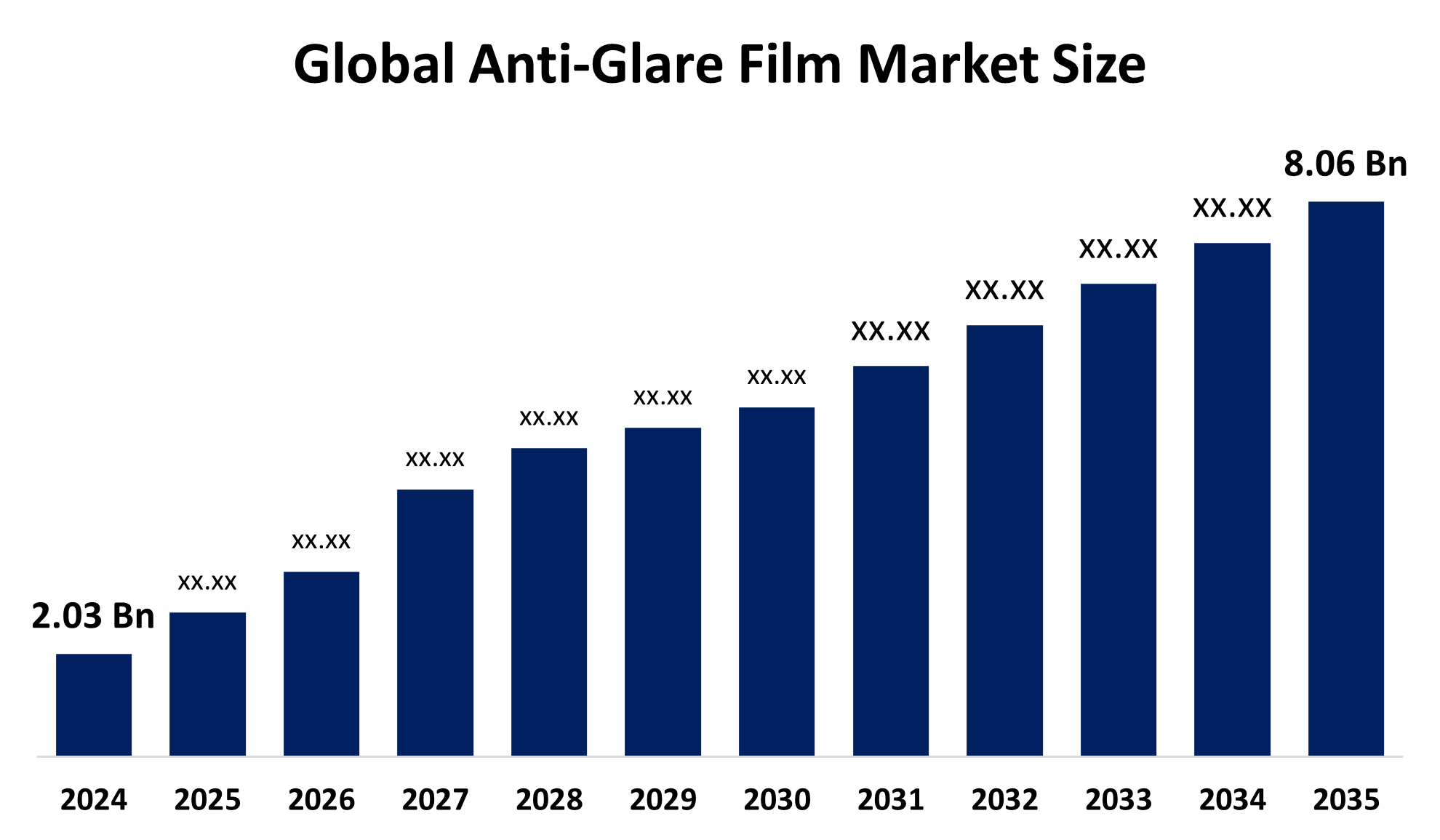
- The Global Anti-Glare Film Market Size Was Estimated at USD 2.03 Billion in 2024
- The Market Size is Expected to Grow at a CAGR of around 13.35% from 2025 to 2035
- The Worldwide Anti-Glare Film Market Size is Expected to Reach USD 8.06 Billion by 2035
- Asia Pacific is expected to grow the fastest during the forecast period.
Get more details on this report -
According to a research report published by Spherical Insights and Consulting, The Global Anti-Glare Film Market Size was worth around USD 2.03 Billion in 2024 and is Predicted to Grow to around USD 8.06 Billion by 2035 with a Compound Annual Growth Rate (CAGR) of 13.35% from 2025 to 2035. Opportunities in the anti-glare film market are fueled by factors such as the growing need for high-clarity screens, the growing use of consumer electronics, the integration of car displays, renewable energy panels, and technological developments that improve optical performance and durability.
Market Overview
The "Global Anti-Glare Film Market" refers to the worldwide industry that makes money from polymeric films intended to reduce perceived glare and specular reflection. These films enhance contrast in natural daylight, lessen eye strain, and enhance readability outside by employing light-diffusing particles, nanostructured coatings, or controlled surface roughening. They are distinguished from strictly anti-reflective films that reduce reflections through interference rather than diffusion by optical metrics such as haze (usually 20–25%), gloss thresholds, distinctness of image (DOI), and light transmission.
In August 2025, Dexerials Corporation launched its advanced sputtering-based anti-reflection films globally, securing the largest market share for the sixth consecutive year amid rising demand for durable, high-visibility automotive and consumer electronics displays. The proliferation of large-format cockpit displays, increased pixel densities, outdoor readability standards, and stricter legibility requirements in automotive settings, the category is evolving from a specialized optical enhancement layer to a baseline display-performance and automotive safety requirement. The rise in screen time worldwide is the main factor propelling the market for anti-glare films. Prolonged use of displays has become inevitable due to remote work and digital learning.
Report Coverage
This research report categorizes the Global Anti-Glare Film Market based on various segments and regions, forecasts revenue growth, and analyzes trends in each submarket. The report analyses the key growth drivers, opportunities, and challenges influencing the anti-glare film market. Recent market developments and competitive strategies, such as expansion, product launch, development, partnership, merger, and acquisition, have been included to draw the competitive landscape in the market. The report strategically identifies and profiles the key market players and analyses their core competencies in each sub-segment of the anti-glare film market.
Global Anti-Glare Film Market Report Coverage
| Report Coverage | Details |
|---|---|
| Base Year: | 2024 |
| Market Size in 2024: | USD 2.03 Billion |
| Forecast Period: | 2025-2035 |
| Forecast Period CAGR 2025-2035 : | 13.35% |
| 2035 Value Projection: | USD 8.06 Billion |
| Historical Data for: | 2020-2023 |
| No. of Pages: | 195 |
| Tables, Charts & Figures: | 102 |
| Segments covered: | By Base Film, By Coating Technology |
| Companies covered:: | 3M Company, Covestro AG, Dai Nippon Printing Co., Ltd., Mitsubishi Chemical Corporation, Ningbo Solartron Technology Co., Ltd., Nitto Denko Corporation, SKC hi-tech & marketing Co., Ltd., Toppan Inc. and Other Key Players |
| Pitfalls & Challenges: | and COVID-19 Impact Analysis |
Get more details on this report -
Driving Factors
The increasing adoption of advanced display technologies in the automotive, consumer electronics, healthcare, and industrial sectors is the primary driver of the Global Anti-Glare Film Market. The expanding usage of smartphones, tablets, laptops, smart televisions, and interactive kiosks has increased the need for better optical clarity and less surface reflection. The increasing incorporation of digital dashboards and entertainment systems in cars facilitates market expansion because glare reduction is essential for both driver safety and display readability. The necessity for screen-based gadgets that are more visually comfortable and less taxing on the eyes has also increased due to the quick digital transformation of educational organizations and business enterprises.
Restraining Factors
The market for anti-glare films is constrained by a number of factors, including high production costs, consumer electronics price sensitivity, the availability of substitute glare-reduction technologies, possible limitations on display clarity, volatile raw material prices, and strict environmental regulations that impact coating and manufacturing procedures.
Market Segmentation
The anti-glare film market share is classified into base film, coating technology, and application.
- The PET films segment dominated the market in 2024, approximately 52%, and is projected to grow at a substantial CAGR during the forecast period.
Based on the base film, the Global Anti-Glare Film Market is divided into PET films, polycarbonate, acrylic films, and PET / PC films. Among these, the PET films segment dominated the market in 2024, approximately 52%, and is projected to grow at a substantial CAGR during the forecast period. PET offers consistent optical performance throughout extended production runs and wide web widths by serving as a solid substrate for homogeneous matte and nano-structured coatings. Polyethylene terephthalate (PET) films are ideal for touch panel and display protection applications because of their strong adhesion, high transparency, and dimensional stability.
- The matte coatings segment accounted for the largest share in 2024, approximately 50%, and is anticipated to grow at a significant CAGR during the forecast period.
Based on the coating technology, the Global Anti-Glare Film Market is divided into matte coatings, nano coatings, light diffusion coatings, and anti-reflection coatings. Among these, the matte coatings segment accounted for the largest share in 2024, approximately 35%, and is anticipated to grow at a significant CAGR during the forecast period. In consumer electronics where visual comfort and less eye strain are essential, such as smartphones, laptops, monitors, and televisions, matte coatings are extensively used. Large-scale commercialization is further aided by their affordability and compatibility with a variety of base films, including PET and polycarbonate.
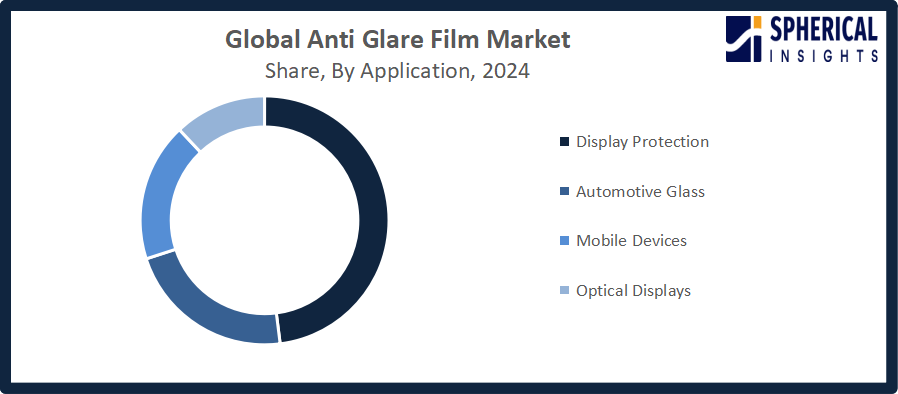
- The display protection segment accounted for the highest market revenue in 2024, approximately 48%, and is anticipated to grow at a significant CAGR during the forecast period.
Based on the application, the Global Anti-Glare Film Market is divided into display protection, automotive glass, mobile devices, and optical displays. Among these, the display protection segment accounted for the highest market revenue in 2024, approximately 35%, and is anticipated to grow at a significant CAGR during the forecast period. The demand for protective films that improve screen durability while lowering glare and reflection has surged due to the quick spread of smartphones, tablets, laptops, monitors, and televisions. Display protection anti-glare films reduce eye strain, enhance visual clarity, and preserve screen visibility in a range of lighting scenarios.
Get more details on this report -
Regional Segment Analysis of the Anti-Glare Film Market
- North America (U.S., Canada, Mexico)
- Europe (Germany, France, U.K., Italy, Spain, Rest of Europe)
- Asia-Pacific (China, Japan, India, Rest of APAC)
- South America (Brazil and the Rest of South America)
- The Middle East and Africa (UAE, South Africa, Rest of MEA)
Asia Pacific is anticipated to hold the largest share of the anti-glare film market over the predicted timeframe.

Get more details on this report -
Asia Pacific is anticipated to hold the largest share of the Anti-Glare Film Market over the predicted timeframe. Particularly in countries like China, Japan, South Korea, and India, the area is a global hub for the manufacture of vehicle display systems, smartphones, tablets, televisions, computers, and more. Rapid urbanization, growing disposable income, and greater digital use all contribute to the need for state-of-the-art display technology with glare-reduction characteristics. To reduce aviation and road glare while maintaining efficiency, JinkoSolar (China) launched anti-glare, low-reflection PV modules certified by TÜV Rheinland, Swiss SPF, and undergoing CPVT testing in early 2026. This is China's first triple-certified anti-glare solar product for highways, airports, and barriers.
North America is expected to grow at a rapid CAGR in the Anti-Glare Film Market during the forecast period. The region is home to several high-end consumer electronics, state-of-the-art automotive systems, and medical display technologies that require enhanced optical clarity and reduced reflection. The convergence of sophisticated driver aid technologies and high standards for interior design is reflected in demand. Government announcements and launches: In 2025–2026, the government will not make any significant direct announcements on anti-glare films; nevertheless, federal subsidies for solar energy and EV adoption in the United States indirectly encourage relevant anti-glare PV coatings and vehicle displays.
Competitive Analysis:
The report offers the appropriate analysis of the key organizations/companies involved within the Anti-Glare Film Market, along with a comparative evaluation primarily based on their product of offering, business overviews, geographic presence, enterprise strategies, segment market share, and SWOT analysis. The report also provides an elaborative analysis focusing on the current news and developments of the companies, which includes product development, innovations, joint ventures, partnerships, mergers & acquisitions, strategic alliances, and others. This allows for the evaluation of the overall competition within the market.
List of Key Companies
- 3M Company
- Covestro AG
- Dai Nippon Printing Co., Ltd.
- Mitsubishi Chemical Corporation
- Ningbo Solartron Technology Co., Ltd.
- Nitto Denko Corporation
- SKC hi-tech & marketing Co., Ltd.
- Toppan Inc.
- Others
Key Target Audience
- Market Players
- Investors
- End-users
- Government Authorities
- Consulting and Research Firm
- Venture capitalists
- Value-Added Resellers (VARs)
Recent Development
- In September 2025, Xinmei launched large-scale production lines for polarizer surface treatment films, addressing rising global demand for high-performance optical films that enhance display clarity and glare reduction across smartphones and automotive head-up displays.
Market Segment
This study forecasts revenue at global, regional, and country levels from 2020 to 2035. Spherical Insights has segmented the Anti-Glare Film Market based on the below-mentioned segments:
Global Anti-Glare Film Market, By Base Film
- PET Films
- Polycarbonate
- Acrylic Films
- PET / PC Films
Global Anti-Glare Film Market, By Coating Technology
- Matte Coatings
- Nano Coatings
- Light Diffusion Coatings
- Anti-Reflection Coatings
Global Anti-Glare Film Market, By Application
- Display Protection
- Automotive Glass
- Mobile Devices
- Optical Displays
Global Anti-Glare Film Market, By Regional Analysis
- North America
- US
- Canada
- Mexico
- Europe
- Germany
- UK
- France
- Italy
- Spain
- Russia
- Rest of Europe
- Asia Pacific
- China
- Japan
- India
- South Korea
- Australia
- Rest of Asia Pacific
- South America
- Brazil
- Argentina
- Rest of South America
- Middle East & Africa
- UAE
- Saudi Arabia
- Qatar
- South Africa
- Rest of the Middle East & Africa
Frequently Asked Questions (FAQ)
-
1. What is anti-glare film?Anti-glare film is a surface treatment or thin layer applied to glass or display panels to reduce light reflection and glare. It improves screen visibility, enhances contrast, and minimizes eye strain in bright environments.
-
2. What are the key drivers of the anti-glare film market?Major growth drivers include increasing demand for electronic displays, rising use of smartphones and tablets, growth in automotive displays, expansion of commercial buildings with large glass surfaces, and increasing awareness of eye protection solutions.
-
3. Which industries use anti-glare films?Anti-glare films are widely used in consumer electronics, automotive, healthcare, retail displays, aviation, architecture, and industrial equipment sectors.
-
4. What types of anti-glare films are available?The market is segmented into matte-coated films, etched films, anti-reflective films, and multilayer optical films. Each type differs in glare reduction efficiency and application suitability.
-
5. How is anti-glare film different from anti-reflective film?Anti-glare films diffuse reflected light to reduce harsh reflections, while anti-reflective films use optical coatings to minimize reflection and improve light transmission. Both improve visibility but work through different mechanisms.
-
6. What materials are used in anti-glare film manufacturing?Common materials include polyethylene terephthalate (PET), polycarbonate (PC), acrylic, and specialized optical coatings designed to reduce reflection and enhance durability.
-
7. What are the key benefits of anti-glare films?Benefits include improved readability under sunlight, reduced eye fatigue, enhanced display clarity, scratch resistance, protection against fingerprints, and extended device lifespan.
-
8. Which regions dominate the anti-glare film market?Asia-Pacific leads due to strong electronics manufacturing in countries like Japan, China, and South Korea. North America and Europe also hold significant shares due to demand from automotive and commercial sectors.
-
9. What challenges does the anti-glare film market face?Challenges include high production costs for advanced optical films, competition from integrated anti-glare display technologies, price sensitivity in consumer electronics, and raw material price fluctuations.
-
10. What is the future outlook of the anti-glare film market?The market is expected to grow steadily, driven by expanding use of touchscreens, digital signage, EV displays, smart windows, and wearable devices. Technological advancements in nano-coatings and multifunctional films will further boost market demand.
Need help to buy this report?