Global Anesthesia Gas Blenders Market Size, Share, and COVID-19 Impact Analysis, By Product (Manual and Electronic), By Application (Ambulatory Surgical Centers and Hospitals), and By Region (North America, Europe, Asia-Pacific, Latin America, Middle East, and Africa), Analysis and Forecast 2025 - 2035.
Industry: Healthcare
Global Anesthesia Gas Blenders Market Insights Forecasts to 2035
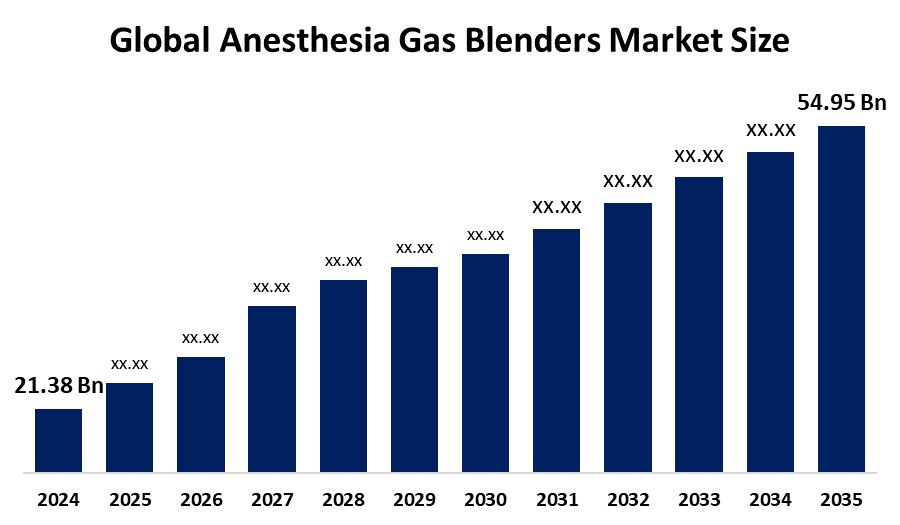
- The Global Anesthesia Gas Blenders Market Size Was Estimated at USD 21.38 Billion in 2024
- The Market Size is Expected to Grow at a CAGR of around 8.96% from 2025 to 2035
- The Worldwide Anesthesia Gas Blenders Market Size is Expected to Reach USD 54.95 Billion by 2035
Get more details on this report -
Key Takeaways -
- North America dominated the market with the largest share in 2024.
- Asia Pacific is expected to grow the fastest during the forecast period.
- By product, the manual segment holds the dominant share in the anesthesia gas blenders market, while the electronic segment is the emerging segment in the market.
- By application, the hospital segment is anticipated to hold the dominant share, on the other hand, the ambulatory surgical centers segment is the fastest growing segment in the market.
According to a research report published by Spherical Insights and Consulting, the Global Anesthesia Gas Blenders Market size was worth around USD 21.38 Billion in 2024 and is predicted to grow to around USD 54.95 Billion by 2035 with a compound annual growth rate (CAGR) of 8.96% from 2025 and 2035. The market for anesthesia gas blenders has a number of opportunities to grow due to the ongoing development of portable, cost-effective devices and the integration of IoT/AI for monitoring.
Key Trends in Medical Anesthesia Gas Blenders Market –
- Adoption of electronic gas mixing systems
- Demand for compact devices from Ambulatory Surgical Centers (ASCs)
Market Overview
The global anesthesia gas blenders industry is the market for specialized medical devices that precisely mix medical gases (oxygen, air, nitrous oxide) for safe, controlled delivery during surgeries. An anesthesia gas blender is a main component of an anesthesia delivery machine, primarily functioning for mixing two or more gases to provide anesthesia during surgery. Gases such as oxygen are mixed with nitrous oxide and other anesthesia gases to deliver a blend of gases in a measured amount to the patient undergoing prolonged surgery, as accurate gas concentrations are essential for procedures ranging from respiratory support and anesthesia to neonatal care.
Incorporation of safety alarms and digital controls into medical gas blenders helps in improving dependability and patient safety, essential in ensuring reliable gas supply, upholding stringent legal requirements, and assisting medical professionals in providing efficient and secure patient care in a range of healthcare settings. Furthermore, electronic medical records and digital health platforms are the areas where a large number of contemporary medical gas blenders are integrated, streamlining workflow, promoting real-time monitoring of gas usage, and improving patient data management.
Innovation and market expansion are anticipated as a result of major players' growing R&D expenditures and the expanding partnerships. Recently, in January 2025, Drager shared that the Atlan A350/A350XL Anesthesia Machines have received an Innovative Technology Product designation for anesthesia equipment from Vizient, Inc., the largest healthcare performance improvement company in the country.
Report Coverage
This research report categorizes the anesthesia gas blenders market based on various segments and regions, forecasts revenue growth, and analyzes trends in each submarket. The report analyses the key growth drivers, opportunities, and challenges influencing the anesthesia gas blenders market. Recent market developments and competitive strategies such as expansion, type launch, development, partnership, merger, and acquisition have been included to draw the competitive landscape in the market. The report strategically identifies and profiles the key market players and analyses their core competencies in each sub-segment of the anesthesia gas blenders market.
Driving Factors
An increasing number of global surgical procedures, along with an increasing geriatric population
Anesthesia gas blenders help in preventing hypoxia during surgical procedures, ensuring patient safety, and maintaining a precise fraction of inspired oxygen levels. It was found that 11% of the global burden of disease requires surgical or anesthesia care or both. According to the Lancet Commission for Global Surgery (LCoGS), 5000 procedures are needed to address the surgical burden of diseases affecting 100,000 people in low and middle-income countries (LMICs). The reported rates of surgery vary from 295 in LMICs to 23,000 in high-income countries (HIC) per 100,000 population.
Elderly patients commonly have injuries or other medical conditions requiring surgery. Further, these patients are at high risk of perioperative morbidity and mortality, needs precise control of gas mixtures and flow rates essential for safety.
Increasing Technological Advancements and well-equipped multi-speciality hospitals and surgical centers
With the changing inclination towards safer, precise inhalable anesthesia, the adoption of electronic/smart gas blenders is contributing to propel the market growth. For instance, Seleon’s Digital Gas Mixer is integrated as a modular assembly into various ventilators in paediatrics and anaesthesia machines. Further, increased prioritization for inhaled anesthesia with an increase in the number of well-equipped multispeciality hospitals and surgical centres is contributing to escalate anesthesia gas blenders market.
Restraining Factors
Increased equipment costs, device complexity, a shortage of skilled professionals to operate complex devices, and stringent regulations are challenging factors in the market. Furthermore, failure of the electric power in the electronic anesthesia gas blender device is restricting its adoption, thereby restraining the market growth.
Market Segmentation
The Anesthesia Gas Blenders Market share is classified into product and application.
- The manual segment dominated the market with a significant share of around 45.0% in 2024 and is projected to grow at a substantial CAGR during the forecast period.
Based on the product, the anesthesia gas blenders market is divided into manual and electronic. Among these, the manual segment dominated the market with a significant share of around 45.0% in 2024 and is projected to grow at a substantial CAGR during the forecast period. This is due to reliability, tactile control via physical knobs and flowmeters, offering independence from electricity and complex software that is important for emergency, low-resource, or portable settings. While the electronic segment is the emerging segment in the anesthesia gas blenders market, due to its accuracy in mixing with digital setpoints, integrated sensors, and event logging for audits.
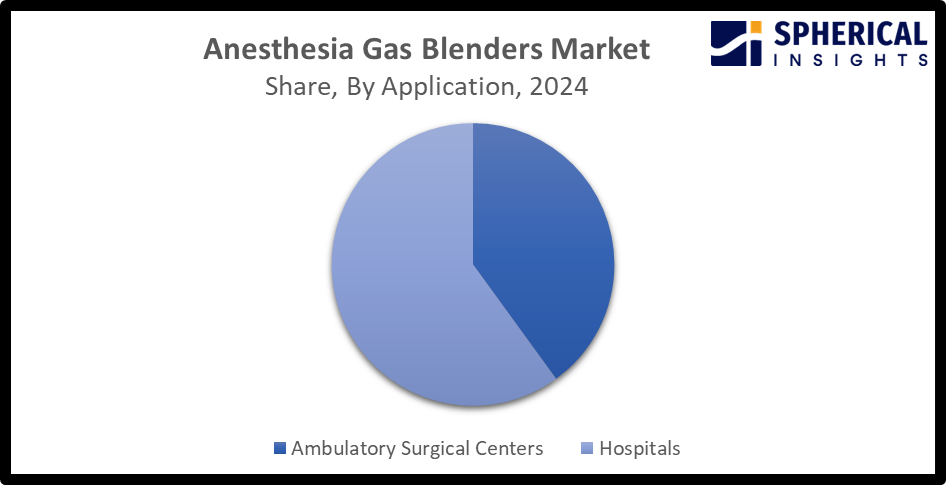
- The hospitals segment accounted for the largest market share of about 60.0% in 2024 and is projected to grow at a substantial CAGR during the forecast period.
Based on the application, the anesthesia gas blenders market is divided into ambulatory surgical centers and hospitals. Among these, the hospitals segment accounted for the largest market share of about 60.0% in 2024 and is projected to grow at a substantial CAGR during the forecast period. An upsurging need for advanced anesthesia delivery systems and availability of robust ventilatory gas supply in operating rooms and ICUs contribute to driving the segmental market growth. Further, the ambulatory surgical centers segment is the fastest-growing segment in the market during the forecast period. This is attributed to the increase in minimally invasive, outpatient surgeries requiring advanced, compact, and automated systems that enhance patient safety.
Get more details on this report -
Regional Segment Analysis of the Anesthesia Gas Blenders Market
- North America (U.S., Canada, Mexico)
- Europe (Germany, France, U.K., Italy, Spain, Rest of Europe)
- Asia-Pacific (China, Japan, India, Rest of APAC)
- South America (Brazil and the Rest of South America)
- The Middle East and Africa (UAE, South Africa, Rest of MEA)
North America is anticipated to hold the largest share of the anesthesia gas blenders market over the predicted timeframe.
North America is anticipated to hold the largest share of about 35.0% in the anesthesia gas blenders market over the predicted timeframe. The market ecosystem in North America is strong, due to the growing emphasis on delivering accurate and safe anesthesia, along with an increasing prevalence of chronic diseases. The U.S. is leading the North America anesthesia gas blenders market, holding about 71% regional share due to the presence of established healthcare facilities and emphasis on patient safety.
Asia Pacific is expected to grow at a rapid CAGR of approximately 16.4% in the anesthesia gas blenders market during the forecast period. The Asia Pacific area has a thriving market for anesthesia gas blenders due to the growing number of surgical procedures, expanding healthcare infrastructure, and anesthesia awareness. Due to government-led healthcare infrastructure modernization and increased medical tourism, the market is expected to grow. China is the leading country in the Asia Pacific anesthesia gas blenders market owing to a robust domestic manufacturing base for medical gas equipment, rapid adoption of advanced healthcare technology, and increased surgical volume.
Competitive Analysis:
The report offers the appropriate analysis of the key organizations/companies involved within the anesthesia gas blenders market, along with a comparative evaluation primarily based on their type of offering, business overviews, geographic presence, enterprise strategies, segment market share, and SWOT analysis. The report also provides an elaborative analysis focusing on the current news and developments of the companies, which includes type development, innovations, joint ventures, partnerships, mergers & acquisitions, strategic alliances, and others. This allows for the evaluation of the overall competition within the market.
List of Key Companies
- Advin Health Care
- Armstrong Medical Ltd.
- Braun Melsungen AG
- Becton, Dickinson and Company
- BioMed Devices
- Drägerwerk AG & Co. KGaA
- EKU Elektronik GmbH
- General Electric Company
- Getinge AB
- Hamilton Medical AG
- IndoSurgical Private Limited
- Koninklijke Philips N.V.
- Medtronic plc
- Mindray Medical International Limited
- Others
Key Target Audience
- Market Players
- Investors
- End-users
- Government Authorities
- Consulting And Research Firm
- Venture capitalists
- Value-Added Resellers (VARs)
Recent Development
In October 2025, North American Partners in Anesthesia (NAPA) announced that it would begin providing anesthesia services at two SightMD facilities on Long Island: Long Island Ambulatory Surgery Center in Brentwood, NY, and Suffolk Surgery Center in Shirley, NY.
In January 2025, the government confirmed funding and a realistic timetable to put the New Hospital Programme on track to deliver all of its hospital projects, directly increasing demand for capital medical equipment and advanced gas blending systems.
In September 2023, Dräger launched Atlan Anesthesia Workstations. The Atlan anesthesia workstation family (A100, A300, A350), features advanced, scalable, and safe ventilation for surgical patients, ranging from neonates to adults.
Market Segment
This study forecasts revenue at global, regional, and country levels from 2020 to 2035. Spherical Insights has segmented the Anesthesia Gas Blenders Market based on the below-mentioned segments:
Global Anesthesia Gas Blenders Market, By Product
- Manual
- Electronic
Global Anesthesia Gas Blenders Market, By Application
- Ambulatory Surgical Centers
- Hospitals
Global Anesthesia Gas Blenders Market, By Regional Analysis
- North America
- US
- Canada
- Mexico
- Europe
- Germany
- UK
- France
- Italy
- Spain
- Russia
- Rest of Europe
- Asia Pacific
- China
- Japan
- India
- South Korea
- Australia
- Rest of Asia Pacific
- South America
- Brazil
- Argentina
- Rest of South America
- Middle East & Africa
- UAE
- Saudi Arabia
- Qatar
- South Africa
- Rest of the Middle East & Africa
Frequently Asked Questions (FAQ)
-
1. What is the market size of the Anesthesia Gas Blenders market?The global Anesthesia Gas Blenders market size is expected to grow from USD 21.38 Billion in 2024 to USD 54.95 Billion by 2035, at a CAGR of 8.96% during the forecast period 2025-2035.
-
2. Which region holds the largest share of the Anesthesia Gas Blenders market?North America is anticipated to hold the largest share of the Anesthesia Gas Blenders market over the predicted timeframe.
-
3. What is the forecasted CAGR of the Global Anesthesia Gas Blenders Market from 2024 to 2035?The market is expected to grow at a CAGR of around 8.96% during the period 2024–2035.
-
4. Who are the top companies that are involved in the Global Anesthesia Gas Blenders Market?Key players include Advin Health Care, Armstrong Medical Ltd., B. Braun Melsungen AG, Becton, Dickinson and Company, BioMed Devices, Drägerwerk AG & Co. KGaA, EKU Elektronik GmbH, General Electric Company, Getinge AB, Hamilton Medical AG, IndoSurgical Private Limited, Koninklijke Philips N.V., Medtronic plc, and Mindray Medical International Limited.
-
5. What are the main drivers in the Anesthesia Gas Blenders Market?An increasing number of global surgical procedures, along with an increasing geriatric population, increasing technological advancements, and presence of well-equipped multi-speciality hospitals and surgical centers, are major market growth drivers of the Anesthesia Gas Blenders market.
-
6. What challenges are limiting the adoption of Anesthesia Gas Blenders?Factors like the increased equipment costs, device complexity, a shortage of skilled professionals to operate complex devices, and stringent regulations remain key restraints in the Anesthesia Gas Blenders market.
-
7. What are the key trends in the anesthesia gas blenders market?The adoption of electronic gas mixing systems and the demand for compact devices from ambulatory surgical centers (ASCs) are major key trends in the anesthesia gas blenders market.
Need help to buy this report?