Global Aluminium Rolling Oil Market Size, Share, and COVID-19 Impact Analysis, By Product Type (Synthetic, Semi-Synthetic, Mineral-Based, and Bio-Based), By Application (Hot Rolling, Cold Rolling, and Foil Rolling), By End-User (Automotive, Packaging, Building & Construction, Electrical & Electronics, and Others), and By Region (North America, Europe, Asia-Pacific, Latin America, Middle East, and Africa), Analysis and Forecast 2025 - 2035
Industry: Chemicals & Materials
Global Aluminium Rolling Oil Market Insights Forecasts to 2035
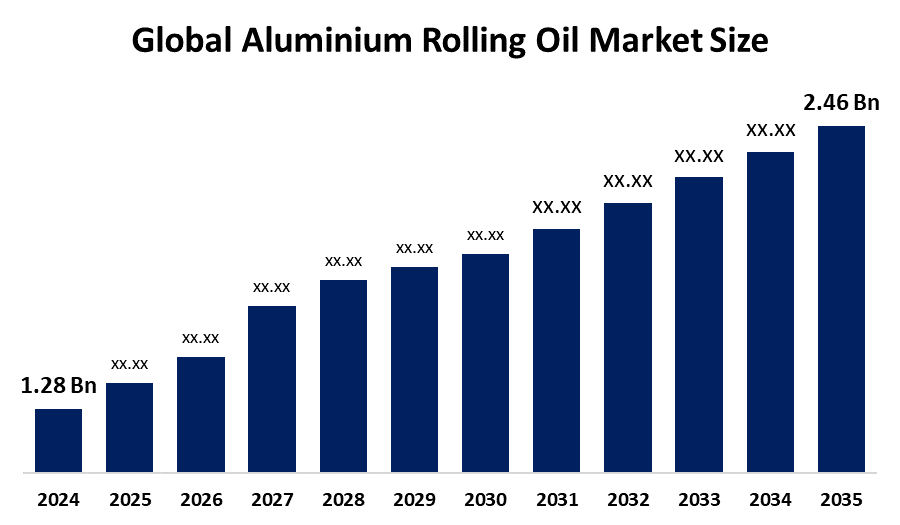
- The Global Aluminium Rolling Oil Market Size Was Estimated at USD 1.28 Billion in 2024
- The Market Size is Expected to Grow at a CAGR of around 6.12% from 2025 to 2035
- The Worldwide Aluminium Rolling Oil Market Size is Expected to Reach USD 2.46 Billion by 2035
- North America is expected to grow the fastest during the forecast period.
Get more details on this report -
According to a research report published by Spherical Insights and Consulting, The Global Aluminium Rolling Oil Market Size Was Worth Around USD 1.28 Billion In 2024 And Is Predicted To Grow To Around USD 2.46 Billion By 2035 With A Compound Annual Growth Rate (CAGR) Of 6.12% From 2025 To 2035. The aluminium rolling oil market is expanding as demand for lightweight electric vehicle materials, sustainable packaging, and infrastructure growth rises. Adoption is fueled by advanced, eco-friendly, high-performance lubricants increasingly used in automotive and packaging applications.
Market Overview
The global aluminium rolling oil market refers to the sector producing specialized lubricants used during the rolling and shaping of aluminium sheets and foils, ensuring high surface quality, reducing friction, and enhancing equipment efficiency. These oils are widely applied in the automotive, aerospace, packaging, and construction industries, where high-precision aluminium products are essential.
The market is primarily driven by the automotive industry's rapid shift toward lightweight materials to improve fuel efficiency and meet emission regulations, with aluminium usage in vehicles increasing by 15–20% annually. Additional growth drivers include the expansion of the packaging and construction sectors, particularly in developing regions. In March 2026, Australia announced an A$2 billion partnership with Rio Tinto to secure Boyne aluminium smelter operations until 2040 under the “Future Made in Australia” program. This initiative supports A$7.5 billion in renewable energy projects, sustaining smelter output and boosting demand for rolling oils in low-carbon aluminium production.
Opportunities are significant in emerging Asia-Pacific markets, led by China and India, which together account for approximately 45% of the global market share. Rapid industrialization and infrastructure development in these regions continue to drive demand. Additionally, the shift toward sustainable manufacturing is creating opportunities for bio-based rolling oils with up to 30% reduced carbon footprints, aligning with increasingly stringent environmental regulations worldwide.
In January 2025, India’s Bureau of Indian Standards revised IS 14385 for aluminium cold rolling oils, updating specifications for sheet and foil production. Published for public comment, the revision aligns with modern industry practices and is expected to enhance quality standards for specialized lubricants in the Indian market.
Report Coverage
This research report categorizes the aluminium rolling oil market based on various segments and regions, forecasts revenue growth, and analyzes trends in each submarket. The report analyses the key growth drivers, opportunities, and challenges influencing the aluminium rolling oil market. Recent market developments and competitive strategies, such as expansion, type launch, development, partnership, merger, and acquisition, have been included to draw the competitive landscape in the market. The report strategically identifies and profiles the key market players and analyses their core competencies in each sub-segment of the aluminium rolling oil market.
Global Aluminium Rolling Oil Market Report Coverage
| Report Coverage | Details |
|---|---|
| Base Year: | 2024 |
| Market Size in 2024: | USD 1.28 Billion |
| Forecast Period: | 2025-2035 |
| Forecast Period CAGR 2025-2035 : | CAGR Of 6.12% |
| 2035 Value Projection: | USD 2.46 Billion |
| Historical Data for: | 2020-2023 |
| No. of Pages: | 250 |
| Tables, Charts & Figures: | 112 |
| Segments covered: | By Product Type, By Application, By End-User |
| Companies covered:: | Quaker Chemical Corporation ExxonMobil Corporation Indian Oil Corporation Limited Croda International Plc TotalEnergies SE Eastern Petroleum Pvt. Ltd. Avani Petrochem Tashoil Company Petroyag Fuchs Petrolub SE Idemitsu Kosan Co., Ltd. Sinopec Limited Gazprom Neft PJSC Hindalco Industries Limited Others |
| Pitfalls & Challenges: | Covid 19 Impact Challenges, Future, Growth and Analysis |
Get more details on this report -
Driving Factors
The global aluminium rolling oil market is driven by increasing aluminium production and consumption across the automotive, aerospace, packaging, and construction industries. The automotive sector’s focus on lightweight materials has increased aluminium usage by approximately 7–9% annually, boosting demand for rolling oils that improve surface quality and rolling efficiency. Rapid industrialization in the Asia-Pacific region, especially in China and India, which together contributed over 40% of global aluminium output in 2023, further supports lubricant consumption.
Restraining Factors
The global aluminium rolling oil market is constrained by volatile base oil prices, which affect profitability. Stringent environmental regulations on VOC emissions and waste management add compliance expenses. Moreover, the growing use of alternative lubricants and recycling methods in aluminium manufacturing can reduce reliance on conventional rolling oils, limiting overall market demand.
Market Segmentation
The aluminium rolling oil market share is classified into product type, application, and end-user.
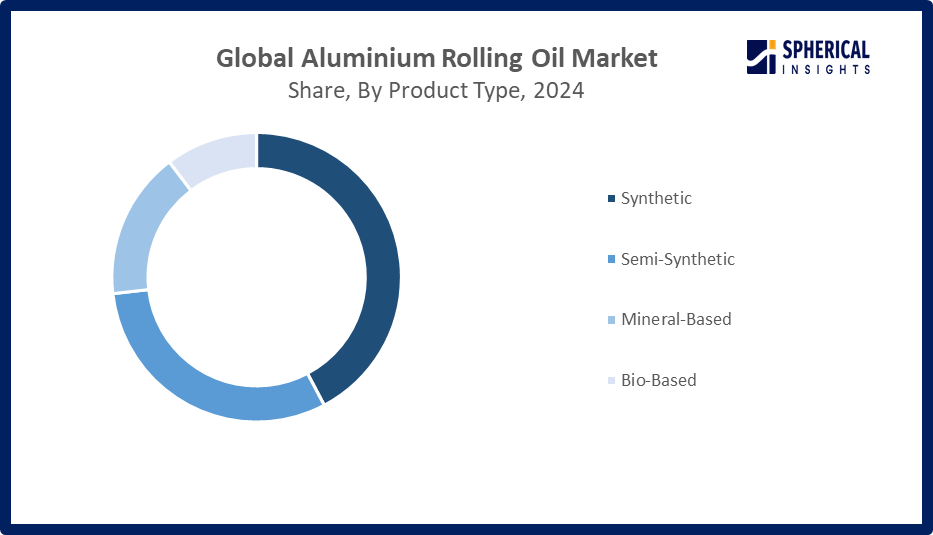
- The synthetic segment dominated the market in 2024, approximately 42% and is projected to grow at a substantial CAGR during the forecast period.
Based on the product type, the aluminium rolling oil market is divided into synthetic, semi-synthetic, mineral-based, and bio-based. Among these, the synthetic segment dominated the market in 2024 and is projected to grow at a substantial CAGR during the forecast period. Synthetic oils, made from chemical compounds, provide excellent thermal stability, oxidation resistance, and superior lubricity, making them ideal for high-speed, high-temperature aluminium rolling processes. Their ability to ensure high-quality sheet and foil production is boosting adoption, as manufacturers increasingly seek enhanced performance and reliability in end-use applications within the aluminium rolling industry.
Get more details on this report -
- The cold rolling segment accounted for the largest share in 2024, approximately 48% and is anticipated to grow at a significant CAGR during the forecast period.
Based on the application, the aluminium rolling oil market is divided into hot rolling, cold rolling, and foil rolling. Among these, the cold rolling segment accounted for the largest share in 2024 and is anticipated to grow at a significant CAGR during the forecast period. Cold rolling, conducted at or near room temperature, produces thin aluminium sheets and strips with precise dimensions and smooth surfaces. Cold rolling oils reduce friction, heat, and wear, ensuring high-quality output. Rising demand for lightweight, premium aluminium in automotive, packaging, and electronics, along with advances in cold rolling technologies and specialized oils, is driving market growth.
- The automotive segment accounted for the highest market revenue in 2024, approximately 37% and is anticipated to grow at a significant CAGR during the forecast period.
Based on the end-user, the aluminium rolling oil market is divided into automotive, packaging, building & construction, electrical & electronics, and others. Among these, the automotive segment accounted for the highest market revenue in 2024 and is anticipated to grow at a significant CAGR during the forecast period. The automotive industry is a major aluminium consumer, valuing its lightweight and high-strength properties. Aluminium rolling oils are critical for producing high-quality sheets and components used in vehicles. Growing demand for fuel-efficient and lightweight cars, along with the rising adoption of electric vehicles to improve battery efficiency, is driving increased use of rolling oils in this sector.
Regional Segment Analysis of the Aluminium Rolling Oil Market
- North America (U.S., Canada, Mexico)
- Europe (Germany, France, U.K., Italy, Spain, Rest of Europe)
- Asia-Pacific (China, Japan, India, Rest of APAC)
- South America (Brazil and the Rest of South America)
- The Middle East and Africa (UAE, South Africa, Rest of MEA)
Asia Pacific is anticipated to hold the largest share of the aluminium rolling oil market over the predicted timeframe.

Get more details on this report -
Asia Pacific is anticipated to hold the 42% share of the aluminium rolling oil market over the predicted timeframe. The region dominates the aluminium rolling oil market, fueled by rapid industrial growth, rising aluminium production, and expanding automotive and packaging industries. Key countries, including China, India, and Japan, lead the region, with China contributing over 40% of global output. Increasing demand for lightweight vehicle materials, growth in electronics manufacturing, and large-scale infrastructure projects drive rolling oil usage. Furthermore, adoption of advanced aluminium processing technologies and supportive government policies promoting domestic production enhance the region’s market share and growth prospects. In January 2026, Chinas Ministry of Commerce and Customs introduced the Export License Management Catalog (2026), requiring lubricating oils, greases, and base oils, including aluminum rolling oils, to obtain export licenses. The one-license-per-shipment rule raises compliance costs and administrative complexity for manufacturers in China, a key global supplier.
North America is expected to grow at a rapid CAGR in the aluminium rolling oil market during the forecast period. The region rapidly growing in the aluminium rolling oil market with approximate 23% share, supported by increasing demand for lightweight aluminium in automotive, aerospace, and packaging sectors. The United States and Canada are major contributors, with the U.S. leading in electric vehicle production and aerospace. Growth is further driven by adoption of advanced manufacturing technologies, high-performance and eco-friendly rolling oils, and government policies promoting sustainable industrial practices, improving efficiency while ensuring compliance with strict environmental regulations across the region.
Europes aluminium rolling oil market is expanding due to high demand from automotive, aerospace, and packaging industries, led by Germany, France, and Italy. The region emphasizes lightweight, high-quality aluminium for improved fuel efficiency and sustainability. Strict environmental regulations and the shift to eco-friendly, high-performance rolling oils are driving manufacturers to upgrade processes, fostering market growth and promoting technological advancements throughout Europe.
Competitive Analysis:
The report offers the appropriate analysis of the key organizations/companies involved within the aluminium rolling oil market, along with a comparative evaluation primarily based on their type of offering, business overviews, geographic presence, enterprise strategies, segment market share, and SWOT analysis. The report also provides an elaborative analysis focusing on the current news and developments of the companies, which includes type development, innovations, joint ventures, partnerships, mergers & acquisitions, strategic alliances, and others. This allows for the evaluation of the overall competition within the market.
List of Key Companies
- Quaker Chemical Corporation
- ExxonMobil Corporation
- Indian Oil Corporation Limited
- Croda International Plc
- TotalEnergies SE
- Eastern Petroleum Pvt. Ltd.
- Avani Petrochem
- Tashoil Company
- Petroyag
- Fuchs Petrolub SE
- Idemitsu Kosan Co., Ltd.
- Sinopec Limited
- Gazprom Neft PJSC
- Hindalco Industries Limited
- Others
Key Target Audience
- Market Players
- Investors
- End-users
- Government Authorities
- Consulting and Research Firm
- Venture capitalists
- Value-Added Resellers (VARs)
Recent Development
- In January 2026, Hindalco Industries announced a 21,000 crore aluminium smelter expansion and a 4,500 crore FRP and battery-grade foil facility in Odisha. India’s first battery-grade foil supports 100 GWh lithium-ion production, advancing electric mobility, energy storage, and domestic high-grade aluminium capabilities.
- In March 2025, Chinas MIIT and nine agencies launched the Aluminum Industry High-Quality Development Plan (2025-2027) to promote green, low-carbon growth, energy-efficient technologies, and cleaner production. This restructuring is expected to boost demand for high-performance, eco-friendly rolling oils in aluminum processing.
- In November 2024, China announced changes to its export tax rebate policy, effective December 1, 2024. Aluminum, copper, and certain oils lose rebates, while rates for refined oils, photovoltaic products, batteries, and select minerals drop from 13% to 9%, affecting 24 tariff codes including aluminum plates, foils, tubes, and profiles.
- In October 2024, Quaker Houghton will showcase its new aluminum hot rolling fluid, QH EVEROLL A 5000, at ALUMINIUM 2024, Düsseldorf. The non-soap emulsion enhances mill cleanliness, surface quality, and filtration, supporting all aluminum alloy strip production, while minimizing maintenance and preventing sludge formation.
- In June 2023, TotalEnergies Lubrifiants expanded its aluminum rolling portfolio, establishing the Aluminum Rolling Competence Center (ARCC) with experts in North America and Europe. New labs and plants in Germany, Spain, and the USA support hot and cold rolling oils, technical services, and advanced lubricant technologies globally.
Market Segment
This study forecasts revenue at global, regional, and country levels from 2020 to 2035. Spherical Insights has segmented the aluminium rolling oil market based on the below-mentioned segments:
Global Aluminium Rolling Oil Market, By Product Type
- Synthetic
- Semi-Synthetic
- Mineral-Based
- Bio-Based
Global Aluminium Rolling Oil Market, By Application
- Hot Rolling
- Cold Rolling
- Foil Rolling
Global Aluminium Rolling Oil Market, By End-User
- Automotive
- Packaging
- Building & Construction
- Electrical & Electronics
- Others
Global Aluminium Rolling Oil Market, By Regional Analysis
- North America
- US
- Canada
- Mexico
- Europe
- Germany
- UK
- France
- Italy
- Spain
- Russia
- Rest of Europe
- Asia Pacific
- China
- Japan
- India
- South Korea
- Australia
- Rest of Asia Pacific
- South America
- Brazil
- Argentina
- Rest of South America
- Middle East & Africa
- UAE
- Saudi Arabia
- Qatar
- South Africa
- Rest of the Middle East & Africa
Frequently Asked Questions (FAQ)
-
1. How do synthetic rolling oils impact market dynamics compare to mineral-based oils?Synthetic rolling oils impact market dynamics by offering higher thermal stability, reduced oxidation, and up to 25-30% longer service life than mineral oils, driving adoption in high-precision aluminium rolling and boosting overall market growth.
-
2. How is technological innovation in eco-friendly and high-performance oils shaping the market?Technological innovations in eco-friendly and high-performance rolling oils, including biodegradable and low-VOC formulations, improve efficiency by 15-25%, reduce environmental impact, and drive global adoption, supporting sustainable growth in the aluminium rolling oil market.
-
3. How do fluctuations in raw material prices affect the aluminium rolling oil market?Fluctuations in raw material prices, such as base oils and additives, can increase production costs by 10–15%, impacting aluminium rolling oil pricing, profit margins, and supply stability in global markets.
-
4. What is the economic impact of aluminium production growth on rolling oil consumption?Rising aluminium production drives rolling oil consumption, as global output growth of ~4–6% annually increases demand for lubricants, boosting market revenue and supporting downstream industries like automotive, packaging, and construction.
-
5. How are government regulations and environmental standards influencing the industry?Government regulations and environmental standards, including VOC limits and waste disposal rules, increase compliance costs by 10–12%, driving adoption of eco-friendly, biodegradable aluminium rolling oils while promoting sustainable, energy-efficient industrial practices globally.
-
6. What innovations are being introduced to enhance efficiency and reduce energy use in rolling oil applications?Innovations such as high-performance synthetic oils, micro-emulsion formulations, and advanced cooling lubricants improve aluminium rolling efficiency by 15-20%, reduce energy consumption, extend tool life, and enhance surface quality in industrial applications.
-
7. How is digital transformation and smart manufacturing affecting rolling oil efficiency?Digital transformation and smart manufacturing, including IoT sensors and real-time monitoring, improve aluminium rolling oil efficiency by up to 20%, optimize lubricant usage, reduce waste, and enhance production consistency in modern rolling mills.
-
8. What are the major trends in cold and hot rolling applications influencing market growth?Major trends in cold and hot rolling applications include increased demand for high‑strength aluminum for EVs and packaging, with cold‑rolled products growing 5-6% annually, boosting rolling oil consumption in precision finishing.
Need help to buy this report?