Global AI in Patient Management Market Size, Share, and COVID-19 Impact Analysis, By Offering Type (Software Platforms, Standalone AI Modules and Copilots, Managed Services, and Professional Services), By Application (AI-driven Patient Access and Scheduling, AI-driven Patient Engagement and Communication, AI-driven Care Coordination and Case Management, AI-driven Inpatient Patient Flow and Capacity Management, AI-driven Discharge Planning and Transitions of Care, AI-Driven Remote Patient Monitoring Triage and Alerts, and Others), By End User (Hospitals and Integrated Delivery Networks, Ambulatory Clinics and Physician Groups, Payers, and Others), and By Region (North America, Europe, Asia-Pacific, Latin America, Middle East, and Africa), Analysis and Forecast 2025 - 2035
Industry: Healthcare
Global AI in Patient Management Market Size Insights Forecasts to 2035
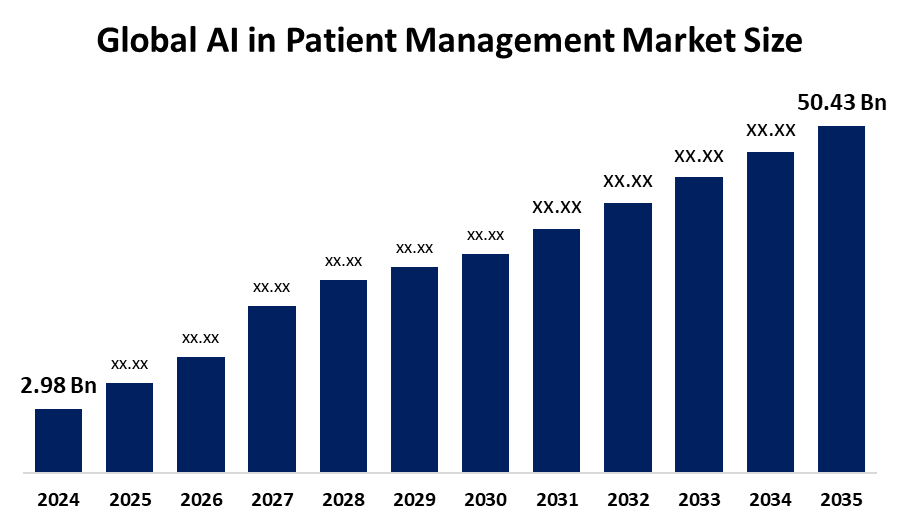
- The Global AI in Patient Management Market Size Was Estimated at USD 2.98 Billion in 2024
- The Market Size is Expected to Grow at a CAGR of around 29.32% from 2025 to 2035
- The Worldwide AI in Patient Management Market Size is Expected to Reach USD 50.43 Billion by 2035
- Asia Pacific is expected to grow the fastest during the forecast period.
Get more details on this report -
According to a Research Report Published by Spherical Insights and Consulting, The Global AI In Patient Management Market Size was worth around USD 2.98 Billion in 2024 and is predicted to grow to around USD 50.43 Billion by 2035 with a compound annual growth rate (CAGR) of 29.32% from 2025 to 2035. The AI in patient management market is growing rapidly due to rising chronic disease prevalence, severe healthcare staff shortages, and the urgent need for operational efficiency. AI enables personalized care, automated documentation, predictive analytics, and remote monitoring.
AI in Patient Management Market Key Takeaways
- By region, North America held the largest market share of 39.60% in 2024.
- By region, Asia Pacific is expected to grow at the fastest CAGR during the foreseeable period.
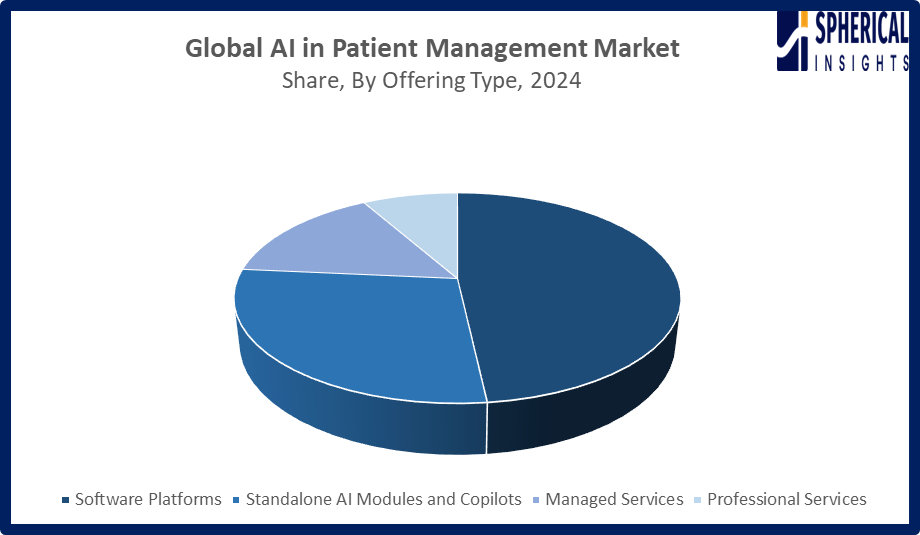
- By offering type, the software platforms segment held the largest market share of 48% in 2024.
- By offering type, the managed services segment is expected to grow at the fastest CAGR in the market between 2024 and 2035.
- By application, the AI-driven patient engagement and communication segment held a 25% share in 2024.
- By application, the AI-driven discharge planning and transition of care segment is projected to grow at the fastest CAGR during the foreseeable period.
- By end user, the hospitals and integrated delivery networks segment held the largest market share of 57% in 2024.
- By end user, the ambulatory clinics and physicians group segment is projected to grow at the fastest CAGR during the foreseeable period.
Market Overview
The global AI in patient management market encompasses AI-powered software platforms, standalone modules, and copilots that automate, predict, and optimize patient-facing workflows, including access/scheduling, engagement/communication, care coordination, risk stratification, remote monitoring, discharge planning, and virtual triage, integrating with EHRs and real-time data across hospitals, clinics, ambulatory settings, and telehealth. Key uses include predictive no-show reduction and intelligent scheduling, personalized chatbots/reminders for adherence, readmission risk scoring, virtual nursing assistants, inpatient flow optimization, and proactive chronic-care engagement. In March 2026, Ireland launched AI for Care, a national strategy for safe, responsible AI in health and social care. The plan enhances clinical care, operations, research, and public health through faster diagnoses, improved patient flow, AI-supported planning, and administrative automation, emphasizing human oversight and compliance with the EU AI Act.
Market growth is primarily driven by the increasing demand for efficient and personalized care, the rising prevalence of chronic diseases requiring continuous management, and significant advancements in machine learning that improve diagnostic accuracy. A key opportunity lies in mental health, where AI tools can help bridge the gap caused by a shortage of professionals and social stigma. In the U.S., nearly 60 million people experience mental illness, highlighting a critical need for scalable AI solutions. In February 2026, IFPMA addressed the WHO Executive Board, emphasizing AI’s potential in healthcare R&D, patient outcomes, and public health surveillance. The statement called for ethical, secure AI use and collaborative stakeholder engagement in shaping the 2028–2033 WHO digital health and AI strategy.
AI in Patient Management Market Trends
- Rising adoption of AI-powered predictive analytics is improving patient care and operational efficiency.
- Integration of AI with electronic health records (EHRs) enables data-driven personalized treatment.
- Telehealth and remote monitoring platforms are increasingly leveraging AI for continuous care.
- Virtual assistants and chatbots enhance patient engagement and adherence to treatment plans.
- AI-driven risk stratification tools help reduce readmissions and optimize hospital workflows.
- Growing focus on mental health is driving AI solutions to bridge professional shortages.
Report Coverage
This research report categorizes the AI in patient management market based on various segments and regions, forecasts revenue growth, and analyzes trends in each submarket. The report analyses the key growth drivers, opportunities, and challenges influencing the AI in patient management market. Recent market developments and competitive strategies, such as expansion, type launch, development, partnership, merger, and acquisition, have been included to draw the competitive landscape in the market. The report strategically identifies and profiles the key market players and analyses their core competencies in each sub-segment of the AI in patient management market.
AI in Patient Management Market Report Coverage
| Report Coverage | Details |
|---|---|
| Base Year: | 2024 |
| Market Size in 2024: | USD 2.98 Billion |
| Forecast Period: | 2025-2035 |
| Forecast Period CAGR 2025-2035 : | CAGR of 29.32% |
| 2035 Value Projection: | USD 50.43 Billion |
| Historical Data for: | 2020-2023 |
| No. of Pages: | 240 |
| Tables, Charts & Figures: | 120 |
| Segments covered: | By Offering Type, By Application |
| Companies covered:: | Microsoft, Google Cloud, GE HealthCare Technologies Inc., Siemens Healthineers AG, Amazon Web Services, NVIDIA Corporation, IBM, Oracle Corporation, Tempus AI, Inc., Epic Systems, Salesforce, Qventus, Aidoc Medical Ltd., Luma Health, Kyruus Health, and other key players |
| Pitfalls & Challenges: | COVID-19 Empact, Challenge, Future, Growth, & Analysis |
Get more details on this report -
Driving Factors
The global AI in patient management market is propelled by the increasing prevalence of chronic diseases, which impact more than 40% of the population, driving demand for continuous monitoring and personalized care. Rising healthcare spending, surpassing USD 9.8 trillion globally, encourages providers to implement cost-effective AI solutions. Post-pandemic growth in telehealth and digital health platforms, with usage up over 35%, further supports adoption. The widespread integration of electronic health records, present in 70-80% of hospitals, facilitates data-driven AI insights. Additionally, government initiatives promoting AI in healthcare and advancements in machine learning are fueling investment, innovation, and enhanced patient management worldwide.
Restraining Factors
Key restraining factors in the global AI in patient management market include high implementation and integration costs, data privacy and security concerns, and a lack of skilled professionals. Additionally, regulatory complexities and interoperability issues across healthcare systems limit widespread adoption, particularly in developing regions with constrained digital infrastructure.
Market Segmentation
Offering Type Insights
Why did the software platforms segment dominate the AI in patient management market?
The software platforms segment dominated the market in 2024. The growth is driven by their ability to integrate with EHRs, telehealth, and hospital systems, enabling seamless data management, predictive analytics, and clinical decision support. These platforms streamline workflows, enhance patient monitoring, support personalized care, and improve operational efficiency, making them essential for healthcare providers seeking cost-effective, scalable, and data-driven solutions.
The managed services segment is expected to show the fastest growth over the forecast period, due to increasing demand for outsourced AI solutions, enabling healthcare providers to access expertise, reduce IT burden, ensure seamless implementation, and optimize patient management without heavy infrastructure investments.
Get more details on this report -
Application Insights
How does the AI-driven patient engagement and communication segment lead the AI in patient management market?
The AI-driven patient engagement and communication reduction segment led the market in 2024 by enhancing personalized interactions through chatbots, virtual assistants, and automated reminders. These tools improve adherence, streamline appointment scheduling, and provide 24/7 support, boosting patient satisfaction. By reducing administrative workload and enabling proactive care, AI-driven engagement strengthens patient-provider relationships and drives adoption across hospitals, clinics, and telehealth platforms.
The AI-driven discharge planning and transitions of care segment is expected to witness the fastest growth in the market over the forecast period. The growth is owing to increasing demand for streamlined patient handoffs, reduced readmissions, enhanced care coordination, and automated workflow solutions that improve efficiency and patient outcomes across healthcare settings.
End User Insights
Which end user segment dominated the AI in patient management market?
The hospitals and integrated delivery networks segment contributed the biggest market share in 2024. Market growth is driven by increasing patient volumes, complex care needs, and investments in data management and operational efficiency. Integrated delivery networks and hospitals manage extensive provider networks, reducing costs and standardizing care. They support digital platforms like EHRs, enable data interoperability, and streamline complex clinical and administrative workflows, enhancing overall healthcare efficiency and coordination.
The ambulatory clinics and physician groups segment is expected to expand rapidly in the market in the coming years, as rising outpatient visits, increasing adoption of AI for workflow optimization, patient engagement, and predictive care, and the need for cost-effective, efficient, and data-driven healthcare solutions.
Regional Segment Analysis of the AI in Patient Management Market
- North America (U.S., Canada, Mexico)
- Europe (Germany, France, U.K., Italy, Spain, Rest of Europe)
- Asia-Pacific (China, Japan, India, Rest of APAC)
- South America (Brazil and the Rest of South America)
- The Middle East and Africa (UAE, South Africa, Rest of MEA)
Why has North America dominated the AI in patient management market?

Get more details on this report -
North America dominated the AI in patient management market by holding the largest share of 40% in 2024. The region's growth is due to advanced healthcare infrastructure, high adoption of electronic health records (EHRs), and significant investments in AI and digital health technologies. Strong government support, robust funding for healthcare innovation, and a large patient population with chronic diseases further drive demand. Additionally, widespread telehealth integration and focus on value-based care accelerate AI adoption, enhancing efficiency, predictive analytics, and personalized patient management. In August 2025, the White House and CMS launched a public-private initiative uniting 60+ tech and healthcare firms to create a patient-centric digital health ecosystem, enhancing interoperability, AI-powered chronic care tools, digital services, and secure health data sharing, while emphasizing voluntary participation and patient control.
U.S. AI in Patient Management Market Trends
The U.S. AI in patient management market is expanding rapidly, driven by increasing chronic disease prevalence, widespread electronic health record adoption, and growing telehealth use. AI-driven tools such as predictive analytics, virtual assistants, and automated workflow solutions enhance patient engagement, streamline care coordination, reduce costs, and improve overall healthcare outcomes. In July 2025, the U.S. advanced healthcare AI through the America’s AI Action Plan and HHS AI Strategy, promoting responsible AI adoption. Initiatives include AI Centers of Excellence, interoperability standards, clinical decision support, predictive analytics, workforce development, and improved patient outcomes in chronic care and personalized management.
Why is Asia Pacific the fastest-growing region in the AI in patient management market?
Asia Pacific is expected to experience the fastest growth during the predicted timeframe, attributed to rising healthcare digitization, increasing chronic disease prevalence, and growing investments in AI-driven solutions. Expanding telehealth services, government initiatives promoting digital health, and the large, tech-savvy population accelerate adoption, enabling improved patient monitoring, predictive care, workflow automation, and cost-efficient healthcare delivery. In February 2026, Union Health Minister Shri Jagat Prakash Nadda launched SAHI and BODH at the India AI Impact Summit 2026, advancing safe, ethical AI in healthcare. Highlighting strong digital infrastructure and quality data, he noted India’s decade-long foundation in digital health, initiated under the Digital India programme in 2015.
China AI in Patient Management Market Trends
China’s AI in patient management market is growing rapidly, driven by government initiatives promoting digital healthcare, widespread adoption of electronic health records, and rising chronic disease prevalence. AI applications in predictive analytics, virtual assistants, remote monitoring, and workflow automation enhance patient care, reduce costs, and improve operational efficiency across hospitals and clinics. In December 2025, China advanced its AI+ initiative to integrate AI across primary care, medical imaging, chronic disease management, and patient consultation. Aiming for widespread AI-assisted diagnosis by 2027, the plan leverages large medical models, remote services, and ecosystem development to enhance efficiency, accessibility, and quality in grassroots healthcare.
Competitive Analysis:
The report offers the appropriate analysis of the key organizations/companies involved within the AI in patient management market, along with a comparative evaluation primarily based on their type of offering, business overviews, geographic presence, enterprise strategies, segment market share, and SWOT analysis. The report also provides an elaborative analysis focusing on the current news and developments of the companies, which includes type development, innovations, joint ventures, partnerships, mergers & acquisitions, strategic alliances, and others. This allows for the evaluation of the overall competition within the market.
List of Key Companies
- Microsoft
- Google Cloud
- GE HealthCare Technologies Inc.
- Siemens Healthineers AG
- Amazon Web Services
- NVIDIA Corporation
- IBM
- Oracle Corporation
- Tempus AI, Inc.
- Epic Systems
- Salesforce
- Qventus
- Aidoc Medical Ltd.
- Luma Health
- Kyruus Health
- Others
Key Target Audience
- Market Players
- Investors
- End-users
- Government Authorities
- Consulting and Research Firm
- Venture capitalists
- Value-Added Resellers (VARs)
Recent Development
- In January 2026, Aidoc announced FDA clearance for the healthcare industry’s first comprehensive AI triage solution. Powered by its CARE AI model, the tool enables early detection of critical findings, reduces emergency department delays, addresses imaging backlogs, and improves patient flow through streamlined triage of acute conditions.
- In December 2025, Qventus announced Allina Health as the first client of its AI Solution Factory, a co-development model for custom AI solutions. The partnership aims to support frontline care teams, enhance operational efficiency, reduce staff burnout, and improve patient care across Allina Health’s healthcare system.
- In January 2025, Tempus AI launched Olivia, an AI-enabled personal health concierge app that centralizes patient data from EHRs and health devices. The app provides actionable insights, organizes records into a dynamic timeline, answers health queries, and connects to external resources, empowering patients to manage and share their health information effectively.
- In July 2025, Kyruus Health expanded its Reach platform, now covering over 90% of U.S. search engine traffic, including Google, Bing, ChatGPT, and Perplexity AI. The platform enhances AI-powered patient acquisition by connecting provider listings across digital channels, leveraging trusted data, and meeting patients where they search for care.
- In October 2024, Luma Health launched Spark, an AI integrated with its EHR-connected patient engagement platform. Spark enhances smart scheduling, self-service referrals, and real-time appointment confirmations, improving patient access, streamlining workflows, and enabling providers to efficiently manage appointments while boosting engagement before and after visits.
- In October 2024, Google Cloud launched Vertex AI Search for Healthcare and enhanced Healthcare Data Engine, helping developers reduce administrative burdens. With clinicians spending up to 28-36 hours weekly on non-clinical tasks, these tools aim to cut burnout, streamline workflows, and improve patient care through interoperable, AI-powered solutions.
Market Segment
This study forecasts revenue at global, regional, and country levels from 2020 to 2035. Spherical Insights has segmented the AI in patient management market based on the below-mentioned segments:
Global AI in Patient Management Market, By Offering Type
- Software Platforms
- Standalone AI Modules and Copilots
- Managed Services
- Professional Services
Global AI in Patient Management Market, By Application
- AI-driven Patient Access and Scheduling
- AI-driven Patient Engagement and Communication
- AI-driven Care Coordination and Case Management
- AI-driven Inpatient Patient Flow and Capacity Management
- AI-driven Discharge Planning and Transitions of Care
- AI-Driven Remote Patient Monitoring Triage and Alerts
- Others
Global AI in Patient Management Market, By End User
- Hospitals and Integrated Delivery Networks
- Ambulatory Clinics and Physician Groups
- Payers
- Others
Global AI in Patient Management Market, By Regional Analysis
- North America
- US
- Canada
- Mexico
- Europe
- Germany
- UK
- France
- Italy
- Spain
- Russia
- Rest of Europe
- Asia Pacific
- China
- Japan
- India
- South Korea
- Australia
- Rest of Asia Pacific
- South America
- Brazil
- Argentina
- Rest of South America
- Middle East & Africa
- UAE
- Saudi Arabia
- Qatar
- South Africa
- Rest of the Middle East & Africa
Frequently Asked Questions (FAQ)
-
1. How is AI improving patient outcomes and clinical decision-making?AI improves patient outcomes and clinical decision-making by enabling predictive analytics and personalized care, reducing hospital readmissions by up to 25%, and assisting clinicians in faster, data-driven treatment decisions.
-
2. How are government policies influencing AI adoption in patient management?Government policies, including the EU AI Act and U.S. HHS AI strategies, drive AI adoption in patient management, with over 60% of hospitals aligning solutions to regulatory and compliance frameworks in 2024.
-
3. What economic benefits do AI solutions offer healthcare providers?AI solutions offer healthcare providers cost savings of up to 20-25%, reduce administrative workload by 30%, and optimize resource utilization, enhancing operational efficiency and improving patient throughput in hospitals and clinics.
-
4. How are hospitals and integrated delivery networks leveraging AI for efficiency?Hospitals and integrated delivery networks leverage AI for workflow automation, predictive analytics, and patient monitoring, improving operational efficiency; studies show AI adoption reduces administrative tasks by 25-30%, enhancing staff productivity and patient care.
-
5. Which emerging technologies are expected to transform the AI patient management landscape?Emerging technologies like AI-powered chatbots, machine learning algorithms, predictive analytics, and remote monitoring devices are transforming patient management, with adoption projected to reach over 40% of hospitals globally by 2026.
-
6. How is machine learning enhancing predictive analytics in patient care?Machine learning enhances predictive analytics in patient care by analyzing EHR and sensor data, enabling early disease detection, reducing readmissions by up to 20%, and improving personalized treatment plans across healthcare systems.
-
7. How is AI-enabled remote patient monitoring transforming chronic disease management?AI-enabled remote patient monitoring improves chronic disease management by tracking vital signs in real-time, reducing hospitalizations by 15-20%, enhancing medication adherence, and enabling timely interventions for conditions like diabetes and heart disease.
-
8. How are AI copilots and modules improving clinical decision support?AI copilots and modules enhance clinical decision support by analyzing patient data, suggesting treatment options, and reducing diagnostic errors by up to 30%, accelerating decisions and improving care quality across hospitals and clinics.
Need help to buy this report?