Global AI In Microscopy Market Size, Share, and COVID-19 Impact Analysis, By Component (AI-Enabled Microscopes, AI-Based Microscopy Software, and Services), By Microscopy Type (Optical Microscopy, Fluorescence Microscopy, Electron Microscopy, and Others), By End Use (Hospital Laboratories, Clinical Research Laboratories, Pharmaceutical & Biotechnology Companies, Academic & Research Institutes, and Others), and By Region (North America, Europe, Asia-Pacific, Latin America, Middle East, and Africa), Analysis and Forecast 2025 - 2035
Industry: Healthcare
Global AI In Microscopy Market Size Insights Forecasts to 2035
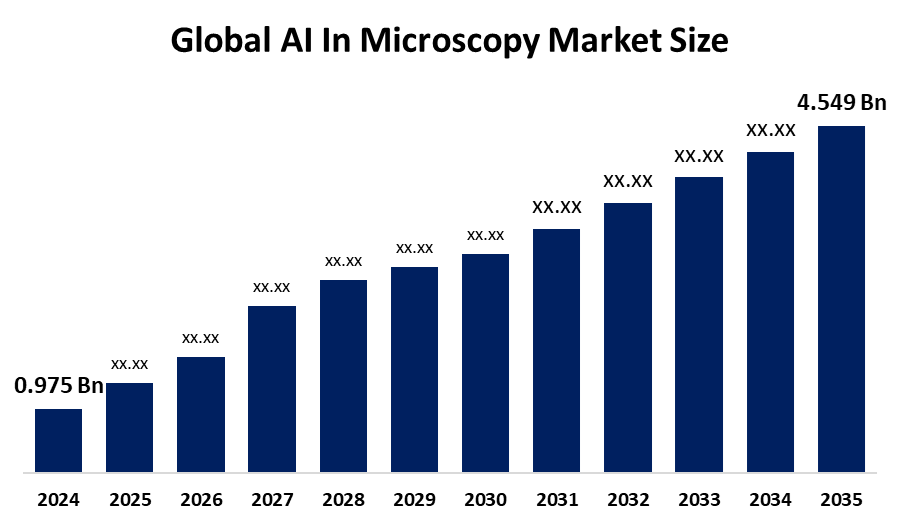
- The Global AI In Microscopy Market Size Was Estimated at USD 0.975 Billion in 2024
- The Market Size is Expected to Grow at a CAGR of around 15.03% from 2025 to 2035
- The Worldwide AI In Microscopy Market Size is Expected to Reach USD 4.549 Billion by 2035
- Asia Pacific is expected to grow the fastest during the forecast period.
Get more details on this report -
According to a Research Report Published by Spherical Insights and Consulting, The Global AI In Microscopy Market Size was worth around USD 0.975 Billion in 2024 and is predicted to grow to around USD 4.549 Billion by 2035 with a compound annual growth rate (CAGR) of 15.03% from 2025 to 2035. Global integration of sophisticated computation into hardware, cloud-based data management, deep learning-based image analysis, label-free imaging & artificial labeling, and super-resolution with image restoration are all driving opportunities in the AI in microscopy market.
Market Overview
The AI in microscopy market refers to the global industry segment focused on the development, sale, and adoption of microscopy systems and solutions that incorporate artificial intelligence technologies to automate, enhance, and accelerate microscopic imaging and analysis. These include AI-enabled microscopes, AI-based software and analytics platforms, and related services that utilize machine learning, deep learning, and computer vision to improve imaging accuracy, speed, and data interpretation.
Governments play a critical enabling and regulatory role in accelerating innovation, ensuring safety, and supporting widespread adoption. For instance, in July 2025, the U.S. National Science Foundation (NSF) awarded a USD 1.2 million research grant to a team at Vanderbilt University to develop a smart microscope system that uses artificial intelligence to enhance cell imaging and analysis, particularly for studying diseases such as cancer.
In March 2024, India’s Cabinet approved the IndiaAI Mission with a budget outlay of INR 10,371.92 crore over five years to strengthen AI capabilities, computing infrastructure, research, and applications across sectors. The initiative is being implemented by the Ministry of Electronics and Information Technology (MeitY) to support AI research, infrastructure, and ecosystem development.
The rapid pace of technological advancement is one of the key drivers of the growth of the AI in microscopy market.
Report Coverage
This research report categorizes the AI in microscopy market based on various segments and regions, forecasts revenue growth, and analyzes trends in each submarket. The report analyses the key growth drivers, opportunities, and challenges influencing the AI in microscopy market. Recent market developments and competitive strategies, such as expansion, product launch, development, partnership, merger, and acquisition, have been included to draw the competitive landscape in the market. The report strategically identifies and profiles the key market players and analyzes their core competencies in each sub-segment of the AI in microscopy market.
AI In Microscopy Market Report Coverage
| Report Coverage | Details |
|---|---|
| Base Year: | 2024 |
| Market Size in 2024: | USD 0.975 Billion |
| Forecast Period: | 2025-2035 |
| Forecast Period CAGR 2025-2035 : | CAGR of 15.03% |
| 2035 Value Projection: | USD 4.549 Billion |
| Historical Data for: | 2020-2023 |
| No. of Pages: | 240 |
| Tables, Charts & Figures: | 120 |
| Segments covered: | By Component, By Microscopy Type |
| Companies covered:: | Carl Zeiss AG, Leica Microsystems GmbH, Nikon Corporation, Olympus Corporation, Thermo Fisher Scientific Inc., Bruker Corporation, Aiforia Technologies, Scopio Labs Ltd., Mindpeak GmbH, JEOL Ltd., Cognex Corporation, Ariadne.ai, Nanotronics, SigTuple, Paige.AI, and other key players |
| Pitfalls & Challenges: | COVID-19 Empact, Challenge, Future, Growth, & Analysis |
Get more details on this report -
Driving Factors
Rapid technological innovation is one of the main drivers of the AI in microscopy market's growth. Adoption of AI-powered microscopes and software platforms that enhance imaging precision, automate pattern recognition, and accelerate data analysis, which is the main factor driving the market for AI in microscopy. In this field, innovation and investment are driven by the increasing demand for precision diagnostics, personalized medicine, and automated laboratory workflows, coupled with the need for faster and more accurate microscopic analysis. Strong government support for advancements in deep learning, machine vision, real-time image processing, along with integration of cloud and edge computing further drives the market.
In May 2025, Japan’s House of Councillors adopted the Act on the Promotion of Research, Development, and Utilization of Artificial Intelligence Technologies, establishing a national framework to support AI research and adoption across industries and scientific fields, including AI-enhanced microscopy systems.
Restraining Factors
High development and deployment costs, data privacy and security concerns, integration complexity, limited commercial readiness, limited awareness or skepticism among researchers, and slow regulatory approval processes are the main factors restricting the use of AI in microscopy market.
Market Segmentation
The AI in microscopy market share is classified into component, microscopy type, and end use.
- The AI-enabled microscopes segment dominated the market in 2024, approximately 48%, and is projected to grow at a substantial CAGR during the forecast period.
Based on the component, the AI in microscopy market is divided into AI-enabled microscopes, AI-based microscopy software, and services. Among these, the AI-enabled microscopes segment dominated the market in 2024, approximately 48%, and is projected to grow at a substantial CAGR during the forecast period. High ability to provide automated and real-time image analysis, significantly increasing diagnostic speed and accuracy, cost effectiveness, enabling rapid data generation, is driving the AI-enabled microscopes industry.
- The optical microscopy segment accounted for the largest share in 2024, approximately 48%, and is anticipated to grow at a significant CAGR during the forecast period.
Based on the microscopy type, the AI in microscopy market is divided into optical microscopy, fluorescence microscopy, electron microscopy, and others. Among these, the optical microscopy segment accounted for the largest share in 2024, approximately 48%, and is anticipated to grow at a significant CAGR during the forecast period. High affordability, easy to handle, widespread adoption in life sciences, pathology, and material science, high versatility, and rapid integration with digital imaging is driving the optical microscopy industry.
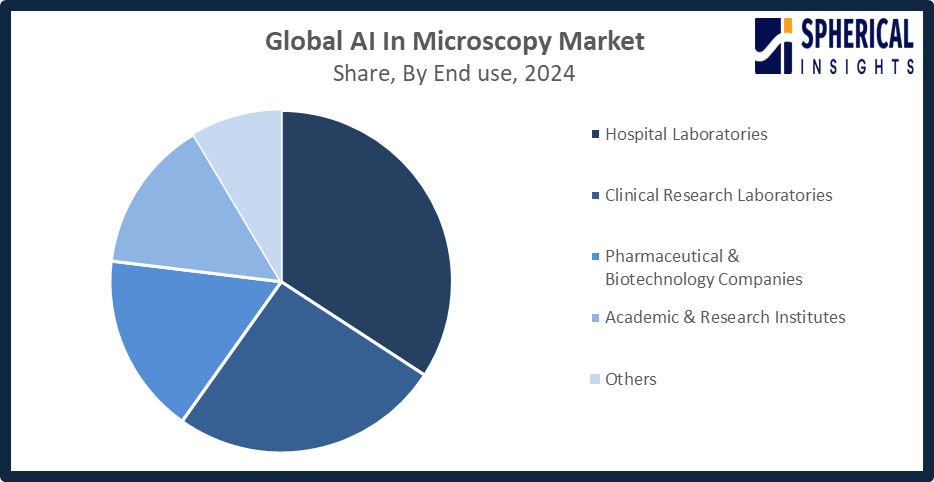
- The hospital laboratories segment accounted for the highest market revenue in 2024, approximately 39%, and is anticipated to grow at a significant CAGR during the forecast period.
Based on the end use, the AI in microscopy market is divided into hospital laboratories, pharmaceutical & biotechnology companies, academic & research institutes, clinical research laboratories, and others. Among these, the hospital laboratories segment accounted for the highest market revenue in 2024, approximately 39%, and is anticipated to grow at a significant CAGR during the forecast period. Increased need for high-throughput, accurate, and rapid diagnostics to manage heavy patient caseloads, reducing diagnostics errors, increasing workflow efficiency, and bolstering the hospital laboratories market.
Get more details on this report -
Regional Segment Analysis of the AI In Microscopy Market
- North America (U.S., Canada, Mexico)
- Europe (Germany, France, U.K., Italy, Spain, Rest of Europe)
- Asia-Pacific (China, Japan, India, Rest of APAC)
- South America (Brazil and the Rest of South America)
- The Middle East and Africa (UAE, South Africa, Rest of MEA)
North America is anticipated to hold the largest share of the AI in microscopy market over the predicted timeframe.

Get more details on this report -
North America is anticipated to hold the largest share of the AI in microscopy market over the forecast period. This leadership is driven by strong government support for the early adoption of advanced imaging technologies and a robust focus on life sciences, clinical diagnostics, and biomedical research, which increasingly rely on AI-enabled microscopy solutions. The region’s position is further strengthened by government programs that provide funding, regulatory frameworks, and strategic initiatives to support the research, development, and adoption of AI-based imaging technologies.
Key government initiatives include Canada’s March 2025 launch of a $300 million AI Compute Access Fund as part of the Sovereign AI Compute Strategy, aimed at developing advanced AI systems, including applications in microscopy. In addition, in January 2024, the U.S. National Science Foundation (NSF) established the NAIRR Pilot to create a nationwide AI research infrastructure that provides access to computing, data, software, and training resources.
Asia Pacific is expected to grow at a rapid CAGR in the AI in microscopy market during the forecast period. Countries such as China, Japan, and South Korea are making significant investments in AI-powered imaging tools that enhance accuracy, automate high-throughput screening, and accelerate analysis. The region’s strong presence in life sciences and biotechnology, combined with a large population and increasing focus on personalized medicine and precision diagnostics, is driving demand for automated, AI-assisted microscopy solutions.
Government initiatives include China’s August 2025 release of official “Opinions on Deeply Implementing the (AI)+ Action”, aimed at expanding AI technologies across healthcare, scientific research, and industrial automation, thereby accelerating AI adoption in microscopy. Additionally, in October 2024, Singapore announced a S$120 million investment in its AI for Science initiative, supporting the development and adoption of AI methods and tools in scientific research, including biomedical and health sciences.
Competitive Analysis
The report provides a comprehensive analysis of the key organizations operating in the AI in microscopy market, along with a comparative evaluation based on their product offerings, business overviews, geographic presence, enterprise strategies, segment market share, and SWOT analysis. It also includes a detailed assessment of recent developments such as product innovations, joint ventures, partnerships, mergers and acquisitions, and strategic alliances. This enables a thorough evaluation of the overall competitive landscape of the market.
Competitive Analysis:
The report offers the appropriate analysis of the key organizations/companies involved within the AI in microscopy market, along with a comparative evaluation primarily based on their product offerings, business overviews, geographic presence, enterprise strategies, segment market share, and SWOT analysis. The report also provides an elaborate analysis focusing on the current news and developments of the companies, which includes product development, innovations, joint ventures, partnerships, mergers & acquisitions, strategic alliances, and others. This allows for the evaluation of the overall competition within the market.
List of Key Companies
- Carl Zeiss AG
- Leica Microsystems GmbH
- Nikon Corporation
- Olympus Corporation
- Thermo Fisher Scientific Inc.
- Bruker Corporation
- Aiforia Technologies
- Scopio Labs Ltd.
- Mindpeak GmbH
- JEOL Ltd.
- Cognex Corporation
- Ariadne.ai
- Nanotronics
- SigTuple
- Paige.AI
- Others
Key Target Audience
- Market Players
- Investors
- End-users
- Government Authorities
- Consulting and Research Firm
- Venture capitalists
- Value-Added Resellers (VARs)
Recent Development
- In February 2026, Carl Zeiss AG announced an investment in Custom Surgical to accelerate AI-powered digital workflows in medical imaging and diagnostics, supporting AI-driven visualization and image-guided analysis, which are core components of next-generation microscopy systems used in ophthalmology and biomedical imaging.
- In November 2025, Epistra and Evident co-developed the FLUOVIEW FV5000 confocal microscope integrated with FLUOVIEW Smart AI software. It uses AI-based object search and automation to streamline microscope operation and improve imaging efficiency.
- In October 2025, Hitachi High-Tech Corporation launched the SU9600 ultrahigh-resolution scanning electron microscope, incorporates automated, high-throughput data acquisition and digital workflows, designed to support large-scale data analysis driven by AI.
- In May 2025, ZEISSPPartnered with Alpenglow Biosciences to develop an AI-powered light-sheet microscopy platform with bioinformatics pipeline by combining advanced imaging with AI analysis for 3D pathology and clinical decision support.
Market Segment
This study forecasts revenue at global, regional, and country levels from 2020 to 2035. Spherical Insights has segmented the AI in microscopy market based on the below-mentioned segments:
Global AI In Microscopy Market, By Component
- AI-Enabled Microscopes
- AI-Based Microscopy
- Services
Global AI In Microscopy Market, By Microscopy Type
- Optical Microscopy
- Fluorescence Microscopy
- Electron Microscopy
- Others
Global AI In Microscopy Market, By End Use
- Hospital Laboratories
- Clinical Research Laboratories
- Pharmaceutical & Biotechnology Companies
- Academic & Research Institutes
- Others
Global AI In Microscopy Market, By Regional Analysis
- North America
- US
- Canada
- Mexico
- Europe
- Germany
- UK
- France
- Italy
- Spain
- Russia
- Rest of Europe
- Asia Pacific
- China
- Japan
- India
- South Korea
- Australia
- Rest of Asia Pacific
- South America
- Brazil
- Argentina
- Rest of South America
- Middle East & Africa
- UAE
- Saudi Arabia
- Qatar
- South Africa
- Rest of the Middle East & Africa
Frequently Asked Questions (FAQ)
-
1. How does AI improve microscopy?AI improves microscopy by automating image analysis and reducing manual intervention. It enhances the accuracy of detecting patterns and anomalies in microscopic images. AI algorithms can process large datasets much faster than humans.
-
2. What is deep learning in microscopy?Deep learning is a subset of AI that uses neural networks. It helps in recognizing complex patterns in microscopic images. This technology improves image classification and segmentation. It is widely used in disease detection and research. Deep learning continues to advance rapidly.
-
3. What is real-time image analysis?Real-time analysis means processing images instantly. AI enables immediate interpretation of data. This is useful in diagnostics and research. It allows faster decision-making. It also improves workflow efficiency.
-
4. What is the role of data in AI microscopy?Data is essential for training AI models. Large datasets improve accuracy of algorithms. Proper data management is important. Data quality affects results. AI relies heavily on data.
-
5. How does AI reduce workload?AI automates repetitive tasks in microscopy. This reduces the burden on researchers and clinicians. It allows them to focus on complex tasks. AI also speeds up analysis. Overall, it improves productivity.
-
6. What is the future outlook of the market?The market is expected to grow significantly in the coming years. Increasing adoption of AI will drive expansion. Technological advancements will create new opportunities. Demand from healthcare and research will rise. Overall, the future outlook is very positive.
Need help to buy this report?