Global Adaptive Robot Market Size, Share, By Technology (Vision & Sensors, Perception & Speech Recognition, Mobility & Navigation, and Learning), By Application (Industrial Robot, Consumer Robot, Logistics Robot, Service Robot), By End Use (Automotive, Aerospace, Electronics, Food & Beverage, Healthcare, Retail, BFSI, Travel & Transportation, Education, Entertainment), and By Region (North America, Europe, Asia-Pacific, Latin America, Middle East, and Africa), Analysis and Forecast 2025 - 2035
Industry: Semiconductors & Electronics
Global Adaptive Robot Market Size Insights Forecasts to 2035
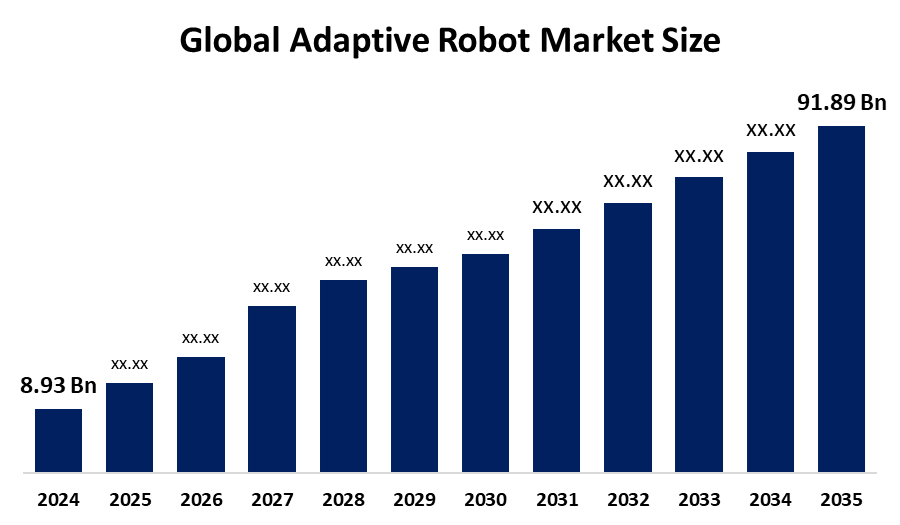
- The Global Adaptive Robot Market Size Was Estimated at USD 8.93 billion in 2024
- The Market Size is Expected to Grow at a CAGR of around 23.61% from 2025 to 2035
- The Worldwide Adaptive Robot Market Size is Expected to Reach USD 91.89 billion by 2035
- Asia Pacific is expected to grow the fastest during the forecast period.
Get more details on this report -
According to a research report published by Spherical Insights, the global Adaptive Robot market size was worth around USD 8.93 billion in 2024 and is predicted to grow to around USD 91.89 billion by 2035 with a compound annual growth rate (CAGR) of 23.61% from 2025 to 2035. The global adaptive robot market is driven by rising demand for automation, labor shortages, technological advancements in AI and sensors, increasing adoption of collaborative robots, and expanding applications across industries.
Market Overview
The global adaptive robot market refers to robotic systems that can change their operational methods to match different environmental conditions, work requirements, and human engagement. These robots use artificial intelligence and machine learning together with sensors to execute complex operations across manufacturing, healthcare, logistics, and service sectors. The market experiences growth because production processes require more automated solutions, which provide accurate results and effective operations, while industrial and healthcare sectors face worker shortages. Government bodies back Industry 4.0 implementation through their support of smart manufacturing and robotics research through their funding and initiative-based programs. In March 2024, The Union Cabinet approved the IndiaAI Mission with a budget outlay of INR 10,371.92 crores over five years, aimed at boosting India’s artificial intelligence ecosystem by supporting innovation, startup financing, and computational infrastructure development. Since its launch, the mission has expanded compute capacity far beyond initial targets, with over 38,000 GPUs now deployed to provide affordable access to advanced AI resources for research and development.
The development of AI algorithms, sensor technology, human-robot collaboration systems, and cloud robotics systems has improved robot systems for better adaptability and operational performance. In October 2025, AgiBot launched its G2 industrial adaptive robot and a no-code platform for programming robot actions, simplifying deployment across manufacturing and logistics sectors.
The current market trends show that businesses are adopting collaborative robots, autonomous mobile robots, and AI-driven predictive maintenance systems, which create flexible automated systems that use intelligent technology. The market offers prospects for growth through creating surgical and rehabilitation solutions in healthcare, automated warehousing in logistics, and consumer service robots and industrial automation solutions in developing markets. The market potential rises because businesses now prioritize energy efficiency and human safety as essential factors for their operations.
Report Coverage
This research report categorizes the global adaptive robot market based on various segments and regions, forecasts revenue growth, and analyzes trends in each submarket. The report analyzes the key growth drivers, opportunities, and challenges influencing the global adaptive robot market. Recent market developments and competitive strategies, such as expansion, product launches, developments, partnerships, mergers, and acquisitions, have been included to outline the competitive landscape of the market. The report also strategically identifies and profiles key market players and analyzes their core competencies in each sub-segment of the adaptive robot market.
Adaptive Robot Market Report Coverage
| Report Coverage | Details |
|---|---|
| Base Year: | 2024 |
| Market Size in 2024: | USD 8.93 Billion |
| Forecast Period: | 2025-2035 |
| Forecast Period CAGR 2025-2035 : | CAGR of 23.61% |
| 2035 Value Projection: | USD 91.89 Billion |
| Historical Data for: | 2020-2023 |
| No. of Pages: | 230 |
| Tables, Charts & Figures: | 120 |
| Segments covered: | By Technology, By Application |
| Companies covered:: | Fanuc Corporation, KUKA AG, ABB Ltd, Yaskawa Electric Corporation, Robert Bosch GmbH, Siemens AG, Rethink Robotics, iRobot Corporation, Flexiv Ltd, Agility Robotics, Figure AI Inc, Hanson Robotics Limited, Furhat Robotics, SoftBank Robotics Corp, Intuitive Surgical Inc, and other key players |
| Pitfalls & Challenges: | COVID-19 Empact, Challenge, Future, Growth, & Analysis |
Get more details on this report -
Driving Factors
The global adaptive robot market is expanding due to increasing demand across multiple industries for flexible robotic systems that leverage intelligent automation. Companies are adopting adaptive robots to improve productivity, reduce operational costs, and maintain consistent product quality despite production variations. Additionally, rising labor shortages and the need to minimize human involvement in hazardous work environments are encouraging the adoption of robotic solutions.
The growing emphasis on workplace safety and operational efficiency is further driving organizations to implement collaborative robots that can work alongside human workers. Rapid advancements in artificial intelligence, machine learning, and sensor technologies are enabling robots to acquire new capabilities and respond effectively to dynamic environments.
The market is experiencing significant growth as industries such as healthcare, logistics, and services increasingly adopt advanced technologies. In December 2025, Flexiv Ltd. launched its Flexiv Mobile Robot (FMR 300), an autonomous mobile robot (AMR) designed to expand the operating space of its adaptive robot arms. The FMR 300 integrates with Flexiv’s Rizon adaptive robots, enabling flexible automation in space-constrained environments and enhancing overall task adaptability.
Restraining Factors
The global adaptive robot market encounters limitations because small and medium enterprises require expensive initial investments and integration costs, which restrict their ability to adopt the technology. The maintenance and operational requirements of advanced systems create difficulties because they demand skilled workers to handle their technical complexities. The market growth faces obstacles because companies have worries about data security issues and system reliability problems, and they need to check how their systems work with existing infrastructure.
Market Segmentation
The global adaptive robot market share is classified into technology, application, and end use.
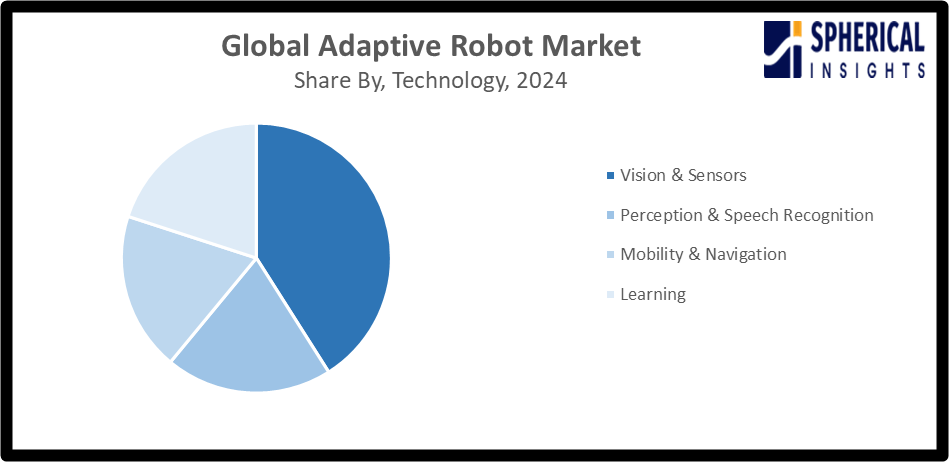
- vision & sensors segment accounted for the largest share in 2024, approximately 41%, and is anticipated to grow at a significant CAGR during the forecast period.
Based on the technology, the global Adaptive Robot market is divided into vision & sensors, perception & speech recognition, mobility & navigation, and learning. Among these, the vision & sensors segment accounted for the largest share in 2024, approximately 41%, and is anticipated to grow at a significant CAGR during the forecast period. This is because vision systems and advanced sensors are fundamental to enabling real-time data collection, object detection, and environment awareness, allowing robots to adapt their actions accurately. Their critical role in improving precision, safety, and efficiency across industrial automation, healthcare, and logistics applications continues to drive strong demand for this segment.
Get more details on this report -
The industrial robot segment accounted for the highest market revenue in 2024, approximately 33%, and is anticipated to grow at a significant CAGR during the forecast period.
Based on the application, the global adaptive robot market is divided into industrial robot, consumer robot, logistics robot, service robot. Among these, the industrial robot segment accounted for the highest market revenue in 2024, approximately 33%, and is anticipated to grow at a significant CAGR during the forecast period. This is because material handling, assembly, and pick-and-place applications in manufacturing are experiencing a surge in demand, driven by Industry 4.0, the need for increased production precision, and the rising trend of flexible automation to handle complex tasks in automotive and electronics.
The automotive segment dominated the market in 2024, approximately 30%, and is projected to grow at a substantial CAGR during the forecast period.
Based on the end use, the global adaptive robot market is divided into automotive, aerospace, electronics, food & beverage, healthcare, retail, BFSI, travel & transportation, education, entertainment. Among these, the automotive segment dominated the market in 2024, approximately 30%, and is projected to grow at a substantial CAGR during the forecast period. The dominance of the automotive sector is largely driven by the high demand for variable industrial robots that can handle rapidly changing product specifications in assembly, painting, and welding processes. Additionally, the push toward Industry 4.0 has increased demand for adaptive robots that enhance productivity, operational efficiency, and workplace safety.
Regional Segment Analysis of the Global Adaptive Robot Market
- North America (U.S., Canada, Mexico)
- Europe (Germany, France, U.K., Italy, Spain, Rest of Europe)
- Asia-Pacific (China, Japan, India, Rest of APAC)
- South America (Brazil and the Rest of South America)
- The Middle East and Africa (UAE, South Africa, Rest of MEA)
North America is anticipated to hold the largest share of the global adaptive robot market over the predicted timeframe.

Get more details on this report -
North America is anticipated to hold the largest share of the global Adaptive Robot market over the predicted timeframe, approximately 40% market share. This growth is driven by strong adoption of advanced automation across manufacturing, healthcare, and logistics industries. High investment in research and development, along with continuous innovation in artificial intelligence and machine learning, supports market expansion. The presence of leading robotics companies and a skilled workforce further accelerates adoption. Additionally, increasing demand for collaborative robots, focus on improving productivity, and early integration of smart manufacturing technologies contribute significantly to regional growth.
The Asia Pacific region is expected to grow at the fastest rate during the forecast period, approximately 28% market share. This growth is driven by rapid industrialization and expanding manufacturing activities across key industries such as electronics, automotive, and consumer goods. Rising demand for cost-efficient automation solutions and increasing adoption of smart factory technologies are key contributors. Government support for industrial automation and digital transformation further boosts the market. In addition, the availability of low-cost labor transitioning to automation, along with growing investments in robotics and infrastructure development, supports strong regional growth.
Competitive Analysis:
The report offers the appropriate analysis of the key organizations/companies involved within the global adaptive robot market, along with a comparative evaluation primarily based on their product offering, business overviews, geographic presence, enterprise strategies, segment market share, and SWOT analysis. The report also provides an elaborative analysis focusing on the current news and developments of the companies, which includes product development, innovations, joint ventures, partnerships, mergers & acquisitions, strategic alliances, and others. This allows for the evaluation of the overall competition within the market.
List of Key Companies
- Fanuc Corporation
- KUKA AG
- ABB Ltd
- Yaskawa Electric Corporation
- Robert Bosch GmbH
- Siemens AG
- Rethink Robotics
- iRobot Corporation
- Flexiv Ltd
- Agility Robotics
- Figure AI Inc
- Hanson Robotics Limited
- Furhat Robotics
- SoftBank Robotics Corp
- Intuitive Surgical Inc
- Others
Key Target Audience
- Market Players
- Investors
- End-users
- Government Authorities
- Consulting and Research Firm
- Venture capitalists
- Value-Added Resellers (VARs)
Recent Development
- In March 2026, major advancements in AI-powered robotic agents enabled robots to perform real-time tasks using natural language commands, improving adaptability in both industrial and consumer applications.
- In January 2026, Arm Holdings launched a new Physical AI division at CES 2026 to expand its presence in the robotics market. The new unit focuses on integrating artificial intelligence with real-world systems such as robots and autonomous machines, combining robotics and automotive technologies under one segment. This move is part of the company’s broader strategy to strengthen its role in next-generation automation and adaptive robotics solutions.
- In October 2025, Figure AI introduced its Figure 03 humanoid Robot, featuring advanced sensors, tactile capabilities, and improved perception systems for adaptive learning and human interaction.
Global Adaptive Robot Market, By Technology
- Vision & Sensors
- Perception & Speech Recognition
- Mobility & Navigation
- Learning
Global Adaptive Robot Market, By Application
- Industrial Robot
- Consumer Robot
- Logistics Robot
- Service Robot
Global Adaptive Robot Market, By End Use
- Automotive
- Aerospace
- Electronics
- Food & Beverage
- Healthcare
- Retail
- BFSI
- Travel & Transportation
- Education
- Entertainment
Global Adaptive Robot Market, By Regional Analysis
- North America
- US
- Canada
- Mexico
- Europe
- Germany
- UK
- France
- Italy
- Spain
- Russia
- Rest of Europe
- Asia Pacific
- China
- Japan
- India
- South Korea
- Australia
- Rest of Asia Pacific
- South America
- Brazil
- Argentina
- Rest of South America
- Middle East & Africa
- UAE
- Saudi Arabia
- Qatar
- South Africa
- Rest of the Middle East & Africa
Frequently Asked Questions (FAQ)
-
What is an adaptive robot?Adaptive robots are advanced robotic systems that can adjust their actions based on real-time data, environment changes, and human interaction using AI, sensors, and machine learning.
-
What industries are driving demand for adaptive robots?Key industries include automotive, electronics, healthcare, logistics, and manufacturing, where flexibility, precision, and automation are increasingly important.
-
What technologies enable adaptive robots?Technologies such as artificial intelligence, machine learning, computer vision, advanced sensors, and cloud computing play a major role in enabling adaptability.
-
How are adaptive robots different from traditional robots?Unlike traditional robots that follow fixed programming, adaptive robots can learn, make decisions, and modify their behavior in dynamic environments.
-
What are the key benefits of adaptive robots?They improve productivity, reduce errors, enhance safety, lower operational costs, and allow flexible automation across different tasks.
-
What challenges are associated with adaptive robots?High initial costs, system complexity, integration issues, and the need for skilled professionals are some major challenges.
-
What is the future outlook of the adaptive robot market?The market is expected to grow rapidly due to increasing automation, AI advancements, and expanding applications across industries worldwide.
-
What is an adaptive robot?Adaptive robots are advanced robotic systems that can adjust their actions based on real-time data, environment changes, and human interaction using AI, sensors, and machine learning.
-
What industries are driving demand for adaptive robots?Key industries include automotive, electronics, healthcare, logistics, and manufacturing, where flexibility, precision, and automation are increasingly important.
-
What technologies enable adaptive robots?Technologies such as artificial intelligence, machine learning, computer vision, advanced sensors, and cloud computing play a major role in enabling adaptability.
-
How are adaptive robots different from traditional robots?Unlike traditional robots that follow fixed programming, adaptive robots can learn, make decisions, and modify their behavior in dynamic environments.
-
What are the key benefits of adaptive robots?They improve productivity, reduce errors, enhance safety, lower operational costs, and allow flexible automation across different tasks.
-
What challenges are associated with adaptive robots?High initial costs, system complexity, integration issues, and the need for skilled professionals are some major challenges.
-
What is the future outlook of the adaptive robot market?The market is expected to grow rapidly due to increasing automation, AI advancements, and expanding applications across industries worldwide.
Need help to buy this report?