Global 3D Tailgating Detection System Market Size, Share, and COVID-19 Impact Analysis, By Component (Hardware, Software, and Services), By Technology (Infrared, Ultrasonic, Microwave, Laser, and Others), By End-User (Commercial Buildings, Government Buildings, Industrial Facilities, and Others), and By Region (North America, Europe, Asia-Pacific, Latin America, Middle East, and Africa), Analysis and Forecast 2025 - 2035
Industry: Semiconductors & Electronics
Global 3D Tailgating Detection System Market Size Insights Forecasts to 2035
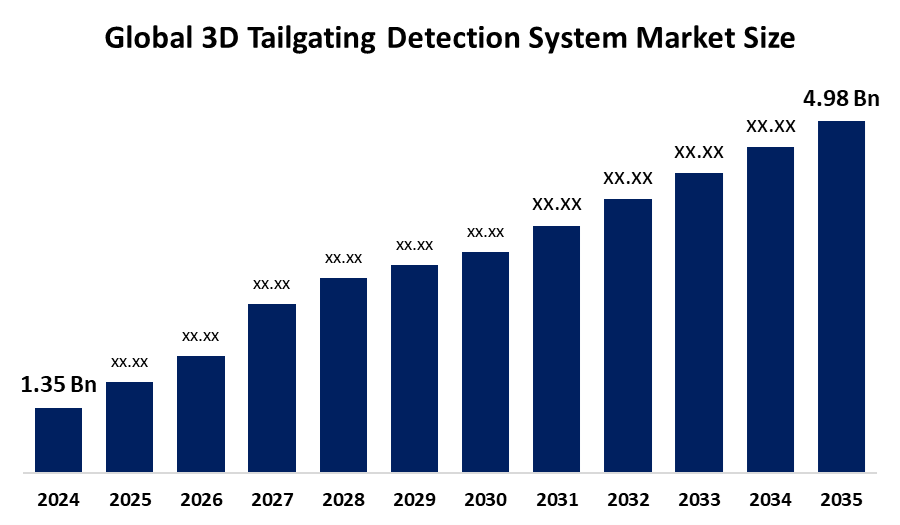
- The Global 3D Tailgating Detection System Market Size Was Estimated at USD 1.35 Billion in 2024
- The Market Size is Expected to Grow at a CAGR of around 12.6% from 2025 to 2035
- The Worldwide 3D Tailgating Detection System Market Size is Expected to Reach USD 4.98 Billion by 2035
- Asia Pacific is expected to grow the fastest during the forecast period.
Get more details on this report -
According to a Research Report Published by Spherical Insights and Consulting, The Global 3D Tailgating Detection System Market Size was worth around USD 1.35 Billion in 2024 and is predicted to grow to around USD 4.98 Billion by 2035 with a compound annual growth rate (CAGR) of 12.6% from 2025 to 2035. The 3D tailgating detection market is growing rapidly due to rising physical security concerns, the urgent need for automated access control, and the integration of AI/machine learning for high-precision detection, particularly in smart buildings, commercial, and high-security government facilities.
Market Overview
The global 3D tailgating detection system market encompasses advanced security and safety solutions that utilize three-dimensional sensing technologies, such as LiDAR, radar, infrared, and camera-based systems, to identify and prevent unauthorized close, following (tailgating) in both vehicular and physical access settings. These systems are deployed in smart cities, commercial facilities, transportation hubs, and automotive safety applications to enhance security, reduce accidents, and enable automated monitoring. In November 2025, Europe’s NIS2 Directive enforces stringent physical security measures, including tailgating prevention, as part of cybersecurity risk management. It mandates centralized, auditable access logs integrated with IT monitoring, boosting demand for advanced access control systems. Non-compliance risks fines up to €10 million or 2% of global turnover.
Market expansion is fueled by growing security concerns and regulatory requirements for strong access control and collision prevention, as well as technological advancements like AI and machine learning, which improve detection precision. Key opportunities exist in public transportation, vehicle safety, and smart infrastructure integration, driven by increasing demand for real-time, scalable 3D sensing solutions, declining hardware costs, and reduced adoption barriers. In May 2025, Queensland launches Australia’s first tailgating detection cameras. The system warns drivers in real-time via electronic message boards, promoting safe following distances. While non-penalizing, the initiative addresses rising tailgating, linked to nearly 2,000 serious crashes, and aims to reduce rear-end collisions and improve road safety.
Report Coverage
This research report categorizes the 3D tailgating detection system market based on various segments and regions, forecasts revenue growth, and analyzes trends in each submarket. The report analyses the key growth drivers, opportunities, and challenges influencing the 3D tailgating detection system market. Recent market developments and competitive strategies, such as expansion, type launch, development, partnership, merger, and acquisition, have been included to draw the competitive landscape in the market. The report strategically identifies and profiles the key market players and analyses their core competencies in each sub-segment of the 3D tailgating detection system market.
3D Tailgating Detection System Market Report Coverage
| Report Coverage | Details |
|---|---|
| Base Year: | 2024 |
| Market Size in 2024: | USD 1.35 Billion |
| Forecast Period: | 2025-2035 |
| Forecast Period CAGR 2025-2035 : | CAGR of 12.6% |
| 2035 Value Projection: | USD 4.98 Billion |
| Historical Data for: | 2020-2023 |
| No. of Pages: | 230 |
| Tables, Charts & Figures: | 120 |
| Segments covered: | By Component, By End-User |
| Companies covered:: | OPTEX Company, Limited, Irisys, Integrated Design Ltd, Kouba Systems, Detex Corporation, FASTCOM Technology S.A., Infineon Technologies AG, Alcatraz AI, Vzense Technology, LMI Technologies Inc., Axis Communications, Convergint Technologies, Keyence Corporation, and other key players |
| Pitfalls & Challenges: | COVID-19 Empact, Challenge, Future, Growth, & Analysis |
Get more details on this report -
Driving Factors
Market expansion is fueled by growing demand for improved safety and security across automotive, commercial, and public infrastructure sectors. Heightened worries about vehicle collisions, unauthorized entry, and workplace safety are encouraging organizations to implement advanced detection solutions. Innovations such as AI-powered sensors, lidar, and machine learning enhance detection precision and minimize false alarms, promoting wider adoption. Additionally, urbanization and smart city developments are driving the use of real-time monitoring and automated traffic management, while regulatory requirements for access control and safety in commercial and transportation facilities further support market growth. In December 2025, India’s National Road Safety Board mandated Advanced Traffic Management Systems on highways, including AI-powered video incident detection and surveillance. The initiative aims to enhance real-time road safety, reduce accidents, and drive wider adoption of sensor-based monitoring and detection technologies across the nation’s traffic infrastructure.
Restraining Factors
The global 3D tailgating detection system market faces restraints from high implementation costs ranging from $15,000 to $50,000 per entry point limit adoption, particularly for small to midsize businesses. Integration complexities with legacy infrastructure and privacy concerns regarding workplace surveillance, especially under regulations like GDPR, further hinder market growth.
Market Segmentation
The 3d tailgating detection system market share is classified into component, technology, and end-user.
- The hardware segment dominated the market in 2024, approximately 42% and is projected to grow at a substantial CAGR during the forecast period.
Based on the component, the 3D tailgating detection system market is divided into hardware, software, and services. Among these, the hardware segment dominated the market in 2024 and is projected to grow at a substantial CAGR during the forecast period. The hardware segment led the market, driven by the increasing deployment of sensors, cameras, and LiDAR devices across commercial, automotive, and transportation sectors. Rising demand for reliable physical security and vehicular safety solutions, coupled with technological advancements in 3D sensing and decreasing hardware costs, has propelled the segment’s significant market share and sustained growth globally.
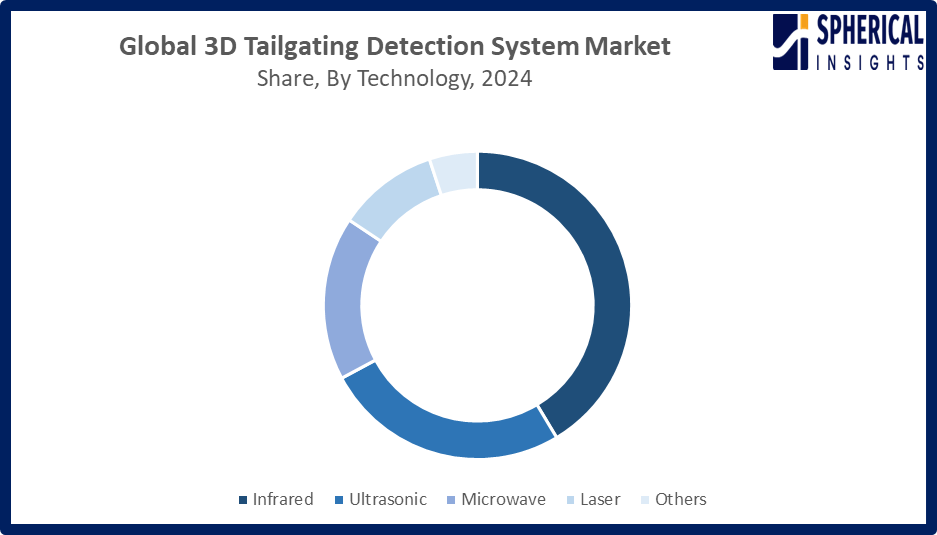
- The infrared segment accounted for the largest share in 2024, approximately 41% and is anticipated to grow at a significant CAGR during the forecast period.
Based on the technology, the 3D tailgating detection system market is divided into infrared, ultrasonic, microwave, laser, and others. Among these, the infrared segment accounted for the largest share in 2024 and is anticipated to grow at a significant CAGR during the forecast period. The segment in the 3D tailgating detection market owing to its high accuracy in detecting human and vehicle movement in various lighting and weather conditions. Its ability to operate effectively in low-light and night-time environments makes it ideal for both physical access control and traffic safety applications, driving widespread adoption and strong market growth globally.
Get more details on this report -
- The commercial buildings segment accounted for the highest market revenue in 2024, approximately 38% and is anticipated to grow at a significant CAGR during the forecast period.
Based on the end-user, the 3D tailgating detection system market is divided into commercial buildings, government buildings, industrial facilities, and others. Among these, the commercial buildings segment accounted for the highest market revenue in 2024 and is anticipated to grow at a significant CAGR during the forecast period. The commercial buildings segment is growing in the market, driven by increasing security concerns in offices, shopping malls, and corporate complexes. Rising adoption of advanced access control systems, regulatory mandates for workplace safety, and the integration of AI-powered detection technologies have fueled demand, making commercial infrastructure a key driver for market expansion globally.
Regional Segment Analysis of the 3D Tailgating Detection System Market
- North America (U.S., Canada, Mexico)
- Europe (Germany, France, U.K., Italy, Spain, Rest of Europe)
- Asia-Pacific (China, Japan, India, Rest of APAC)
- South America (Brazil and the Rest of South America)
- The Middle East and Africa (UAE, South Africa, Rest of MEA)
North America is anticipated to hold the largest share of the 3D tailgating detection system market over the predicted timeframe.

Get more details on this report -
North America is anticipated to hold the 45% share of the 3D tailgating detection system market over the predicted timeframe. The region dominates the 3D tailgating detection system market, primarily driven by the U.S., which leads in smart infrastructure adoption and stringent security regulations. Growing implementation of advanced access control in commercial buildings, transportation hubs, and automotive safety applications fuels demand. In 2025, the U.S. accounted for over 40% of North America’s market share, supported by regulatory mandates like FERC’s CIP-015-1 standard, increasing investments in AI-powered security solutions, and rising concerns over unauthorized access and vehicular accidents across critical infrastructure. In July 2025, the U.S. Federal Energy Regulatory Commission approved CIP-015-1, mandating enhanced Physical Access Control Systems for critical electric infrastructure. The standard emphasizes tailgating detection, driving utilities to modernize access control systems to protect critical cyber assets and strengthen overall infrastructure security.
Asia Pacific is expected to grow at a rapid CAGR in the 3D tailgating detection system market during the forecast period. The region is rapidly growing in the 3D tailgating detection system market, led by China and India, due to increasing urbanization, smart city initiatives, and rising security concerns in the commercial and transportation sectors. In 2025, China accounted for nearly 30% of the regional market, fueled by government investments in AI-based surveillance, while India’s highway and infrastructure modernization programs are boosting demand for advanced tailgating detection and access control solutions. In December 2024, India’s MeitY updated CCTV standards, mandating enhanced physical security, access control, and encrypted networks for all cameras. The move improves surveillance quality and cybersecurity, laying the groundwork for advanced technologies, including tailgating detection systems, and strengthening the nation’s smart security ecosystem.
Europe’s 3D tailgating detection system market growth is driven by Germany, France, and the UK, fueled by strict security regulations and smart infrastructure adoption. In 2025, Germany accounted for over 25% of the regional market, supported by mandates like the NIS2 Directive, rising demand for AI-enabled access control in commercial buildings and transportation hubs, and increasing investments in real-time monitoring and collision prevention technologies.
Competitive Analysis:
The report offers the appropriate analysis of the key organizations/companies involved within the 3D tailgating detection system market, along with a comparative evaluation primarily based on their type of offering, business overviews, geographic presence, enterprise strategies, segment market share, and SWOT analysis. The report also provides an elaborative analysis focusing on the current news and developments of the companies, which includes type development, innovations, joint ventures, partnerships, mergers & acquisitions, strategic alliances, and others. This allows for the evaluation of the overall competition within the market.
List of Key Companies
- OPTEX Company, Limited
- Irisys
- Integrated Design Ltd
- Kouba Systems
- Detex Corporation
- FASTCOM Technology S.A.
- Infineon Technologies AG
- Alcatraz AI
- Vzense Technology
- LMI Technologies Inc.
- Axis Communications
- Convergint Technologies
- Keyence Corporation
- Others
Key Target Audience
- Market Players
- Investors
- End-users
- Government Authorities
- Consulting and Research Firm
- Venture capitalists
- Value-Added Resellers (VARs)
Recent Development
- In March 2026, India’s NHAI deploys AI-powered dashcams across highways to monitor traffic in real-time. The system detects violations like speeding, tailgating, and unsafe lane changes, enabling faster emergency responses, deterring reckless driving, and providing accurate evidence for accident investigation and road safety management nationwide.
- In March 2026, Infineon Technologies launched the 28nm TEGRION SLI22 automotive security controller, featuring post-quantum cryptography and BSI Common Criteria certification. Designed for eSIM, V2X, and car access, it enhances system integrity, complements Infineon’s SLI portfolio, and offers a compact ETSI MFF3 package, reducing space requirements by 70%.
- In May 2025, pmdtechnologies and Infineon unveiled their REAL3 3D Time-of-Flight sensor solution for vehicles. The technology enables precise driver monitoring, occupant detection, gesture control, facial recognition, and smart airbags, enhancing in-cabin safety, comfort, and compliance with evolving automotive safety regulations for connected and autonomous vehicles.
- In January 2025, LMI Technologies launched the GoPxL Anomaly Detector, a 3D defect detection solution for automotive, food, building material, and tire industries. Utilizing AI and onboard GoMax processing, it integrates with Gocator sensors, enabling training and deployment without additional hardware or cloud resources, with free firmware and evaluation options.
- In May 2024, Flir, a Teledyne Technologies company, launched the Trafibot AI 4K camera system for interurban traffic intelligence. Featuring dual AI models and a 3D world tracker, it detects vehicles, pedestrians, tailgating, lane violations, and obstacles in real-time, delivering high-resolution traffic data without bandwidth loss for safer road monitoring.
Market Segment
This study forecasts revenue at global, regional, and country levels from 2020 to 2035. Spherical Insights has segmented the 3D tailgating detection system market based on the below-mentioned segments:
Global 3D Tailgating Detection System Market, By Component
- Hardware
- Software
- Services
Global 3D Tailgating Detection System Market, By Technology
- Infrared
- Ultrasonic
- Microwave
- Laser
- Others
Global 3D Tailgating Detection System Market, By End-User
- Commercial Buildings
- Government Buildings
- Industrial Facilities
- Others
Global 3D Tailgating Detection System Market, By Regional Analysis
- North America
- US
- Canada
- Mexico
- Europe
- Germany
- UK
- France
- Italy
- Spain
- Russia
- Rest of Europe
- Asia Pacific
- China
- Japan
- India
- South Korea
- Australia
- Rest of Asia Pacific
- South America
- Brazil
- Argentina
- Rest of South America
- Middle East & Africa
- UAE
- Saudi Arabia
- Qatar
- South Africa
- Rest of the Middle East & Africa
Frequently Asked Questions (FAQ)
-
1. Which technological innovations are driving advancements in 3D tailgating detection systems?Advanced 3D sensors (LiDAR, depth cameras), AI and machine‑learning analytics, and cloud/edge processing are boosting 3D tailgating detection accuracy and efficiency; AI‑powered systems now cut false alarms and offer real‑time alerts, supporting the market’s projected nearly $2.5 billion growth by 2035.
-
2. How are AI and machine learning improving detection accuracy in 3D tailgating systems?AI and machine learning enhance 3D tailgating systems by reducing false positives, adapting to diverse environments, and improving object classification; advanced models can boost detection accuracy by over 90 % in complex scenarios, enabling real‑time alerts and smarter decision‑making for safety and security applications.
-
3. What are the key trends in the adoption of 3D tailgating detection systems across commercial buildings?Key trends in commercial buildings include integration with AI‑powered access control, cloud analytics, and IoT security platforms, with adoption expected to exceed 35% annual growth as demand rises for touchless entry and real‑time intrusion prevention in high‑traffic facilities.
-
4. How are regulatory mandates affecting the implementation of 3D tailgating detection solutions worldwide?Regulatory mandates like FERC CIP‑015‑1 in the U.S. and NIS2 in Europe are accelerating 3D tailgating detection deployment, with compliance‑driven demand expected to push adoption rates above 25 % CAGR through 2030 in access control and critical infrastructure markets.
-
5. What economic factors are supporting the growth of the global 3D tailgating detection market?Rising security spending, declining sensor costs, and investment in smart infrastructure are driving the 3D tailgating detection market, with global security technology expenditures projected to exceed $150 billion by 2028, boosting adoption across industries and accelerating market growth.
-
6. How are smart city initiatives contributing to market expansion for 3D tailgating detection technologies?Smart city projects are expanding demand for 3D tailgating detection by integrating advanced traffic and access control systems; with global smart city tech spending projected to surpass $820 billion by 2026, these initiatives accelerate the deployment of real‑time safety and monitoring solutions across urban infrastructure.
-
7. What role do sensor technologies like LiDAR, infrared, and radar play in market innovation?Sensor technologies such as LiDAR, infrared, and radar drive 3D tailgating detection innovation by enabling high-accuracy, all-weather monitoring; LiDAR adoption alone is projected to grow at 22 % CAGR through 2030, enhancing real-time security and collision prevention capabilities.
-
8. What challenges or barriers could impact the adoption of 3D tailgating detection systems globally?Global adoption of 3D tailgating detection systems faces challenges like high initial costs, integration complexity, and privacy concerns, with surveys indicating over 40 % of facilities cite budget and compliance barriers limiting deployment.
-
1. Which technological innovations are driving advancements in 3D tailgating detection systems?Advanced 3D sensors (LiDAR, depth cameras), AI and machine‑learning analytics, and cloud/edge processing are boosting 3D tailgating detection accuracy and efficiency; AI‑powered systems now cut false alarms and offer real‑time alerts, supporting the market’s projected nearly $2.5 billion growth by 2035.
-
2. How are AI and machine learning improving detection accuracy in 3D tailgating systems?AI and machine learning enhance 3D tailgating systems by reducing false positives, adapting to diverse environments, and improving object classification; advanced models can boost detection accuracy by over 90 % in complex scenarios, enabling real‑time alerts and smarter decision‑making for safety and security applications.
-
3. What are the key trends in the adoption of 3D tailgating detection systems across commercial buildings?Key trends in commercial buildings include integration with AI‑powered access control, cloud analytics, and IoT security platforms, with adoption expected to exceed 35% annual growth as demand rises for touchless entry and real‑time intrusion prevention in high‑traffic facilities.
-
4. How are regulatory mandates affecting the implementation of 3D tailgating detection solutions worldwide?Regulatory mandates like FERC CIP‑015‑1 in the U.S. and NIS2 in Europe are accelerating 3D tailgating detection deployment, with compliance‑driven demand expected to push adoption rates above 25 % CAGR through 2030 in access control and critical infrastructure markets.
-
5. What economic factors are supporting the growth of the global 3D tailgating detection market?Rising security spending, declining sensor costs, and investment in smart infrastructure are driving the 3D tailgating detection market, with global security technology expenditures projected to exceed $150 billion by 2028, boosting adoption across industries and accelerating market growth.
-
6. How are smart city initiatives contributing to market expansion for 3D tailgating detection technologies?Smart city projects are expanding demand for 3D tailgating detection by integrating advanced traffic and access control systems; with global smart city tech spending projected to surpass $820 billion by 2026, these initiatives accelerate the deployment of real‑time safety and monitoring solutions across urban infrastructure.
-
7. What role do sensor technologies like LiDAR, infrared, and radar play in market innovation?Sensor technologies such as LiDAR, infrared, and radar drive 3D tailgating detection innovation by enabling high-accuracy, all-weather monitoring; LiDAR adoption alone is projected to grow at 22 % CAGR through 2030, enhancing real-time security and collision prevention capabilities.
-
8. What challenges or barriers could impact the adoption of 3D tailgating detection systems globally?Global adoption of 3D tailgating detection systems faces challenges like high initial costs, integration complexity, and privacy concerns, with surveys indicating over 40 % of facilities cite budget and compliance barriers limiting deployment.
Need help to buy this report?