Global 3D Printed Maxillofacial Implant Market Size to Exceed USD 4.102 Billion By 2035 | CAGR Of 5.61%
Category: HealthcareGlobal 3D Printed Maxillofacial Implant Market Size to Exceed USD 4.102 Billion By 2035
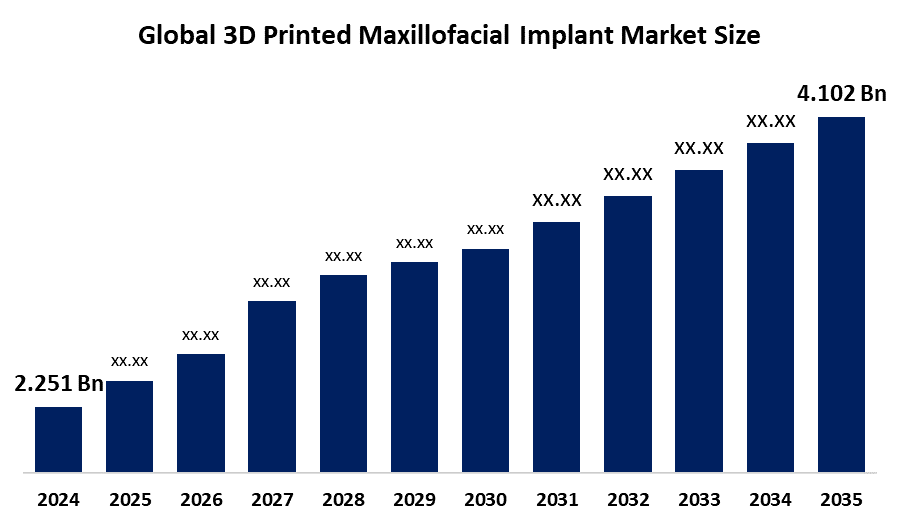
According to a research report published by Spherical Insights & Consulting, The Global 3D Printed Maxillofacial Implant Market Size is Expected To Grow from USD 2.251 Billion in 2024 to USD 4.102 Billion by 2035, at a CAGR of 5.61% during the forecast period 2025-2035.
Get more details on this report -
Browse 210 Market Data Tables And 45 Figures Spread Through 190 Pages and In-Depth TOC On the" Global 3D Printed Maxillofacial Implant Market Size, Share, and COVID-19 Impact Analysis, By Material (Titanium, POM, Polyether Ether Ketone, and Glass Ceramics), By Technology (Stereolithography, Selective Laser Sintering, Fused Deposition Modeling, and Computer-Aided Design), By Application (Craniomaxillofacial Reconstruction, Dental Implants, Orthognathic Surgery, and Trauma Reconstruction), By End-Use (Hospitals, Dental Clinics, and Ambulatory Surgical Centers), and By Region (North America, Europe, Asia-Pacific, Latin America, Middle East, and Africa), Analysis and Forecast 2025 – 2035. " Get Detailed Report Description Here:https://www.sphericalinsights.com/reports/3d-printed-maxillofacial-implant-market
The 3D-printed maxillofacial implant market involves the production and application of patient-specific implants using additive manufacturing to repair or replace facial structures, including the mandible, zygomatic bones, orbital walls, and cranial segments. These implants are used in trauma reconstruction, congenital deformity correction, orthognathic surgery, dental rehabilitation, and oncology-related facial reconstruction. Market growth is driven by rising trauma cases, growing demand for customized treatments, and rapid advancements in biomaterials. Innovations such as porous titanium structures, bioresorbable polymers, hybrid materials, and fully customized implant geometries enhance integration and reduce surgical time. The adoption of point-of-care 3D printing in hospitals and surgical robotics further supports expansion. Opportunities are increasing in developing regions due to improved healthcare infrastructure, government support, and investments in bioprinting and regenerative medicine. Additionally, digital surgical planning, AI-assisted design, precision 3D printing, and minimally invasive procedures are accelerating clinical acceptance and improving outcomes, while the ageing population and rising healthcare expenditure further boost market growth. The 3D-printed maxillofacial implant market faces restraints from high costs, limited reimbursement, and strict regulations.
The titanium segment dominated the market in 2024 and is projected to grow at a substantial CAGR during the forecast period.
Based on the material, the 3D printed maxillofacial implant market is divided into titanium, POM, polyether ether ketone, and glass ceramics. Among these, the titanium segment dominated the market in 2024 and is projected to grow at a substantial CAGR during the forecast period. 3D printing offers mechanical stability, durability, and easy customization for patient-specific implants, making it highly suitable. Widespread clinical adoption and established regulatory familiarity with titanium implants further support the global growth of this market segment.
The stereolithography segment accounted for the largest share in 2024 and is anticipated to grow at a remarkable CAGR during the forecast period.
Based on the technology, the 3D printed maxillofacial implant market is divided into stereolithography, selective laser sintering, fused deposition modeling, and computer-aided design. Among these, the stereolithography segment accounted for the largest share in 2024 and is anticipated to grow at a significant CAGR during the forecast period. Stereolithography (SLA) enables accurate modelling of intricate facial structures, reduces post-processing, and enhances surgical outcomes. Its extensive use in presurgical planning, prototyping, and custom implant fabrication drives strong growth and preference over other 3D printing methods.
The craniomaxillofacial reconstruction segment accounted for the largest share in 2024 and is anticipated to grow at a remarkable CAGR during the forecast period.
Based on the application, the 3D printed maxillofacial implant market is divided into craniomaxillofacial reconstruction, dental implants, orthognathic surgery, and trauma reconstruction. Among these, the craniomaxillofacial reconstruction segment accounted for the largest share in 2024 and is anticipated to grow at a significant CAGR during the forecast period. Demand for precise, patient-specific implants enhancing functional and aesthetic outcomes drives growth. Advancements in 3D printing, improved biocompatible materials, and the rising use of minimally invasive surgeries further support this segment’s market dominance.
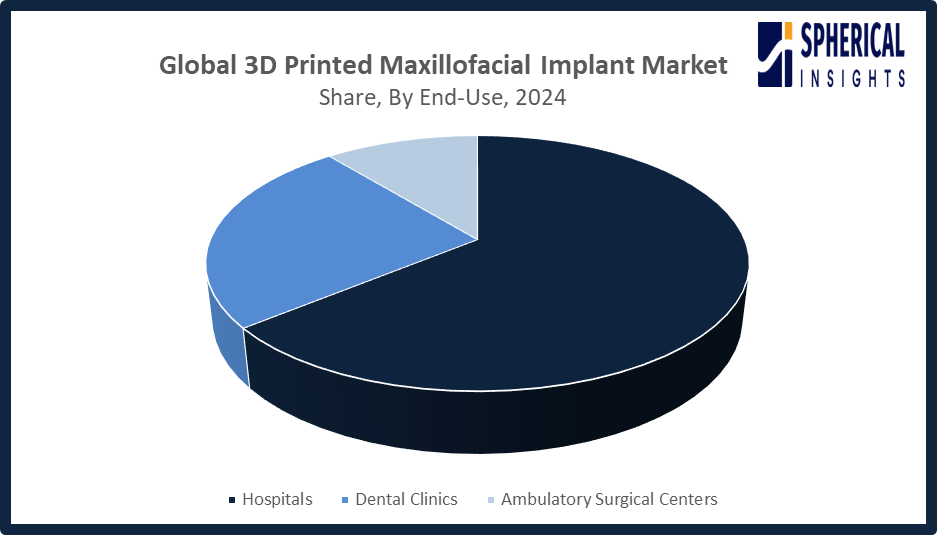
The hospitals segment accounted for the highest market revenue in 2024 and is anticipated to grow at a significant CAGR during the forecast period.
Based on the end-use, the 3D printed maxillofacial implant market is divided into hospitals, dental clinics, and ambulatory surgical centers. Among these, the hospitals segment accounted for the highest market revenue in 2024 and is anticipated to grow at a significant CAGR during the forecast period. Hospitals increasingly use patient-specific implants for trauma, craniofacial reconstruction, and oncology surgeries, leveraging in-house 3D printing and digital planning. Growing healthcare investments and emphasis on better surgical outcomes are fueling the rapid global growth of this segment.
Get more details on this report -
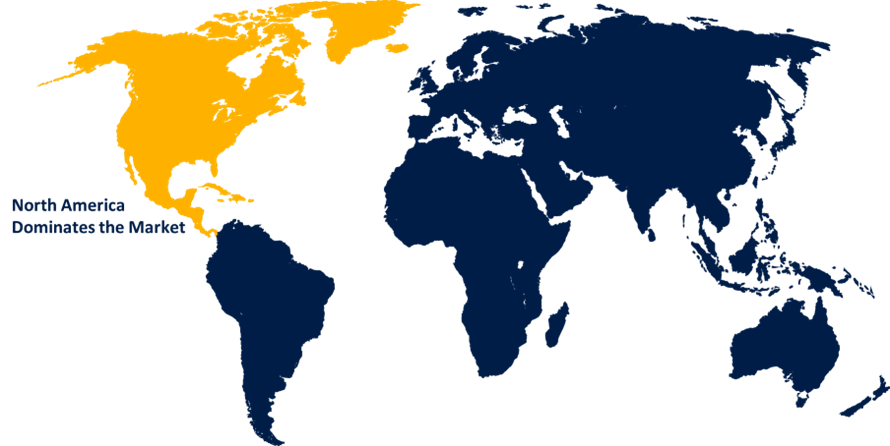
North America is expected to hold the majority share of the global 3D printed maxillofacial implant market during the forecast period.
North America is expected to hold the majority share of the global 3D printed maxillofacial implant market during the forecast period. North America’s market growth is fueled by high healthcare spending and the adoption of innovative medical technologies. The United States leads regionally due to major medical device companies, favorable FDA regulations for personalized 3D-printed implants, and a high incidence of trauma, congenital defects, and cancer-related reconstruction.
Get more details on this report -
Asia Pacific is anticipated to grow at the fastest pace in the global 3D printed maxillofacial implant market during the forecast period. Rising medical tourism and awareness of personalized treatments are boosting the regional market. China leads with a large patient base, advanced medical technology adoption, and supportive government policies, while India drives growth through affordable healthcare, expanding hospitals, and increased 3D-printed implant use.
Major vendors in the global 3D printed maxillofacial implant market are Materialise, 3D Systems, Stratasys, EOS, Renishaw plc, EnvisionTEC, Medtronic Plc., Johnson & Johnson, Dentsply Sirona, Zimmer Biomet, Stryker Corporation, Boston Medical Products, Formlabs, KLS Martin, Oxford Performance Materials, and Others.
Key Target Audience
- Market Players
- Investors
- End-users
- Government Authorities
- Consulting and Research Firm
- Venture capitalists
- Value-Added Resellers (VARs)
Key Market Development
- In November 2025, Materialise announced a new U.S. 3D printing facility to accelerate delivery of patient-specific medical implants, as surgeons increasingly adopt 3D printing for its added value in personalized patient care and improved surgical outcomes.
- In March 2022, Dentsply Sirona announced initiatives to enhance digital workflows for dentists, labs, and patients, including a partnership with Google Cloud and a new medical-grade 3D-printing solution. Dental professionals were invited to a virtual event on March 4 to learn more.
Market Segment
This study forecasts revenue at global, regional, and country levels from 2020 to 2035. Spherical Insights has segmented the 3D printed maxillofacial implant market based on the below-mentioned segments:
Global 3D Printed Maxillofacial Implant Market, By Material
- Titanium
- POM
- Polyether Ether Ketone
- Glass Ceramics
Global 3D Printed Maxillofacial Implant Market, By Technology
- Stereolithography
- Selective Laser Sintering
- Fused Deposition Modeling
- Computer-Aided Design
Global 3D Printed Maxillofacial Implant Market, By Application
- Craniomaxillofacial Reconstruction
- Dental Implants
- Orthognathic Surgery
- Trauma Reconstruction
Global 3D Printed Maxillofacial Implant Market, By End-Use
- Hospitals
- Dental Clinics
- Ambulatory Surgical Centers
Global 3D Printed Maxillofacial Implant Market, By Regional Analysis
- North America
- US
- Canada
- Mexico
- Europe
- Germany
- UK
- France
- Italy
- Spain
- Russia
- Rest of Europe
- Asia Pacific
- China
- Japan
- India
- South Korea
- Australia
- Rest of Asia Pacific
- South America
- Brazil
- Argentina
- Rest of South America
- Middle East & Africa
- UAE
- Saudi Arabia
- Qatar
- South Africa
- Rest of the Middle East & Africa
About the Spherical Insights & Consulting
Spherical Insights & Consulting is a market research and consulting firm which provides actionable market research study, quantitative forecasting and trends analysis provides forward-looking insight especially designed for decision makers and aids ROI.
Which is catering to different industry such as financial sectors, industrial sectors, government organizations, universities, non-profits and corporations. The company's mission is to work with businesses to achieve business objectives and maintain strategic improvements.
CONTACT US:
For More Information on Your Target Market, Please Contact Us Below:
Phone: +1 303 800 4326 (the U.S.)
Phone: +91 90289 24100 (APAC)
Email: inquiry@sphericalinsights.com, sales@sphericalinsights.com
Contact Us: https://www.sphericalinsights.com/contact-us
Need help to buy this report?