Top 25 Companies in Global Dry Natural Gas Market: Statistics Report Till 2035
RELEASE DATE: Mar 2026 Author: Spherical InsightsRequest Free Sample Speak to Analyst
Introduction
The global dry natural gas market comprises processed natural gas from which liquids and impurities have been removed, making it suitable for direct use in power generation, industrial heating, and residential consumption. It plays a critical role in the global energy mix due to its efficiency, transportability, and relatively lower emissions compared to other fossil fuels. Market growth is primarily driven by rising global energy demand, rapid industrialization, and the transition toward cleaner fuels. Expanding liquefied natural gas (LNG) trade, increasing investments in pipeline infrastructure, and growing demand from power and petrochemical sectors further support market expansion. Opportunities exist in the development of unconventional gas resources, advancements in gas processing technologies, and increasing adoption of natural gas in emerging economies. Additionally, integration with renewable energy systems enhances its strategic importance.
Navigate Future Markets with Confidence: Insights from Spherical Insights LLP
The insights presented in this blog are derived from comprehensive market research conducted by Spherical Insights LLP, a trusted advisory partner to leading global enterprises. Backed by in-depth data analysis, expert forecasting, and industry-specific intelligence, our reports empower decision-makers to identify strategic growth opportunities in fast-evolving sectors. Clients seeking detailed market segmentation, competitive landscapes, regional outlooks, and future investment trends will find immense value in the full report. By leveraging our research, businesses can make informed decisions, gain a competitive edge, and stay ahead in the transition toward sustainable and profitable solutions.
Unlock exclusive market insights—Download the Brochure now and dive deeper into the future of the global dry natural gas market.
Market Segmentation
Global Dry Natural Gas Market Size, Share, and, By Source (Conventional Gas and Unconventional Gas), By Application (Power Generation, Industrial, Residential, Commercial, and Transportation), By Distribution Channel (Pipeline and Liquefied Natural Gas (LNG)), By End User (Utilities, Industrial Users, and Others), By Region (North America, Europe, Asia-Pacific, Latin America, and Middle East & Africa), Analysis and Forecast 2024 – 2035.
Global Dry Natural Gas Market Size & Statistics
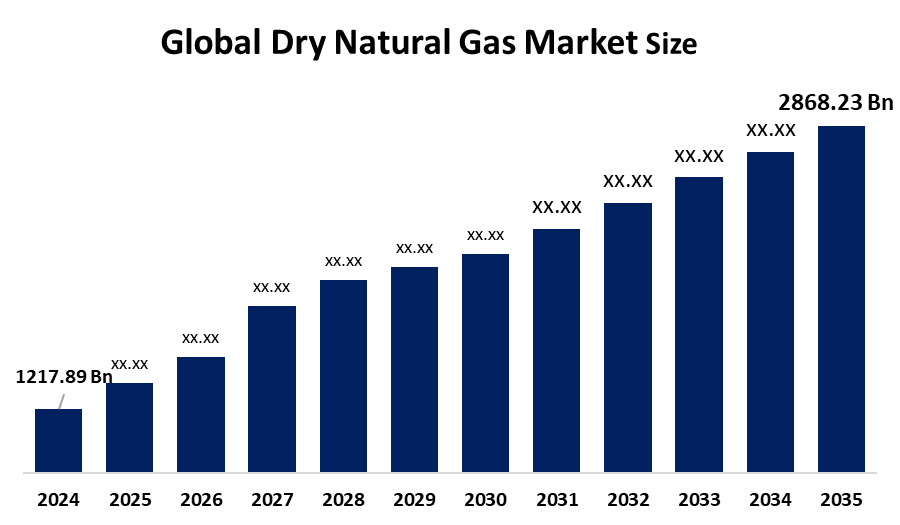
- The market size for Global Dry Natural Gas was estimated to be worth USD 1217.89 billion in 2024.
- The market is going to expand at a CAGR of 8.1% between 2024 and 2035.
- The Global Dry Natural Gas market size is anticipated to reach USD 2868.23 billion by 2035.
- North America is expected to generate the largest revenue during the forecast period in the Global Dry Natural Gas market
- Asia Pacific is expected to grow at the fastest rate during the forecast period in the Global Dry Natural Gas market.
Regional growth and demand
Asia Pacific is expected to grow at the fastest rate during the forecast period in the global dry natural gas market. Asia Pacific is expected to grow at the fastest rate due to rapid industrialization, urban expansion, and increasing energy demand in countries such as China and India. Government initiatives promoting cleaner fuels over coal, along with expanding LNG import infrastructure, are accelerating market adoption. Rising investments in gas-based power generation and distribution networks further support regional growth.
North America is expected to generate the largest revenue during the forecast period in the global dry natural gas market. North America is expected to generate the highest revenue due to supported by abundant shale gas reserves and advanced extraction technologies. The region benefits from well-established pipeline infrastructure, strong domestic consumption, and significant LNG export capacity. Continuous technological advancements and stable regulatory frameworks further reinforce its leadership in the market.
Ready to lead the Dry Natural Gas Market?
Discover the regional trends and growth factors shaping the industry. We’re here to assist with expert, personalized data.
Call +1 303 800 4326 or Send us a message for a personalized consultation.
Top 10 Trends in the Global Dry Natural Gas Market
- Expansion of LNG Trade and Export Capacity
- Rising Development of Unconventional Gas Resources
- Increasing Integration with Renewable Energy Systems
- Growth in Gas-Based Power Generation
- Expansion of Pipeline Infrastructure Networks
- Digitalization and Smart Monitoring in Gas Operations
- Growing Demand from Petrochemical Industries
- Policy Support for Cleaner Fossil Fuels
- Advancements in Gas Processing and Storage Technologies
- Increasing Cross-Border Gas Trade Agreements
Unlock exclusive market insights—Download the Brochure now and dive deeper into the future of the global dry natural gas market.
- Expansion of LNG Trade and Export Capacity
The expansion of liquefied natural gas infrastructure is a significant trend shaping the global dry natural gas market. Increasing investments in liquefaction and regasification terminals are enabling long-distance gas transportation and improving supply flexibility. Countries with abundant reserves are strengthening their export capabilities, while importing nations are diversifying energy sources. This trend enhances global trade dynamics and reduces dependency on pipeline-based supply. Additionally, LNG development supports energy security and facilitates access to cleaner fuel alternatives, particularly in regions lacking domestic production, thereby contributing to sustained market growth and international market integration.
- Rising Development of Unconventional Gas Resources
The growing focus on unconventional gas resources, such as shale gas and tight gas, is transforming the supply landscape of the dry natural gas market. Technological advancements in hydraulic fracturing and horizontal drilling have improved extraction efficiency and cost-effectiveness. This has significantly increased production capacity, particularly in regions with previously inaccessible reserves. The development of unconventional resources reduces reliance on conventional gas fields and enhances supply security. Furthermore, it supports price stability by diversifying supply sources, while encouraging investments in exploration and production activities across various geographies, thereby strengthening long-term market sustainability.
- Increasing Integration with Renewable Energy Systems
Dry natural gas is increasingly being integrated with renewable energy systems to support grid stability and reliability. As renewable sources such as wind and solar are intermittent in nature, natural gas provides a flexible backup for power generation. This complementary role enhances energy efficiency and ensures consistent electricity supply. The integration also supports the transition toward lower-carbon energy systems by reducing dependence on more carbon-intensive fuels like coal. Additionally, hybrid energy systems combining gas and renewables are gaining traction, particularly in emerging economies, contributing to a balanced and resilient energy mix.
- Growth in Gas-Based Power Generation
The increasing adoption of natural gas in power generation is a key trend driving market expansion. Gas-fired power plants offer higher efficiency, lower emissions, and operational flexibility compared to coal-based plants. This makes them an attractive option for countries aiming to meet environmental regulations while ensuring reliable electricity supply. Rising electricity demand, particularly in developing regions, is further accelerating the deployment of gas-based power infrastructure. Additionally, the relatively lower capital investment and shorter construction timelines of gas power plants contribute to their growing preference, reinforcing the role of natural gas in global energy systems.
- Expansion of Pipeline Infrastructure Networks
The development and expansion of pipeline infrastructure remain critical for the efficient transportation of dry natural gas. Governments and private players are investing in cross-border and domestic pipeline networks to enhance connectivity between production sites and consumption centers. This expansion reduces transportation costs and improves supply reliability. It also facilitates regional energy trade and strengthens market integration. In emerging economies, new pipeline projects are supporting the penetration of natural gas into previously underserved areas, thereby increasing consumption. Advanced monitoring and maintenance technologies are further improving pipeline safety and operational efficiency.
Unlock exclusive market insights—Download the Brochure now and dive deeper into the future of the global dry natural gas market.
Empower your strategic planning:
Stay informed with the latest industry insights and market trends to identify new opportunities and drive growth in the global dry natural gas market. To explore more in-depth trends, insights, and forecasts, please refer to our detailed report.
Top 25 Companies Leading the Global Dry Natural Gas Market
- ExxonMobil Corporation
- Gazprom
- Qatar Energy
- Shell plc
- Chevron Corporation
- TotalEnergies SE
- PetroChina Company Limited
- ConocoPhillips
- Chesapeake Energy Corporation
- Equinor ASA
- Eni S.p.A.
- Cheniere Energy, Inc.
- Sinopec
- CNOOC Limited
- EQT Corporation
- Canadian Natural Resources Limited
- Petronas
- Woodside Energy Group Ltd.
- Novatek PJSC
- Coterra Energy Inc.
- Southwestern Energy Company
- Antero Resources Corporation
- Range Resources Corporation
- Devon Energy Corporation
- Occidental Petroleum Corporation
- ExxonMobil Corporation
Headquarters: Irving, Texas, USA
ExxonMobil Corporation, active in over 50 countries, is a leading integrated energy company with significant operations in dry natural gas exploration, production, and global trade. The company maintains a strong presence across North America, Europe, Asia-Pacific, and the Middle East, with extensive unconventional gas assets and LNG investments. Its operations span the entire value chain, including upstream extraction and downstream distribution. ExxonMobil plays a critical role in ensuring energy security and supporting the transition toward lower-emission fuels through its expanding natural gas portfolio and global supply capabilities.
- Gazprom
Headquarters: Moscow, Russia
Gazprom, active in more than 20 countries, is one of the world’s largest natural gas producers and a dominant supplier of dry natural gas, particularly across Europe and parts of Asia. The company operates extensive pipeline networks and is heavily involved in exploration, production, and export activities. Its large reserve base and infrastructure enable consistent long-distance supply. Gazprom’s strategic role in cross-border gas trade and its strong control over transmission systems position it as a key player in shaping global natural gas dynamics.
- Qatar Energy
Headquarters: Doha, Qatar
Qatar Energy, active in over 30 countries, is a state-owned energy company and a global leader in liquefied natural gas production and export. The company plays a vital role in the dry natural gas market through large-scale LNG projects and international partnerships. Its operations are centered on efficient gas extraction, processing, and global distribution. Qatar Energy’s expanding LNG capacity and long-term supply agreements strengthen its influence across Asia, Europe, and emerging markets, ensuring reliable access to cleaner energy sources.
- Shell plc
Headquarters: London, United Kingdom
Shell plc, active in more than 70 countries, is a major integrated energy company with a strong focus on natural gas and LNG operations. The company is involved in upstream gas production, liquefaction, shipping, and regasification, making it a key participant in the global dry natural gas value chain. Shell’s diversified geographic presence and advanced technological capabilities support efficient energy delivery. Its emphasis on gas as a transition fuel reinforces its role in reducing carbon intensity while meeting growing global energy demand.
- Chevron Corporation
Headquarters: San Ramon, California, USA
Chevron Corporation, active in over 25 countries, is a leading energy company with substantial involvement in dry natural gas production and LNG projects. The company operates major gas fields and liquefaction facilities, particularly in North America and Australia. Its integrated operations include exploration, development, and global distribution of natural gas. Chevron’s focus on large-scale projects and long-term supply commitments enhances its position in the global market, supporting reliable energy supply and contributing to the shift toward lower-carbon energy solutions.
Unlock exclusive market insights—Download the Brochure now and dive deeper into the future of the global dry natural gas market.
Are you ready to discover more about the global dry natural gas market?
The report provides an in-depth analysis of the leading companies operating in the global dry natural gas market. It includes a comparative assessment based on their product portfolios, business overviews, geographical footprint, strategic initiatives, market segment share, and SWOT analysis. Each company is profiled using a standardized format that includes:
Company Profiles
- ExxonMobil Corporation
- Business Overview
- Company Snapshot
- Products Overview
- Company Market Share Analysis
- Company Coverage Portfolio
- Financial Analysis
- Recent Developments
- Merger and Acquisitions
- SWOT Analysis
- Gazprom
- Qatar Energy
- Shell plc
- Chevron Corporation
- TotalEnergies SE
- PetroChina Company Limited
- ConocoPhillips
- Chesapeake Energy Corporation
- Others.
Conclusion
The global dry natural gas market is witnessing steady growth, driven by rising energy demand, increasing preference for cleaner-burning fuels, and expanding industrial and power generation applications. Dry natural gas provides a reliable and relatively lower-emission energy source for residential, commercial, and large-scale industrial use, supporting the transition toward a more sustainable energy mix. Advancements in LNG infrastructure, unconventional gas extraction, and pipeline connectivity further enhance supply efficiency and market accessibility. Leading companies such as ExxonMobil Corporation, Gazprom, Qatar Energy, Shell plc, and Chevron Corporation are strengthening their global footprint, contributing to market expansion. Overall, dry natural gas plays a crucial role in ensuring energy security and enabling a gradual shift toward lower-carbon energy systems worldwide.
Unlock exclusive market insights—Download the Brochure now and dive deeper into the future of the global dry natural gas market.
Our Top Reports
Construction Punch List Software Market Size, Growth 2035
China Foodservice Market Size and Growth
Europe LPG Market Size, Shares, Trends to 2035
United Kingdom Swine Vaccines Market Forecasts to 2035
Global Vitamin C Market Size, Growth, Forecast 2035
About the Spherical Insights & Consulting
Spherical Insights & Consulting is a market research and consulting firm which provides actionable market research study, quantitative forecasting and trends analysis provides forward-looking insight especially designed for decision makers and aids ROI.
Which is catering to different industry such as financial sectors, industrial sectors, government organizations, universities, non-profits and corporations. The company's mission is to work with businesses to achieve business objectives and maintain strategic improvements.
CONTACT US:
For More Information on Your Target Market, Please Contact Us Below:
Phone: +1 303 800 4326 (the U.S.)
Phone: +91 90289 24100 (APAC)
Email: inquiry@sphericalinsights.com, sales@sphericalinsights.com
Contact Us: https://www.sphericalinsights.com/contact-us
Need help to buy this report?