Top 20 Companies in Global Water Quality Instruments Market (2026–2035): Spherical Insights Analysis
RELEASE DATE: Apr 2026 Author: Spherical InsightsRequest Free Sample Speak to Analyst
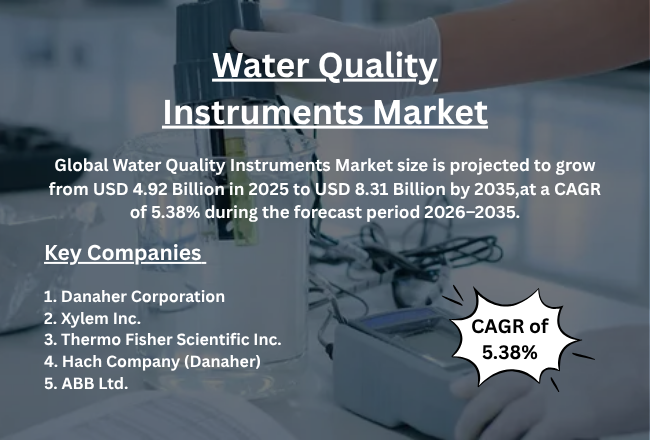
According to a research report published by Spherical Insights & Consulting, the Global Water Quality Instruments Market size is projected to grow from USD 4.92 Billion in 2025 to USD 8.31 Billion by 2035, at a CAGR of 5.38% during the forecast period 2026–2035. The global water quality instruments market is driven by rising concerns over water pollution, strict government regulations, increasing demand for safe drinking water, and growing industrial and municipal water treatment needs worldwide.
Introduction
The global water quality instruments market refers to the industry segment focused on technologies and devices used to monitor, analyze, and maintain water purity across various applications. The instruments serve multiple purposes because they enable municipal water treatment plants, industrial facilities, laboratories, environmental monitoring agencies and residential systems to deliver safe and clean drinking water. The system enables researchers to assess six essential water quality elements, which include pH levels, turbidity measurements, dissolved oxygen content, conductivity standards, salinity rates and chemical pollution levels. The market is expanding rapidly because people are increasingly concerned about water pollution, while environmental regulations become more stringent, and people need safe drinking water throughout the world. The industrialization process, combined with urbanization growth, creates a pressing requirement to implement continuous water quality monitoring systems. Modern technology developments, which include IoT-enabled sensors, real-time monitoring systems and AI-driven data analysis tools, enhance both measurement precision and operational performance. Governments throughout multiple countries are committing substantial financial resources to developing water infrastructure projects and implementing sustainable development programs. The public knows more about environmental conservation and public health issues, so they are choosing to adopt new practices. The incorporation of intelligent water management solutions together with digital monitoring systems drives the continued expansion of the market. The water quality instruments market provides essential support for environmental preservation, law enforcement, and the protection of clean drinking water sources throughout the world.
Navigate Future Markets with Confidence: Insights from Spherical Insights LLP
The insights presented in this blog are derived from comprehensive market research conducted by Spherical Insights LLP, a trusted advisory partner to leading global enterprises. Backed by in-depth data analysis, expert forecasting, and industry-specific intelligence, our reports empower decision-makers to identify strategic growth opportunities in fast-evolving sectors. Clients seeking detailed market segmentation, competitive landscapes, regional outlooks, and future investment trends will find immense value in the full report. By leveraging our research, businesses can make informed decisions, gain a competitive edge, and stay ahead in the transition toward sustainable and profitable solutions.
Unlock exclusive market insights—Download the Brochure now and dive deeper into the future of the Water Quality Instruments Market.
Market Segmentation
Global Water Quality Instruments Market Size, Share, By Product Type (Portable, Bench-top), By Test Type (Turbidity, pH, Dissolved Oxygen, Conductivity, TOC, Others), By End User (Water Treatment Plants, Laboratories, Industrial, Aquaculture, Other), and By Region (North America, Europe, Asia-Pacific, Latin America, Middle East, and Africa), Analysis and Forecast 2026 – 2035
Water Quality Instruments Market Size & Statistics
- The Market Size for Water quality instruments Was Estimated to be worth USD 4.92 Billion in 2025.
- The Market is Going to Expand at a CAGR of 5.38% between 2026 and 2035.
- The Global Water Quality Instruments Market Size is anticipated to reach USD 8.31 Billion by 2035.
- North America is expected to generate the highest revenue during the forecast period in the Water quality instruments Market.
- Asia Pacific is expected to grow at the fastest rate during the forecast period in the Water quality instruments Market.

Regional growth and demand
Asia Pacific is expected to grow at the fastest rate during the forecast period in the water quality instruments market. Asia Pacific is expected to grow fastest due to rising water pollution concerns, government initiatives for clean water infrastructure, increasing industrial and municipal water treatment projects, technological advancements in water quality instruments, and growing awareness of environmental sustainability and safe drinking water solutions.
Unlock exclusive market insights—Download the Brochure now and dive deeper into the future of the Water Quality Instruments Market.
North America is expected to generate the highest revenue during the forecast period in the water quality instruments market. North America is expected to generate the highest demand due to supportive government regulations, strong adoption of advanced water treatment and monitoring systems, well-developed infrastructure, and high awareness of environmental sustainability and safe drinking water technologies.
Ready to lead the water quality instruments market?
Discover the regional trends and growth factors shaping the industry. We’re here to assist with expert, personalized data.
Call +1 303 800 4326 or Send us a message for a personalized consultation.
Top 10 Trends in the Water Quality Instruments Market
- Rising adoption of real-time water quality monitoring systems
- Integration of IoT-enabled smart sensors and connected devices
- Increasing use of AI and machine learning for predictive water analysis
- Growing demand for portable and handheld water testing instruments
- Expansion of automated and remote water monitoring solutions
- Increasing regulatory pressure on industrial and municipal water quality compliance
- Development of multi-parameter water quality measurement devices
- Adoption of cloud-based data management and analytics platforms
- Focus on sustainable and energy-efficient water testing instruments
- Rising investment in advanced wastewater treatment monitoring technologies
- Rising adoption of real-time water quality monitoring systems
Real-time water quality monitoring systems have become more common, which results in better water management practices for municipalities, industrial facilities and environmental organizations. The systems provide continuous monitoring of essential water quality factors, which include pH levels, turbidity levels, dissolved oxygen levels and contaminant concentrations while generating immediate notifications about any detected anomalies. Real-time monitoring provides better accuracy than traditional manual testing methods because it decreases the time needed to respond to incidents while protecting water sources from contamination. The public health system works because governments and industries use these systems to meet strict environmental guidelines, which protect public health. Operators can make better decisions through improved efficiency because digital sensors plus cloud connectivity provide them access to real-time data from remote locations. This trend becomes essential for areas that experience both water scarcity and pollution problems because immediate solutions are necessary to maintain sustainable and safe operations.
2.Integration of IoT-enabled smart sensors and connected devices
The integration of IoT-enabled smart sensors and connected devices is significantly enhancing the capabilities of water quality instruments. The advanced sensors operate as continuous data collectors, which transmit water quality information to centralized platforms through their wireless communication capabilities. The system enables users to monitor operations in real-time while providing remote system access and allowing multiple stakeholders to share information without barriers. IoT-based systems reduce the need for manual inspections, thereby lowering operational costs and human error. The system enables organizations to conduct predictive maintenance because it identifies potential system failures before they become actual problems. Organizations from utilities to industries to environmental agencies are implementing IoT-enabled solutions to achieve better operational efficiency while meeting their regulatory obligations. The connected systems enable organizations to manage their entire water network because they simplify the monitoring of their distributed infrastructure. As smart city initiatives expand globally, IoT integration is becoming a key driver of innovation in the water quality instruments market.
3.Increasing use of AI and machine learning for predictive water analysis
The growing adoption of artificial intelligence (AI) and machine learning (ML) technologies in water quality instruments creates new possibilities for predicting water quality assessment results. The systems use both historical data and current data streams to identify patterns which help them predict contamination events and improve treatment solutions. The AI-powered systems utilize advanced technology to detect environmental anomalies which conventional monitoring techniques cannot identify. The machine learning algorithms achieve better accuracy results because they acquire knowledge from fresh data inputs that become available during subsequent times. This approach enables water utilities and industries to utilize data analysis for effective resource allocation decisions. The system uses AI to establish automatic reporting functions while monitoring compliance requirements and optimizing system performance. The growing complexity of water management needs during urban development and climate change impacts will make AI and machine learning vital resources for creating dependable, sustainable water quality monitoring systems.
Unlock exclusive market insights—Download the Brochure now and dive deeper into the future of the Water Quality Instruments Market.
4.Growing demand for portable and handheld water testing instruments
The increasing need for portable water testing equipment, which can be used in field locations, drives the demand for these instruments, which can assess water quality in different situations. The small devices enable users to conduct laboratory-free testing of essential water quality indicators, which include pH levels, turbidity measurements, chlorine concentrations, and conductivity assessment. The equipment finds application in field inspections and environmental monitoring work, agricultural practices, aquaculture operations and emergency response activities. The portable devices deliver immediate test results, which makes them essential for use in remote locations that require urgent decision-making. Researchers, technicians, and regulatory bodies are adopting the technology because it provides them with affordable equipment that is easy to operate and can be used anywhere. The latest technological innovations have increased their measurement precision, extended their operational time, and enhanced their ability to connect with other devices. The need for portable water testing devices has become necessary because water safety issues now exist throughout the world, thus enabling fast and dependable water quality assessments.
5.Expansion of automated and remote water monitoring solutions
The expansion of automated and remote water monitoring solutions is playing a crucial role in modernizing water quality management systems. These solutions use advanced sensors, communication networks, and control systems to continuously monitor water conditions without requiring constant human intervention. Remote monitoring allows operators to track water quality data from centralized dashboards, improving efficiency and reducing operational costs. Automation helps in the early detection of contamination, system failures, or chemical imbalances, enabling faster corrective actions. These systems are widely used in large-scale water treatment plants, industrial facilities, and distributed water networks. Integration with cloud platforms further enhances accessibility and data analysis capabilities. As water infrastructure becomes more complex and geographically dispersed, automated and remote monitoring technologies are increasingly essential for ensuring consistent water quality, regulatory compliance, and sustainable resource management.
Empower your strategic planning:
Stay informed with the latest industry insights and market trends to identify new opportunities and drive growth in the water quality instruments market. To explore more in-depth trends, insights, and forecasts, please refer to our detailed report.
Unlock exclusive market insights—Download the Brochure now and dive deeper into the future of the Water Quality Instruments Market.
Top 20 Companies Leading the Water Quality Instruments Market
- Danaher Corporation
- Xylem Inc.
- Thermo Fisher Scientific Inc.
- Hach Company (Danaher)
- ABB Ltd.
- Emerson Electric Co.
- Endress+Hauser Group
- Horiba, Ltd.
- Shimadzu Corporation
- Honeywell International Inc.
- General Electric Company
- Evoqua Water Technologies LLC
- Hanna Instruments, Inc.
- Metrohm AG
- Mettler-Toledo International Inc.
- Yokogawa Electric Corporation
- Teledyne Technologies Incorporated
- Agilent Technologies, Inc.
- PerkinElmer, Inc.
- SUEZ Water Technologies & Solutions
- Danaher Corporation
Headquarters: Washington, D.C., USA
Danaher Corporation operates as the leading worldwide company for water quality instruments, which it sells across more than 60 countries. The company provides advanced analytical instruments, diagnostic solutions, and water testing technologies through its strong portfolio, including brands like Hach. Danaher focuses on delivering high-precision water quality monitoring systems for municipal, industrial, and environmental applications. The solutions provided by the company enable users to identify pollutants while they meet environmental standards, and they enhance water protection efforts. The company demonstrates its dedication to ongoing product development through its advanced research facilities and its use of digital technologies, which include IoT monitoring systems and data processing capabilities. Danaher provides dependable water testing products that help international organizations maintain water safety regulations while they manage water resources sustainably.
2.Xylem Inc.
Headquarters: Washington, D.C., USA
Xylem Inc. operates as a top international water technology firm that develops solutions for monitoring, treating, and analyzing water quality. The company operates in more than 150 countries while supplying advanced instruments and systems that measure water parameters, including pH, turbidity, conductivity and dissolved oxygen. Xylem works to develop solutions that address global water problems through its intelligent infrastructure and digital water technology systems. The company provides its solutions to municipal water systems, industrial facilities, and environmental monitoring programs. The organization supports sustainable practices by developing solutions that promote water efficiency while minimizing environmental damage. XyleM develops smart sensors and remote monitoring systems together with data-based water management platforms to support worldwide water safety efforts, water conservation activities, and infrastructure development projects.
Unlock exclusive market insights—Download the Brochure now and dive deeper into the future of the Water Quality Instruments Market.
3.Thermo Fisher Scientific Inc.
Headquarters: Waltham, Massachusetts, USA
Thermo Fisher Scientific Inc. stands as the foremost global provider of scientific instruments and laboratory products, which include their advanced water quality testing solutions. The company provides highly accurate analytical instruments used for detecting chemical, biological, and physical contaminants in water. Its product portfolio supports environmental testing, industrial water monitoring, and research applications. Thermo Fisher develops products that combine innovative technologies with precise laboratory measurements for their testing solutions. The company uses advanced technologies, which include spectroscopy, chromatography and molecular analysis methods to develop its water quality testing systems. The company serves various industries, which include environmental agencies, pharmaceuticals and food safety organizations. Through its continuous research and development efforts and worldwide operations, Thermo Fisher establishes safe drinking water standards while enhancing environmental monitoring capabilities across the globe.
4.Hach Company (Danaher)
Headquarters: Loveland, Colorado, USA
Hach Company operates as a subsidiary of Danaher Corporation while establishing itself as a worldwide leader in water quality testing and analysis solutions. The company specializes in developing dependable instruments, reagents, and software products which customers use for testing water and wastewater. Municipal water plants, industrial facilities, and environmental laboratories depend on Hach solutions to maintain water safety and meet regulatory requirements. The company provides instruments that users find easy to operate while delivering precise measurement capabilities and support through dedicated customer support. The company offers a product lineup that includes portable testers, online analyzers and laboratory instruments that enable users to execute continuous and accurate monitoring. Hach drives digital transformation by developing cloud-based data management systems and smart monitoring technologies. The organization contributes to better global water quality management while protecting environmental sustainability.
5.ABB Ltd.
Headquarters: Zurich, Switzerland
ABB Ltd. is a worldwide technology leader that delivers advanced systems for automation and electrification and digital technology solutions that include water quality monitoring systems. The company delivers complete instrumentation and control systems that industrial facilities and water treatment plants use to manage water resources. ABB’s solutions enable industries to monitor essential water parameters in real time, which helps them increase operational efficiency while complying with environmental regulations. The company uses its automation expertise and digitalization skills to create intelligent water resource systems. ABB uses IoT technology together with AI systems and advanced analytics to improve its water management solutions by making them more effective and dependable. The company provides services to electric utilities, local governments, and manufacturing industries across the globe. ABB advances sustainable development through its commitment to innovation, which enables effective water resource management while it supports global initiatives that provide access to clean drinking water.
Are you ready to discover more about the water quality instruments market?
The report provides an in-depth analysis of the leading companies operating in the global water quality instruments market. It includes a comparative assessment based on their product portfolios, business overviews, geographical footprint, strategic initiatives, market segment share, and SWOT analysis. Each company is profiled using a standardized format that includes:
Unlock exclusive market insights—Download the Brochure now and dive deeper into the future of the Water Quality Instruments Market.
Company Profiles
- Danaher Corporation
- Business Overview
- Company Snapshot
- Products Overview
- Company Market Share Analysis
- Company Coverage Portfolio
- Financial Analysis
- Recent Developments
- Merger and Acquisitions
- SWOT Analysis
- Xylem Inc.
- Thermo Fisher Scientific Inc.
- Hach Company (Danaher)
- ABB Ltd.
- Emerson Electric Co.
- Endress+Hauser Group
- Horiba, Ltd.
- Shimadzu Corporation
- Others.
Unlock exclusive market insights—Download the Brochure now and dive deeper into the future of the Water Quality Instruments Market.
Conclusion
The global water quality instruments market is experiencing continuous growth because of increased water pollution concerns, stricter government regulations, and the rising need for clean drinking water in residential, commercial and industrial sectors. Technological advancements that include IoT-enabled sensors and AI-based monitoring systems, together with real-time data analytics, improve the water testing process by increasing its accuracy, efficiency and reliability. The market experiences growth because companies invest in both wastewater treatment systems and smart water management infrastructure. The growing environmental consciousness, together with sustainability programs, drives organizations to implement advanced water monitoring technologies. The water quality instruments market worldwide receives major contributions from Danaher Corporation, Xylem Inc., Thermo Fisher Scientific, Hach Company, and ABB Ltd. through their innovative work and international business expansion efforts.
Our Reports :
https://www.sphericalinsights.com/reports/consumer-telematics-market
https://www.sphericalinsights.com/reports/interior-shading-systems-market
https://www.sphericalinsights.com/reports/singapore-fabric-softeners-and-conditioners-market
https://www.sphericalinsights.com/reports/canada-frozen-food-market
About the Spherical Insights & Consulting
Spherical Insights & Consulting is a market research and consulting firm which provides actionable market research study, quantitative forecasting and trends analysis provides forward-looking insight especially designed for decision makers and aids ROI. Which is catering to different industry such as financial sectors, industrial sectors, government organizations, universities, non-profits and corporations. The company's mission is to work with businesses to achieve business objectives and maintain strategic improvements.
CONTACT US:
For More Information on Your Target Market, Please Contact Us Below:
Phone: +1 303 800 4326 (the U.S.)
Phone: +91 90289 24100 (APAC)
Email: inquiry@sphericalinsights.com, sales@sphericalinsights.com
Contact Us: https://www.sphericalinsights.com/contact-us
Need help to buy this report?