Top 15 Companies in Global Next Generation Memory Technologies Market: Statistics Report Till 2035
RELEASE DATE: Apr 2026 Author: Spherical InsightsRequest Free Sample Speak to Analyst
Introduction
The global next generation memory technologies market refers to advanced memory solutions designed to overcome the limitations of traditional memory, such as DRAM and NAND flash. The technologies, which include MRAM, ReRAM and PCM, provide users with faster performance, lower energy requirements and better data storage capabilities. The technologies find common usage in data centers and, artificial intelligence systems, consumer electronics devices and automotive technology. The market is expanding rapidly because of two factors: the increase in data generation and the rising need for high-performance computing, and the progress made in cloud computing and Internet of Things technologies. The market for memory solutions develops because of the requirement for memory solutions that use less energy while delivering better performance and better scalability. The development of next generation memory technologies throughout the world keeps progressing because of ongoing research work and substantial funding in semiconductor development.
In November 2025, Micron Technology announced plans to invest $9.6 billion in a high-bandwidth memory (HBM) fabrication plant in Japan, supported by government subsidies. The project aims to boost next-generation memory production for AI and high-performance computing while strengthening global semiconductor supply chains and accelerating technological innovation.
Navigate Future Markets with Confidence: Insights from Spherical Insights LLP
The insights presented in this blog are derived from comprehensive market research conducted by Spherical Insights LLP, a trusted advisory partner to leading global enterprises. Backed by in-depth data analysis, expert forecasting, and industry-specific intelligence, our reports empower decision-makers to identify strategic growth opportunities in fast-evolving sectors. Clients seeking detailed market segmentation, competitive landscapes, regional outlooks, and future investment trends will find immense value in the full report. By leveraging our research, businesses can make informed decisions, gain a competitive edge, and stay ahead in the transition toward sustainable and profitable solutions.
Unlock exclusive market insights—Download the Brochure now and dive deeper into the future of the Next generation memory technologies Market.
Market Segmentation
Global Next Generation Memory Technologies Market Size, Share, By Technology (Non-Volatile Memory, Volatile Memory, Magneto resistive Random Access Memory, Phase Change Memory and Resistive Random Access Memory), By Form Factor( Chip-On-Board, Ball Grid Array, Dual In-Line Package and Thin Small Outline Package), By Application (Consumer Electronics, Automotive, Telecommunications, Data Centers and Industrial), By End Use (Personal Use, Enterprise Use and Government), and By Region (North America, Europe, Asia-Pacific, Latin America, Middle East, and Africa), Analysis and Forecast 2025 – 2035
Next Generation Memory Technologies Market Size & Statistics
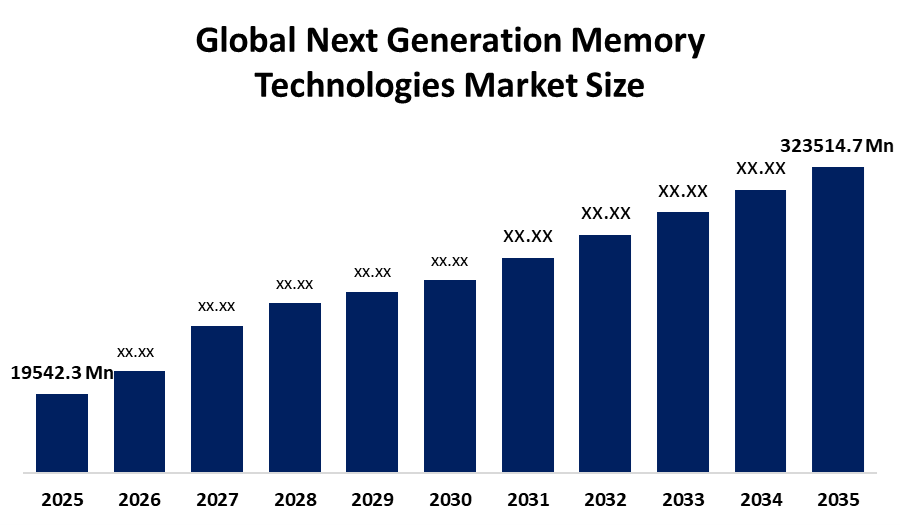
- The Market Size for Next Generation Memory Technologies Was Estimated to be worth USD 19542.3 Million in 2025.
- The Market is Going to Expand at a CAGR of 32.4% between 2025 and 2035.
- The Global Next Generation Memory Technologies Market Size is anticipated to reach USD 323514.7 Million by 2035.
- North America is expected to generate the highest revenue during the forecast period in the Next Generation Memory Technologies Market
- Asia Pacific is expected to grow at the fastest rate during the forecast period in the Next Generation Memory Technologies Market.
Regional growth and demand
Asia Pacific is expected to grow at the fastest rate during the forecast period in the next generation memory technologies market. The semiconductor manufacturing sector is expanding, while there is increasing demand for artificial intelligence and data center applications, and government support for chip production, and the advanced memory technologies HBM, DRAM, and NAND receive more investment. The regional market experiences accelerated growth because of digitalization and increased electronics consumption.
North America is expected to generate the highest revenue during the forecast period in the next generation memory technologies market. The dominance of this market segment results from two factors, which include the presence of major semiconductor companies and the establishment of strong research and development facilities, together with actual usage of AI-powered computing systems and the growing need for high-performance memory products, which data centers and, cloud services and advanced computing domains require.
Ready to lead the Next Generation Memory Technologies Market ?
Discover the regional trends and growth factors shaping the industry. We’re here to assist with expert, personalized data.
Call +1 303 800 4326 or Send us a message for a personalized consultation.
Top 10 Trends in the Next Generation Memory Technologies Market
- Rise of non-volatile memory technologies (MRAM, ReRAM, PCM)
- Integration with artificial intelligence and machine learning
- Growing demand for high-bandwidth memory (HBM)
- Expansion of data centers and cloud computing
- Increasing adoption in automotive and autonomous systems
- Shift toward energy-efficient and low-power memory solutions
- Advancements in spintronics and new memory architectures
- Rising investment in semiconductor manufacturing and fabs
- Emergence of processing-in-memory (PIM) technology
- Increasing demand for real-time data processing and edge computing
- Rise of Non-Volatile Memory Technologies (MRAM, ReRAM, PCM)
The market is currently experiencing strong interest in non-volatile memory technologies, which include MRAM, ReRAM and PCM. The memory technologies maintain data storage during power outages, which results in both energy efficiency and improved reliability. The memory technologies provide superior performance with their ability to read and write data faster while handling more data and expanding to larger systems compared to traditional DRAM and NAND memory. The technological benefits of these systems make them ideal for use in data centers and, consumer products and industrial applications. The growing requirement for durable and efficient memory systems drives the adoption of non-volatile memory technologies, which now form the basis of future computing systems.
- Integration with Artificial Intelligence and Machine Learning
Next generation memory technologies are increasingly being integrated with artificial intelligence (AI) and machine learning (ML) systems. AI workloads need fast data processing together with minimal delays and maximum data transfer capacity, but standard memory systems fail to deliver these requirements. Advanced memory solutions such as HBM and MRAM provide capabilities that fulfill these needs through their ability to deliver quicker data retrieval and enhanced computational power. The system improves AI application performance across multiple fields, including image recognition, natural language processing and autonomous systems. The rising adoption of AI technologies across different industries creates a corresponding need for specialized memory systems that enable intelligent computing.
- Growing Demand for High-Bandwidth Memory (HBM)
High-bandwidth memory (HBM) has become essential for contemporary computing systems because it supports artificial intelligence, graphics processing and high-performance computing applications. HBM provides significantly higher data transfer speeds and bandwidth compared to traditional memory technologies, which enable faster data processing and improved system performance. The technology has become essential for GPUs, data centers and advanced computing platforms, which require efficient processing of large data volumes. The rising demand for HBM occurs because industries develop more data-intensive applications. The continuous development of HBM design and manufacturing processes has created advanced capabilities that position HBM as a major force driving future memory technologies development.
- Expansion of Data Centers and Cloud Computing
Data centers and cloud computing services are growing rapidly, which creates a need for developing new memory technologies. With digital data from IoT devices, streaming services and enterprise applications continuing to expand organizations require memory systems that can manage extensive data storage and processing needs. Next generation memory technologies provide data center operators with superior speed and better capacity to expand operations while consuming less power. Cloud service providers are increasing their use of these solutions because they help organizations achieve better system performance while decreasing their operational expenses. The current trend will keep progressing because worldwide data consumption and cloud service usage continue to grow.
- Increasing Adoption in Automotive and Autonomous Systems
Automotive manufacturers are starting to use next generation memory technologies, which they apply to advanced driver-assistance systems (ADAS) and autonomous vehicle systems. The systems need memory that can deliver fast performance together with dependable operation and long-lasting durability to handle real-time data from their sensors, cameras and navigation systems. Automotive applications can use MRAM technology because its components deliver high endurance, together with low power use and immediate data access. The automotive industry demands advanced memory solutions because it is moving toward electric vehicles and automated driving systems. The worldwide trend toward better vehicle safety measures, enhanced vehicle connectivity and advanced smart mobility technologies supports this development.
Unlock exclusive market insights—Download the Brochure now and dive deeper into the future of the Next generation memory technologies Market.
Empower your strategic planning:
Stay informed with the latest industry insights and market trends to identify new opportunities and drive growth in the next generation memory technologies market. To explore more in-depth trends, insights, and forecasts, please refer to our detailed report.
Top 15 Companies Leading the Next Generation Memory Technologies Market
- Samsung Electronics Co., Ltd.
- SK Hynix Inc.
- Micron Technology, Inc.
- Intel Corporation
- Kioxia Holdings Corporation
- Western Digital Corporation
- Fujitsu Limited
- IBM Corporation
- Infineon Technologies AG
- NXP Semiconductors N.V.
- Everspin Technologies Inc.
- Winbond Electronics Corporation
- Adesto Technologies Corporation
- Crossbar Inc.
- Panasonic Corporation
- Samsung Electronics Co., Ltd.
Headquarters: Suwon, South Korea
Samsung Electronics Co., Ltd. maintains its position as a leading global technology provider because of its advanced semiconductor manufacturing capabilities and innovative research activities in next-generation memory technologies. The company is creating high-bandwidth memory (HBM) and MRAM and next-generation DRAM memory solutions, which serve AI, data center and high-performance computing needs. Samsung maintains its competitive advantage through its ability to produce large quantities of products and its ongoing commitment to research and development. Its advanced memory products exist in various applications, which include consumer electronics, enterprise storage and automotive systems. Samsung drives memory technology development through its dedication to creating new products and building systems that can grow.
- SK Hynix Inc.
Headquarters: Icheon, South Korea
SK Hynix Inc. operates as a leading company in the worldwide memory industry because it develops DRAM products, NAND flash technology and high-bandwidth memory advanced memory systems. The company actively works on creating future memory technologies that will support the increasing requirements of artificial intelligence and data-driven computer programs. SK Hynix enhances memory performance through its ongoing research efforts and its use of cutting-edge production techniques. The company uses its extensive global semiconductor supply chain network to supply major technology firms with its products. SK Hynix invests in cutting-edge memory designs to establish itself as a vital player in upcoming computing developments.
- Micron Technology, Inc.
Headquarters: Boise, Idaho, USA
Micron Technology, Inc. operates as a major producer of memory and storage products while working to develop future memory technologies. The company develops new technologies for DRAM and NAND and high-bandwidth memory (HBM) systems, which enable artificial intelligence, cloud computing and data center operations. Micron dedicates substantial resources to research and development activities, which aim to enhance product performance, decrease energy usage and improve system scalability. The company provides advanced memory solutions that serve multiple industries, such as automotive and mobile device sectors. Micron maintains a worldwide presence and strategic partnerships to help develop high-performance memory solutions for global markets.
- Intel Corporation
Headquarters: Santa Clara, California, USA
Intel Corporation operates as the principal inventor in next generation memory technologies while creating advanced computing and memory systems. The company has been involved in pioneering technologies such as 3D XPoint memory, which provides faster performance and greater durability than conventional memory systems. Intel enhances processing power and operational efficiency through the implementation of sophisticated memory technologies in its processors and data center systems. The company develops new memory technologies through its dedication to artificial intelligence, cloud computing and high-performance computing research. Intel uses its research and development strengths together with its international presence to push forward the development of future memory technologies.
- Kioxia Holdings Corporation
Headquarters: Tokyo, Japan
Kioxia Holdings Corporation, a top developer, specializes in creating flash memory and advanced storage solutions. The company develops next generation NAND technologies together with high-performance memory systems, which enable data-driven applications. Kioxia invests in research and innovation to improve memory density, speed, and energy efficiency. The company provides products that customers use in data centers and, consumer electronics and industrial applications. Kioxia uses its extensive expertise in flash memory and semiconductor technologies to meet the increasing need for efficient memory systems, which can grow with demand. The company expands its worldwide operations through partnerships and improvements in technology.
Unlock exclusive market insights—Download the Brochure now and dive deeper into the future of the Next generation memory technologies Market.
Are you ready to discover more about the next generation memory technologies market?
The report provides an in-depth analysis of the leading companies operating in the global next generation memory technologies market. It includes a comparative assessment based on their product portfolios, business overviews, geographical footprint, strategic initiatives, market segment share, and SWOT analysis. Each company is profiled using a standardized format that includes:
Company Profiles
- Samsung Electronics Co., Ltd.
- Business Overview
- Company Snapshot
- Products Overview
- Company Market Share Analysis
- Company Coverage Portfolio
- Financial Analysis
- Recent Developments
- Merger and Acquisitions
- SWOT Analysis
- SK Hynix Inc.
- Micron Technology, Inc.
- Intel Corporation
- Kioxia Holdings Corporation
- Western Digital Corporation
- Fujitsu Limited
- IBM Corporation
- Infineon Technologies AG
- Others.
Conclusion
The global next generation memory technologies market is experiencing steady expansion because of growing needs for advanced computing systems and the fast increase in data and the technological progress of artificial intelligence and cloud computing. The MRAM, ReRAM, and high-bandwidth memory HBM technologies deliver superior performance through their capability to operate at higher speeds while using less power and storing data more efficiently than existing memory technologies. These systems find widespread application across multiple industries, including data centers consumer electronics, automotive systems and enterprise business operations. The market growth accelerates through ongoing product development, substantial funding for semiconductor research and increasing use of cutting-edge memory technologies. The major companies in the industry, which include Samsung Electronics Co Ltd, Micron Technology Inc and Intel Corporation, are the primary drivers of global technological progress.
OUR TOP REPORTS
Construction Punch List Software Market Size, Growth 2035
China Foodservice Market Size and Growth
Europe LPG Market Size, Shares, Trends to 2035
United Kingdom Swine Vaccines Market Forecasts to 2035
Global Vitamin C Market Size, Growth, Forecast 2035
Unlock exclusive market insights—Download the Brochure now and dive deeper into the future of the Next generation memory technologies Market.
About the Spherical Insights & Consulting
Spherical Insights & Consulting is a market research and consulting firm which provides actionable market research study, quantitative forecasting and trends analysis provides forward-looking insight especially designed for decision makers and aids ROI.
Which is catering to different industry such as financial sectors, industrial sectors, government organizations, universities, non-profits and corporations. The company's mission is to work with businesses to achieve business objectives and maintain strategic improvements.
CONTACT US:
For More Information on Your Target Market, Please Contact Us Below:
Phone: +1 303 800 4326 (the U.S.)
Phone: +91 90289 24100 (APAC)
Email: inquiry@sphericalinsights.com, sales@sphericalinsights.com
Contact Us: https://www.sphericalinsights.com/contact-us
Need help to buy this report?