United States Indoor Farming Market Size, Share, And COVID-19 Impact Analysis, By Facility Type (Greenhouse, Indoor Vertical Farms, Container Farms, Indoor Deep Water Culture, And Others), By Crop Type (Fruits, Vegetables And Herbs, Flowers And Ornaments, And Others), By Components (Hardware And Software) By Growing System (Aeroponics, Hydroponics, Aquaponics, Soil-based, And Hybrid), And United States Indoor Farming Market Insights, Industry Trend, Forecast To 2035
Industry: Agriculture
United States Indoor Farming Market Insights Forecasts to 2035
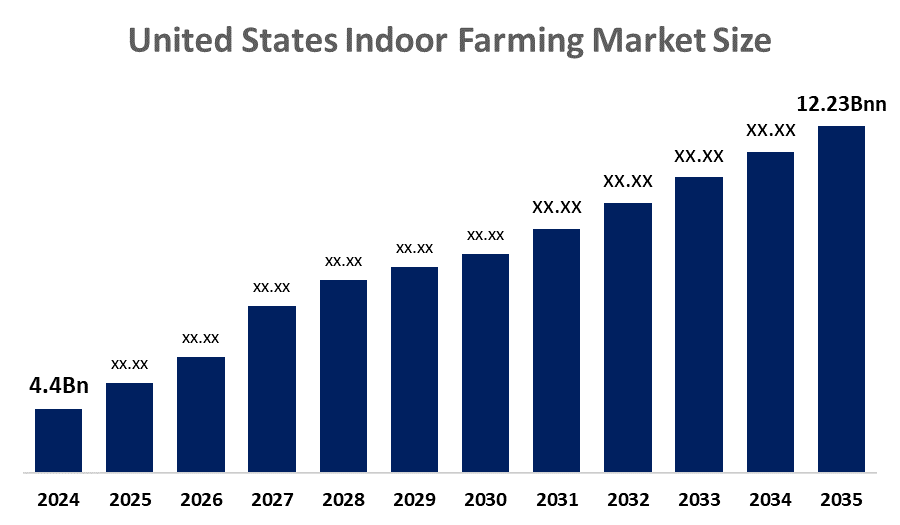
- United States Indoor Farming Market Size Was Estimated at USD 4.4 Billion in 2024.
- The Market Size is Expected to Grow at a CAGR of Around 9.74% from 2025 to 2035.
- United States Indoor Farming Market Size is Expected to Reach USD 12.23 Billion by 2035.
Get more details on this report -
According to a research report published by Spherical Insights & Consulting, the United States Indoor Farming Market size is anticipated to reach USD 12.23 Billion by 2035, growing at a CAGR of 9.74% from 2025 to 2035. The United States Indoor Farming market is driven by the urbanization and healthy lifestyle which increases the demand for fresh and high quality food, practice of growing crops indoors throughout the year, using less water than traditional farming methods, and using fewer pesticides results in environmental benefits. Also U.S. government-supported programs promote the growth of the indoor farming market.
Market Overview
Indoor farming refers to the cultivation of crops within controlled indoor environments using advanced technologies such as fluorescent or LED lighting, automated climate systems, and digital controls. This approach enables farmers to precisely regulate key growth factors including temperature, humidity, and light intensity, ensuring optimal nutrient delivery and consistent crop production. The use of vertical racks and shelving systems further maximizes space utilization, allowing multiple layers of plant cultivation within a limited area.The United States indoor farming market primarily consists of indoor greenhouses and vertical farms, where crops are grown under controlled atmospheric conditions. Plants cultivated through indoor farming methods receive water and nutrients directly at the root level using hydroponic or aeroponic systems, offering a more efficient and sustainable alternative to traditional farming practices.Market growth is driven by increasing consumer demand for pesticide-free, fresh produce, rapid urbanization, and busy lifestyles that favor locally grown food. Additionally, the adoption of advanced technologies enhances productivity and resource efficiency. Strong government support through initiatives led by the U.S. Department of Agriculture (USDA), including the Urban Agriculture and Innovative Production (UAIP) grants, has significantly accelerated the commercial adoption of Controlled Environment Agriculture (CEA).In 2024, the USDA awarded an additional USD 5.2 million across 17 UAIP projects to support urban, indoor, and innovative farming practices nationwide. The program received a record 620 applications, more than double the previous year, highlighting rising interest, participation, and investment in the U.S. indoor farming sector.
Report Coverage
This research report categorizes the market for the United States indoor farming market based on various segments and regions, and forecasts revenue growth and analyses trends in each submarket. The report analyses the key growth drivers, opportunities, and challenges influencing the United States indoor farming market. Recent market developments and competitive strategies, such as expansion, product launch, development, partnership, merger, and acquisition, have been included to draw the competitive landscape in the market. The report strategically identifies and profiles the key market players and analyses their core competencies in each sub-segment of the United States indoor farming market.
United States Indoor Farming Market Report Coverage
| Report Coverage | Details |
|---|---|
| Base Year: | 2024 |
| Market Size in 2024: | USD 4.4 Billion |
| Forecast Period: | 2025-2035 |
| Forecast Period CAGR 2025-2035 : | 9.74% |
| 2035 Value Projection: | USD 12.23 Billion by 2035 |
| Historical Data for: | 2020-2023 |
| No. of Pages: | 180 |
| Tables, Charts & Figures: | 120 |
| Segments covered: | By Facility Type, By Crop Type, By Components, By Growing System |
| Companies covered:: | AeroFarms, Freight Farms, Plenty, Bowery Farming, BrightFarms, Gotham Greens, Altius Farms, Crop One Holdings, Inc., 80 Acres Urban Agriculture, Inc., Eden Green Technology, Heliospectra, Vertical Harvest Farms, and Others |
| Pitfalls & Challenges: | COVID-19 Empact, Challenge, Future, Growth, & Analysis |
Get more details on this report -
Driving Factors
United States indoor farming market is driven by the increasing demand for fresh and high-quality food, less water and pesticides use leads to healthy environment, consumer preference to choose organic food, urbanization and lifestyle changes, consumer focus on sustainability, food security, and year-round availability, and strong government support with state-level incentives fuels growth.
Restraining Factors
The high upfront expenses associated with lighting, climate control systems and automation, unavailability of a trained workforce, consumer education limitations, scalability issues, and technical difficulty hold back the expansion restrain the indoor farming market in United States.
Market Segmentation
The United States indoor farming market share is classified into facility type, crop type, component, and growing system.
- The greenhouse segment accounted for the largest revenue market share in 2024 and is expected to grow at a significant CAGR during the forecast period.
The United States indoor farming market is segmented by facility type into greenhouse, indoor vertical farms, container farms, indoor deep water culture and others. Among these, greenhouse segment accounted for the largest revenue market share in 2024 and is expected to grow at a significant CAGR during the forecast period. The segmental growth is driven by their establishment presence and the ability to provide a stable environment for crop growth. Greenhouses offer a controlled climate, allowing for year-round cultivation and consistent production of various indoor crops. This stability is crucial for the market growth as it provides a reliable source of fresh produce for consumers.
- The fruits, vegetables and herbs segment dominated the market in 2024 and is projected to grow at a substantial CAGR during the forecast period.
The Unites States indoor farming market is segmented by crop type into fruits, vegetables and herbs, flowers and ornaments and others. Among these, the fruits, vegetables and herbs segment dominated the market in 2024 and is projected to grow at a substantial CAGR during the forecast period. The growth of the segment is due to their high demand for consumption and versatility in indoor cultivation. These crops are essential for human nutrition and can be grown in controlled environments, making them suitable for indoor farming practices. Additionally, the popularity of special crops, which include fruits and vegetables, contributes to their market share, as they are cultivated for food, medicinal purposes, and aesthetic enjoyment.
- The hardware segment accounted for the largest revenue market share in 2024 and is expected to grow at a significant CAGR during the forecast period.
The United States indoor farming market is segmented by components into hardware and software.Among these, the hardware. The segmental growth is driven by the dominance attributed to the extensive use of technologies in indoor farming practices, which enhance efficiency and sustainability in food production. The hardware component helps control the indoor climate with chillers, heaters, air-conditioning units, humidifiers, and air movement fans, among others.
- The hydroponics segment dominated the market in 2024 and is projected to grow at a substantial CAGR during the forecast period.
The United States indoor farming market is segmented by growing system into aeroponics, hydroponics, aquaponics, soil-based and hybrid. Among these, the hydroponics segment dominated the market in 2024 and is projected to grow at a substantial CAGR during the forecast period. The growth of the segment is due to its ability to achieve high yields and conserve water, increasing demand for sustainable and locally sourced food options, as well as advancements in technology that enhance crop yields and resource efficiency.
Competitive Analysis:
The report offers the appropriate analysis of the key organizations/companies involved within The United States indoor farming market, along with a comparative evaluation primarily based on their product offering, business overviews, geographic presence, enterprise strategies, segment market share, and SWOT analysis. The report also provides an elaborate analysis focusing on the current news and developments of the companies, which includes product development, innovations, joint ventures, partnerships, mergers & acquisitions, strategic alliances, and others. This allows for the evaluation of the overall competition within the market.
List of Key Companies
- AeroFarms
- Freight Farms
- Plenty
- Bowery Farming
- BrightFarms
- Gotham Greens
- Altius Farms
- Crop One Holdings, Inc.
- 80 Acres Urban Agriculture, Inc.
- Eden Green Technology
- Heliospectra
- Vertical Harvest Farms
- Others
Key Target Audience
- Market Players
- Investors
- End-users
- Government Authorities
- Consulting and Research Firm
- Venture capitalists
- Value-Added Resellers (VARs)
Recent Development
- In July 2025, BrightFarms, a national leader in indoor farming and a Cox Farms brand, debuted its bold new packaging and rebrand, spotlighting the benefits of greenhouse-grown greens as the category continues to build. With a vibrant new visual identity, brighter colors, and updated product names, BrightFarms makes easier than ever for shoppers to identify its pesticide-free salads on shelves. The rebrand follows a milestone year for the company, which opened three state-of-the-art greenhouse hubs in Illinois, Texas, and Georgia expanding accessibility of its fresh, locally-grown greens to two-thirds of the U.S. population.
- April 2025, AeroFarms, the leading supplier of microgreens to the U.S. retail market, announced the launch of its newest microgreen : Micro Bok Choy. AeroFarms Micro Bok Choy was first of its kind in U.S. retail, delivering a unique and versatile flavour for everyday meals. The mild and sweet flavour of Micro Bok Choy serves as a perfect complement to sandwiches, stir-fries, smoothies, and tacos, while its texture and bite-size appeal create an ideal lettuce substitute for center-of-the-plate salad microgreens. The company’s new microgreen was available for purchase at leading retailers nationwide, including Whole Foods Market, Giant Food, and H Mart.
Market Segment
This study forecasts revenue at the United States, regional, and country levels from 2025 to 2035. Spherical Insights has segmented the United States Indoor Farming Market based on the below-mentioned segments:
United States Indoor Farming Market, By Facility Type
- Greenhouse
- Indoor Vertical Farms
- Container Farms
- Indoor Deep Water Culture
- Others
United States Indoor Farming Market, By Crop Type
- Fruits, Vegetables and Herbs
- Flowers and Ornaments
- Others
United States Indoor Farming Market, By Component
- Hardware
- Software
United States Indoor Farming Market, By Growing System
- Aeroponics
- Hydroponics
- Aquaponics
- Soil-based
- Hybrid
Need help to buy this report?