Global Small-molecule Respiratory Drugs Market Size, Share, and COVID-19 Impact Analysis, By Products (Bronchodilators, Anti-Inflammatory Agents, Leukotriene Modifiers, and Others), By Application (Asthma, COPD, and Other Respiratory Disorders), and By Region (North America, Europe, Asia-Pacific, Latin America, Middle East, and Africa), Analysis and Forecast 2025 - 2035.
Industry: Healthcare
Global Small-molecule Respiratory Drugs Market Insights Forecasts to 2035
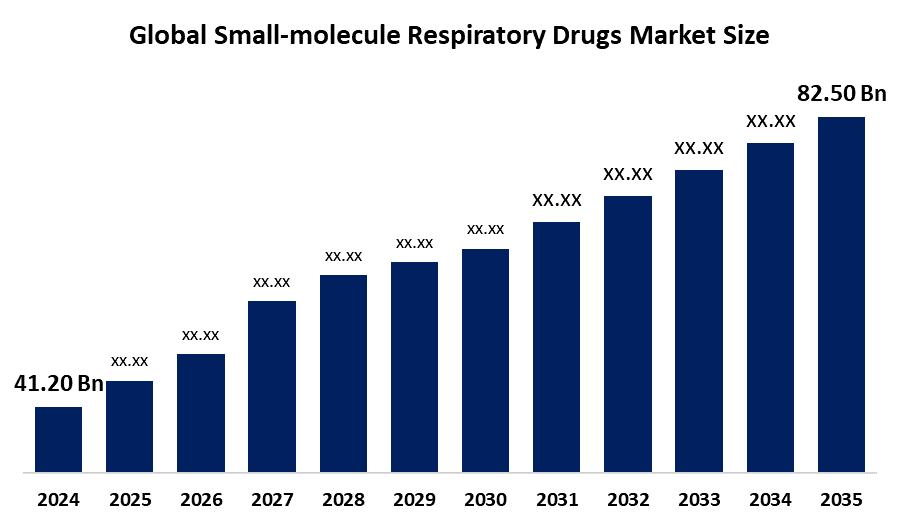
- The Global Small-molecule Respiratory Drugs Market Size Was Estimated at USD 41.20 Billion in 2024
- The Market Size is Expected to Grow at a CAGR of around 6.52% from 2025 to 2035
- The Worldwide Small-molecule Respiratory Drugs Market Size is Expected to Reach USD 82.50 Billion by 2035
Key Takeaways -
- North America dominated the market with the largest share in 2024.
- Asia Pacific is expected to grow the fastest during the forecast period.
- By Product Type, the bronchodilators segment dominates the small-molecule respiratory drugs market with about 37.5% share, while anti-inflammatory agents segment is the emerging segment in the market.
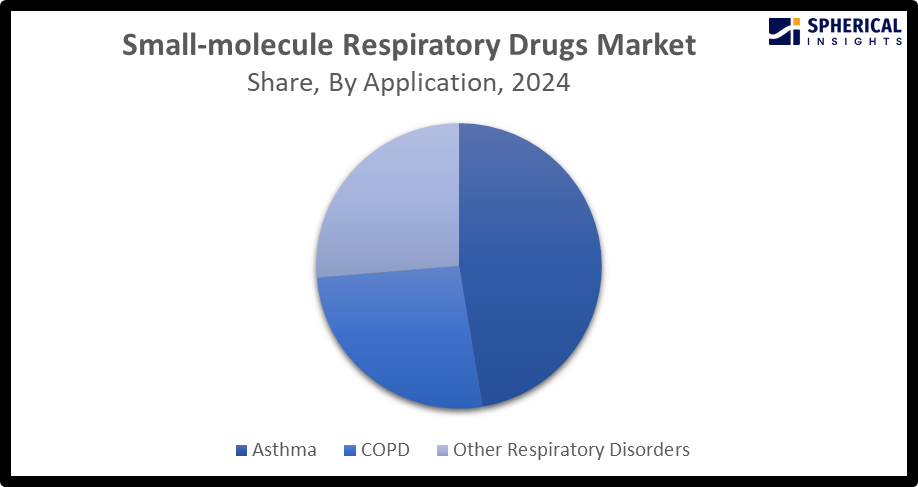
- By Application, the asthma segment is anticipated to hold the dominant share of about 45.0%, on the other hand, the COPD segment is the fastest growing in the small-molecule respiratory drugs market.
Get more details on this report -
According to a research report published by Spherical Insights and Consulting, the Global Small-molecule Respiratory Drugs Market size was worth around USD 41.20 Billion in 2024 and is predicted to grow to around USD 82.50 Billion by 2035 with a compound annual growth rate (CAGR) of 6.52% from 2025 and 2035. The market for small-molecule respiratory drugs has a number of opportunities to grow due to the ongoing development of targeted therapies for asthma/COPD, AI-driven drug discovery for fibrosis, and reformulation of existing treatments into advanced inhaled delivery systems.
Key Trends in Small-molecule Respiratory Drugs Market –
- Emergence of Triple-combination therapies
- Adoption of digital health technologies such as smart inhalers
- Emphasis on advanced delivery methods like nano-carriers
Market Overview
The global small-molecule respiratory drugs industry encompasses the development, manufacturing, and sale of low-molecular-weight compounds (typically <900 Daltons) used to treat respiratory diseases such as asthma, COPD, and cystic fibrosis. Small-molecule respiratory drugs are typically administered via inhalation for direct lung delivery or orally for chronic conditions such as asthma, COPD, and fibrosis, providing a more stable and cost-effective alternative to biologic therapies. Inhaled drugs are more advantageous for the treatment of respiratory diseases over oral drugs by delivering the drug directly to the lungs, thus improving the therapeutic index.
Innovation and market expansion are anticipated as a result of major players' growing investment in the expansion of the pharma company’s production base. For instance, in November 2025, AstraZeneca is pouring $136 million more into the expansion of an inhalants production base in China. The latest investment brings the British pharma’s total investment at the site in Qingdao to $886 million. Furthermore, in July 2025, AstraZeneca announced $50 billion of investment in the United States by 2030, building on America’s global leadership in medicines manufacturing and R&D.
Report Coverage
This research report categorizes the Small-molecule Respiratory Drugs market based on various segments and regions, forecasts revenue growth, and analyzes trends in each submarket. The report analyses the key growth drivers, opportunities, and challenges influencing the Small-molecule Respiratory Drugs market. Recent market developments and competitive strategies such as expansion, type launch, development, partnership, merger, and acquisition have been included to draw the competitive landscape in the market. The report strategically identifies and profiles the key market players and analyses their core competencies in each sub-segment of the Small-molecule Respiratory Drugs market.
Global Small-molecule Respiratory Drugs Market Report Coverage
| Report Coverage | Details |
|---|---|
| Base Year: | 2024 |
| Market Size in 2024: | USD 41.20 Billion |
| Forecast Period: | 2025-2035 |
| Forecast Period CAGR 2025-2035 : | CAGR of 6.52% |
| 2035 Value Projection: | USD 82.50 Billion |
| Historical Data for: | 2020-2023 |
| No. of Pages: | 201 |
| Tables, Charts & Figures: | 128 |
| Segments covered: | By Products,By Application,By Region |
| Companies covered:: | AstraZeneca, GSK, Novartis AG, Boehringer Ingelheim, Teva Pharmaceutical Industries Ltd. |
| Pitfalls & Challenges: | COVID-19 Empact, Challenge, Future, Growth, & Analysis |
Get more details on this report -
Driving Factors
Increased prevalence of respiratory diseases globally
It was estimated that in 2019, CRD were the third leading cause of death, which is 4.0 million deaths, with a prevalence of 454.6 million cases globally. COPD, with 212.3 million prevalent cases, was the primary cause of deaths from CRDs, which accounts for 3.3 million deaths, while asthma is the highest prevalent case of CRD, accounting for 262.4 million cases. Small molecule drugs used for chronic respiratory conditions like COPD and asthma emphasizes on reducing inflammation and improving lung function. Key small molecules include phosphodiesterase-4 (PDE4) inhibitors, inhaled corticosteroids, bronchodilators, and other novel/emerging agents.
Air pollution and an expanding ageing population
Air pollution is a growing global problem threatening the health of the entire population. It was estimated that ambient (outdoor) air pollution in both cities and rural areas caused 4.2 million premature deaths globally per year in 2019, which is caused by exposure to fine particulate matter, which causes several diseases, including respiratory disease. Some 14% of outdoor air pollution related premature deaths were due to chronic obstructive pulmonary disease, 14% were due to acute lower respiratory infections, and 4% of deaths were due to lung cancers.
Further, it is estimated that the share of the population aged 60 years and over increased from 1 billion in 2020 to 1.4 billion, and by 2025, the world’s population of people aged 60 years and older double (2.1 billion). This increasing ageing population is contributing to driving the market demand, as this age group is more susceptible to respiratory conditions.
Increasing drug discovery research and increased healthcare accessibility
The continuous drug discovery research, strengthening the development pipeline for respiratory therapeutics, is driving the market. For instance, respiratory syncytial virus (RSV) drug discovery is focusing on the promising findings from agents targeting the fusion and polymerase proteins. Further, small molecule respiratory drugs provide superior accessibility over biologics owing to lower production costs, oral administration options, and ease of transport.
Restraining Factors
Lengthy regulatory approval processes, increased R&D costs
Lengthy and complex regulatory approval processes, which lead to delays in the commercialization of new small-molecule respiratory drugs, as well as increased R&D costs and failure, pose financial risk, ultimately challenging the small-molecule respiratory drugs market.
Market Segmentation
The Small-molecule Respiratory Drugs Market share is classified into products and application.
- The bronchodilators segment dominated the market with about 37.5% share in 2024 and is projected to grow at a substantial CAGR during the forecast period.
Based on the products, the small-molecule respiratory drugs market is divided into bronchodilators, anti-inflammatory agents, leukotriene modifiers, and others. Among these, the bronchodilators segment dominated the market with about 37.5% share in 2024 and is projected to grow at a substantial CAGR during the forecast period. This is due to the increasing prevalence of respiratory diseases, which leads to the demand for bronchodilator drugs. Bronchodilator drugs like beta 2 agonist are effectively used with inhaled corticosteroids as add-on therapy. While the anti-inflammatory agents segment is the emerging segment in the small-molecule respiratory drugs market. The agents are used for respiratory diseases like COPD and asthma, targeting specific intracellular pathways like JAK/STAT or PDE4 for reducing airway inflammation.
- The asthma segment accounted for the largest market share of about 45.0% in 2024 and is projected to grow at a substantial CAGR during the forecast period.
Based on the application, the small-molecule respiratory drugs market is divided into asthma, COPD, and other respiratory disorders. Among these, the asthma segment accounted for the largest market share of about 45.0% in 2024 and is projected to grow at a substantial CAGR during the forecast period. Asthma is a wide-reaching, chronic inflammatory illness that impacts millions of people daily, frequently responsible for unscheduled healthcare usage and missed workdays and school. With the growing technical advancement and formulation improvements, the ongoing R&D efforts for next-generation small molecules are anticipated to drive the market demand, especially across hospitals, speciality clinics, and retail pharmacies. Further, the COPD segment is the fastest-growing segment in the small-molecule respiratory drugs market, owing to the increasing air pollution and ageing population, along with the emergence of significant treatments like bronchodilators, corticosteroids, and combination therapies that are delivered via inhalers and nebulizers.
Get more details on this report -
Regional Segment Analysis of the Small-molecule Respiratory Drugs Market
- North America (U.S., Canada, Mexico)
- Europe (Germany, France, U.K., Italy, Spain, Rest of Europe)
- Asia-Pacific (China, Japan, India, Rest of APAC)
- South America (Brazil and the Rest of South America)
- The Middle East and Africa (UAE, South Africa, Rest of MEA)
North America is anticipated to hold the largest share of the Small-molecule Respiratory Drugs market over the predicted timeframe.
North America is anticipated to hold the largest share of about 63.0% in the Small-molecule Respiratory Drugs market over the predicted timeframe. The market ecosystem in North America is strong, due to the ongoing development of small drug molecules. For instance, in October 2024, Scientists at Scripps Research and its drug discovery arm, Calibr-Skaggs, develop first-in-class small molecules to repair damaged tissues. The demand for small-molecule respiratory drugs has been driven by the region's growing pharmaceutical and biotechnology companies and robust R&D initiatives. The U.S. is leading the North America small-molecule respiratory drugs market, due to increased prevalence of chronic respiratory diseases and emphasis on guideline-based treatment, patient adherence, and combination therapy optimization.
Asia Pacific is expected to grow at a rapid CAGR of approximately 8.0% in the small-molecule respiratory drugs market during the forecast period. The Asia Pacific area has a thriving market for small-molecule respiratory drugs due to increasing technological advancements, collaborations in genomic research, reduced DNA sequencing costs, and the prevalence of genetic disorders. China is the leading country in the region’s market, growing at a CAGR of 9.4%, owing to a rapidly ageing population, and a strong focus on hospital-based prescribing and local production. For instance, in august 2025, Fosun Pharma's Small Molecule Innovative Drug XH-S004 Achieves Overseas Licensing for a Potential Total of $645 Million.
Competitive Analysis:
The report offers the appropriate analysis of the key organizations/companies involved within the small-molecule respiratory drugs market, along with a comparative evaluation primarily based on their type of offering, business overviews, geographic presence, enterprise strategies, segment market share, and SWOT analysis. The report also provides an elaborative analysis focusing on the current news and developments of the companies, which includes type development, innovations, joint ventures, partnerships, mergers & acquisitions, strategic alliances, and others. This allows for the evaluation of the overall competition within the market.
List of Key Companies
- AstraZeneca
- GSK
- Novartis AG
- Boehringer Ingelheim
- Teva Pharmaceutical Industries Ltd.
- Others
Key Target Audience
- Market Players
- Investors
- End-users
- Government Authorities
- Consulting And Research Firm
- Venture capitalists
- Value-Added Resellers (VARs)
Recent Development
- In August 2025, Shanghai Fosun Pharmaceutical struck a deal worth up to $645 million to hand ex-China rights for its experimental respiratory drug XH-S004 to US-based Expedition Therapeutics.
- In July 2025, Verona Pharma brings to Merck the inhaled drug Ohtuvayre, which is FDA-approved as a treatment for chronic obstructive pulmonary disease. Merck has reached a $10 billion deal to acquire Verona Pharma.
- In June 2024, Verona Pharma Drug with Dual Mechanism lands FDA approval in COPD. Verona Pharma’s COPD drug Ohtuvayre is a single small molecule that blocks two targets to bring patients both bronchodilation and anti-inflammation-inflammatory effects.
Market Segment
This study forecasts revenue at global, regional, and country levels from 2020 to 2035. Spherical Insights has segmented the Small-molecule Respiratory Drugs Market based on the below-mentioned segments:
Global Small-molecule Respiratory Drugs Market, By Products
- Bronchodilators
- Anti-Inflammatory Agents
- Leukotriene Modifiers
- Others
Global Small-molecule Respiratory Drugs Market, By Application
- Asthma
- COPD
- Other Respiratory Disorders
Global Small-molecule Respiratory Drugs Market, By Regional Analysis
- North America
- US
- Canada
- Mexico
- Europe
- Germany
- UK
- France
- Italy
- Spain
- Russia
- Rest of Europe
- Asia Pacific
- China
- Japan
- India
- South Korea
- Australia
- Rest of Asia Pacific
- South America
- Brazil
- Argentina
- Rest of South America
- Middle East & Africa
- UAE
- Saudi Arabia
- Qatar
- South Africa
- Rest of the Middle East & Africa
Need help to buy this report?