Global Post-Acute Care Market Size, Share, and COVID-19 Impact Analysis, By Condition (Neurological Disorders, Brain Injury, Amputations, Spinal Cord Injury, Wound Management, and Others), By Age Group (Elderly, Adults, and Others), By Service (Skilled Nursing Facilities, Home Health Agencies, Long-Term Care Hospitals, Hospice Care, Inpatient Rehabilitation Facilities, and Others), and By Region (North America, Europe, Asia-Pacific, Latin America, Middle East, and Africa), Analysis and Forecast 2025 - 2035.
Industry: Healthcare
Global Post-Acute Care Market Insights Forecasts to 2035
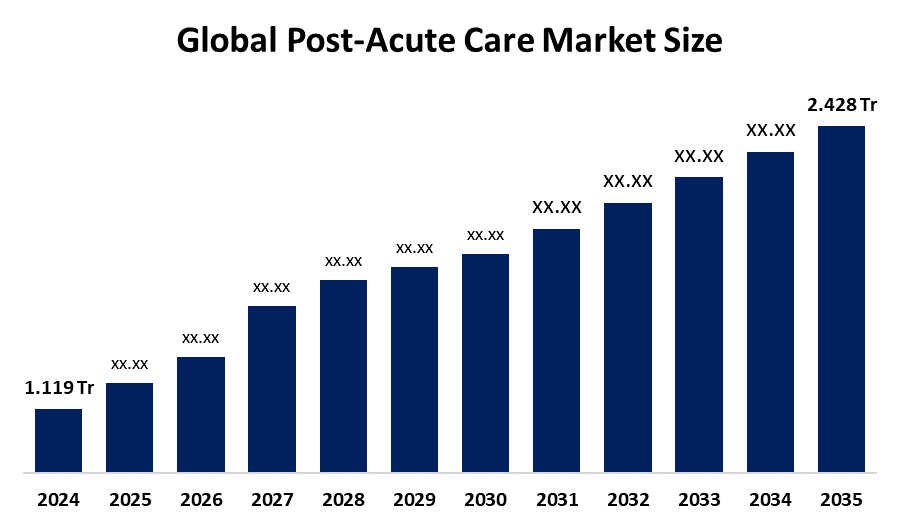
- The Global Post-Acute Care Market Size Was Estimated at USD 1.119 Trillion in 2024
- The Market Size is Expected to Grow at a CAGR of around 7.3% from 2025 to 2035
- The Worldwide Post-Acute Care Market Size is Expected to Reach USD 2.428 Trillion by 2035
- Asia Pacific is expected to grow the fastest during the forecast period.
Get more details on this report -
According to a research report published by Spherical Insights and Consulting, the global post-acute care market size was worth around USD 1.119 trillion in 2024 and is predicted to grow to around USD 2.428 trillion by 2035 with a compound annual growth rate (CAGR) of 7.3% from 2025 to 2035. Global expansion of AI-driven analytics, remote patient monitoring, and cloud-based software, rising demand for home-based services, caregiver shortages, and the need for improved and personalized patient outcomes are all driving opportunities in the post-acute care market.
Market Overview
The post-acute care market refers to the healthcare system encompasses skilled nursing facilities, home health agencies, hospital outpatient rehabilitation facilities and long-term care facilities after a patient is discharged from an acute hospital stay with the intent to assist patients in recovering successfully with the ultimate goal of reducing the number of patients who will be readmitted to acute care facilities. These include the development of telehealth models, remote patient monitoring systems, data-based coordination of care and value-based payment models which have different emphases on efficiency or quality of care, and therefore improve overall health outcomes.
Governments play a critical role by shaping reimbursement policies, setting quality standards, funding public health programs, and encouraging integration of digital health technologies to ensure accessibility, affordability, and improved quality of post-acute services. For example, In July 2022, the U.S. Centers for Medicare & Medicaid Services announced a 2.7% increase in Medicare Part A payments to Skilled Nursing Facilities for FY 2023, reinforcing government support and value-based reforms in the post-acute care market.
In April 2015, the Japan’s AMED established to promote integrated medical R&D funding areas such as medical devices, regenerative medicine, and digital health technologies supporting innovation that indirectly strengthens the post-acute care market through improved recovery and long-term care solutions.
Report Coverage
This research report categorizes the post-acute care market based on various segments and regions, forecasts revenue growth, and analyzes trends in each submarket. The report analyses the key growth drivers, opportunities, and challenges influencing the post-acute care market. Recent market developments and competitive strategies, such as expansion, product launch, development, partnership, merger, and acquisition, have been included to draw the competitive landscape in the market. The report strategically identifies and profiles the key market players and analyses their core competencies in each sub-segment of the post-acute care market.
Global Post-Acute Care Market Report Coverage
| Report Coverage | Details |
|---|---|
| Base Year: | 2024 |
| Market Size in 2024: | USD 1.119 trillion |
| Forecast Period: | 2025-2035 |
| Forecast Period CAGR 2025-2035 : | CAGR of 7.3% |
| 2035 Value Projection: | USD 2.428 trillion |
| Historical Data for: | 2020-2023 |
| No. of Pages: | 187 |
| Tables, Charts & Figures: | 123 |
| Segments covered: | By Condition,By Age Group,By Service |
| Companies covered:: | Encompass Health Corporation, Kindred Healthcare, LHC Group, Amedisys Inc., Brookdale Senior Living Inc., and other key players |
| Pitfalls & Challenges: | COVID-19 Empact, Challenge, Future, Growth, & Analysis |
Get more details on this report -
Driving Factors
Rapid technological innovation is one of the key drivers of growth in the post-acute care market. A rapidly aging population, coupled with a rising prevalence of chronic diseases and complex health conditions, is significantly increasing the demand for rehabilitation services, thereby fueling market expansion.Growth in home healthcare services driven by convenience and cost-effectiveness along with continuous investments in advanced healthcare technologies such as medical devices, mobile health, and data-driven care models, is further accelerating innovation in this sector.Additionally, increased government support is promoting the development of continuous and integrated care through advancements in digital health technologies.In July 2025, India’s Ministry of Health and Family Welfare approved the establishment of over 200 Day Care Cancer Centres in district hospitals for FY 2025–26, as announced in the Union Budget 2025–26. This initiative aims to provide chemotherapy and follow-up care closer to patients’ homes, thereby strengthening decentralized post-acute care services.
Restraining Factors
High development and deployment costs, regulatory and reimbursement challenges, slow adoption of value-based payment models, technological barriers, socioeconomic and geographic limitations, and shortage of trained healthcare professionals are the main factors restricting the post-acute care market.
Market Segmentation
The post-acute care market share is classified into condition, age group, and service.
- The neurological disorders segment dominated the market in 2024, approximately 26%, and is projected to grow at a substantial CAGR during the forecast period.
Based on the condition, the post-acute care market is divided into neurological disorders, brain injury, amputations, spinal cord injury, wound management, and others. Among these, the neurological disorders segment dominated the market in 2024, approximately 26%, and is projected to grow at a substantial CAGR during the forecast period. Rapid aging population, leading cause of disability and high burden, high need for intensive rehabilitation, increasing adoption of advanced technologies, and high patient volume are driving the neurological disorders industry.
- The elderly segment accounted for the largest share in 2024, approximately 60%, and is anticipated to grow at a significant CAGR during the forecast period.
Based on the age group, the post-acute care market is divided into elderly, adult, and others. Among these, the elderly segment accounted for the largest share in 2024, approximately 60%, and is anticipated to grow at a significant CAGR during the forecast period. Rapid global aging of the population, higher prevalence of chronic diseases, rising life expectancy, frequent hospital discharges, and the need for rehabilitation are driving the elderly industry.
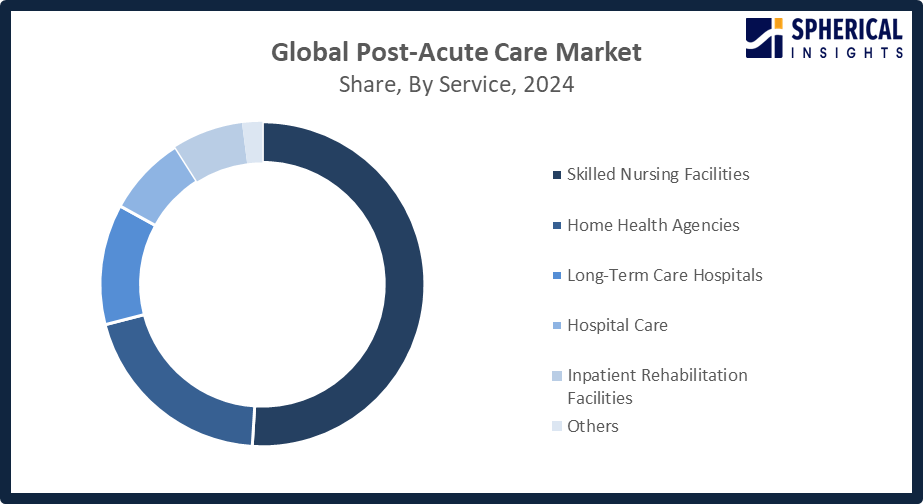
- The skilled nursing facilities segment accounted for the highest market revenue in 2024, approximately 51%, and is anticipated to grow at a significant CAGR during the forecast period.
Based on the service, the post-acute care market is divided into skilled nursing facilities, home health agencies, long-term care hospitals, hospice care, inpatient rehabilitation facilities, and others. Among these, the skilled nursing facilities segment accounted for the highest market revenue in 2024, approximately 51%, and is anticipated to grow at a significant CAGR during the forecast period. Increased demand for comprehensive 24/7 care, high rehabilitation capability for elderly patients, and providing coordinated care reducing the likelihood of readmission is bolstering skilled nursing facilities market.
Regional Segment Analysis of the Post-Acute Care Market
- North America (U.S., Canada, Mexico)
- Europe (Germany, France, U.K., Italy, Spain, Rest of Europe)
- Asia-Pacific (China, Japan, India, Rest of APAC)
- South America (Brazil and the Rest of South America)
- The Middle East and Africa (UAE, South Africa, Rest of MEA)
Get more details on this report -
North America is anticipated to hold the largest share of the post-acute care market over the predicted timeframe.
North America is anticipated to hold the largest share of the post-acute care market over the predicted timeframe. Strong government backing for well-established healthcare infrastructure with widespread availability of skilled nursing facilities, inpatient rehabilitation centers, rapidly aging population with high prevalence of chronic diseases, and home health services are what propel North America. The region's position is further reinforced by government programs promoting high healthcare expenditure, advanced technology adoption, and widespread integration of telehealth and remote patient monitoring enhance care quality and efficiency.Government initiatives are playing a crucial role in strengthening the post-acute care market. In February 2026, the U.S. Centers for Medicare & Medicaid Services (CMS) extended the Hospital at Home waiver, enabling reimbursable hospital-level care at home and expanding post-acute service delivery. Earlier, in October 2018, CMS launched the Bundled Payments for Care Improvement (BPCI) Advanced program to align hospitals with post-acute care providers and reduce hospital readmissions.In July 2025, Mexico’s IMSS-Bienestar announced an investment of over MX$21 billion to strengthen public healthcare infrastructure and expand services for uninsured populations, further supporting post-acute care development.Asia Pacific is expected to witness a rapid CAGR in the post-acute care market during the forecast period. Countries such as China, Japan, and India are making significant investments in healthcare infrastructure, digital health, and telemedicine. The presence of major rehabilitation centers, home-based care services, and long-term care facilities is accelerating demand for advanced post-acute care across the region.Government initiatives and continued investments in healthcare infrastructure and digital technologies are further driving adoption. Additionally, rising disposable incomes, expanding health insurance coverage, and increasing private sector participation are improving access to post-acute care services.Key government programs in the region include Japan’s Medical DX Reiwa Vision 2030 (April 2023), which focuses on advancing digital transformation in healthcare through telemedicine and integrated digital systems. In India, eSanjeevani under the Ayushman Bharat Digital Mission (June 2022) has expanded telehealth services to support home-based post-acute care. Meanwhile, China’s Healthy China 2030 plan (October 2016) promotes a tiered healthcare system linking hospitals with rehabilitation centers to strengthen post-acute care delivery.
Competitive Analysis:
The report offers the appropriate analysis of the key organizations/companies involved within the post-acute care market, along with a comparative evaluation primarily based on their product of offering, business overviews, geographic presence, enterprise strategies, segment market share, and SWOT analysis. The report also provides an elaborative analysis focusing on the current news and developments of the companies, which includes product development, innovations, joint ventures, partnerships, mergers & acquisitions, strategic alliances, and others. This allows for the evaluation of the overall competition within the market.
List of Key Companies
- Encompass Health Corporation
- Kindred Healthcare
- LHC Group
- Amedisys Inc.
- Brookdale Senior Living Inc.
- Genesis HealthCare
- The Ensign Group, Inc.
- Select Medical Holdings Corporation
- AccentCare, Inc.
- Aveanna HealthCare
- ProMedica Senior Care
- Korian
- ORPEA
- DomusVi
- Life Care Centers of America
- Others
Key Target Audience
- Market Players
- Investors
- End-users
- Government Authorities
- Consulting and Research Firm
- Venture capitalists
- Value-Added Resellers (VARs)
Recent Developments
• In March 2026, PointClickCare announced a new purpose-built electronic health record (EHR) system designed to unify patient records and improve workflows across physician practices and post-acute care facilities, enhancing data exchange and clinical decision-making.
• In January 2026, Claim Health launched an AI-powered revenue infrastructure platform for post-acute care, securing USD 4.4 million in seed funding. The platform automates referral-to-reimbursement workflows, reducing administrative burden and improving financial outcomes.
• In October 2025, Clinware introduced an AI-powered platform to optimize admissions and workflows for skilled nursing facilities and the broader post-acute care continuum. The company raised USD 4.25 million in funding to accelerate patient placements and enhance care delivery.
• In July 2025, Trella Health released its 2025 Post-Acute Care Industry Trend Report, providing updated insights on utilization patterns and the impact of Medicare Advantage, helping providers navigate the evolving post-acute care landscape.
• In April 2023, Indian out-of-hospital care provider HCAH (HealthCare at Home) opened its sixth Transition Care Centre in Kolkata. This expansion strengthens services such as inpatient rehabilitation, long-term care, home rehabilitation, and chronic disease management, improving post-acute support beyond traditional hospital settings.
Market Segment
This study forecasts revenue at global, regional, and country levels from 2020 to 2035. Spherical Insights has segmented the post-acute care market based on the below-mentioned segments:
Global Post-Acute Care Market, By Condition
- Neurological Disorders
- Brain Injury
- Amputations
- Spinal Cord Injury
- Wound Management
- Others
Global Post-Acute Care Market, By Age Group
- Elderly
- Adults
Global Post-Acute Care Market, By Service
- Skilled Nursing Facilities
- Home Health Agencies
- Long-Term Care Hospitals
- Hospital Care
- Inpatient Rehabilitation Facilities
- Others
Global Post-Acute Care Market, By Regional Analysis
- North America
- US
- Canada
- Mexico
- Europe
- Germany
- UK
- France
- Italy
- Spain
- Russia
- Rest of Europe
- Asia Pacific
- China
- Japan
- India
- South Korea
- Australia
- Rest of Asia Pacific
- South America
- Brazil
- Argentina
- Rest of South America
- Middle East & Africa
- UAE
- Saudi Arabia
- Qatar
- South Africa
- Rest of the Middle East & Africa
Need help to buy this report?